Leapmotor's "Half-Price" Curse
Author: Qi Xiao, Editor: Jia Xin
If we talk about which brand will perform the best among new energy vehicles in 2025, Leapmotor must be on the list of candidates.
On March 16th, Leapmotor released its financial report. It delivered 596,600 vehicles throughout the year, a year-on-year increase of 103.1%. Its revenue also doubled to 64.73 billion yuan. The gross profit margin increased by 6.1 percentage points to 14.5%, and it also achieved a positive annual net profit for the first time, turning from a loss of 2.82 billion yuan in 2024 to a profit of 540 million yuan.
Leapmotor has become the second new - force carmaker after Li Auto that can support itself by selling cars. However, Li Auto, an ever - profitable top performer, saw its net profit shrink by 85.8% in 2025.
As the saying goes, the income statement is about face, the balance sheet is about substance, and the cash - flow statement is about daily life. Leapmotor achieved positive cash flow from operating activities and free cash flow in both 2024 and 2025. In 2025, the net inflow from operating activities was 12.62 billion yuan, and the free cash flow was 7.82 billion yuan. This means that Leapmotor can not only support itself but also has surplus funds for large - scale capital expenditures.
It can be said that Leapmotor has proven its ability to survive.
In addition, Leapmotor has set a goal of selling 1 million vehicles and achieving a profit of 5 billion yuan in 2026.
However, the capital market doesn't seem to give Leapmotor special treatment. In the second half of 2025, both Li Auto and Leapmotor saw their stock prices continuously decline, almost halving. In 2026, Leapmotor's stock price performance also didn't outperform other new energy vehicle manufacturers.
Why is this the case? What is the market worried about?
I. Price Slasher: Selling Cars with the Logic of Industrial Products
Leapmotor's breakthrough path is reflected in its product pricing.
Labels such as "Half - price Li Auto", "Price Slasher", and "Extreme Cost - effectiveness" are not only the definitions given to Leapmotor by the outside world but also Leapmotor's own pricing logic.
Take the Leapmotor C10 as an example. It is a mid - size SUV with excellent performance in terms of space, power, and range configuration. Coupled with its relatively low price, it comprehensively builds a strong cost - effectiveness advantage. Although its monthly sales lag behind the comparable models of BYD, a leading brand, the C10 still ranks among the top in the segmented market with a stable monthly sales volume of over 10,000 units.
Zhu Jiangming, the founder of Leapmotor, has a classic statement: "Use the To B logic to do To C business."
Generally speaking, To C business needs to tell stories and build brands, while the To B logic is to make products without premium. Just like selling stainless steel, if your product is the same as others but 20 yuan cheaper, people will buy yours.
That is, instead of being brand - oriented, Leapmotor prices its products based on cost. From the very beginning, Leapmotor didn't intend to make money from brand premium. It makes money from production efficiency.
If other new energy vehicle manufacturers are more like technological products, then Leapmotor is more like an industrial product. The two have different competitive advantages. The former relies on brand premium, while the latter is driven by cost.
Naturally, the target audiences are also significantly different.
Some people believe that if the rise of new premium brands like Wenjie and Li Auto is attributed to overseas premium brands such as BBA, then the success of Leapmotor is related to overseas mainstream brands such as Volkswagen, Honda, Toyota, and Nissan.
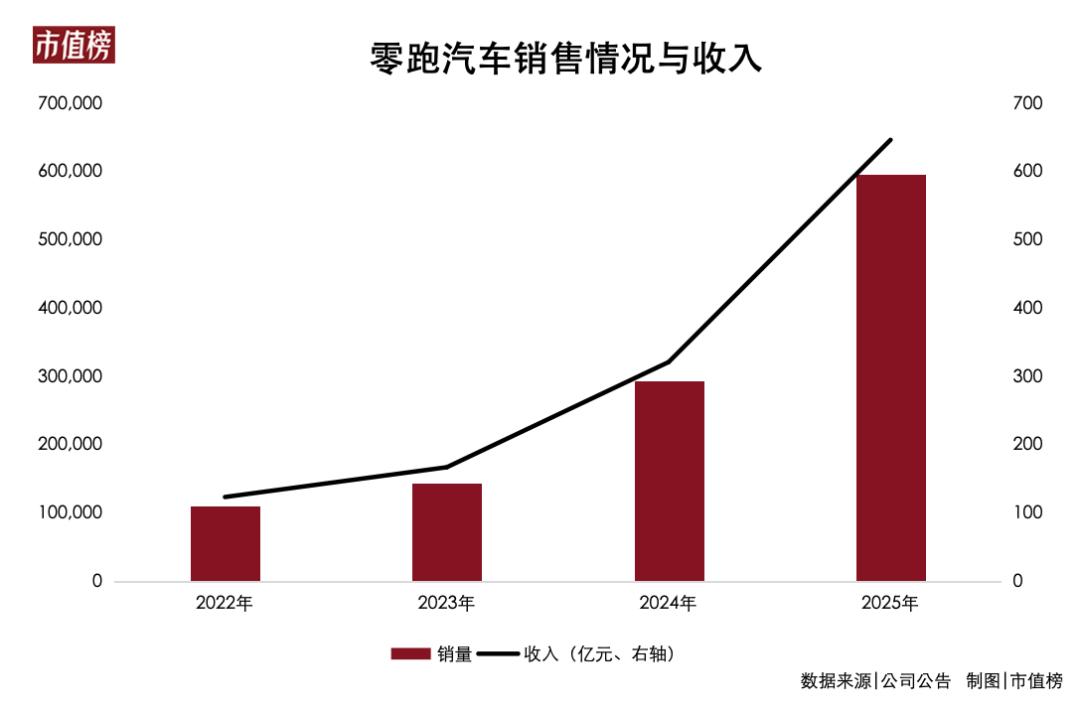
However, a low price means a naturally thin profit margin.
Other new energy vehicle manufacturers regard a 20% gross profit margin as a sign of healthy operation and the break - even point. The highest gross profit margin of Leapmotor appeared in the fourth quarter of 2025, which was only 15%.
Even if Leapmotor launches higher - priced models in the future, it will still control the average gross profit margin at around 15%.
Pressing the price so low will greatly increase the difficulty of making money, which requires Leapmotor to have obvious cost advantages.
Leapmotor is a player in full - scale self - research. It develops core components such as the three - electric system, intelligent driving, and intelligent cockpit by itself. The core components developed and manufactured by Leapmotor account for 65% of the total vehicle cost. Calculated based on the average 15% gross profit margin of suppliers, compared with outsourcing, this gives Leapmotor a vehicle cost advantage of about 10%.
In 2025, Leapmotor built a new parts base in Huzhou, expanding its self - research scope to seats, bumpers, and compressors, with the goal of achieving an 80% self - research rate of key components.
Cost reduction through technology is also continuous. The battery - less CTC technology launched in 2022 reduced the cost per vehicle by nearly 1,500 yuan. The Leap3.5 architecture released in 2025 integrates the three domain controllers of the intelligent cockpit, intelligent driving, and vehicle body into a central domain controller. The platform - based layout achieves an 88% component common rate, shortens the R & D cycle, and reduces costs.
It is these technological accumulations that give Leapmotor the opportunity to enjoy the benefits of economies of scale.
There is a "Wright's Law" in the manufacturing industry. The core idea is that every time the cumulative production of a certain product doubles, the cost will decrease by a constant percentage. In the automotive field, it is generally believed that this percentage is 15%.
A research report points out that in terms of single - model scale effect, the gap between Leapmotor and BYD and Geely is already small. The report also points out that it can be roughly understood that Leapmotor has a cost advantage of a few thousand yuan compared with a certain traditional giant.
In addition to the advantages in production such as BOM, expenses are also diluted with the rapid growth of scale, showing a stronger leverage effect.
While its revenue soared, Leapmotor's R & D expense ratio dropped from 9% in 2024 to 6.6%, and its sales expense ratio dropped from 6.6% to 5.6%.
Under the influence of multiple factors, Leapmotor achieved profitability. In 2025, the profit per vehicle was 905 yuan. If we look at a single quarter, the profit per vehicle in the fourth quarter reached 1,790 yuan.
Leapmotor has proven that the cost - effectiveness path can work, and it can also be regarded as a benchmark for "small profit but large sales".
II. Why is Leapmotor Undervalued?
Leapmotor has delivered a very impressive report card, but the capital market hasn't given corresponding applause.
As of the close on March 17th, NIO's market value was HK$117.1 billion, and its revenue in 2025 was 87.5 billion yuan. Li Auto's market value was HK$154.3 billion, and its revenue in 2025 was 112.3 billion yuan. XPeng Motors' market value was HK$149.5 billion, and its revenue in 2025 was about 76.7 billion yuan (calculated based on the median expected revenue in the fourth quarter).
Calculated at an exchange rate of 1.13, the market value per yuan of revenue for NIO and Li Auto is around 1.2 yuan, and XPeng's is higher, about 1.7 yuan.
For Leapmotor, the market value per yuan of revenue is about 0.9 yuan.
This clearly shows that the capital market has different pricing logics for different positioning.
In the current capital narrative where AI defines cars, self - research on hardware is the "basic skill", and software intelligence is the "imagination".
Leapmotor's self - research focuses on the "invisible" aspects: electric drive, battery management, and domain - control architecture. Self - research and increasing the component common rate can reduce costs and improve efficiency, but they can't create the imagination space for "non - linear growth".
For example, XPeng's revenue growth rate in 2025 was lower than that of Leapmotor, and it was still in the red. However, its intelligent driving strength in the T0 echelon is highly recognized. In 2025, SERES faced pressure in revenue growth, but its valuation was higher than that of Leapmotor.
In other words, the "cost - driven" route chosen by Zhu Jiangming focuses on economies of scale, cost control, and market share, while NIO, XPeng, Li Auto, and SERES choose brand premium and technological iteration. Currently, the two are still clearly distinct, or they are not on the same page.
Under the cost - driven route, once the scale growth rate slows down, the profit elasticity will quickly disappear, so the capital market will give a risk discount.
So, can Leapmotor's scale growth rate always be fast?
Leapmotor's main battlefield is the 100,000 - 200,000 - yuan segmented market, which has the most intense global competition.
In this price range, BYD is an insurmountable mountain. In 2025, BYD's models such as Qin L and Song Pro were upgraded and their prices were cut. The "more for less" strategy squeezed the profit margins of competitors to a very thin level.
There are also counter - attacks from traditional automakers. Geely Galaxy, Changan Deepal, and Chery Fengyun are intensively launching new models in the same class, all using the strategy of "higher - level configuration + lower price". Moreover, their channel penetration ability and brand recognition are not inferior to Leapmotor.
In 2026, Leapmotor has set a goal of selling 1 million vehicles annually, including 850,000 in the domestic market and 150,000 overseas. Only 60,000 vehicles were delivered in the first two months, which means it needs to sell 94,000 vehicles per month on average in the following months. However, Leapmotor's best monthly sales record was 70,300 vehicles.
In addition, Leapmotor's overseas business highly depends on strategic cooperation and local layout. There are unpredictable risks in aspects such as overseas trade barriers, supply - chain compliance, local product adaptation, and channel construction progress, which may become uncertain factors for its long - term valuation.
III. Increment and Variables in the Valuation Battle
To win the valuation battle, Leapmotor needs to fight two battles: one is to "go global", and the other is to "move upmarket".
Among them, the latter has a greater impact on valuation. Because going global is just an increment, while brand upgrading is a variable. The valuation logic for a carmaker that can only sell cars at 150,000 yuan is completely different from that for one that can sell at 300,000 yuan.
In 2026, Leapmotor will launch four new models.
The A10 will be launched on March 26th. With a 500 - km range, an 8650 chip, and an 8295 cockpit, this configuration is offered at a price in the 100,000 - yuan range, still using the familiar "high - end configuration at a low price" strategy. Another new model in the A series is the A05, whose price threshold may be even lower than that of the A10. It will probably compete with models such as Geely Xingyuan and Wuling Bingo S.
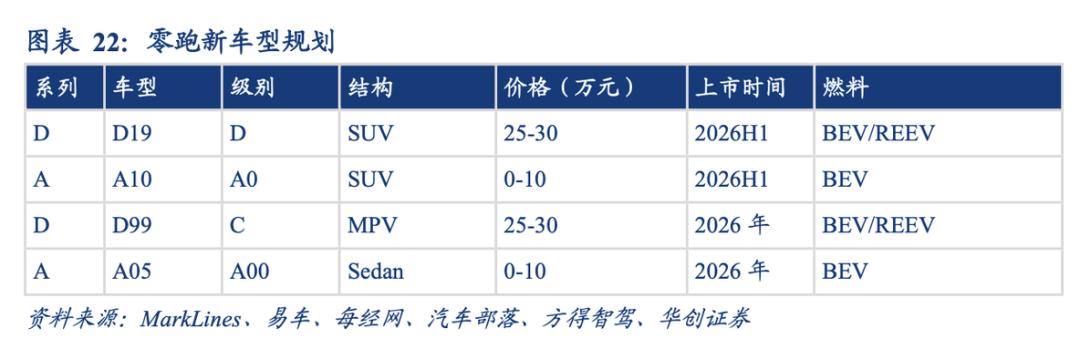
The real variable is the D series. The D19 is positioned as a large six - or seven - seat SUV, and the D99 is a mid - large MPV. The price range is expected to be between 250,000 and 300,000 yuan, and its product competitiveness focuses on stronger range and intelligent configuration.
Such a product matrix aims to use the A/B/C series to drive sales volume and use the D series to test whether the ceiling above 300,000 yuan can be broken.
This also means that Leapmotor is blurring the clear - cut audience segmentation. In the past, consumers bought Leapmotor cars because of "cost - effectiveness", but for consumers in the 300,000 - yuan range, cost - effectiveness may not be the top factor in their car - buying decisions.
This is where the difficulty of brand upgrading lies.
Once consumers form a "low - price" perception of a brand, changing its image requires presenting products that are amazing and far exceed expectations. BYD has Yangwang, a hardcore off - road vehicle with a million - yuan price tag and the ability to turn in place, which has directly raised the brand's ceiling to a new height.
The D series of Leapmotor bears this important task, but no one can answer whether the D19 can be that "amazing" product at present.
The bigger variable lies in intelligent driving.
Intelligent driving is the anchor point for carmakers to demonstrate product value in the next stage and is also a value point recognized by the outside world.
XPeng is making great progress in VLA. Li Auto invests half of its annual R & D expenses of 11.3 billion yuan in AI. NIO is self - researching chips. All of them are competing in the field of intelligent driving.
Leapmotor started relatively late in intelligent driving because its financing was much worse than others. "In the first 10 years, we had to ensure our survival, so we didn't dare to spend too much on intelligent driving." In 2025, Leapmotor's R & D expenditure was 4.29 billion yuan, a year - on - year increase of 47.9%.
Regarding intelligent driving in 2026, Leapmotor says it will have a breakthrough.
"The route of assisted driving is constantly changing. You may be the best today, but he may be the best tomorrow. However, it will eventually converge," said Zhu Jiangming. Leapmotor is a slow - starter, relying on late - comer advantages. In 2021, the intelligent driving team had only dozens of people, and it rented computing power. Now, "it has caught up with the rhythm and is starting to approach the level of the first echelon."
According to the plan, in the second quarter of 2026, Leapmotor will launch a city - leading assistance function covering the whole country. By the end of the year, it will complete the construction of the intelligent driving base model and implement an assisted driving solution based on a large AI model. The D19 will be the first to be equipped with the VLA large model, and it will be pushed to the whole series through OTA later.
Bringing high - level intelligent driving to Leapmotor's basic market through cost control will undoubtedly enhance Leapmotor's competitive advantage. However, in the higher - price range, just "catching up with the rhythm" may not be enough for the late - comer Leapmotor. Leading by half or even one position can make consumers less hesitant when placing an order.