The "newcomer" in materials, seize this wave of dividends tightly.
In 2026, the domestic carbon fiber industry is experiencing a dual - drive of technological breakthroughs and market expansion, with its global voice steadily rising.
In the high - end market once dominated by companies such as Toray and Mitsubishi in Japan, domestic enterprises have achieved key breakthroughs. In addition to the continuous growth of demand in traditional application fields, emerging sectors have become an important engine for the growth of high - performance carbon fiber demand.
Combined with factors such as raw material price fluctuations, the release of overseas orders, and export policy adjustments, the domestic carbon fiber industry has entered a dual opportunity period of technological upgrading and market expansion.
01
- Technological Breakthroughs
As a core material for high - end manufacturing and national defense science and technology, the high - end carbon fiber market was long dominated by Japanese companies. China started research and development in 1975 with the "7511 Project". From 2018 to 2020, the industry's technology advanced rapidly: domestic substitution of mid - and low - end products was completed first, and continuous breakthroughs were made in high - end R & D.
From 2018 to 2021: Small - batch trial production of T1000 - grade carbon fiber was completed;
2022: T1000 - grade carbon fiber was officially commercialized;
By the end of 2023: Companies such as Zhongfu Shenying achieved large - scale supply of T1000 - grade carbon fiber;
March 2026: Zhongfu Shenying announced the mass production of T1200 - grade carbon fiber, with a strength exceeding 8000 MPa, breaking the monopoly of Japanese companies in the top - level carbon fiber field and marking that domestic carbon fiber has entered the stage of running side - by - side with international giants in the high - end field.
Currently, domestic carbon fiber has formed a clear technological echelon:
T300, T400 (Mid - and Low - end): The technology is mature, and the performance and stability are comparable to those of Toray, achieving full import substitution;
T700, T800 (Mainstream): They have become the mainstream products in fields such as wind power and pressure vessels;
T1000 and above (High - end): Mass production is ramping up, gradually penetrating into high - end scenarios such as Starlink satellites and humanoid robots.
However, there are still short - boards waiting for technological breakthroughs. The quality stability and uniformity of high - end products still need to be optimized. The gap in technological equipment leads to lower profitability compared with overseas companies. Moreover, most domestic enterprises mainly use the dry - jet wet - spinning process, and the problem of homogeneous competition is prominent. This is the key direction for the subsequent upgrading of leading enterprises.
- Demand Reconstruction
Driven by technological maturity and cost optimization, the application scenarios of domestic carbon fiber continue to expand, forming a pattern of "traditional fields consolidating the basic market and emerging fields driving growth". Among them, the annual growth rate of high - performance carbon fiber of T800 and above is expected to reach 20% - 30%, which is the core main line of industry growth.
- Market Size and Domestic Substitution Process
In 2024, the global carbon fiber consumption was 130,000 tons, with China accounting for 62,000 tons (domestic supply of 47,000 tons, and the import dependence was 24%); in 2025, the domestic consumption is expected to be 75,000 tons, and in 2026, it will increase to 85,000 tons. The import volume will further drop to 10,000 - 12,000 tons, and the domestic substitution process will continue to accelerate.
- Traditional Sectors
The large - scale development of wind turbine blades (length over 80 meters, diameter over 185 meters) has promoted the increase in carbon fiber demand. In 2024, the domestic consumption of carbon fiber for wind power was 18,000 tons. In 2025, it is expected to be 35,000 tons, and in 2026, it will reach 40,000 - 45,000 tons, accounting for nearly 50% of the domestic total consumption.
The demand in fields such as aerospace, photovoltaic thermal fields, and pressure vessels is growing steadily: in 2025, the consumption in aerospace will be 7,500 tons, and in 2026, it will increase to 10,000 tons; the consumption in photovoltaic thermal fields and pressure vessels will be stable at 5,000 - 6,000 tons, which is an important demand basis for mid - and low - end carbon fiber.
- Emerging Sectors
Starlink Satellites: Each satellite requires 20 kg of M40 - grade carbon fiber. From the end of 2024 to 2025, China plans to launch 20,000 - 30,000 satellites annually, and the demand in this field alone will be 400 - 600 tons;
Humanoid Robots: Each robot requires 5 - 7 kg of T1000 - grade carbon fiber. With the advancement of industrialization, the total consumption of high - end products such as T800, T1000, and T1200 is expected to be 1,000 - 1,100 tons in 2025, becoming the core incremental market for high - end carbon fiber.
- Potential Explosive Directions
Low - altitude Economy: The market size is expected to reach 2 trillion yuan in 2030. Carbon fiber has been widely used in eVTOLs and drones. DJI drones use T400 - grade large - tow carbon fiber, with an annual consumption of nearly 1,000 tons. After the implementation of airspace policies, the demand is expected to be further released;
New - energy Vehicles: CATL uses 7,000 - 8,000 tons of carbon fiber pre - oxidized yarn annually. Huawei has proposed that if the price of carbon fiber drops to 60,000 yuan per ton and safety requirements are met, the annual consumption can reach 24,000 tons. After the cost drops, it may become an important sector.
- Supply Pattern
The domestic carbon fiber industry is dominated by companies such as Jilin Chemical Fiber, Zhongfu Shenying, Guangwei Composites, and Shanghai Jinshan. Each enterprise relies on different process routes to layout niche sectors, and cost control ability is the core competitive factor. Jilin Chemical Fiber has achieved a global low - cost advantage through the wet - spinning process and leads in the large - tow carbon fiber for wind power field.
- Capacity and Process Layout
Jilin Chemical Fiber: The total cost of the wet - spinning process is about 72,000 yuan per ton (5,000 yuan per ton lower than Zhongfu Shenying's dry - jet wet - spinning process). It can still make a profit when the selling price in the wind power field is 60,000 yuan per ton. Its four affiliated enterprises have nearly 30 carbonization production lines, with a capacity of over 60,000 tons, making it the domestic capacity leader;
Zhongfu Shenying: It focuses on the dry - jet wet - spinning process, with an existing capacity of 28,500 tons. A new capacity of 10,000 tons will be released in the second half of 2026, focusing on high - end fields such as aerospace and humanoid robots;
Shanghai Jinshan: It uses the sodium sulfate method, with a headquarters capacity of 13,500 tons. In May or June 2026, the Ordos base will add 5,000 tons, mainly targeting T400 - grade large - tow carbon fiber;
Guangwei Composites: The total capacity is 6,500 tons, and it has been deeply involved in the high - end aerospace market.
- Process Routes and Suitable Fields
Dry - jet Wet - spinning (Zhongfu Shenying, Toray): It is suitable for high - strength and high - modulus high - end products, and is used in aerospace and humanoid robots;
Wet - jet Wet - spinning (Jilin Chemical Fiber, Mitsubishi): It is mainly for T700 - T800 grades, with significant advantages in low cost and large - tow, and is the mainstream in civilian fields such as wind power and photovoltaics;
Sodium Sulfate Method (Shanghai Jinshan): It mainly produces T400 - grade large - tow carbon fiber, which is used in wind power and drones.
02
- Price Expectations
Since December 2025, the carbon fiber industry has experienced two rounds of price increases: Jilin Chemical Fiber took the lead in raising the price by 5,000 yuan per ton, and the whole industry followed. In March 2026, Jilin Chemical Fiber raised the price again, pushing the price out of the bottom and ending the low - price competition pattern. "Steady growth" has become a consensus.
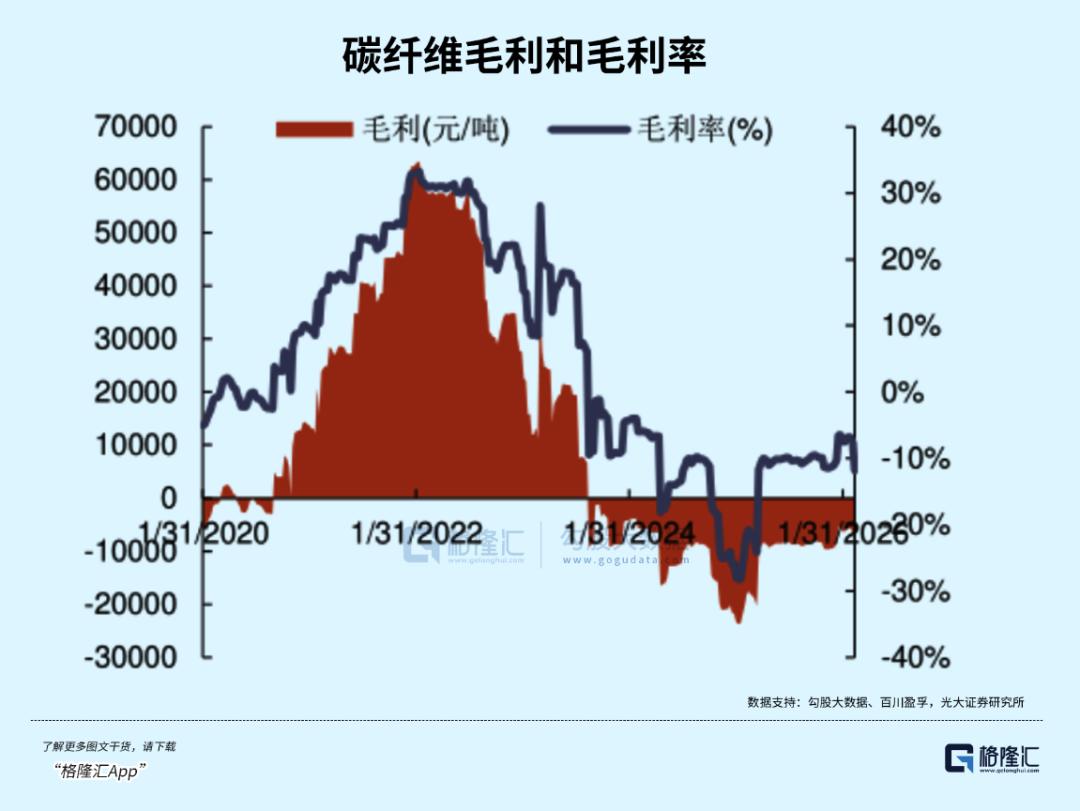
- Core Reasons for Price Increases
Cost Pressure: The core raw material, acrylonitrile, is affected by international oil prices, and its price has risen from 8,000 yuan per ton to 10,000 - 12,000 yuan per ton. Coupled with the increase in energy, labor, and equipment depreciation costs, the industry's profitability is under pressure, and the cost is transferred to the end - users.
Tight Supply - demand of High - quality Capacity: Although the total global carbon fiber capacity has increased, the high - quality capacity in high - end fields such as aerospace and wind turbine blades has not expanded synchronously. The industry competition has shifted to product structure, application scenarios, and added value, and leading enterprises have actively adjusted prices.
Overseas Demand Support: Since April 2026, the UK has imposed zero tariffs on imported wind power and energy - storage products, releasing orders worth 200 billion yuan and with an installed capacity of 8.3 GW. Most of them are expected to be placed in China, supporting the price of large - tow carbon fiber.
- Subsequent Price Trends
The future price will "steadily rise with controllable fluctuations": The rise in international oil prices drives up the price of acrylonitrile, and the carbon fiber price will rise synchronously. Since April 1, 2026, China has cancelled the export tax rebate for carbon fiber and strengthened export review. About 10% of the export capacity has returned to the domestic market, alleviating domestic price competition. The industry is gradually moving away from low - price order - grabbing and entering the stage of value competition.
03
- Future Trends and Investment Opportunities
The international competitiveness of domestic carbon fiber continues to increase. In 2025, the export volume was 15,000 tons, mainly flowing to the wind power and specific military fields. 20% - 30% of the carbon fiber used in wind power was for export. Products of enterprises such as Jiangsu Hengtong and Jiangsu Aosheng were exported through channels such as Siemens Gamesa. In 2026, the export volume is expected to continue to grow. T300 - grade carbon fiber for wind power has replaced overseas products. International wind power giants such as Vestas purchase Chinese carbon fiber components for assembly and export. The overseas market has become an important growth space for domestic enterprises.
Domestic carbon fiber has emerged from the stage of over - capacity and inventory backlog and entered the golden period of high - quality development, accelerated domestic substitution, and global layout. In the future, there will be three major trends:
High - end Upgrade: The quality stability and uniformity of high - performance carbon fiber such as T1000, T1200, and M - grade will be improved, and large - scale application in high - end fields will be gradually realized, breaking the remaining overseas barriers;
Differentiated Competition: Leading enterprises rely on process advantages to layout niche sectors. Jilin Chemical Fiber and others focus on civilian large - tow carbon fiber, while Zhongfu Shenying and Guangwei Composites are deeply involved in the military and high - end manufacturing fields to avoid homogeneous competition;
Global Layout: Relying on the cost - performance advantage, it expands the overseas market, especially in civilian fields such as wind power and low - altitude economy, gradually replacing overseas products and becoming an important global carbon fiber supplier.
- Investment Directions
Large - tow Leaders: They have cost and scale advantages, such as Jilin Chemical Fiber, which leads in the domestic wind power market share and benefits from the release of overseas wind power orders;
High - end Technology Enterprises: Such as Zhongfu Shenying and Guangwei Composites, which have achieved technological breakthroughs and mass production of high - end carbon fiber such as T1000 and T1200, and benefit from the demand in emerging sectors such as humanoid robots, Starlink satellites, and aerospace;
Upstream Supporting Enterprises: Sectors such as acrylonitrile, pre - oxidized yarn, and carbonization equipment will benefit synchronously with the expansion of carbon fiber capacity and the growth of demand.
As a core material for high - end manufacturing, carbon fiber is an important foundation for the development of new energy, high - end equipment, national defense science and technology, and other fields. With domestic technological breakthroughs, cost optimization, and demand expansion, the industry is facing important opportunities. In the future, with the explosion of emerging sectors and the acceleration of global layout, domestic carbon fiber is expected to move from "running side - by - side" to "leading" and occupy a core position in the global market, becoming a benchmark industry for domestic substitution in high - end manufacturing.
- Risk Warnings
Risks of raw material price fluctuations of carbon fiber; risks of the implementation of relevant industrial policies falling short of expectations; risks of intensified industry market competition; risks of the progress of high - end carbon fiber technology breakthroughs and mass production falling short of expectations; risks of the demand release in downstream application fields falling short of expectations; risks of supply - demand imbalance caused by the over - expected construction of industry capacity; risks of the commercialization progress of emerging application fields falling short of expectations; risks of enterprises' process optimization and cost control falling short of expectations.
Disclaimer:
This article is copyrighted by the research team of Beijing Gelonghui Investment Consulting Co., Ltd. (Zeng Run: A0160623020001). This report is prepared based on the principles of independence, objectivity, fairness, and prudence. The information is sourced from public materials and is legally, reasonably, and appropriately collected, abstracted, and edited.
The stock market is risky, and you need to be cautious when entering. Any investment advice in this article is not a basis for your investment and trading. You must make independent investment decisions and bear the risks on your own. Any unauthorized release, reproduction, dissemination, online publication, or re - posting by any unit or individual is regarded as infringement, and our company will pursue legal liability for infringement in accordance with the law.