More than a hundred brands such as Florasis, HBN, and Cibio'age have broken through. What did the investment institutions behind them bet on?
Can consumer investment still be pursued?
Against the backdrop of the booming financing in AI and embodied intelligence, the consumer sector, which offers long - term and stable returns, remains a track that cannot be ignored. Since this Spring Festival, the potential of AI connecting with the consumer sector has for the first time caught the industry's attention. Starting from 2025, the consumer sector has been gradually recovering from its trough: MIXUE, Laopu Gold, and Pop Mart have successively hit the daily limit. The "Three Sisters in the Hong Kong Stock Market" have reshaped the valuation system of the consumer sector. Dozens of beauty companies are vying for IPOs, and Maogeping once topped the list of beauty stocks in the Hong Kong stock market.
While many people are still arguing about the opposition between "consumption downgrade" and "consumption upgrade", the "List of Rising Brands in the FMCG Industry in the Third Quarter of 2025" (based on the China Online Consumer Brand Index CBI) released by institutions such as the National School of Development at Peking University provides a clearer answer: The consumer market is not simply polarized but has spawned a new brand - growth logic during the structural adjustment.
The list is compiled by the National School of Development at Peking University, the Institute of Digital Finance at Peking University, and the School of Management at Sun Yat - sen University, with technical support from Alibaba's Taotian Group. It is based on the real consumption behavior data from Taobao and Tmall. This top - 100 list covering four core tracks of beauty, mother - and - baby, personal care, and household cleaning not only presents the strength of current rising brands but also reveals the transformation of industry evaluation criteria.
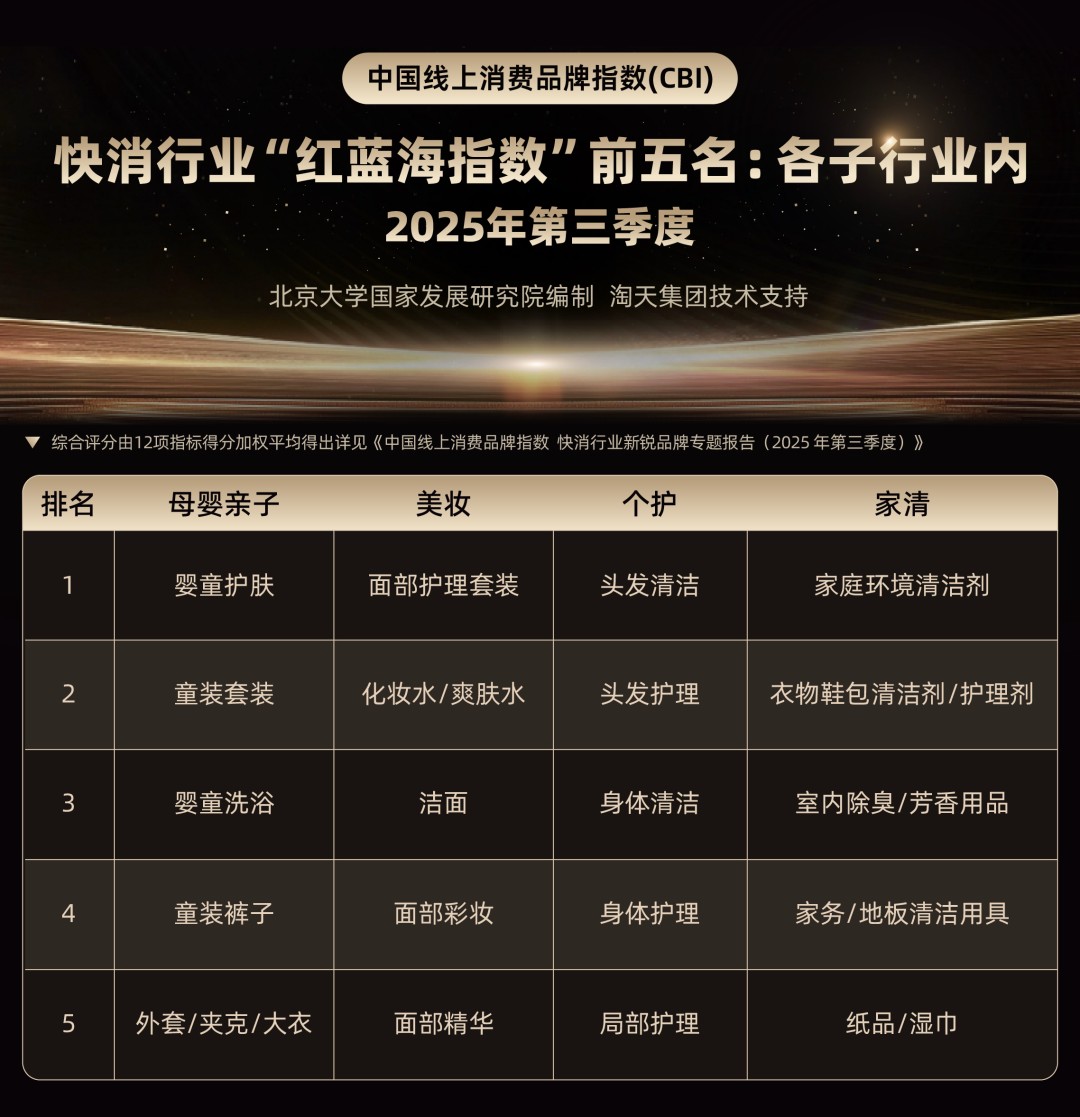
By examining the investment and financing histories of the brands on the list, it can be found that many companies have the following characteristics: in - depth participation of industrial capital, emphasis on both efficacy and emotional value, and continuous improvement of financing and valuation through innovation in niche tracks. As the bubble of "new consumption" fades, these rising brands and companies are facing new survival rules.
Beauty Sector is Dividing, with More Opportunities in Personal Care and Mother - and - Baby
The beauty sector has always been a major part of FMCG brands. However, throughout 2025, only a few brands such as RED CHAMBER, Florasis, LAN, and Yujian successfully raised funds, and more hot money is flowing to upstream raw material manufacturers. This means that after the financing boom of "new consumption", beauty brands are moving towards differentiation.
The list can provide a reference. Starting from the third quarter of 2025, the "List of Rising Brands in the FMCG Industry" has undergone an important upgrade. Like a "brand data investment bank", it not only publishes the brand scoring model and formula but also makes public the sub - item scores of the top 100 brands. It also draws on the concept of "Red Ocean/Blue Ocean Strategy" by Kim and Mauborgne to comprehensively score nearly 200 sub - categories in various sub - industries of the FMCG industry, using indicators such as entry barriers, the difference between search and transaction growth rates, and the proportion of new brands to identify categories with greater growth potential.
In the third quarter of 2025, the top five tracks with the highest "red - blue ocean" scores are: hair cleaning, facial care sets, lotion/toner, baby skincare, and children's clothing sets.
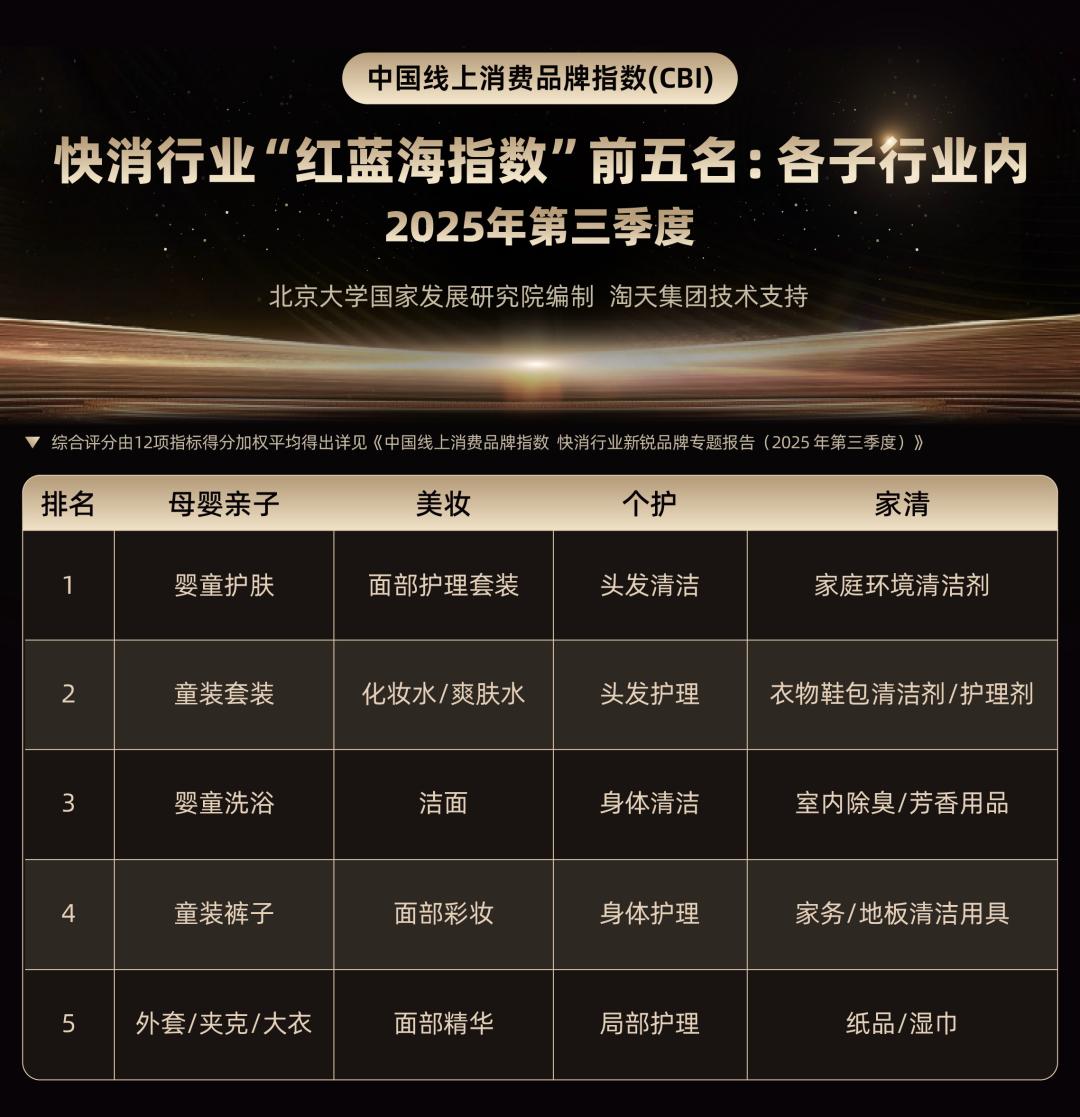
Specifically, new brands have emerged in the hair cleaning category.
Backed by the Proya Group, Off&Relax officially entered the Chinese market in 2021 and has since achieved explosive growth with a growth rate of over 100%, ranking among the top in the skincare and haircare categories on platforms such as Tmall Global and Douyin. Off&Relax has a new approach, positioning itself as an "expert in comprehensive scalp healing for Asians", integrating scientific scalp healing strategies with aromatherapy to provide emotional value to consumers while emphasizing efficacy. Off&Relax has become a core part of Proya's "second growth curve". Its revenue in the first half of 2025 increased by 102.52% year - on - year, making it a star brand with a scale of over 500 million yuan within the group.
Belonging to the same personal care category, Yujian's rise is similar to that of Off&Relax. Yujian was established in 2015, positioning itself as a body care brand dedicated to Oriental women. Its main product is bath oil, with Oriental tree oils and fragrances as the core, also providing consumers with a dual experience of body care and emotional relaxation. In 2025, Yujian received investment from the Betta Group. After the transaction, Betta will hold 15.79% of Yujian's equity through Hainan Betta, becoming the second - largest shareholder after Yujian's brand founder, Li Li.
Among the beauty categories, the facial care segment is a relatively blue - ocean niche track. Emphasizing both technology and marketing is the key for new brands to gain the favor of capital.
For example, LAN, established in 2019, entered the market with the concept of "nourishing the skin with oil" and has won the national sales championship for facial essential oils for two consecutive years. LAN completed two rounds of financing totaling 200 million yuan within half a year. After the financing boom of "new consumption" subsided, after three years of research and development, it successfully registered a new raw material, Huabai and callus extract, in 2025. In 2025, Shanghai Meifangfang Investment Company, a subsidiary of beauty giant L'Oréal China, invested in LAN, making it the first domestic skincare brand invested by Meifangfang in China.
On the beauty track, Zhuzhan also stood out in the capital market in 2025, completing nearly 100 million yuan in Series A and Series A+ financing, led by Sheepy Group and followed by Jiebai Consumption Fund. Zhuzhan was established in 2020, positioning itself as a "Chinese pure beauty brand", implementing the concept of pure beauty from raw material selection to packaging design. With its differentiated positioning, Zhuzhan has received three rounds of financing in five years.
The rising brand Florasis, which is at a more advanced stage of development, received further support from industrial capital in 2025. In September 2025, it completed a Series B exclusive financing from Proya, and the financing funds are specifically used for global expansion, supply - chain upgrade, and content innovation. With over 5 million fans on overseas social media and a pricing in the European and American markets comparable to Chanel, Florasis has become a representative brand of Chinese beauty products going global.
On the list, there are also beauty companies rushing to list on the Hong Kong stock market. HBN, launched in 2019, is the first domestic skincare brand to propose the concept of "real efficacy", focusing on the A - alcohol anti - aging track, which was a blank area for domestic brands. Its GMV reached 1.022 billion yuan only three years after its establishment. In 2020, it completed strategic financing through equity transfer, introducing well - known institutions and individual investors such as Meitu and Yingxin Investment, laying a financial foundation for brand research and development and channel expansion. On January 26, 2026, HBN officially submitted an application for listing on the main board of the Hong Kong Stock Exchange and is currently waiting for a hearing.
In addition, there are many niche areas in the mother - and - baby track worthy of attention, such as baby skincare. In 2020, the penetration rate of children's sunscreen in China was only 0.3%, less than one - twentieth of the global average. It was by targeting the long - neglected children's skincare market that Coppertone made its children's sunscreen sales rank first in Asia and also received investment from L Catterton, a fund under LV.
What Kind of FMCG Brands Can Raise Funds?
When talking about the once - booming "new consumption", Chang Bin, the managing partner of Qichen Capital, recently said: Taking cosmetics as an example, at that time, new brands could quickly launch a large number of products. The core was to rely on the mature large - scale solutions of the upstream, only making a small amount of product differentiation design and marketing positioning, lacking in - depth research and development, and having weak product barriers. Moreover, both production and channels were open supply chains, making it difficult to distinguish the efficiency of enterprises in the industry.
Ultimately, if startups don't focus on product research and development, they can easily enter the market but have difficulty building competitive barriers. This is a valuable lesson for the consumer industry. Of course, startups today face more challenges than this. Using the investment and financing histories of the brands on the list as a model, from the four dimensions of track selection, capital connection, brand value, and capitalization path, we try to summarize several financing experiences for rising FMCG brands and consumer brands:
(1) Target Blue - Ocean Niche Tracks and Avoid Red - Ocean Price Competition
We suggest referring to the high - potential tracks in the CBI Red - Blue Ocean Index. Relying on the "Red - Blue Ocean Index" of the list, choose to enter tracks with moderate barriers, a large difference between search and transaction growth rates, and a high proportion of new brands. As mentioned above, tracks such as hair cleaning, facial care sets, and baby skincare, which have the highest scores, are more likely to attract capital attention compared to other areas.
In a highly competitive track like beauty, finding blank areas in the track and entering niche scenarios has become the key to success. When HBN was established, it chose to enter the A - alcohol anti - aging track, which domestic brands had not deeply explored. Simpcare focused on the 200 - billion - scale sensitive - skin skincare track. In short, the core idea for beauty startups today should be to avoid price wars in the mass market and build a core financing advantage through track differentiation.
This is also more fully reflected in the top three brands in the mother - and - baby track. BeBeBus, Coppertone, and Wanyaya focus on baby strollers, baby skincare, and baby rockers respectively, making scenario segmentation in large categories, reducing the intensity of competition, and helping capital actively predict the growth potential of the brands.
Take the newly listed BeBeBus as an example. It entered the high - end mother - and - baby track, with a gross profit margin of over 47% for three consecutive years and an average unit price of core orders of over 2,400 yuan. It is known as the "Hermès in the baby stroller industry". In 2024, its GMV ranked first among China's mid - to high - end durable parenting products. Since its establishment, the parent company has completed three rounds of financing, introducing star investors such as Tiantu Capital, Gaorong Capital, Matrix Partners, and Taikang Life Insurance. The post - investment valuation soared from 300 million yuan to 2 billion yuan. On September 23, 2025, BeBeBus's parent company listed on the Hong Kong Stock Exchange, with its stock price rising by over 40% at the opening and a market value of over 9 billion Hong Kong dollars, becoming a benchmark for the capitalization of rising mother - and - baby brands.
(2) Select Capital Providers Targetedly and Bind with Industrial Capital
During the recovery of the consumer market, large industrial players such as Betta, L'Oréal, and Proya have been more active in high - profile investment cases in the past year.
In 2025, leading enterprises in tracks such as beauty, mother - and - baby, and personal care are actively deploying rising brands and actively binding with startups in the upstream and downstream of the industrial chain. According to incomplete statistics, in the past three years, the three major groups of L'Oréal, Estée Lauder, and Unilever have initiated a total of 43 investment and acquisition cases, among which L'Oréal has made over 10 investments in China.
Connecting with industrial capital first can not only solve the funding problem but also help startups address the short - comings in the supply chain and channels. For example, the rapidly rising Off&Relax is backed by the Proya Group. Another example is Florasis, which has always had in - depth involvement of industrial players in its financing. In the early stage, it introduced investment from a related party of the contract manufacturer, which has 18 years of experience in brand product customization and forms in - depth synergy with Florasis at the supply - chain level. Later, it received exclusive financing from Proya, which provided assistance on its global expansion path. Sheepy Group, which invested in Zhuzhan, is both an investor and an industrial player. With its mature experience in product research and development, supply - chain management, and market promotion, it helps Zhuzhan make further progress in product innovation and market expansion. These cases prove that industrial capital can not only provide funds but also bring core resources such as supply - chain integration, channel resources, and industry experience.
In addition to industrial capital, introducing star financial investors can help increase brand valuation and capitalization potential. For example, BeBeBus introduced first - tier VCs such as Tiantu, Gaorong, and Matrix, and Simpcare received investment from institutions such as ZhenFund. The endorsement of first - tier financial investors can not only bring funds but also provide guidance on the capitalization path for the brand's subsequent IPO and mergers and acquisitions, while also increasing the brand's industry recognition.
(3) Emphasize Both Efficacy and Emotional Value
Feng Weidong, the founding partner of Tiantu Capital, believes that on the one hand, consumption focusing on cost - effectiveness has risen in the past two years; on the other hand, high - end brands that have withstood the test are receiving more and more favor, and consumers will reward themselves with "small joys". Indeed, in recent years, the emotional economy has become the core driving force in the consumer market. According to data from iiMedia Research, the market size of China's emotional economy reached about 2.31 trillion yuan in 2024 and is expected to exceed 4.5 trillion yuan by 2029, showing great growth potential.
On the product side, it is recommended to strengthen efficacy and build a core barrier with data. Chang Bin of Qichen Capital believes that in the next five to ten years, the cosmetics industry will shift to be driven by efficacy, and brands need to conduct in - depth scientific research on raw materials and skin mechanisms. In fact, the evaluation of the product strength of FMCG brands in China has shifted from trendy products to hard - core efficacy. For example, HBN uses laboratory data to prove the anti - aging effect of A - alcohol, Simpcare verifies product recognition with a repurchase rate of over 50%, and BeBeBus's gross profit margin of over 47% also reflects the product's premium ability.
On the experience side, startups can further explore consumers' psychology and provide precise emotional value. Led by the wealth effect of Pop Mart, capital will undoubtedly be more inclined to brands that can provide emotional value. On the list, Off&Relax's scented skincare and haircare, Florasis's girlish aesthetics, and ZanJia's scented cleaning all add emotional experiences on the basis of efficacy. By creating emotional value through scenario storytelling, sensory symbols, and brand concepts, brands can achieve differentiation from competitors.
What is being squeezed out now is the past type of trendy and experimental consumption. Brands that truly have efficacy and can provide emotional value can still attract capital.
(4) Profitability, Going Global, and a Clear Capitalization Path
The logic of "burning money for scale" is over. The core trend in the consumer investment market in 2025 is "profitability is king". Many niche brands on Tmall's 618 achieved double - digit growth. Brands such as Simpcare and BeBeBus have continued to make profits, and moving towards high - profit margins has become a trend.
Take Simpcare as an example. It completed three rounds of financing within eight months after its establishment in 2019, completed a Series C financing in 2021, and has completed a total of seven rounds of financing, with a valuation of nearly 4 billion yuan. Entering the niche market of sensitive skin, Simpcare's camellia series ranks first on Tmall's repurchase list for skincare sets. The company has been profitable for three consecutive years, with a GMV of over 2 billion yuan in 2024 and an average repurchase rate of over 50% for a long time. In 2024, Simpcare repurchased shares and distributed dividends of 70 million yuan