Mehr als hundert Marken wie Florasis, HBN und CibioLab haben sich erfolgreich durchgesetzt. Was haben die dahinterstehenden Investmentinstitute getroffen?
Can one still invest in the consumer sector?
In the face of the intense financing activities in the AI and Embodied Intelligence sectors, the long - term lucrative consumer sector still remains an important area that must not be ignored. Since this Chinese New Year, the potential of the connection between AI and consumption has for the first time caught the industry's attention. Starting from 2025, the demand in the consumer sector has gradually increased again: MIXUE, Laopu Gold, and POP MART have successively reached record highs. The "Three Sisters on the Hong Kong Stock Exchange" have re - defined the valuation system in the consumer sector. Dozens of cosmetics companies have applied for stock listings, and Maogeping was for a while the top performer among cosmetics stocks on the Hong Kong Stock Exchange.
While many people are still arguing about the contradictions between "consumption downgrading" and "consumption upgrading", the "List of Rising Brands in the Fast - Moving Consumer Goods (FMCG) Sector" for the third quarter of 2025, published by institutions such as the National School of Development of Peking University (based on the Chinese Online Consumer Industry Index CBI), provides a clearer answer: The consumer market is not simply polarized, but has produced new growth logics for brands in the structural adjustment.
The list was compiled by the National School of Development of Peking University, the Peking University Institute of Digital Finance, and the School of Business of Sun Yat - sen University, and was technically supported by Alibaba Taotian Group. It is based on real consumption data from Taobao and Tmall. This list of the top 100 brands in the four core areas of cosmetics, baby and children's products, personal care, and household cleaning not only shows the strength of the current rising brands but also the change in industry valuation standards.
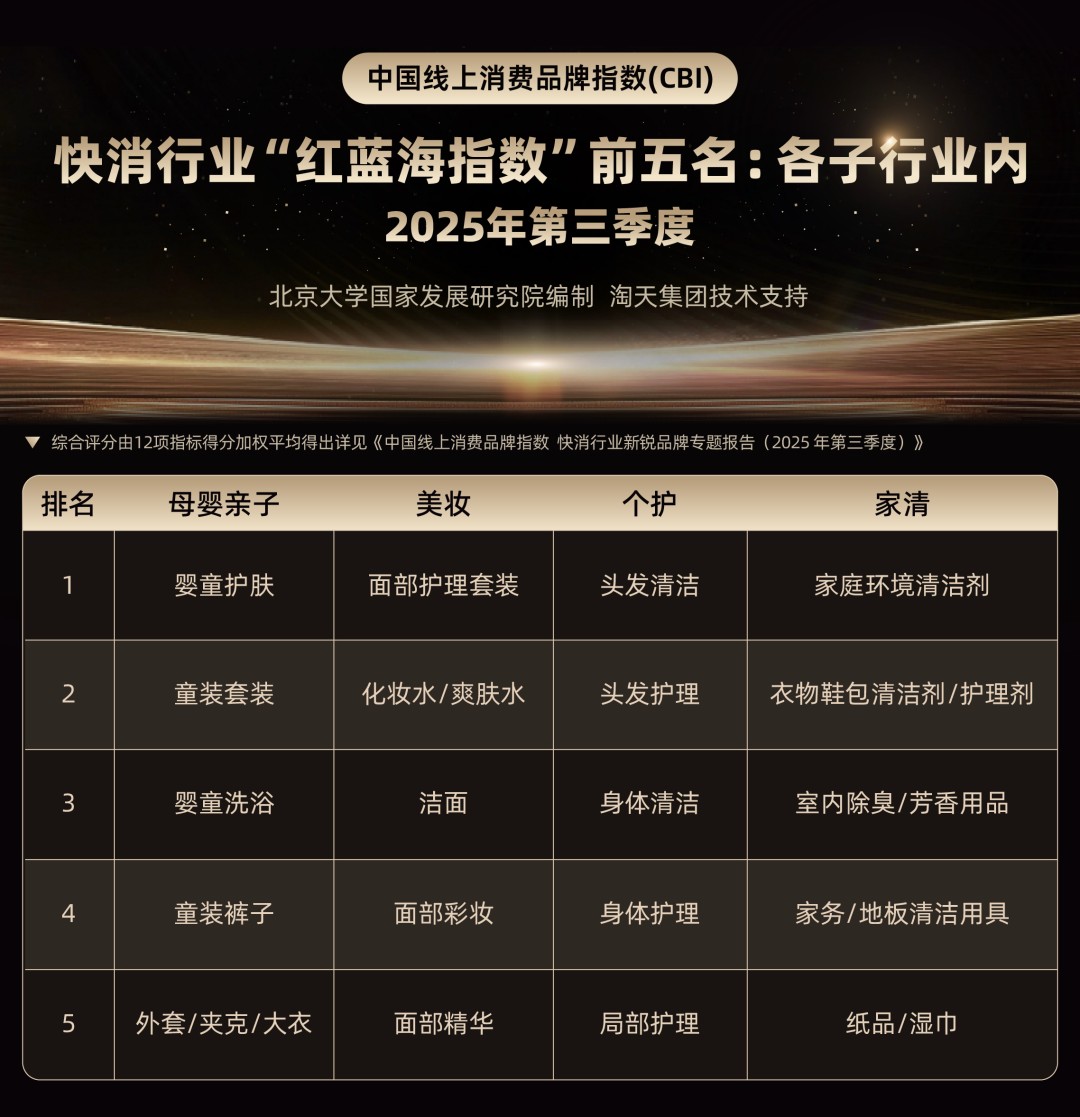
If one looks at the financing history of the brands represented on the list, one will find that many companies have the following characteristics: In - depth participation of industrial capital, appreciation of both effectiveness and emotional value, and continuous improvement of financing and valuation through innovation in niche markets. After the bubble of the "New Consumption" burst, these rising brands and companies are facing new survival rules.
Differentiation in the cosmetics industry, many opportunities in personal care and baby and children's products
Cosmetics have always played a central role in the FMCG sector. However, in 2025, only a few brands such as RED CHAMBER, Flower Knows, LAN, and Yujian successfully carried out financing. More money is flowing into the raw material manufacturers in the upper value - chain. This means that the cosmetics brands are diverging after the financing wave of the "New Consumption".
The list can serve as a reference. Starting from the third quarter of 2025, the "List of Rising Brands in the FMCG Sector" was significantly improved. Similar to a "brand data investment banker", it has not only published the valuation model and formula for the brands but also disclosed the individual indicator values of the top 100 brands. Referring to the concept of the "Red/Blue Ocean Strategy" by Kim and Mauborgne, it has conducted a comprehensive evaluation of nearly 200 niches in different sectors of the FMCG industry and identified the niches with greater growth potential using indicators such as entry barriers, search - sales growth difference, and the proportion of new brands.
In the third quarter of 2025, the five sectors with the highest "Red/Blue Ocean" ratings were, in order: Hair cleaning, facial care sets, toner, baby care, and children's sets.
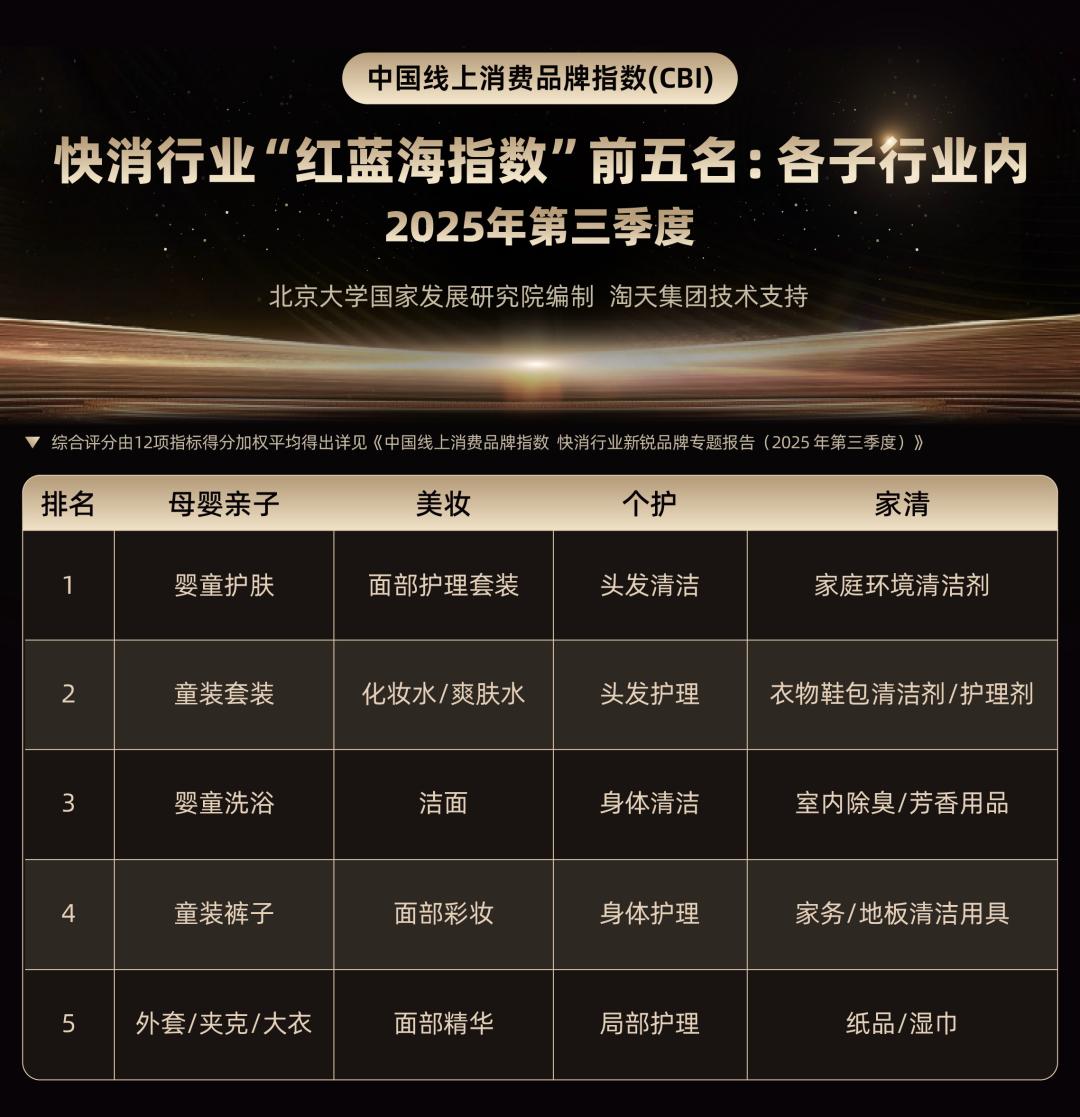
More specifically, a new brand has actually established itself in the hair cleaning category.
Supported by the Proya Group, Off&Relax entered the Chinese market in 2021 and has since achieved a growth of over 100%. It is at the top of the rankings for hair and personal care products on platforms such as Tmall Global and Douyin. Off&Relax has chosen a new approach and positions itself as a "specialist in the holistic care of the Asian scalp system". It combines scientific scalp care strategies with aromatherapy and offers consumers not only effectiveness but also emotional value. Off&Relax has become a core part of Proya's "second growth curve". In the first half of 2025, it achieved a sales increase of 102.52% compared to the previous year and has become a star brand with sales of over 500 million yuan within the group.
Similar to Off&Relax, Yujian has also established itself in the personal care category. Yujian was founded in 2015 and positions itself as a brand for the personal care of Eastern women. Its main product is bath oil, which is based on Eastern wood oils and fragrances and offers consumers both personal care and emotional relaxation. In 2025, Yujian received an investment from Bettenny Group. After the deal is completed, Bettenny Group will hold 15.79% of Yujian's shares through Hainan Bettenny and will thus become the second - largest shareholder after the founder Li Li.
Within the cosmetics category, facial care is a relatively untapped niche market. The combination of technology and marketing is the key for new brands to obtain capital.
For example, the brand LAN, founded in 2019, entered the market with its concept of "oil - based care" and has held the top position in the sales statistics of facial essence oils in China for two years. LAN completed two rounds of financing totaling 200 million yuan within six months. After the financing wave of the "New Consumption", it worked on research for three years and successfully developed and registered a new raw material, Huabai and callus tissue extract, in 2025. In 2025, the investment company Shanghai Meifangfang, which is part of the cosmetics giant L'Oréal China, invested in LAN, thus investing in the first domestic skin - care brand in China.
The brand RED CHAMBER also showed remarkable performance on the capital market in 2025. It completed a Series A and Series A+ financing of nearly 100 million yuan, with Shuiyang Co., Ltd. as the main investor and Jiebai Consumption Fund as a co - investor. RED CHAMBER was founded in 2020 and positions itself as a "Chinese Pure Cosmetics Brand". From raw material selection to packaging design, the concept of pure cosmetics is implemented. Thanks to its differentiated positioning, RED CHAMBER has received three rounds of financing in five years.
The rising brand Flower Knows, which is in a more advanced stage of development, received further support from industrial capital in 2025. In September 2025, it completed a Series B financing from Proya, and the financing funds will clearly be used for global expansion, improvement of the supply chain, and content innovation. With over 5 million fans on overseas social media and prices comparable to those of Chanel in Western markets, Flower Knows is a representative brand for the export of Chinese cosmetics products.
There are also cosmetics companies on the list that are applying for a stock listing on the Hong Kong Stock Exchange. HBN, which entered the market in 2019, is the first Chinese skin - care brand to introduce the concept of "real effectiveness". It focuses on the previously untapped market segment of anti - aging products with A - Retinol. Just three years after its founding, HBN reached a GMV of 1.022 billion yuan. In 2020, it completed a strategic financing through a share transfer and introduced well - known institutions and private investors such as Meitu.com and Yingxin Investment to create a financial foundation for brand research and channel expansion. On January 26, 2026, HBN officially applied for a stock listing on the main board of the Hong Kong Stock Exchange and is currently awaiting review.
In addition, there are many niche markets in the baby and children's products industry that are worth noting, such as baby care. In 2020, the penetration rate of children's sunscreen products in China was only 0.3%, less than one - twentieth of the global average. Turtle Dad targeted this long - neglected market segment and brought the sales volume of children's sunscreen products in Asia to the top. In addition, it received an investment from L Catterton, a fund of the LV Group.
Which FMCG brands can obtain capital?
Regarding the then - intense "New Consumption" wave, Chang Bin, the Managing Partner of Qichen Capital, recently said: Take the cosmetics industry as an example. At that time, new brands could quickly bring a large number of products to the market. The core was to use established scalable solutions in the upper value - chain. They only made minor product differentiations and marketing positionings, but lacked basic research and development, and the product barriers were weak. In addition, the production and sales channels were open supply chains, and it was difficult to increase the efficiency differences between companies in the industry.
Ultimately, it is difficult for start - up brands that do not invest in product development to create a competitive advantage. This is a valuable lesson for the consumer industry. Of course, start - up companies today are not only facing these challenges. Based on the financing history of the brands on the list, we try to give some financing recommendations for rising FMCG brands and consumer brands from the four dimensions of sector selection, capital connection, brand value, and capitalization path:
(1) Focus on untapped niche markets and avoid price wars in overcrowded markets
We recommend referring to the CBI Red - Blue Ocean Index and selecting niche markets with appropriate entry barriers, a large difference between search and sales growth, and a high proportion of new brands. As mentioned before, niche markets such as hair cleaning, facial care sets, and baby care, which have received the highest ratings, are more likely to attract the attention of capital providers compared to other areas.
In an industry as highly competitive as the cosmetics industry, the key to success is to find market gaps and focus on niche scenarios. When founded, HBN focused on the anti - aging market with A - Retinol, which has not been strongly developed by Chinese brands. Skmur focuses on the 20 - billion - yuan market for skin - care products for sensitive skin. Overall, the core idea when founding a cosmetics brand today should be to avoid price wars in the mass markets and create a core advantage in financing through market differentiation.
This is also clearly shown by the top three brands in the baby and children's products industry. BeBeBus, Turtle Dad, and Wanyaya focus on baby strollers, baby care, and cradles respectively. By differentiating the scenarios in the large product categories, they reduce the intensity of competition and help capital better assess the growth potential of the brands.
Take the recently listed BeBeBus as an example. It has focused on the premium segment of baby and children's products and has achieved a profit margin of over 47% for three years. The average end - consumer price of its core products is over 2,400 yuan. It is called "the Hermès of the baby stroller industry" and had the highest GMV in the Chinese premium segment for durable baby products in 2024. The parent company has completed three rounds of financing since its founding and introduced star investors such as Tiantu Investment, Gao Rong Capital, Matrix Partners, and Taikang Life Insurance. The post - investment enterprise value has increased from 300 million yuan to 2 billion yuan. On September 23, 2025, the parent company of BeBeBus was listed on the Hong Kong Stock Exchange and rose by over 40% on the listing day. The market value is over 9 billion Hong Kong dollars. BeBeBus is thus a model for the capitalization of rising baby and children's products brands.
(2) Select capital providers purposefully and connect with industrial capital
During the consumer boom in recent years, large industrial groups such as Bettenny, L'Oréal, and Proya have been very active in top cases.
In 2025, the market leaders in the cosmetics, baby and children's products, and personal care industries all actively targeted rising brands and actively connected with start - up companies in the entire supply chain. According to incomplete statistics, the three groups L'Oréal, Estée Lauder, and Unilever have carried out a total of 43 investments and acquisitions in the past three years, with L'Oréal investing in China more than 10 times.
Connecting with industrial capital as a priority can not only solve the capital problem but also help to address the weaknesses in the supply chain and sales channels of start - up brands. For example, the rapidly rising Off&Relax is supported by the Proya Group. Also, in the financing of Flower Knows, an industrial partner has always been deeply involved. At the beginning, it introduced investments from a contract manufacturer who has 18 years of experience in product creation for brands and has a connection with Flower Knows at the supply chain level.