The mobile phone industry is experiencing a wave of resignations. Where have the people who left gone?
The prices of mobile phones have gone up, and the people in the industry are leaving.
The surge in demand for storage chips triggered by the AI boom has led to a more than 80% increase in storage prices. A wave of collective price hikes has swept across the entire mobile phone and even the hardware industry.
On March 16th, vivo issued an official announcement, putting an end to the month - long "price - hike wave". Starting from March 18th, the prices of some of vivo and iQOO's currently available models will be officially adjusted.
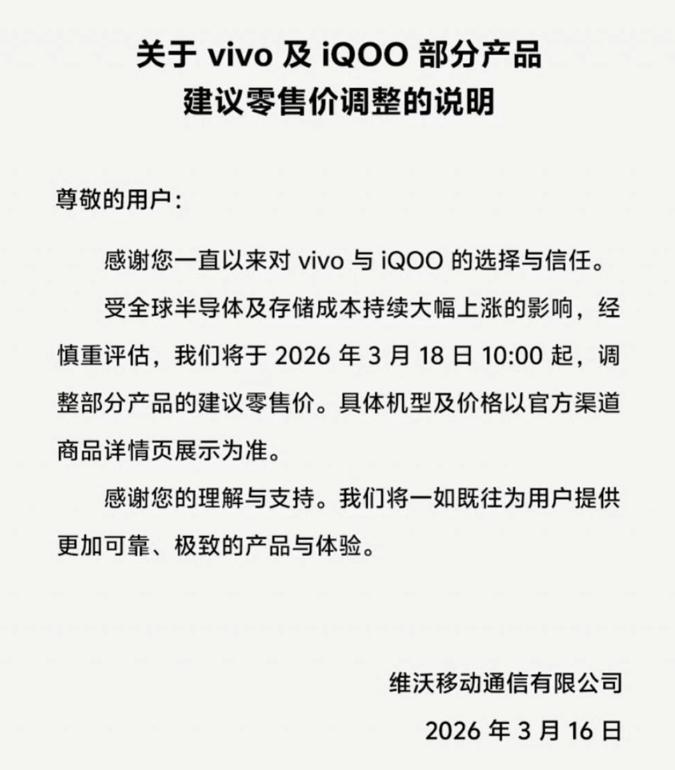
This is already the second leading brand and its sub - brand to officially announce a price increase this month.
Previously, OPPO and OnePlus announced on March 10th that they would adjust prices starting from the 16th. Without exception, the reason was the increase in upstream storage costs.
Actually, there were already undercurrents in the offline channels earlier. Industry insiders revealed that the price of vivo's high - end phones increased by 500 yuan, the price of Honor's new folding - screen phones jumped by 1000 yuan, and even Redmi, known as the "cost - performance butcher", quietly raised the price of some models by 100 yuan.
In the mobile phone market in 2026, the era of "low - price involution" is long gone. What's even more alarming than the rising prices of mobile phones is that the people who make mobile phones are leaving the industry one by one. For example, senior executives are changing jobs, and R & D personnel are leaving. From the automotive to the robotics industry, from AI to smart home, talents from the mobile phone industry are flocking to various "trendy" sectors.
Why has the price - hike wave triggered by storage chips become the "fuse for talent drain" in the mobile phone industry? And which brands are suffering the most?
Mobile phone industry becomes a "military academy", and "graduates" are going to trendier sectors
The story doesn't start in the mobile phone factory but in the distant AI server rooms.
Since the second half of 2025, the demand for generative AI and large - model training has skyrocketed. The demand for DRAM and NAND in an AI server is about 8 times and 3 times that of an ordinary server respectively.
This has led to a fundamental change in the market position of storage chips. They have evolved from traditional consumer - electronics components to strategic infrastructure resources.
Storage giants such as Samsung, SK Hynix, and Micron have unhesitatingly shifted their production capacity towards high - profit HBM (High - Bandwidth Memory). After all, the profit of a single high - end HBM chip can be equivalent to that of dozens or even hundreds of ordinary consumer - grade memory chips.
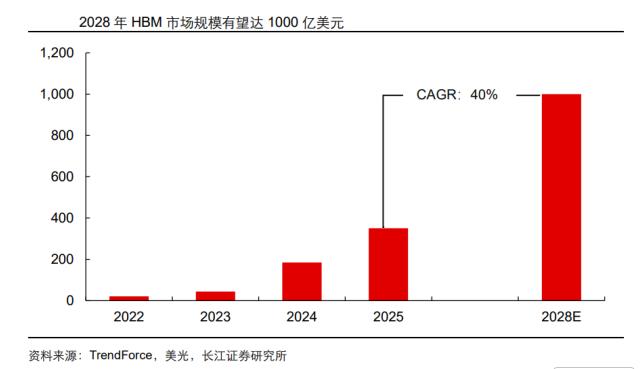
HBM is a storage chip directly packaged with GPUs and ASICs. With the rapid iteration of GPU and ASIC products and the high - speed growth of demand, its market size is also expanding rapidly. According to Micron's prediction, the HBM market size is expected to reach $100 billion in 2028, with a compound growth rate of up to 40% from 2025 to 2028.
Data provided by Yuan Shuai, the co - founder of Xinzhipai, shows that in Q1 2026, the proportion of global storage - chip production capacity allocated to AI servers has exceeded 45%, compared with only 22% in the same period in 2025. The proportion of production capacity for mobile - phone storage chips has dropped from 38% to 24%.
This "crowding - out effect" has directly led to an extension of the delivery cycle of mobile - phone storage chips from an average of 2 weeks to 8 weeks. Some manufacturers have even faced supply shortages. With supply falling short of demand, prices have started to spiral out of control.
IDC data shows that the cost of memory semiconductors in the BOM (Bill of Materials) of smartphones has jumped from the previous 10% - 15% to over 20%. For mid - and low - end models, it is even approaching 30% - 40%. Some budget phones have fallen into the negative - gross - margin range.
"In some batches, the procurement price of storage chips has even exceeded the pricing of end - products, resulting in a 'cost - inversion' phenomenon," Zhang Xinyuan, the head of Kefangde Consulting Agency, described the serious situation. This means that for mid - and low - end mobile phones that focus on cost - performance, the more you sell, the more you may lose.
When the cost pressure cannot be transferred, "death" becomes the only way out.
At the end of February 2026, news that Meizu's mobile - phone business had essentially stopped and would officially exit the market in March shocked the industry. The details of Meizu's "collapse" have also been pieced together by the media recently.
This veteran mobile - phone manufacturer with a 23 - year history finally couldn't survive this winter of rising storage prices. According to the report of "Intelligent Emergence", Meizu carried out a drastic restructuring, and more than 50% of its employees, about 400 people, are about to leave.
People familiar with the matter said that most of them will complete the formalities within that week, receive "N + 2" compensation, and bid farewell to this once "dream phone". This is the end of an era. In an earlier official announcement, Meizu straightforwardly stated the reason: "The sky - rocketing memory prices have made the commercialization of new mobile - phone products impossible."
What's more interesting is where these people are going. The remaining employees of Meizu have not been simply "laid off" but have been diverted to two seemingly unrelated directions. Some have been integrated into the Flyme in - car system team to continue serving Geely's automotive ecosystem, while others have turned to the exploration of AI software.
And the once - popular "PANDAER" trendy brand has also been spun off to be self - supporting.
Wang Teng, a former core executive of Xiaomi, recently revealed the industry's hardships. This "veteran" who has been in the mobile - phone industry for nearly a decade said bluntly on a social platform that "memory prices will continue to rise in the second quarter. This year is extremely difficult for the consumer - electronics industry. I estimate that there will be a wave of large - scale layoffs in various companies."
His judgment is not unfounded. As an industry veteran who grew from a product manager in Xiaomi's mobile - phone department to the general manager of the Redmi brand, he witnessed the golden age of the mobile - phone industry and clearly saw the current contraction of the industry. Wang Teng himself left Xiaomi in September 2025 and founded a technology company focusing on sleep - health products, completely bidding farewell to the mobile - phone industry.
There are not a few industry executives like Wang Teng who have left. A group of well - known figures in the mobile - phone circle, such as Guo Rui from Honor, Jiang Hairong from Huawei, Song Ziwei and Ge Lan (Jian Zhong) from vivo, and the core executive team of Xingji Meizu, have all chosen to leave and engage in sectors such as the automotive industry, embodied intelligence, and AI + application - based fields.
The departure of senior executives often means a change in the industry's direction, while the loss of ordinary practitioners directly reflects the industry's survival status.
Some consumers who have contacted employees of several leading mobile - phone brands said that after adding salespeople from multiple brands, they found that some of them had gone to Tesla, some to Li Auto, and others to sell Salomon products.
A netizen who had been in the mobile - phone industry for many years said that when he first entered the industry, it felt okay. He had been in the mobile - phone business for almost 7 years, but now he feels that the market is just like this.
Few of those who have left the mobile - phone industry seem willing to come back.
Huawei and Apple sit firmly on the "fishing platform", while OPPO, vivo, Xiaomi, and Honor respond with price hikes
The current mobile - phone industry is in a battle for the existing market. Changing employers in the mobile - phone industry is just like changing "holes". Therefore, many employees and executives who have left the mobile - phone industry are more willing to go to emerging industries such as the automotive, robotics, and AI sectors.
The core problem is that the "innovation dividend" in the mobile - phone industry is drying up, and the double - edged sword of "cost - performance" has cut not only consumers but also practitioners.
On March 10th, OPPO took the lead in starting the price - hike wave. It's worth noting that the main models with price increases are OPPO's A - series and K - series low - end budget phones.
This is not a coincidence. Xiang Ligang, the chairman of the Zhongguancun Information Consumption Alliance, revealed the truth: "It's very simple for low - end mobile phones to be the first to raise prices." The core driving force behind the current wave of cost increases is the rising price of storage chips. The procurement cost of such chips is similar for mobile phones with different positioning. However, although low - end phones have high sales volume, their profit margins are extremely low, and there is little room for cost digestion.
Data speaks the loudest. A research report from the third - party institution Countpoint shows that for a low - end phone priced at $200 (about 1400 yuan), with a typical storage configuration of 6GB LPDDR4X + 128GB eMMC, the total BOM cost in the first quarter of 2026 in this price range will increase by 25% quarter - on - quarter. Storage devices will account for as much as 43% of the total bill of materials.
What does this mean? It means that in a mobile phone priced at 1000 yuan, storage chips alone will cost 430 yuan.
A mobile - phone dealer said bluntly: "The storage prices have increased too much. The prices of offline mobile phones have already started to rise. Currently, there are no mobile phones priced under 1000 yuan in the market. The prices have all increased by several hundred yuan."
This is the cruel reality. Low - end phones have no profit buffer. For every increase in cost, the profit decreases. Raising prices is the only way out. And the concept of the so - called "budget phone" is accelerating its demise in this wave of price hikes.
If low - end phones are the first victims, then mid - end phones are the most awkward "sandwiched layer".
For models with a wholesale price of $400 - 600 (2800 - 4200 yuan), the proportion of storage costs is expected to rise to 20% - 16%, and the pressure is also huge. But what's more fatal is that after the price increase of mid - end phones (for example, from 1999 yuan to 2500 yuan), they will easily compete with the previous - generation flagship models after price cuts.
When the price difference narrows to a few hundred yuan, consumers will inevitably re - evaluate the cost - performance. The mid - end market is squeezed from both sides. It has to compete with old flagship models for users upwards, and manufacturers are reluctant to invest in the low - profit budget - phone market downwards. This may trigger a vicious cycle of "price increase - slow sales - higher prices", which is most harmful to brands that rely on the cost - performance strategy.
So brands like OPPO, vivo, Xiaomi, OnePlus, and iQOO, which focus on cost - performance and high - volume sales, have relatively thin profit margins and average bargaining power. As Xiang Ligang said: "If the prices of low - end mobile phones don't increase when the price of storage chips rises, there may be no profit or even a loss."
High - end models, on the other hand, are short - term "survivors" with deep moats. For flagship phones priced over $800 (5600 yuan), although the BOM cost is expected to increase by $100 - 150, and the storage cost will account for 23% and 18% respectively, their high gross margins and brand premiums provide sufficient buffer space.
Leading brands such as Huawei and Apple have the ability to absorb the cost by reducing marketing expenses or adjusting configurations, thanks to their supply - chain control, vertical integration capabilities, and loyal customer base. High - end users are less sensitive to prices. What drives them to make a purchase is "who understands my needs better" rather than "who is cheaper".
This wave of price hikes is not just a short - term fluctuation but a permanent upward shift of the industry's average price center. Even if the chip prices fall in the future, manufacturers are more likely to invest the saved cost in R & D or marketing rather than lower the selling price.
However, for the industry, this may not be entirely a bad thing, as it is forcing domestic mobile - phone manufacturers to shift from the past "cost - performance - first" parameter involution to a deeper competition in innovation capabilities and brand strength.
Mobile phones are getting more expensive, and the value logic of hardware is changing
The end of this wave of price hikes has finally reached the consumers.
For ordinary people like you and me, mobile phones are no longer "fast - moving consumer goods" that we replace every year. Reports from market - research institutions have already pointed out that the replacement cycle for users has been extended to over 33 months.
Now, with the price increase, this cycle will only get longer.
So consumers are facing a dilemma. Either you accept the price increase and buy a mobile phone similar to last year's at a higher price, or you delay the replacement and let your three - year - old "old buddy" hold on a little longer.
If the prices of mobile phones rise across the board, what should consumers do? The answer may not lie in the mobile phones themselves.
When the price of mobile phones reaches a certain level, the value gap between them and other smart devices will widen. Instead of spending 10,000 yuan on a top - of - the - line mobile phone, consumers may choose to spend 5000 yuan on an "okay" mobile phone and another 5000 yuan on a robot that can chat with you and help you with your work?
This is the underlying logic of the collective transformation of mobile - phone manufacturers. They not only want to sell you mobile phones but also hope to become the operating - system providers for the robots and cars in your home.
Honor defines mobile phones as the "intelligence center" of robots. Xiaomi has introduced robots into its automotive factories, and Hu Baishan of vivo has long been involved in MR and robotics. They are trying to recapture consumers who are losing interest in mobile phones through new hardware forms.
Of course, this is still "future talk" because it depends on how far the application of robots can go.
Moreover, the rapid popularization of artificial - intelligence technology is driving up the demand for high - end smartphones, and edge - side AI is accelerating its penetration into the mobile - phone market.
In the next few years, the shipment volume and penetration rate of AI - enabled mobile phones will continue to increase. According to Canalys data, it is expected that by 2028, the penetration rate of AI - enabled mobile phones will reach 54%, and more than half of the world's smartphones will be equipped with edge - side AI by then.
Counterpoint predicts that 90% of high - end mobile phones in 2026 will support edge - side AI functions. For mid - range models priced between $100 - 500, affected by the rising memory prices, to control costs, they may increasingly adopt cloud - based AI solutions. The continuous increase in the penetration rate of edge - side AI mobile phones also reflects that the global smartphone market is moving towards high - end and structural upgrading.
