When AI Swallows Two-Thirds of Venture Capital: The Logic of the VC Industry Has Changed
AI has accounted for 65% of the total venture capital investment transactions, with trillions of dollars of capital flowing into the computing power and energy sectors. Meanwhile, the exit market has recovered for the first time in three years, the IPO window has reopened, and founders have regained the initiative in terms of liquidity. However, the market has also become more rational - capital is highly concentrated in leading institutions, and only real value creators can obtain premiums.
Artificial intelligence has moved from the stage of concept hype to the core infrastructure field, driving one of the most important platform transformations in decades. This transformation has brought about three major results: a large influx of capital, rapid revenue growth of AI-native startups, and a risk investment market landscape increasingly dominated by leading companies in each sector.
Meanwhile, the venture capital industry itself is also returning to normal. The exit market has improved for the first time in three years, the IPO window has quietly opened, and founders have regained some control over liquidity. However, the market has become more selective, and capital is increasingly concentrated in the hands of companies and investors with the strongest networks and outstanding performance records.
Overall, these trends mark that the venture capital industry has entered a new stage - its core is no longer speculation but value creation.
The "2026 State of VC Report" released by TrueBridge Capital deeply analyzes the trends behind this transformation. The following are the key points.
AI Platform Transformation
In 2025, as trillions of dollars of capital flowed into the computing power, energy, and infrastructure sectors, AI companies accounted for 65% of the total scale of venture capital investment transactions, up from 46% the previous year.
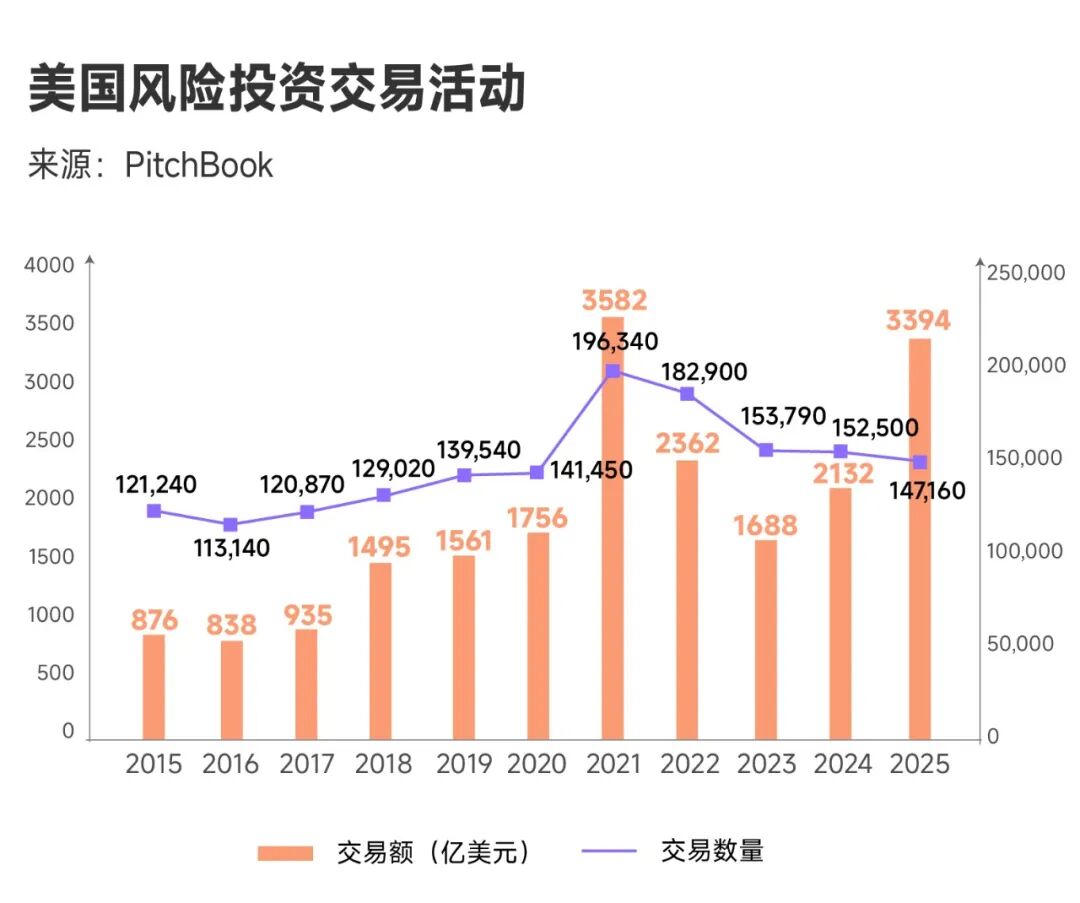
Investors are still active but more cautious in their choices, concentrating capital on a small number of large investment projects. The total annual investment in the AI field still reached $339.4 billion, setting the second-highest record in history.
More than half of the transaction scale was concentrated in a few late-stage financing projects. Even though the number of transactions across the industry decreased, the scale of late-stage financing transactions still increased by 45% year-on-year.
This trend has created a barbell-shaped market structure: transactions are active in the early financing field, the financing scale of top companies is huge, while the middle market is more quiet and rational.
This market pattern has also led to an increasing gap in the returns of venture capital projects. Leading companies in each sector - especially those with differentiated AI technology capabilities - have obtained valuation premiums and even set pricing benchmarks for the entire financing stage. Meanwhile, many companies completed financing at flat or slightly increased valuations.
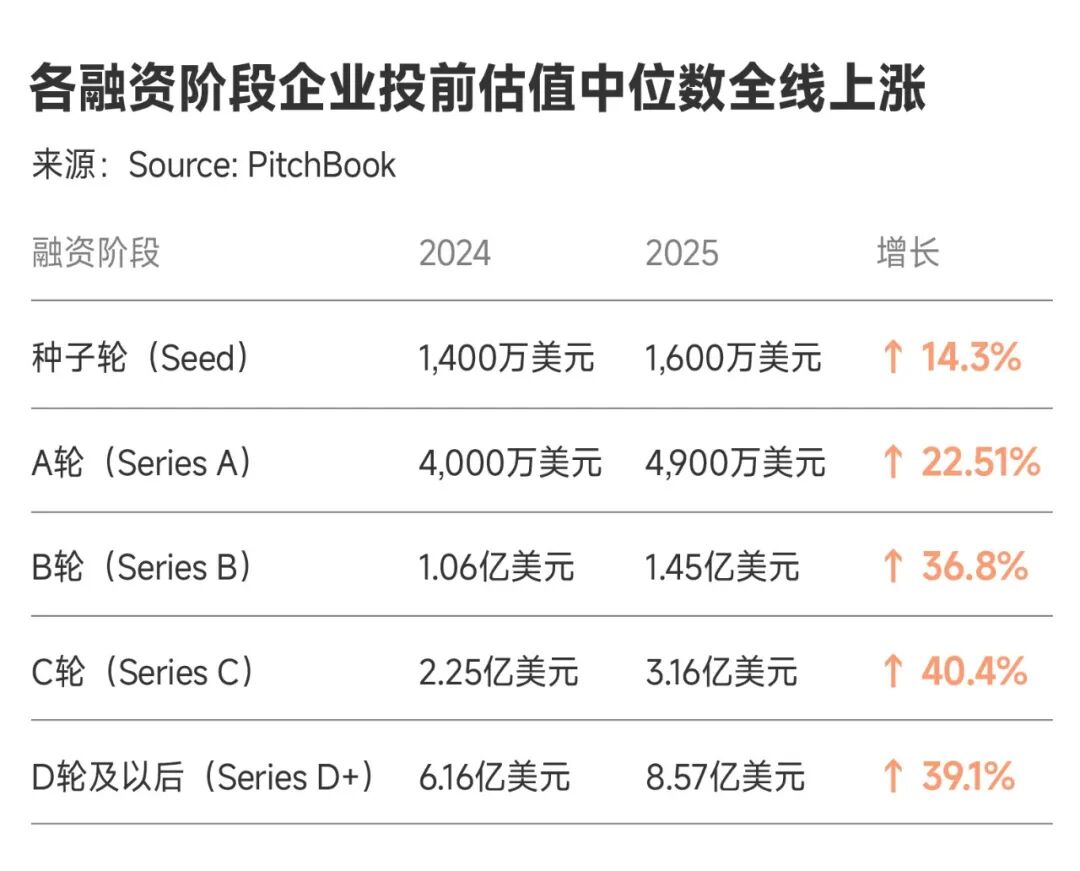
Even though capital is highly concentrated in a few ultra-large financing projects, such as OpenAI's $40 billion financing and Anthropic's $30 billion financing, the median valuations of companies at all financing stages have increased.
After years of doubts about the commercialization of AI, 2025 finally delivered a convincing answer. Driven by a product-driven growth model and the deep integration of AI into daily work processes, AI-native startups such as Cursor, Lovable, StackBlitz, and Emergent achieved annual recurring revenues of over $10 million within 18 months.
Who Holds the Power?
Although the overall performance of the venture capital ecosystem has improved, fundraising remains difficult for many fund managers.
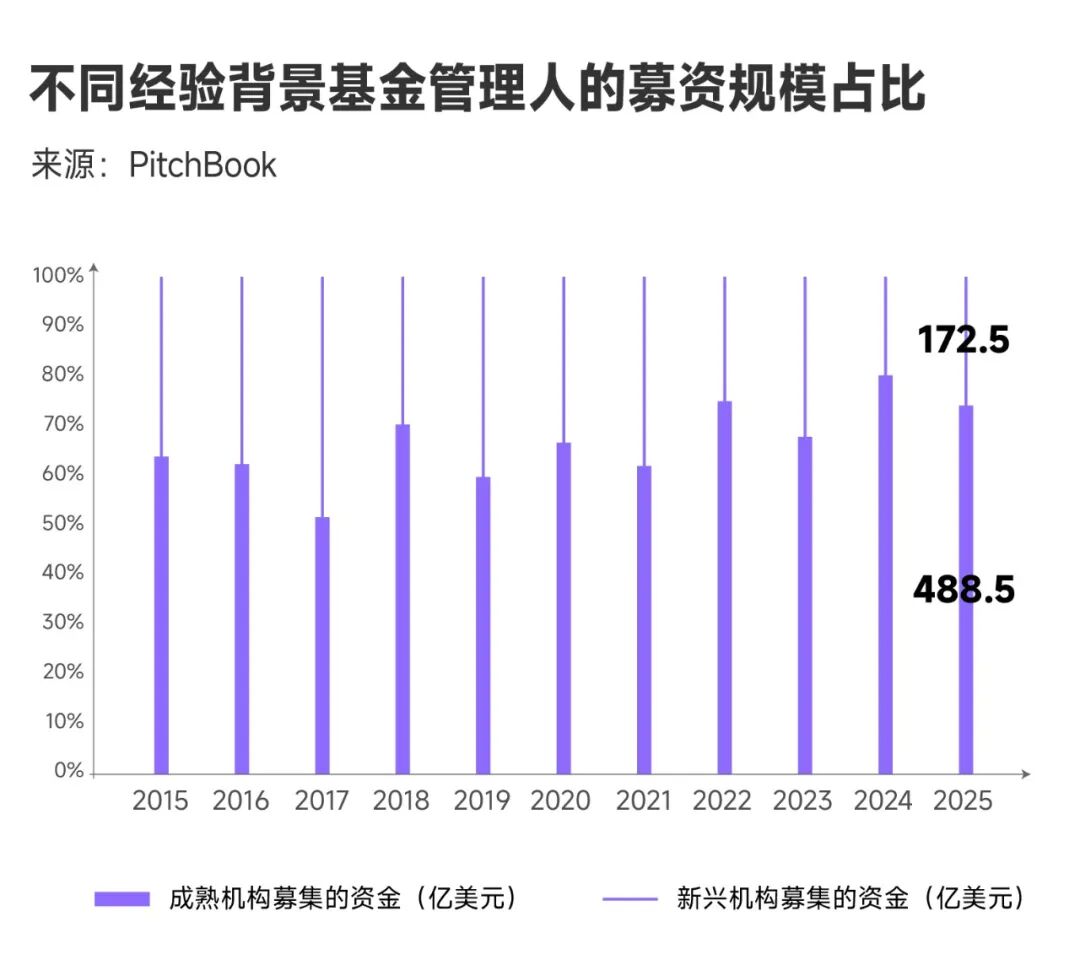
After the industry frenzy in 2021, limited partners remain cautious and exercise strict control over capital. US venture capital institutions raised a total of $66.1 billion through 537 funds, the lowest level in more than a decade.
The tight liquidity and accumulated capital commitments have triggered an obvious trend of "chasing high-quality assets," and limited partners are increasingly inclined to invest in experienced fund managers with excellent performance.
This trend has created a polarization in the fundraising market: established institutions with rich experience can still raise funds continuously, while new fund managers face longer fundraising cycles and greater difficulties.
Today, although funds with a scale of over $500 million account for only a small proportion of recently successfully raised funds, they control more than half of the capital to be invested in the venture capital field.
The high concentration of capital in a few investors also enables these institutions to conduct larger-scale and more confident investments, especially in capital-intensive fields such as AI infrastructure and deep technology.
Capital scarcity is not a new phenomenon. The prominent feature in 2025 is that investors' caution persists, and there is a structural shift in capital allocation concentration in the industry.
Liquidity Always Finds an Outlet
After years of dormancy, liquidity is starting to return.
In 2025, there were a total of 1,635 venture capital exit transactions, with a total value of $297.6 billion, almost doubling from the previous year and making it one of the strongest exit years in the past decade.
The IPO market also began to recover, with a total of 48 venture capital-backed companies going public, including 17 unicorn enterprises, a significant increase from the past two years.
However, many leading non-listed companies - including SpaceX, Stripe, and Databricks - still choose not to conduct public market transactions.
Instead, the secondary market has risen rapidly, creating an exit value of $94.9 billion, almost equivalent to the total value created by IPOs and mergers and acquisitions. Secondary transactions and share repurchase offers have become important liquidity tools, especially for mid- and late-stage startups.
Since private capital is still abundant, many iconic technology companies are not in a hurry to go public, especially in the context of uneven recent IPO performance. More and more private financings allow early investors and employees to obtain liquidity without going public.
Most merger and acquisition activities occur in the early stage of the venture capital cycle, mainly aiming to acquire talent and expand product capabilities rather than to complete large-scale transactions. However, there are exceptions, such as major transactions like SpaceX's acquisition of xAI, Meta's investment in Scale AI, and Google's acquisition of Wiz.
The structure of acquirers has also changed. Venture capital-backed companies account for 38.4% of merger and acquisition transactions, filling the gap of buyers when listed companies remain cautious due to regulatory uncertainties.
These trends are jointly stabilizing the venture capital exit cycle, providing founders with greater flexibility to continue expanding their business scale without going public.
However, most of the value in the venture capital market is still concentrated in a few large non-listed companies.
Venture Capital: The Engine of Value Creation
Venture capital, once regarded as a niche asset class, is now playing a core role in shaping the global economic landscape.
Companies like Stripe, SpaceX, and Databricks show that with sufficient private capital and a developing secondary market, companies that define the industry landscape can remain non-listed for a longer time while achieving scale development.