Li Auto "Stalls": The Dividend of Extended-Range Technology Peaks, and AI Can't Solve Immediate Problems
「Key Points」 Where is Li Auto headed when Li Xiang starts talking about AI?
Amid the differentiation of the "new forces" in the car - making industry, Li Auto has reached its darkest hour.
In the new - energy vehicle market in 2025, good news came frequently. "New forces" such as Leapmotor, Xiaomi, and XPeng achieved triple - digit high - speed growth in sales. Leapmotor and Xiaomi successively achieved quarterly profits, and the losses of XPeng and NIO narrowed significantly. However, Li Auto, which had been profitable for 11 consecutive quarters, fell behind against the trend and became an "opposite traveler" in the industry.
In the first two months of 2026, Li Auto's decline has not been reversed. On one hand, there is the upward dividend of the industry as a whole, and on the other hand, its own performance is under continuous pressure. How can Li Auto break the deadlock?
Double Blow to Sales and Revenue
Although Li Auto had signaled the decline in revenue in the fourth quarter of last year in advance, the decline still exceeded market expectations.
In the fourth quarter of 2025, Li Auto's vehicle sales revenue was 27.3 billion yuan, a year - on - year decline of 36.1%. The full - year vehicle sales revenue in 2025 was 106.7 billion yuan, a year - on - year decrease of 23%.
The decline in sales revenue is not only affected by the decrease in sales volume but also related to the decrease in the price per vehicle. In the fourth quarter, the average price per vehicle was 250,000 yuan, a decrease of 27,000 yuan compared with the previous quarter. On the one hand, the increasing sales proportion of the more cost - effective i6 had a crowding - out effect on high - priced models such as MEGA and i8, causing the model structure of Li Auto to continuously shift downwards.
On the other hand, the Li series of extended - range vehicles of Li Auto were at the replacement node, and the discount on the old - model Li series increased, pulling down the average price per vehicle. A policy posted by a Li Auto salesperson on the WeChat Moments showed that in December last year, after adding insurance subsidies, cash discounts, and national subsidies, the Li series could have a maximum discount of more than 70,000 yuan.
Affected by this, Li Auto's gross profit margin from vehicle sales in the fourth quarter was 16.8%, a decline of 3 percentage points compared with the 19.8% gross profit margin in the third quarter after excluding the impact of the MEGA recall.
From the perspective of profit indicators, Li Auto's net profit for the whole year of 2025 was about 1.1 billion yuan, but this was partly due to substantial financial management income, with the annual interest income reaching 1.9 billion yuan. As of the end of last year, Li Auto had a cash reserve of up to 101.2 billion yuan on its books, and its cash flow and risk - resistance ability still ranked among the top in the industry. In the fourth quarter, Li Auto's interest income was 430 million yuan, while the net profit in the same period was only about 20 million yuan. If this part of the financial income is deducted, the actual operating profit should be a loss of about 400 million yuan.
Entering 2026, Li Auto has not reversed the decline in sales volume. While the sales volume and net profit of competitors such as NIO and Xiaomi have both improved, Li Auto shows a situation of "declining sales volume and pressure on profitability". When the net profit approaches the break - even point, the deep - seated concerns about Li Auto's business model are also exposed.
Narrowing Extended - Range Dividend and "Internal Struggle" in Pure - Electric Transition
Li Auto's dilemma is essentially the double squeeze of the peak of the "extended - range dividend" and the pain of the "pure - electric transition".
Looking back at the entrepreneurial experience of Li Auto's founder Li Xiang, he has always been known for understanding products. Against the backdrop of being not favored by the industry, Li Auto became the leader of the "new forces" for a while and was the first to achieve profitability by relying on the extended - range route and the concept of "refrigerator, color TV, and big sofa". However, the moat of this successful path is not deep and is facing multiple challenges.
Take the extended - range vehicles that Li Auto started with as an example. Due to the relatively low technical threshold, its market share has been continuously eroded by brands such as Wenjie and Leapmotor. For example, Wenjie is supported by Huawei's intelligent driving technology at a similar price, while Leapmotor is almost half as cheap with the same configuration, diverting a large number of price - sensitive users.
This forces Li Auto to accelerate the iteration of its extended - range products. In the earnings report, Li Xiang said that the new L9 will be launched in the second quarter, with comprehensive upgrades in power, intelligent driving, chassis, and body size. According to industry media such as Dongchedi, the L9 will streamline the model versions, and the price will be lowered to the price range of the original L8, that is, the 300,000 - yuan + range.
The strategy of price reduction and increased configuration + standard equipment being fully equipped is also the current common strategy of competitors such as NIO, Great Wall, and Xiaomi. However, Li Auto's "price war" may have come a bit late. After competitors successively offered significant discounts, Li Auto's response seemed to be half a step behind, and it significantly relaxed terminal discounts in the second half of 2025, missing the critical window to stabilize market share.
The combination of price - cutting and configuration - stacking is also used by Li Auto in its pure - electric models. Previously, due to the failure of MEGA and i8, Li Auto's pure - electric transition has been difficult. Among them, the i8 failed to shoulder the expected sales volume. A car owner who recently purchased an additional 400,000 - yuan - level pure - electric SUV told "Bao Bian" that the i8 has a good driving experience, close to that of a sedan. However, due to its special shape, the space as a six - seat car is a bit cramped, and the price is much more expensive than the five - seat i6. This makes the i8 lack competitiveness when facing external competitors and the i6.
Some new - energy vehicle observers expect that Li Auto may launch a small - battery version of the i8 in the third quarter of this year to boost sales through price reduction. Perhaps to dispel consumers' concerns about the "small battery", Li Auto said in a conference call that starting from 2026, all Li Auto vehicles will only be equipped with batteries from two brands: Li Auto and CATL, and a unified battery standard will be implemented.
However, after the price of pure - electric models is reduced, it may form a "self - competition" with the Li series of extended - range vehicles and continue to drag down the gross profit margin of vehicle sales.
What Can Li Auto Rely on to Counterattack?
Li Auto's counterattack is centered around two main lines: "sales - end transformation" and "AI learning".
Due to the decline in performance in 2025, there have been frequent rumors about Li Auto closing stores and optimizing personnel. At the earnings conference call, Ma Donghui, the president of Li Auto, said that the online rumor that "Li Auto will close 100 stores" is not true, but Li Auto will adjust and optimize some inefficient stores that cannot support the sales target and open new stores in top - tier shopping malls and high - quality auto cities.
Since March 1 this year, Li Auto has implemented a "partner" mechanism in its stores. While adhering to direct sales, it stimulates the vitality of stores by delegating operational decision - making power and profit - sharing to store managers, rather than simply regarding store employees as "workers" of the brand. In Li Auto's view, the effective management of the direct - sales system will form a long - term competitive advantage.
All along, Li Auto has been driven by the logic of "product blockbusters" for growth. After the setback in pure - electric vehicles, can Li Auto's extreme pursuit of product definition still be its core competitive advantage? Li Xiang admitted at the earnings conference call that in the mid - to - high - end new - energy market above 200,000 yuan in 2026, the number of new cars is even equivalent to the sum of the past three years, but the increase in the market cake is limited, so the competition will be more intense.
For this reason, Li Auto has significantly lowered its sales target for 2026, with the year - on - year growth target being only 20%, which is only half of the target growth rate in 2025. Horizontally compared, this figure is far lower than the growth targets of about 75% for Leapmotor, more than 40% for NIO, and more than 30% for Xiaomi.
After the setback in extended - range vehicle sales, whether the i6 can shoulder the sales volume is crucial. In February, the top three best - selling new - energy vehicles were Geely Xingyuan, Tesla Model Y, and Xiaomi YU 7, with sales volumes all exceeding 20,000 units. The i6 ranked fourth with 16,000 units. Li Auto has set a subsequent sales target of more than 20,000 units per month for the i6, which will inevitably engage in close - range competition with the above - mentioned blockbuster models. The result will verify Li Auto's appeal in the pure - electric market.
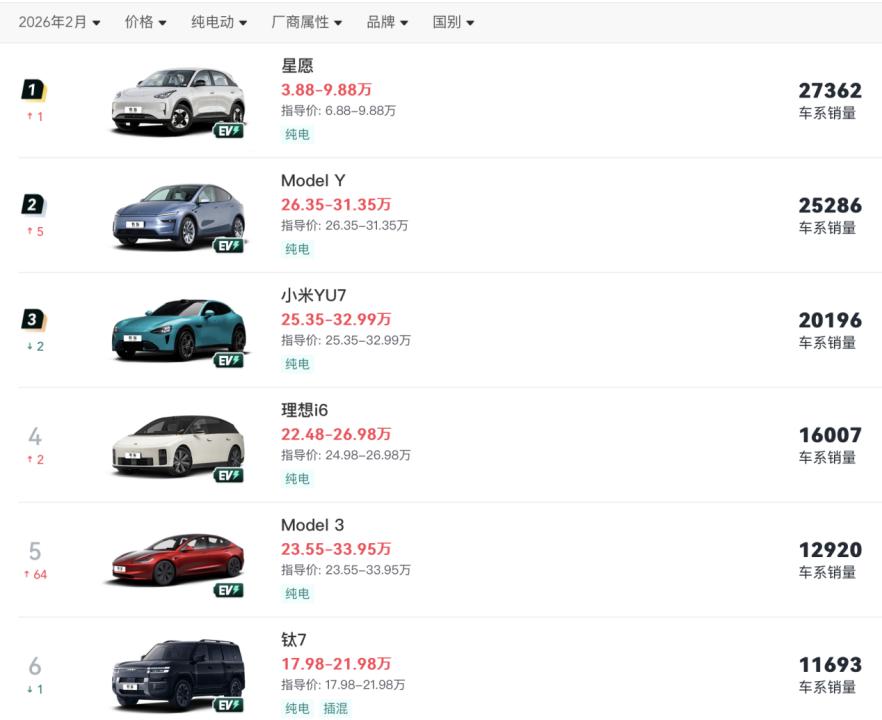
New - energy vehicle sales in February
With the advent of the AI era, Li Auto is forging a new "training wheel" - AI. According to a report from "21st Century Business Herald", in January this year, Li Xiang temporarily held an online all - staff meeting. In the two - hour meeting, the focus was on AI, and he said that "we will definitely make humanoid robots". However, many employees said that they "didn't understand", indicating that before the general trend of AI, there is no synergy within the company, and the strategic planning and implementation lack a clear path.
In 2025, Li Auto's R & D investment reached 11.3 billion yuan, of which AI - related investment accounted for 50%, and this investment strategy continued in 2026. Li Tie, the CFO of Li Auto, said that in the R & D expenses of about 12 billion yuan in 2026, AI - related R & D investment accounts for about half, including self - developed chip development, computing power, and intelligent assisted driving.
Electric vehicles are generally recognized as one of the best carriers of AI + robots, where AI is like the brain, manifested in intelligent driving, intelligent cockpits, etc. Currently, consumers generally believe that Tesla, Huawei, and even XPeng have more advantages in intelligent driving experience. If Li Auto wants to overtake on a curve, it cannot do without high - intensity R & D investment.
Different from XPeng's release of humanoid robots and Xiaomi's focus on large models, which are "pure - blooded" robot + AI, Li Auto's AI is not an independent product but is highly integrated with cars. This shows Li Auto's more pragmatic side. "AI + robot" in the pure - blooded sense is a long - term future and cannot be the current growth point. Instead, it is better to focus AI R & D on the implementation of intelligent driving to boost the sales of existing models.
In fact, Li Auto's experience is not an isolated case but a common transformation dilemma faced by the "new forces". When new - energy vehicle companies shift from "product - driven" to "technology - driven", they will inevitably experience the pain of transformation. The key to breaking the deadlock may lie in hard technologies such as ultra - fast charging, intelligent driving, and chips, as well as new infrastructure.
This article is from the WeChat official account “Bao Bian” (ID: baobiannews), author: Chen Fashan, published by 36Kr with authorization.