Leapmotor: Can the "God Car" for Overseas Markets Really "Lead" the New Forces with a Million Sales?
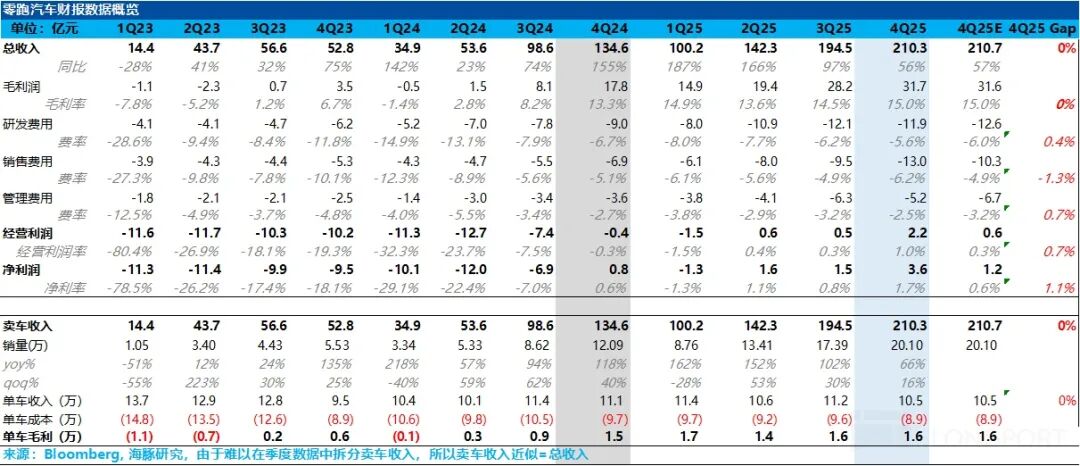
Leapmotor (09863.HK) released its financial report for the fourth quarter of 2025 after the Hong Kong stock market closed on March 16th, Beijing time. This financial report still shows good performance, demonstrating Leapmotor's consistent and stable operational capabilities. Specifically:
1. The revenue is basically in line with expectations, and the average selling price of vehicles is still declining quarter-on-quarter due to the downward shift in the vehicle model structure and promotions: The revenue in this quarter was 21 billion yuan, a year-on-year increase of 56%, basically in line with market expectations. However, the average selling price of vehicles is still declining quarter-on-quarter. This is mainly because Leapmotor increased its promotion efforts in the fourth quarter, and the vehicle model structure continued to shift downward. The proportion of the lower-priced B series + T series in sales is still increasing.
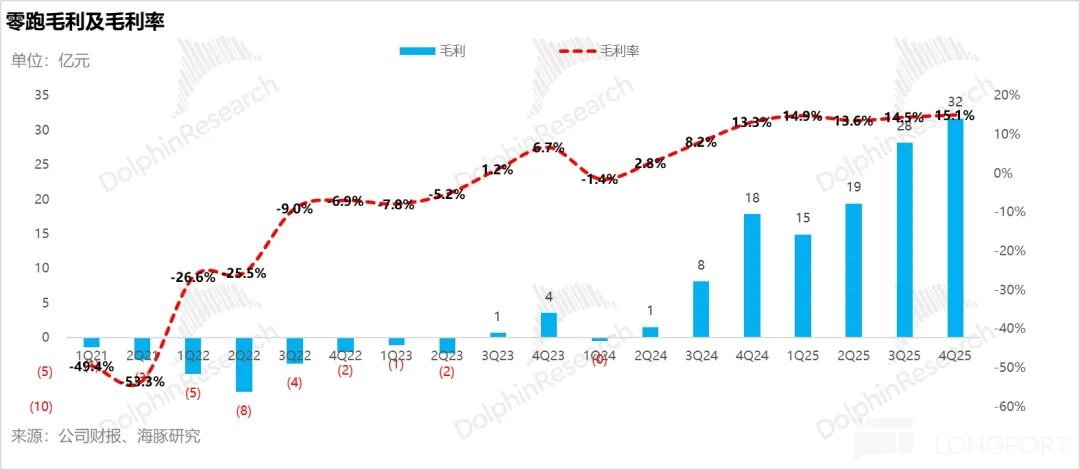
2. The gross profit margin is still increasing quarter-on-quarter: The management previously indicated that in the fourth quarter, due to the increased quarter-on-quarter promotion efforts offsetting the increase in gross profit margin brought about by economies of scale, the gross profit margin would remain flat quarter-on-quarter. However, the gross profit margin in this quarter still increased slightly by 0.5 percentage points to 15% quarter-on-quarter.
Dolphin Jun believes that this is mainly due to a. Leapmotor's continuous cost reduction ability (through platformization and self-developed and self-produced components); b. The release of economies of scale; c. The increase in the gross profit margin brought about by other revenues in the fourth quarter (for example, due to the acceleration of overseas expansion, the recognition of carbon credit revenues in the fourth quarter is expected to double compared to the previous quarter)
3. The company is increasing investment in sales expenses, but is being more cautious with R & D and management expenses: In the fourth quarter, Leapmotor's sales expenses were 1.3 billion yuan, with a relatively high quarter-on-quarter increase (an increase of 350 million yuan). This is mainly due to the increased advertising investment and the simultaneous expansion of the sales network. However, the R & D and management expenses were reasonably controlled and even decreased quarter-on-quarter. Despite the need to invest in R & D in multiple areas such as intelligentization, deepening of self-developed components, and development of new models in the D/A series, the absolute amount still decreased slightly by 20 million yuan quarter-on-quarter to 1.19 billion yuan, indicating that the R & D efficiency is still relatively high.
4. Both the operating profit and net profit are still increasing quarter-on-quarter: The operating profit in this quarter was 220 million yuan, continuing to increase by 170 million yuan quarter-on-quarter. Although the company is still increasing investment in sales expenses, the R & D and management expenses are reasonably controlled, and the gross profit margin is still increasing quarter-on-quarter. The leverage effect brought about by the increase in sales volume is released, and the investment income from the joint venture company is increasing. Finally, the bottom-line net profit was 360 million yuan, exceeding market expectations by 120 million yuan.
Dolphin Jun's view:
Overall, Leapmotor delivered a good and expected performance in the fourth quarter. Although the management previously indicated that in the fourth quarter, due to the increased quarter-on-quarter promotion efforts offsetting the increase in gross profit margin brought about by economies of scale, the gross profit margin would remain flat quarter-on-quarter, the actual gross profit margin still increased quarter-on-quarter, which still reflects Leapmotor's consistent strong cost reduction ability and the increased contribution of carbon credit revenues brought about by the acceleration of overseas expansion.
What is more important than this financial report performance is the market's expectations for Leapmotor in 2026:
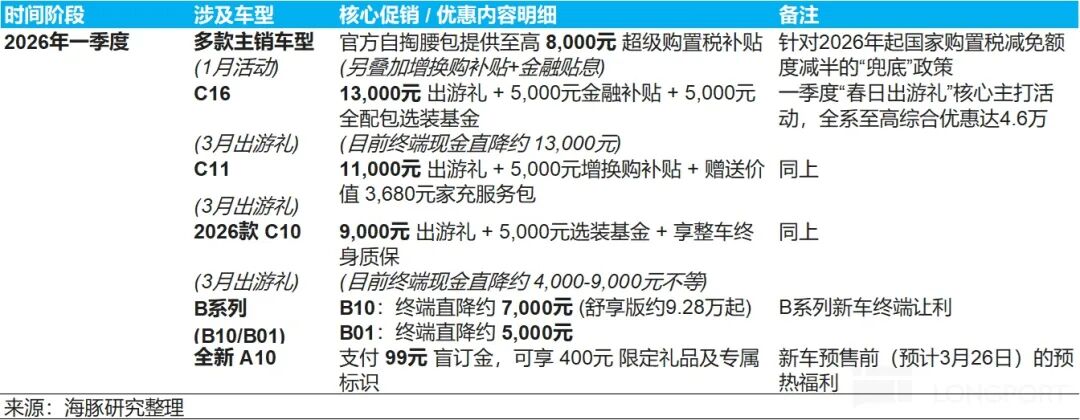
① In the first quarter of 2026, the vehicle model structure will continue to shift downward, and with the increase in promotional discounts, Leapmotor's gross profit margin in the first quarter is expected to continue to be under pressure:
In the first quarter, Leapmotor's sales volume from January to February was only 60,000 vehicles (with an average monthly sales volume of only 30,000 vehicles), a significant decline compared to the average monthly sales volume of 67,000 vehicles in the fourth quarter of last year, and only a 19% year-on-year increase. This is mainly due to
a. Before the launch of the "A10" SUV in the first quarter of 2026, dealers reduced their inventories in advance;
b. Before the implementation of the new 5% vehicle purchase tax policy for new energy vehicles, the demand in the first quarter of 2026 was advanced to the fourth quarter of 2025;
c. The government reduced the subsidy for trade-in programs. The revised 2026 automobile trade-in subsidy plan changed from the policy of unified subsidy amounts for different price segments in 2025 to a proportional subsidy, resulting in a decrease in the subsidy support for low- and mid-range models below 150,000 yuan.
In addition, although the trade-in policy took effect on January 1, 2026, the implementation pace of local government subsidies varied (for example, Hubei Province on January 15th and Jilin Province on January 17th), causing some potential consumers to postpone their car purchase plans. Therefore, the company also increased its overall promotion efforts and provided a purchase tax guarantee policy to boost sales in the first quarter.
The proportion of the low-priced small car T03, which accounts for a relatively high proportion in Leapmotor's vehicle model structure, continued to increase (from 11% in the fourth quarter to 27% in January - February 2026), which will also continue to lower the average selling price per vehicle. Coupled with the weakening of economies of scale due to the quarter-on-quarter decline in sales volume, Dolphin Jun expects that Leapmotor's gross profit margin in the first quarter will continue to be under pressure.
However, the increase in the proportion of overseas sales (the overseas sales volume in January - February 2026 was 24,000 vehicles, and the proportion continued to increase from 14.6% in the fourth quarter of 2025 to 40%) can alleviate the downward pressure on the gross profit margin to a certain extent.
② But after getting through the off-season in the first quarter, looking at the whole year of 2026:
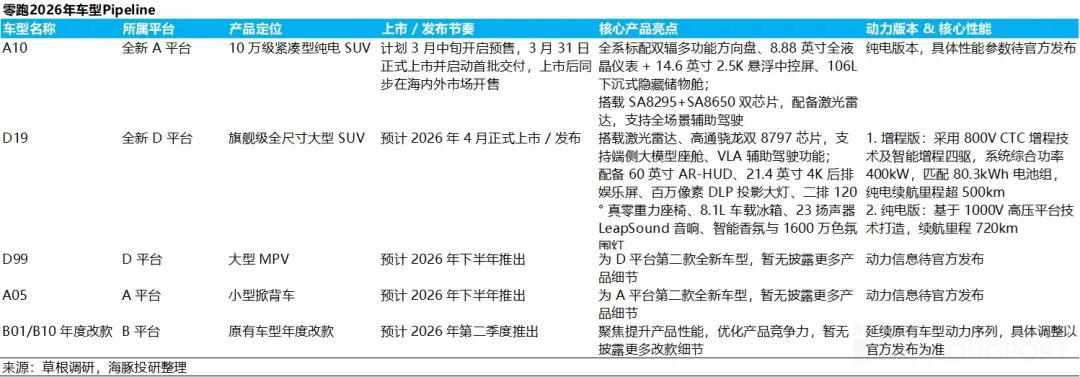
Leapmotor is about to launch 4 new models + 2 facelifted models in 2026 to further enrich its product portfolio:
a. The higher-end D series (models above 200,000 yuan): This platform is the key for Leapmotor to upgrade its brand positioning and vehicle model structure. It will be equipped with six core technologies, such as a large battery for the extended-range version, a 1000V high-voltage platform, and a 1280TOPS high-computing-power intelligent driving chip. The first model based on this platform, the "D19" full-size SUV, will be launched in April 2026, and the "D99" large MPV will be launched later.
b. The volume-selling series (A series): The "A10" compact SUV (launched in March) and the "A05" small hatchback will be launched, targeting the 100,000-yuan market and taking on the core task of expanding sales volume.
c. Facelifted B series: It is expected that the annual facelift of the B01/B10 models will be launched in the second quarter of 2026;
The management has indicated that relying on a strong new product plan, the company's annual sales target for 2026 is 1 million vehicles (including 100,000 - 150,000 vehicles for overseas sales and 850,000 - 900,000 vehicles for domestic sales). And if the annual sales volume in 2026 reaches 1 million vehicles, the company's net profit is expected to reach 5 billion yuan (with a net profit margin of nearly 5%).
The main divergence in the market regarding Leapmotor still lies in doubts about whether Leapmotor can achieve nearly double the sales growth. The main concerns are concentrated in three points:
a. Tightening policy environment: In 2026, the purchase tax for new energy vehicles will be restored to 5%, and the trade-in subsidy will be calculated based on the vehicle price (resulting in an actual decrease in the subsidy for models below 150,000 yuan), which may suppress the overall market demand, especially impacting Leapmotor's main price range.
b. Deteriorating competitive landscape: In 2026, Leapmotor's core battlefield (100,000 - 200,000 yuan) will see the new vehicle cycles of many automakers such as Geely, Great Wall, and XPeng. The market competition is about to enter the deep water area of "zero-sum game", and the marginal dividends of oil-to-electric substitution and self-owned brand substitution are weakening.
c. Extremely high growth base: Jumping from about 600,000 vehicles in 2025 to a total target of 1 million - 1.1 million vehicles means achieving an extremely high growth rate of nearly double (a year-on-year increase of 68% - 84%, against the background of the overall growth rate of the new energy vehicle industry slowing down to about 5% - 15% year-on-year), which is extremely difficult.
Dolphin Jun believes that although achieving nearly double sales growth faces challenges, Leapmotor has unique advantages at the structural level, which may bring unexpected flexibility:
a. High certainty of overseas expansion among new forces:
Among new forces, Leapmotor has a high certainty of export. Due to its cooperation with Stellantis in terms of channel and brand strength, it continued to accelerate the expansion of overseas channels in the fourth quarter. As of the end of 2025, its overseas sales network had rapidly expanded to about 900, of which nearly 90% (about 800) were located in Europe. The B platform and A platform models are more suitable for the European demand for low-priced small cars, so the certainty of overseas expansion is relatively high.
Capacity layout is also advancing simultaneously: The European CKD factory is planned to start production in October 2026 (the B10 will be the first to be produced), and the supporting battery pack factory will also start mass production in July of the same year; the Malaysian KD factory is progressing smoothly, and the company is evaluating the possibility of expanding production in South America using Stellantis' existing facilities. A complete "channel + capacity + supply chain" localization system has laid a solid foundation for achieving the overseas sales target of 100,000 - 150,000 vehicles in 2026.
Currently, Leapmotor's overseas sales volume from January to February 2026 was 24,000 vehicles, which has completed 16% - 24% of the annual overseas sales target. It is expected that the annual overseas sales target of 100,000 - 150,000 vehicles can be easily achieved.
b. Cost control ability brought by vertical integration gives an advantage in the context of continuous industry cost increases:
Currently, Leapmotor's self-developed proportion covers 65% of the vehicle's cost structure, and it has in-depth control over key areas such as the core three-electric system (excluding the battery cell), intelligent driving, and intelligent cockpit.
According to the plan, the company aims to increase the self-developed and self-supplied proportion to 80% in 2026 and plans to include the battery cell in the self-developed system. This will further reduce the dependence on external suppliers, enhance cost control ability. The in-depth vertical integration ability is also the core reason for continuously exceeding market expectations in cost reduction and being able to launch high-cost-performance models, giving an advantage in the context of continuous industry cost increases.
c. Recognition of carbon credit revenues:
Due to the time window of carbon emission regulations in Europe from 2025 - 2027, the electric vehicles sold by Leapmotor in Europe can generate carbon credit revenues (an agreement was signed in June 2025). This part of the revenue is basically in a pure profit model (referring to Tesla), which increases Leapmotor's revenue and gross profit margin level (with a transaction cap of 1.5 billion yuan).
d. The possibility of Leapmotor opening a technology licensing revenue model:
Currently, Leapmotor's technology licensing is mainly with FAW. If Leapmotor can continuously open a model of exporting electronic architecture licensing to automakers and turn technology licensing revenue into a regular income***, a more detailed value analysis has been published in the article of the same name in the "Dynamic - In - depth (Research)" section of the Changqiao App.
The following is a detailed analysis
I. The gross profit margin increased slightly quarter-on-quarter in the fourth quarter
After Leapmotor's performance was announced, since the vehicle sales volume was already known, what investors were most concerned about was the gross profit margin of the automotive business. The management previously indicated that the gross profit margin in the fourth quarter would remain basically flat quarter-on-quarter because the increased quarter-on-quarter promotion efforts offset the increase in gross profit margin brought about by economies of scale.
In fact, Leapmotor's gross profit margin in this quarter was 15%, a slight increase of 0.5 percentage points quarter-on-quarter, slightly higher than the management's guidance. This is mainly due to the company's continuous strong cost reduction ability and the increasing recognition of high-margin carbon credit revenues brought about by the high growth of overseas sales volume in the fourth quarter (it is expected to be over 500 million yuan in Q4 compared to 250 million yuan in Q3).
PS: Since Leapmotor's revenue is mainly divided into ① automotive business revenue; ② service and other sales revenues, but Leapmotor does not split the data of these two businesses on a quarterly basis, so Dolphin Jun analyzes it from the perspective of total revenue.
From the perspective of per-vehicle economics (including service and other business revenues):
a) The average price per vehicle is 105,000 yuan, continuing to decline compared to the previous quarter:
The average price per vehicle in the fourth quarter was 105,000 yuan, a decrease of 7,000 yuan compared to the previous quarter. Although there was higher recognition of carbon credit revenues in this quarter, the actual selling price per vehicle still declined quarter-on-quarter, mainly due to the continued downward shift in the vehicle model structure and the impact of promotional discounts.
① Increased promotional discounts:
In the fourth quarter, the national subsidies in many local areas were phased out ahead of schedule. Since the national subsidy in 2025 was a unified amount, the subsidy ratio for low-priced models was relatively higher, and the phase-out had a more significant impact on the low-priced vehicle market.
In response to the demand pressure, Le