Elon Musk uses AI to sell products, while this Chinese company uses AI to manage 180,000 shelves: Unmanned retail enters the "Agent Era"
In 2026, the AI industry stands at a historic watershed.
Not long ago, Google predicted in its "AI Agent Trends 2026" report that artificial intelligence is undergoing a crucial leap from a "tool that only answers questions" to a "capable assistant" that can independently break down tasks and work across systems.
In this global AI wave, a highly symbolic detail comes from Elon Musk: At the Grok - 4 launch event in April 2025 and the subsequent Vending Bench test, Musk proved with facts that AI can not only chat but also sell goods. Taking the simulated operation test of the Vending - Bench vending machine as an example, Musk let AI fully manage a vending machine, including product selection, pricing, restocking, supplier negotiation, and cash - flow management, demonstrating Grok 4's long - term business decision - making and sustainable profitability, and teasing its large - scale potential. The vending machine driven by Grok - 4 even outperformed GPT - 5 in revenue, making the industry exclaim that "the end of AGI is selling potato chips."
At this time, in the highly competitive unmanned retail circle in China, Musk's vision of "AI taking over a million vending machines" is becoming a reality: Feng E Zushi, an intelligent retail operator, has used AI agents to take over 180,000 smart cabinets.
While most enterprises began to embrace large language models in 2024 and 2025, Feng E Zushi planted the seed of algorithms as early as the end of 2021.
In the initial stage, Feng E Zushi faced numerous difficulties - entering the industry late, unable to engage in the rent price war, and unable to make money in low - traffic scenarios. At that time, AI was also immature. However, the management team with a background of mathematics and algorithm Ph.D.s made a bold judgment: Fake AI would eventually turn into real AI, so they set technology as the core development strategy for the company in the next few years.
In the following four years, with a research and development investment of nearly 250 million and an algorithm team of more than 100 people composed of talents from major Internet companies, based on the extraction of large - scale commercial experience from over 100,000 smart cabinets, a comprehensive agent system called "FLOW Pilot" was born.
Different from the scattered AI applications in the industry, the "FLOW Pilot" comprehensive agent system created by Feng E Zushi consists of four major agents, covering the entire link of sales, product operation, supply - chain planning, and fulfillment execution. Zhu Tao, the COO of Feng E Zushi, gave an analogy: This system is like "Level 4 autonomous driving" in the field of unmanned retail management.
Just as Tesla trains its autonomous driving system with hundreds of millions of miles of road - test data, Feng E Zushi's FLOW Pilot makes hundreds of millions of decisions on operations every day based on 180,000 shelves, while the number of times of manual intervention is only maintained at about 4,000, and intervention is only made in a small number of cases where customers actively apply for adjustments. Zhu Tao said, "This means that its automation level is close to Level 4 autonomous driving."
Zhu Tao defines 2026 as the first year of the transformation of AI from an "assistant" to an "employee." In the unmanned retail industry, when your "employee" is a system that makes hundreds of millions of decisions every day and only requires a few thousand times of intervention, traditional unmanned retail is undergoing a major change.
Recently, we had a conversation with Zhu Tao, the COO of Feng E Zushi, about how to turn AI - taking - over vending machines into a large - scale business.
The following is a conversation (edited) between 36Kr and Zhu Tao, the COO of Feng E Zushi:
A 250 - million - yuan AI bet over four years
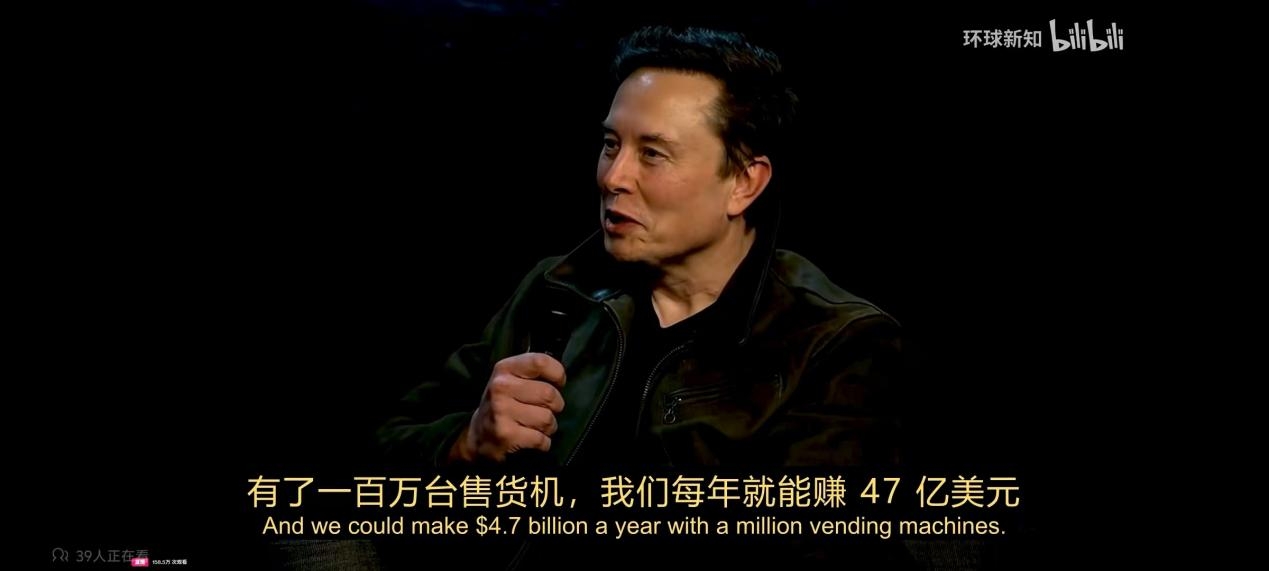
36Kr: Elon Musk said at the Grok4 launch event that he wanted to use AI to directly manage one million vending machines. What was your feeling when you saw this news?
Zhu Tao: We were very excited. The direction of Musk's simulation test was exactly the direction of our technical research at that time, which proved that our investment direction in the past three years was correct. At that time, many peers didn't understand why we had to develop technology. Musk's prediction gave our technical team a "reassurance," making us more confident in the commercial potential of AI in retail.
Source: Bilibili
36Kr: When did Feng E Zushi start investing in the AI field, and what were the specific investments?
Zhu Tao: After completing a 300 - million - yuan Series A financing led by SoftBank at the end of 2021, we determined the development strategy of the technical route and began to firmly increase investment in the AI field from then on. From 2022 to 2025, an additional investment of nearly 250 million was made in the R & D sector.
In terms of talent, we established a R & D team mainly composed of people from Internet companies such as Meituan, ByteDance, and Tencent. In 2022, the team size expanded from 40 to about 130 people, and it currently remains at the level of 120 - 130 people, which is quite rare in the unmanned retail industry.
36Kr: In the past two years, everyone has been talking about the first year of AI and the technological explosion. But if we go back to 2021, AI had not become an industry consensus like it is now. What factors prompted Feng E Zushi to be an "early adopter" at that time?
Zhu Tao: In the domestic self - service retail industry, Feng E Zushi introduced smart cabinets with AI dynamic video recognition technology early on and achieved large - scale application in 2019. At that time, the mainstream technical route in the industry still preferred RFID radio - frequency identification, which had high accuracy but was also expensive, and traditional mechanical cargo lanes.
We also came into contact with smart cabinets based on AI technology early on. Although the recognition technology of smart cabinets was still in the state of "fake AI" at that time, most of the recognition was done manually in the background. Even so, we still adopted these smart cabinets on a large scale, firmly believing that the development of AI technology could truly realize AI recognition. Later, AI recognition was really achieved, and both the equipment cost and the consumer experience were significantly optimized. As an operator that used smart cabinets on a large scale in the industry, we enjoyed the dividends of this wave of AI. It was also from this time that we laid a solid foundation for the layout of AI.
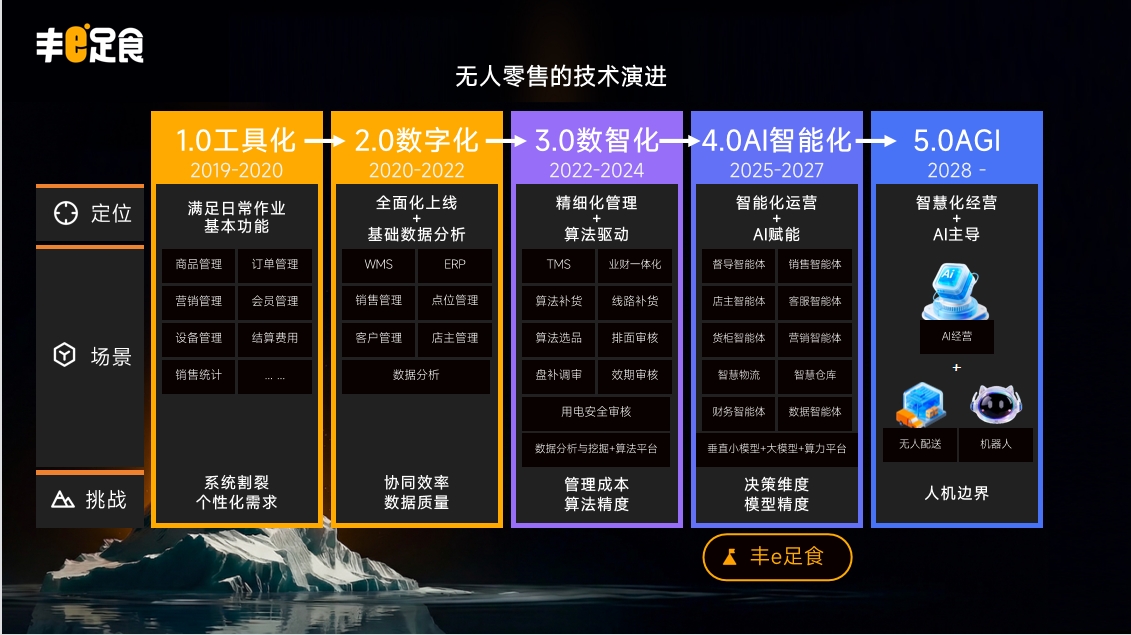
Next, we predicted that for the company to achieve large - scale growth, various scenarios would emerge in the future, and consumers' needs would become more and more diverse. The increase in points would inevitably lead to a continuous increase in the cost of manual management, requiring a large number of management personnel, which was obviously not a long - term solution. So we transferred the upgrade idea and model of AI cabinets to the entire company's business development. Although there was no mature large language model at that time, technologies such as image recognition, video recognition, and deep learning had shown signs of development. Combined with my background as a Ph.D. in algorithm development from an Internet company, I, the company's CEO, and CTO unanimously determined that AI and algorithms would be the core development strategy for the company in the next few years, and we began to increase investment from then on.
We designed the entire company's management organization and guidance system in advance around algorithms and AI architecture. This allowed us to embrace these advanced technologies as quickly as possible when large language models like GPT became popular in 2024 and 2025. The agents we released now also integrate components such as language models and multi - modal models on the basis of the previous agents, further improving their capabilities and effects.
Evolution of unmanned retail technology
36Kr: Most of the industry uses the franchise model, while you have chosen the heavy - investment direct - operation model. What are the main factors you considered? What advantages does this provide for the implementation of your AI?
Zhu Tao: Indeed. The biggest advantage of the direct - operation system is that the service quality is far better than that of the part - time or outsourcing model. The team will not only focus on short - term profits but will strictly follow the company's requirements and try their best to meet various needs of customers.
However, the direct - operation system also has obvious drawbacks. We have a large number of unmanned retail devices, and the affairs at each point are cumbersome. The management scope of replenishment staff is wide, and the points are distributed in different regions. To give full play to the service advantages of the direct - operation system, it is necessary to manage personnel and points in great detail, which brings great management difficulties.
It is precisely to solve the management problems of the direct - operation system that we chose to use AI algorithms to direct the overall operation. Simply put, we first selected the direct - operation system to ensure service quality, and then implemented the full - link application of AI algorithms to manage the direct - operation system well.
36Kr: In the eyes of the outside world, unmanned retail smart cabinets are more of a "hard business" of laying points and competing in operations. Feng E Zushi has found its own way with self - developed AI agents, seemingly breaking this traditional perception. How do your peers evaluate you?
Zhu Tao: Yes. In the past, people may have thought that the unmanned retail industry of smart cabinets was a relatively traditional operation industry, but it's not. Look at Feng E Zushi. The reason why it has reached its current scale is precisely because of our focus and investment in technology. It is also a company that can really make money with AI. We are really using AI and technology to revolutionize the retail industry. When we achieved a certain scale, our peers realized that we are not the same kind of company and not here to take their jobs.
"Autonomous driving" in unmanned retail
36Kr: What does the Feng E agent look like?
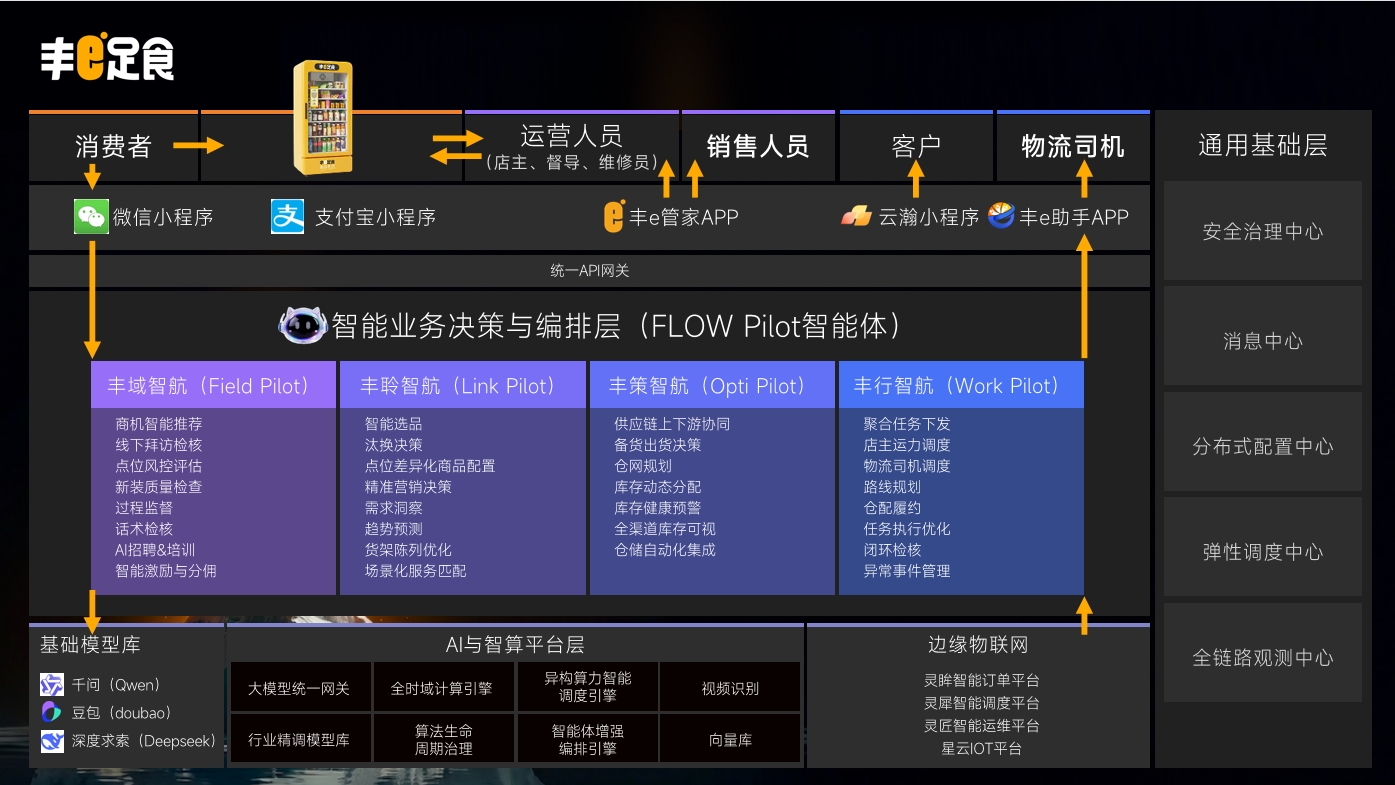
Zhu Tao: Our comprehensive agent for full - link automation is called FLOW Pilot. The "star" in "FLOW" is like our points, which are densely and widely distributed; and the "path" means that these points are not isolated but form a network, where there is an interconnection of products, and there are operational personnel moving between points, with the concept of a route. "Intelligent navigation" means that in this dense network of points, our agent can direct operational personnel to navigate and complete specific tasks in the network, which is the origin of the name. The name also fits the concept of a navigation chart, both having a sense of "flow," which is just a bit related to the English word "FLOW."
FLOW Pilot consists of four core agents, divided according to the full - link of the business:
Field Pilot: Serves sales personnel, responsible for lead screening and cleaning, business opportunity recommendation, visit route planning, and customer conversion policy recommendation;
Link Pilot: Focuses on product operation, listens to consumers' needs, and is responsible for product configuration at points and docking with consumers' personalized needs;
Opti Pilot: Leads supply - chain planning, responsible for inventory replenishment decisions for large warehouses, front - end warehouses, and shelves, as well as order - placing planning for upstream suppliers;
Work Pilot: Responsible for inventory fulfillment execution, converting supply - chain planning into specific tasks, matching logistics personnel and vehicle capacity, and completing task scheduling.
tuyu
36Kr: How do the sub - agents communicate and collaborate with each other?
Zhu Tao: This is actually a major challenge in developing agents. Although different agents have different decision - making roles, there will be decision - making conflicts in many things. For example, if Opti Pilot replenishes more goods, it is to reduce out - of - stock situations; but if its core assessment is product turnover and reducing overstock, it will tend to replenish less. If Opti Pilot replenishes less, the frequency of replenishment tasks for Work Pilot will be forced to increase. If Work Pilot's goal is to control costs, there will be obvious decision - making conflicts, which is the core problem of multi - agent collaboration.
Of course, we also spent a lot of effort on coordinating the agents. We will conduct a large number of A/B tests to weigh the pros and cons of various indicators and finally make the globally optimal decision. We will also precipitate the experience accumulated from these tests into the agents to improve the coordination of decision - making conflicts.
36Kr: Feng E Zushi's agents have been commercially used on a large scale. Why did you choose this time to make the first public announcement?
Zhu Tao: Yes. In the past, no one had heard of this kind of agent in the unmanned retail field. We've heard of coding agents for writing code and some agents that help with recommendations and life planning, but not this kind.
So, to help people better understand, we can make an analogy with autonomous driving. It's different from coding agents, which are all executed on the computer. Our agent is applied to actual business, which is closer to the agent in autonomous driving. For example, autonomous driving needs a perception module, which uses vision, radar, and ultrasonic sensors to fuse information to understand its own state. Our agent also has such a perception ability. It processes various structured data such as sales and inventory, fuses user dialogue information, and information from pictures collected on - site by operational personnel to support its decision - making.
2026 is regarded as the first year of the commercial use of AI agents. We hope that more top AI technology talents will join the Feng E platform and that we can open it up to the industry for discussion to jointly improve the digital and intelligent level of the industry.
36Kr: How to understand the other parts of the agent?
Zhu Tao: Autonomous driving has a task - planning module. From the starting point to the destination, the road surface and traffic conditions of different roads at different times are different. The algorithm may plan a navigation route based on the shortest time. Our Work Pilot is responsible for similar task planning. For example, the tasks of a replenishment staff for each device every day may be different. FLOW Pilot will package each task by point for the replenishment staff and then plan the optimal replenishment route for that day. Finally, autonomous driving has an execution module that issues tasks to the steering wheel and accelerator for control and execution. We also break down complex tasks into sub - tasks and assign them to different execution personnel, and the Work Pilot sub - agent coordinates the completion. In the end, our agent is like an autonomous driving agent in the field of unmanned retail management, driving our entire operation network to achieve our operation goals.
Actually, we can also make an analogy in terms of technical indicators. To measure the ability and automation level of an agent, there is a key indicator. In autonomous driving, it is the number of times of manual intervention per million kilometers. For example, Tesla claims that there are only a few hundred times of manual intervention per million kilometers. We don't have an actual driving mileage here, but FLOW Pilot makes hundreds of millions of decisions every day. Because we have 180,000 shelves, each shelf has about 50 - plus products, and there are also hundreds of SKUs of products in the warehouse that haven't been put on the shelves. The total number of decisions on product selection, inventory, and other tasks for these products reaches hundreds of millions.
Among the hundreds of millions of decisions we make every day, the number of times of manual intervention is about a few thousand, around 4,000. This ratio is quite low. If we correspond each decision to one kilometer, FLOW Pilot needs 40 times of manual intervention per million