Chinese companies account for 70% of the global EV battery market share.
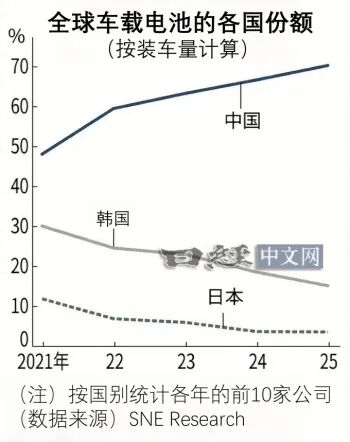
In 2025, Chinese enterprises accounted for over 70% of the EV battery market. Compared with nearly 50% in 2021, their monopoly has further strengthened. Against the backdrop of the slowdown in global EV demand, CATL, the largest enterprise, has expanded its orders in China and Europe, hitting a new record in profits. In contrast, South Korean enterprises are clearly in a tough situation...
In the field of batteries for pure electric vehicles (EVs), the market share of Chinese enterprises is increasing. In 2025, it exceeded 70%, and compared with nearly 50% in 2021, the monopoly has further strengthened. Against the backdrop of the slowdown in global EV demand, CATL (Contemporary Amperex Technology Co., Limited), the largest enterprise, has expanded its orders in China and Europe, hitting a new record in profits. Compared with South Korean enterprises struggling in the major US market, the leading advantage has widened.
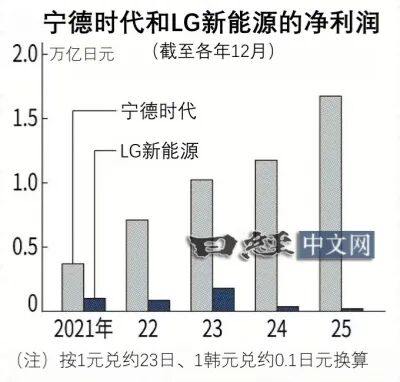
By launching a wide range of products, the competitive advantage is improving. The financial report of CATL for the fiscal year 2025 (ending December 2025) shows that the net profit increased by 42% year - on - year, reaching 72.2 billion yuan, hitting a new record in profits. The company's executives were full of confidence at the recent earnings briefing.
CATL provides a variety of batteries at a wide range of prices for EVs and plug - in hybrid vehicles (PHVs). Its customers include large Chinese automobile enterprises, and it is also expanding cooperation with European enterprises such as Volkswagen Group and Mercedes - Benz Group.
Data from South Korean research firm SNE Research shows that in terms of the installed capacity of vehicle - mounted batteries for EVs, etc., CATL ranks first in the world. Its market share in 2025 increased by 1 percentage point compared with 2024, reaching 39.2%. Against the background of a high market share, it enhances the competitiveness of price and quality, forming a virtuous cycle of further scale expansion.
Global EV sales have slowed down in some regions such as the United States, but overall, they are still growing. The installed capacity of vehicle - mounted batteries is also strong. In 2025, it increased by 32% compared with 2024, reaching 1187 gigawatt - hours (GWh). Among them, the Chinese market accounts for about 60%. The Chinese government promotes the popularization of new energy vehicles such as EVs through high subsidies, and the battery market is also continuously expanding.
Chinese enterprises such as CATL have not only captured the battery demand in their home country but also overseas in Europe, etc., driving growth. Europe has not cultivated powerful battery enterprises, and Chinese enterprises have become the beneficiaries of the demand.
In terms of the installed capacity of vehicle - mounted batteries in 2025, Chinese enterprises occupied 6 out of the top 10 global enterprises. The total share increased by about 4 percentage points compared with 2024, reaching 70.4%.
Among them, BYD (Build Your Dreams), ranked second in the world, installs the batteries developed and produced by its affiliated enterprises in its own EVs and PHVs, and will also expand the supply to external customers such as Xiaomi in China and Stellantis in Europe. The shipments of CALB (China Aviation Lithium Battery Co., Ltd.), ranked fourth, and Gotion High - tech Co., Ltd., ranked fifth, have also continued to grow.
In contrast, South Korean enterprises are clearly in a tough situation. The total share of South Korean enterprises decreased by about 3 percentage points compared with 2024, dropping to 15.3%. It has been halved compared with over 30% in 2021. South Korean manufacturers have been focusing on the US market, which has had a negative impact. This is because in the United States, the Trump administration revised the EV incentive policies of the previous Biden administration, and the sales of EVs are slowing down.
LG Energy Solution, the largest South Korean enterprise and ranked third in the world, gets 40% of its sales from the United States. The financial report for the fiscal year 2025 (ending December 2025) shows that the net profit decreased by 76% year - on - year, dropping to 80.8 billion won. It is less than 1% of CATL's net profit in the same period. SK On, ranked second in South Korea, and Samsung SDI, ranked third, both suffered final losses.
Lee Chang - sik, the Chief Financial Officer (CFO) of LG Energy Solution, explained that "as the demand for EVs continues to decline, the battery industry will also experience temporary negative growth."
South Korean enterprises have to reconsider their strategies for the United States. In early March, SK On laid off about 1000 employees at its battery factory in Georgia, accounting for about 40% of the factory's employees. In December 2025, LG Energy Solution announced that it would sell the assets such as the factory building of the battery factory jointly built with Honda in Ohio to Honda's US subsidiary.
Among Japanese enterprises, Panasonic Holdings Corporation (HD) ranks seventh in the world, but its market share is less than 4%. The battery factory in Kansas, the United States, started production in July 2025, but the full - capacity production time scheduled for the end of fiscal year 2026 has not been determined. The decline in the sales volume of its major customer, Tesla in the United States, has had an impact.
In 2026, the downturn in the Chinese market may have a greater impact on Chinese enterprises. The Chinese government adjusted the subsidy policy for new energy vehicles such as pure electric vehicles at the end of 2025. From January to February 2026, the domestic new - car sales volume of new energy vehicles decreased by 28% year - on - year.
Chinese manufacturers will expand local production to further explore overseas demand. CATL completed the installation of the production line at its first - phase factory in Hungary at the end of 2025 and recently put it into operation. CALB will also increase production in Europe and Southeast Asia. Liu Jingyu, the chairman of the company, said in an interview with Nikkei Asia that in order to adapt to local policies and market demands, the construction of production bases will be steadily promoted.
In view of the slowdown in EV sales, automobile giants in the United States and Europe, as well as Honda, etc., have adjusted their strategies. On the other hand, Chinese enterprises, led by BYD, aim to expand global sales, and battery giants have not relaxed their offensive. If Chinese enterprises improve their technological strength related to EVs, their leading advantage may further widen compared with other enterprises.
This article is from the WeChat official account “Nikkei Chinese Net” (ID: rijingzhongwenwang). The authors are Jing Tianbian (Guangzhou) and Nami Matsuura (Seoul). It is published by 36Kr with authorization.