The valuation of Kimi has skyrocketed fourfold to 120 billion yuan, but not many people in the market truly understand it.
This weekend, the most talked-about news in China's artificial intelligence field is undoubtedly Kimi's new round of financing. This large model company completed three rounds of financing in less than three months, and its valuation soared from $4.3 billion to $18 billion (approximately 120 billion RMB), setting a new record for consecutive financing amounts in the domestic large model field in recent years.
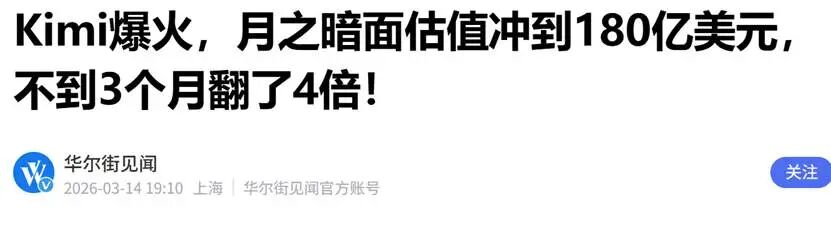
Behind this astonishing speed lies a huge amount of information. Among China's mainstream large model companies, Kimi, due to its non-listed status and minimal information disclosure, has always been the most difficult "dark side" to track in the industry. While Zhipu and MiniMax have put their operational details under the spotlight due to their listing processes, Kimi's movements rely more on word-of-mouth among industry insiders and professional evaluations.
It is precisely this low transparency that makes this round of intensive financing worthy of in-depth examination. Understanding the logic behind "three rounds of financing in three months" can not only help us see this company clearly but also enable us to grasp the real level of the current large model competition in China and even the world.
01
Leading in Cognition Brings Leading in Capability:
From the Foresight of Agent Clusters to Fully Utilizing the OpenClaw Dividend
There has never been a shortage of large model companies in China, but there is a lack of companies that are truly leading in cognition. Kimi's uniqueness can be traced back to a name.
In September 2025, Kimi began a gray-scale test of a new product called "OK Computer" (later renamed Agent). This name, derived from Radiohead's classic album, has a touch of literary charm but also carries the company's deepest strategic judgment: while many of its peers were still competing on the Chatbot track in terms of context length and ranking scores, Kimi was already exploring another path - enabling AI to complete real-world tasks on behalf of humans.
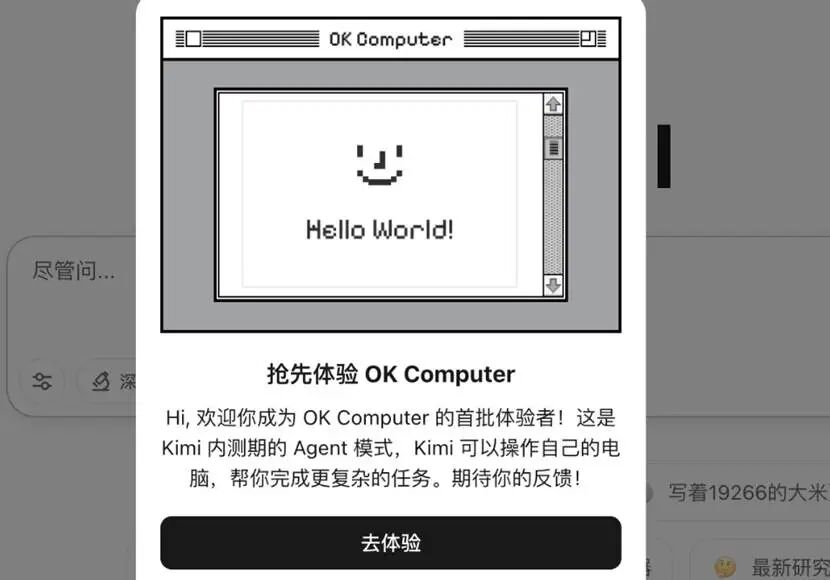
This change in product form reflects a completely different strategic judgment. While the industry was still debating whether large models could understand complex instructions, Kimi had already realized that the language model is just an interactive interface, and what can truly generate great value is the model's transition from "dialogue" to "execution." The core of this judgment is the early insight into the trends of "Computer Use" and Agent.
Zhang Yutong, the president of Kimi, elaborated on this strategy in a sharing session at Tsinghua University: "Our goal is to make Kimi everyone's full-stack assistant." Behind this goal is the path choice that Kimi determined at the beginning of its entrepreneurship: focusing on the logic layer, the Agent layer, and high-value tasks that require long-term planning and complex tool calls.
This cognition is ultimately reflected in the technical path. Kimi added a large amount of real Agent scenario data during the pre-training stage, including data on tool use and multi-round planning trajectories. After the product was launched, real user experiences were used as signals to continuously optimize the model. This means that Kimi's Agent capabilities are "endogenous," growing from the bottom layer of the model rather than being grafted later.
This leading cognition has finally been translated into specific technical achievements. On the SWE-Bench Verified benchmark, which measures software engineering capabilities, Kimi K2 achieved a score of 71.3%, surpassing most open-source and closed-source models. In November 2025, the Kimi K2 Thinking model was released. Trained based on the concept of "model as Agent," it inherently possesses the ability to "think while using tools" and achieved a score of 44.9% in the "Humanity's Last Exam." It also reached the SOTA level in multiple benchmark tests such as the Autonomous Web Browsing Ability (BrowseComp).
By January 2026, when Kimi K2.5 was released, the Agent capabilities had evolved to the "cluster" level. The Agent cluster mode of K2.5 can dispatch up to 100 avatars on-site according to task requirements, process 1,500 steps in parallel, and all role assignments and task breakdowns are finally reviewed and approved by the main Agent.
Yang Zhilin explained this technical direction: "The growth rate of high-quality data cannot keep up with the growth of computing power, and the improvement brought by the traditional method of predicting the next token using Internet data is becoming less and less. However, we can expand through other means, such as Agent clusters - the number of parallelly executed subtasks can be infinitely expanded."
This prediction received strong feedback in early 2026. With the explosion of the open-source agent project OpenClaw, the industry suddenly realized that AI that can "do work" is what users really need. In this "lobster craze," Kimi became one of the most widely used models globally.
Meanwhile, Kimi was also one of the first companies to launch a cloud-based OpenClaw product, and the capabilities of its "Kimi Claw" product have also been verified by the market. In February this year, Kimi Claw reached the top 2 globally on the AI "Lobster List" and ranked first in product visits in China.
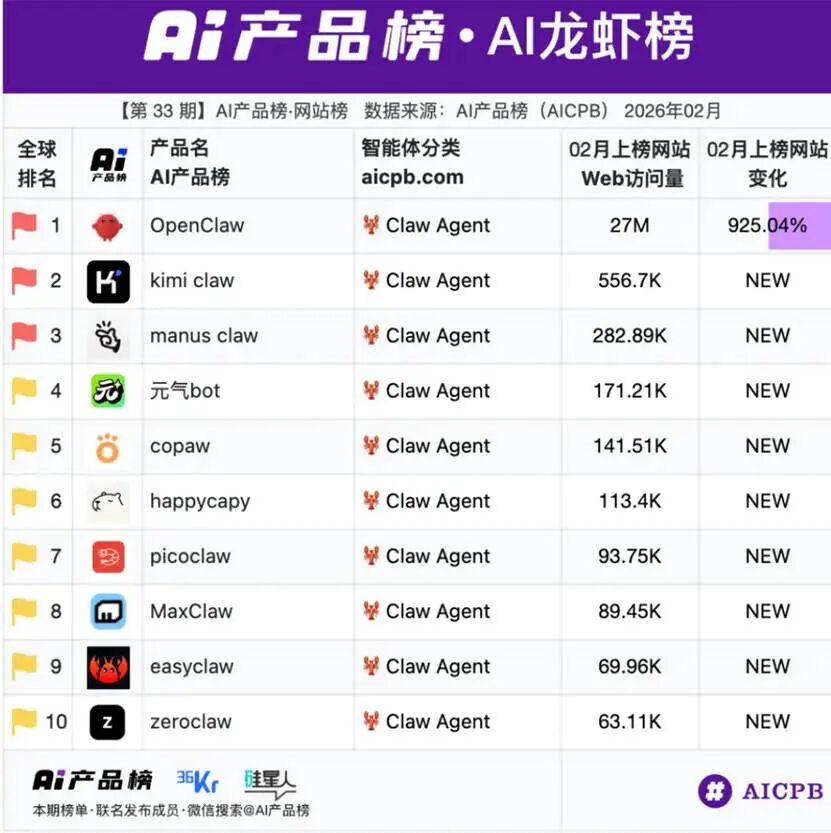
This is not a coincidence but a natural result of leading in cognition. When the tide rushes towards the new continent of Agent, only those who have built their boats in advance can carry the most passengers.
02
The Logic of the Soaring Valuation:
The Emergence of "Cost-Effectiveness" and the Collective Awakening of the Primary Market
If the "lobster craze" proves the correctness of the technical path, then the pursuit of capital proves the viability of the business model. These three rounds of financing within three months can be seen as a collective correction and urgent position-building by the primary market for Kimi.
Previously, the market's spotlight was more on companies like Zhipu and MiniMax that were planning to go public. They received extremely high attention and valuations due to their listing expectations. Because Kimi is not a listed company, its real value was once underestimated or simply benchmarked against others.
However, the listing processes of Zhipu and MiniMax have actually established a new valuation anchor for the industry. In the Hong Kong market, the recent trading valuations of competitors Zhipu and MiniMax range from $34 billion to $45 billion.
This perception of cost-effectiveness was precisely ignited by the outstanding business data. After the launch of Kimi Claw, the number of individual subscription users increased exponentially. Data from global payment giant Stripe revealed this explosive growth: the number of payment orders in January increased by 8,280% month-on-month, and in February, it increased by another 123.8%, directly entering the top ten of Stripe's global list.
Even more astonishing is that since the end of January, Kimi's revenue in 20 days has exceeded that of the entire year of 2025. What's more noteworthy is the change in the revenue structure: after the release of K2.5, Kimi's overseas revenue has exceeded its domestic revenue, indicating that its commercialization has begun to participate in global competition.
Similarweb data shows that after the release of K2.5, the daily average visits to Kimi's overseas API open platform website increased by 10 - 20 times. In February, the visits to the kimi.com website also reached a historical peak, with nearly 120 million visits in the past three months.
From a professional valuation perspective, these data precisely support the leap in valuation. The mainstream view in the market is that for large AI model companies, the traditional Internet valuation framework cannot be applied. Instead, re-pricing should be based on core indicators such as ARR growth rate and Token call volume growth rate.
Taking Kimi as an example, its revenue in 20 days since the end of January has exceeded that of the entire year, which alone indicates that this year's revenue growth rate will be at least about 18 times. According to OpenRouter data, the call volume of the Kimi 2.5 model has remained in the top three this month, with a monthly growth rate of 67%, making it one of the models with the fastest growth rate in China. Even with a simple calculation, its annual revenue and Token call volume growth multiples far exceed 4 times. Therefore, it is not an exaggeration for its valuation to quadruple in three months.
In a horizontal comparison, the market values of Zhipu and MiniMax, which are listed on the Hong Kong Stock Exchange, have reached between $34 billion and $45 billion. In contrast, Kimi's $18 billion valuation seems relatively conservative.
For capital, this is a perfect investment narrative: technological leadership has been proven by industry hotspots, the business model has been initially proven viable with data support, the overseas market has verified the growth potential, and there is still room for valuation compared to listed or planned-to-be-listed benchmark companies. The convergence of these favorable factors has transformed Kimi from an "optional" investment target in the primary market to a "must-seize" one.
The three rounds of financing in three months, with the valuation soaring to $18 billion, may seem crazy, but in fact, it is an efficient pricing by the market in the process of gradually increasing information transparency. When the technical path, business data, and comparative valuation can all be clearly explained, the consensus among capital is quickly reached.
03
The Posture of Preparing for Battle:
Why Such Urgent Need for Funds
From Kimi's perspective, the willingness to complete financing intensively in such a short period, and even the founder described it in an all-staff letter as "the financing amount exceeding that of most IPOs and private placements of listed companies, believing that a larger amount of funds can be raised from the primary market," there is a hidden motivation behind it: the intensity of competition in 2026 far exceeds what the outside world imagines.
The viability of the Agent business model is the greatest benefit for the entire industry, but for individual companies, it means the start of the most brutal arms race. Because everyone can see the same future: Agent is the battleground that must be fought for.
Taking OpenClaw as a reference, the current evolution speed of Agent can no longer be measured in months but in days. This evolution depends on continuous investment in several core capabilities: coding ability, which is the "hand" for Agent to execute tasks and must be dexterous enough; multi-modal ability, which is the "eye" for Agent to observe the world and must be clear enough; and infrastructure expenditure, which is the "blood vessel" for Agent to operate and must be strong enough.
As Agent applications gradually enter the productivity scenario, the scale of Token consumption is growing rapidly. Through specific assumptions (such as a 60% coverage rate of user interaction Tokens), Zhongtai Securities' research established a quantitative model of Token consumption and computing power demand (measured by the number of H100 graphics cards). Through calculation, it can be concluded that an AI application with over 100 million daily active users may consume the computing power equivalent to 141,500 H100 graphics cards per day.
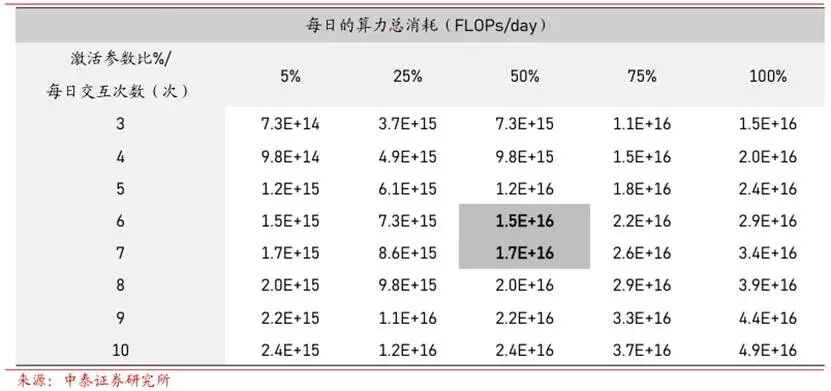
The latest data shows that China's overall daily Token consumption has increased from approximately 100 billion at the beginning of 2024, exceeded 30 trillion in mid-2025, and reached the level of 180 trillion in February 2026.
This means that once Agent becomes the mainstream application form, the computing power cost of the model will no longer increase linearly but exponentially. Any company that wants to stay in the game must be prepared to pay a huge amount of capital for this "computing power tax."
Yang Zhilin clearly stated the strategic goal for 2026 in an internal letter: through technological improvement and model scaling, to increase the equivalent computing power of the next-generation K3 model by at least an order of magnitude and catch up with the world's leading level in pre-training; to vertically integrate model training and product experience to create a K3 model with differentiated capabilities; and finally, to focus on the productization and commercialization of the agent itself, not aiming for an absolute number of users but pursuing the upper limit of intelligence and creating greater productivity value, with the revenue scale achieving an order-of-magnitude growth.
Kimi's decision to continue financing at a valuation of $18 billion, with a financing amount as high as $1 billion, is not just to maintain the status quo but to maintain its leading position in the more brutal competition to come. This is a battle for survival, not just a blood transfusion for development.
04
The Eve of AI OS:
From Lobster to Windows, and Then to a Trillion-Dollar Market
Observing Kimi's financing rhythm in the broader context of industrial history will lead to deeper insights.
The current OpenClaw and Agent craze is actually equivalent to the DOS operating system in the PC era. Next, the industry will inevitably enter the critical period of "Windows" competition. In the DOS era, users had to remember commands and write scripts to make the computer work. In the "Windows" era, the interaction became graphical and intuitive, which is why computers entered thousands of households.
In the field of AI, the current Agent form is similar to the command-line DOS, which proves that machines can perform tasks. The next battlefield will be the AI OS. This AI OS not only needs to understand users' instructions but also be able to schedule underlying computing power resources, manage multi-modal input and output, and even become the core hub of future AI hardware.
Looking at Kimi's accelerated financing and inflated valuation from this perspective, everything becomes clear. The frenzy of capital, on the surface, is the pursuit of the equity of a star startup company. In essence, it reflects the intensifying internal competition in the industry and the race for the future super entrance.
For Kimi, achieving a valuation of $18 billion and three rounds of financing is actually just an entry ticket. This ticket allows them to enter the next arena, but it is far from enough to guarantee victory. On the track to AI OS, the competitors are not only equally fierce startup companies but also giants with cloud resources and ecosystems. The ecosystems quickly built by Tencent and ByteDance around OpenClaw are trying to lock users' habits within their own application systems.
This is a war about the next-generation human-computer interaction interface. Although Kimi is temporarily leading in the model aspect, it still faces huge challenges in the platform, ecosystem, and hardware aspects. These three rounds of financing in three months are just the first batch of ammunition for this long war.
This weekend, when we see the news of Kimi's soaring valuation, we should not just be amazed but also see the AI world that is evolving at an accelerating pace behind it. Its leading technical path has made it stand out in the "lobster craze," the explosion of business data has forced capital to re-price it, and the prediction of the future Agent war has compelled it to reserve supplies at an unprecedented speed.
DOS has arrived, and Windows is on the way. This super war has just completed its warm-up.
"I recognize the storm and am as excited as the sea." This is probably true for Kimi, large models, investors, and everyone.