What's it like to have a brain-computer device implanted for five years?
God Translation Bureau is a compilation team under 36Kr, focusing on fields such as technology, business, the workplace, and life, and mainly introducing new technologies, new ideas, and new trends from abroad.
Editor's note: Rodney Gorham has had the Synchron brain-computer interface implanted for the longest time. Now, he is still constantly exploring new ways of using it. This article is from a compilation, hoping to inspire you.
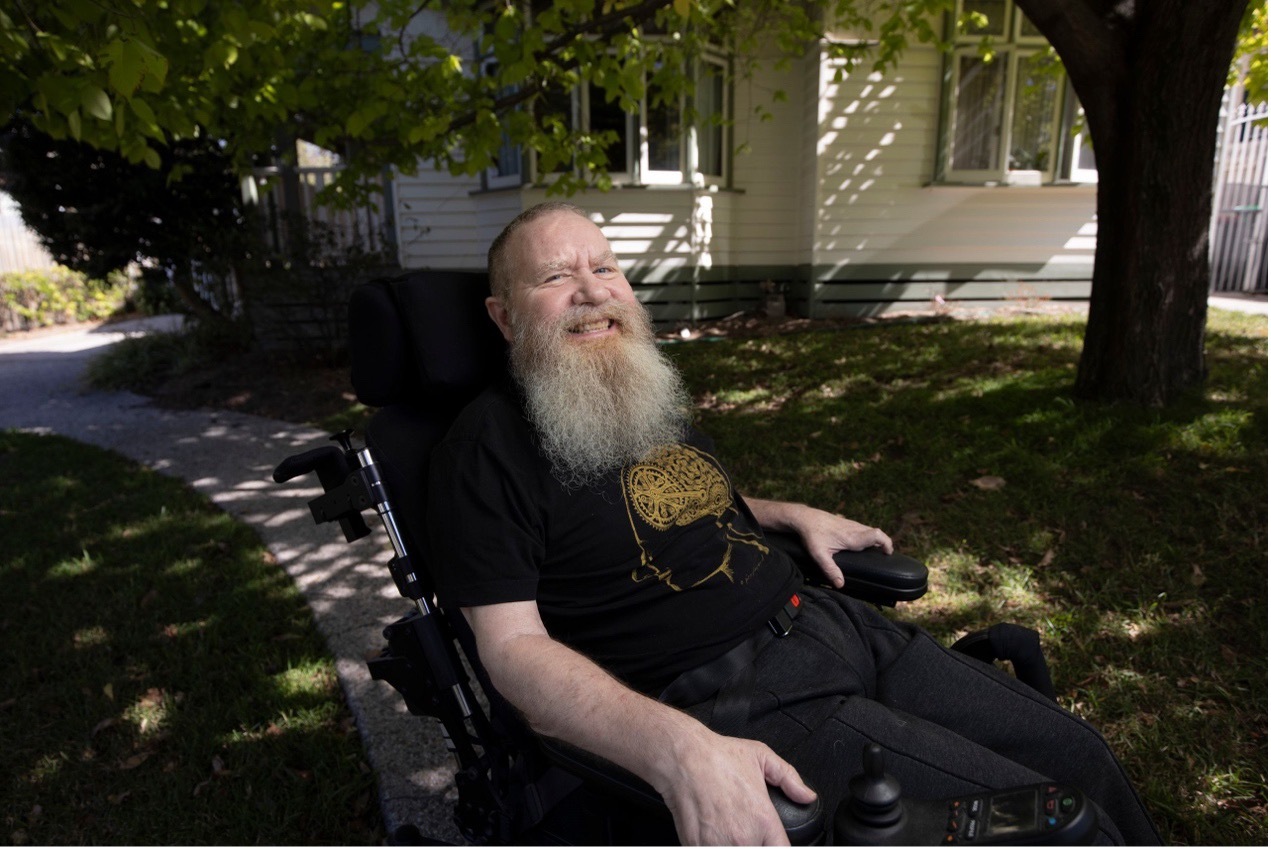
Image source: ARSINEH HOUSPIAN
Rodney Gorham recently reached a milestone that few people can achieve: the brain-computer interface implanted in his body has been in stable use for a full five years.
This experimental implanted device developed by the startup Synchron allows him to control his home computer and other digital devices with just his thoughts. For 65-year-old Gorham, it is a lifesaver because he suffers from amyotrophic lateral sclerosis (ALS, Lou Gehrig's disease) and can no longer walk, speak, or move his hands.
Synchron is one of several companies committed to the commercialization of brain-computer interfaces, including Elon Musk's Neuralink. Their goal is to help paralyzed people. In the past five years, Synchron's software and hardware have undergone multiple iterations, and Gorham has participated throughout, driving the evolution of this technology.
Among the 10 volunteers who received the Synchron implant, Gorham is the one who has used it for the longest time. In December 2020, he received the implant in a trial in Australia.
(Currently, the user who has had a brain-computer interface implanted for the longest time in the world is Nathan Copeland, who has had it for more than 10 years. He has four research-grade electrode arrays from Blackrock Neurotech implanted in his brain.)
"We did a lot of trial and error with Rodney, trying out various functions, just to determine the first core use case and build the first product and clinical trial around it," said Tom Oxley, the founding CEO of Synchron. "He played a key role in testing new decoders, interaction methods, and application integrations."
Synchron's first product is called the Stentrode, a thin mesh catheter placed in a blood vessel near the brain to collect neural signals. It is implanted through the jugular vein below the neck and travels along the blood vessel to the motor cortex of the brain, the area responsible for controlling voluntary movement.
Doctors will implant a signal receiving unit in the patient's chest. After receiving the brain signals, it will transmit them to an external receiver. The company is preparing to conduct a larger-scale critical clinical trial to obtain regulatory approval. They are communicating with the US Food and Drug Administration (FDA) to determine the clinical endpoints of the trial, which are the quantifiable indicators used to evaluate the safety and effectiveness of the device.
Evaluating the effectiveness of a brain-computer interface is much more complicated than evaluating traditional drugs or devices that directly treat diseases, and this is also a difficult problem that the entire field is currently trying to solve. Brain-computer interfaces rely on decoding algorithms to convert brain activity into actions that the user wants to perform.
For example, a person can complete a mouse click on the computer screen just by imagining making a fist or standing on tiptoe.
Although paralyzed people cannot actually make the movements of making a fist or standing on tiptoe, when they try to do so, their brain neurons still emit unique signals. The decoder must be able to stably identify these original neural signals for the brain-computer interface to be truly usable.

Rodney Gorham, who has had the Synchron Stentrode implanted for 5 years, and his dog Piper at his home in Melbourne, Australia.
Oxley said that at first, Gorham could only complete a single click with his thoughts. Later, he advanced to multiple clicks and finally achieved sliding control, just like adjusting a volume knob. Now he can control the computer cursor and achieve two-dimensional control, moving up, down, left, and right on the plane.
Over the years, Gorham has tried to use the implanted device to control various devices. Zafar Faraz, a field clinical engineer at Synchron, said that Gorham directly promoted the development of Apple's brand-new assistive function, Switch Control, which was released last year. This function allows brain-computer interface users to control iPhones, iPads, and Vision Pro with their thoughts.
In a video played at the NVIDIA conference in San Jose, California, last year, Gorham demonstrated using his thoughts to control home devices: playing music on a smart speaker, turning on a fan, adjusting the lights, starting an automatic feeder, and running a robotic vacuum cleaner. All of this happened at his home in Melbourne.
"Rodney has been pushing the boundaries of this technology," said Faraz. As a field clinical engineer, Faraz visits Gorham's home twice a week to guide him in using the brain-computer interface. His job is to monitor the device's performance, troubleshoot problems, and figure out what Gorham can and cannot do with the device.
Synchron relies on this data to continuously improve the system's stability and ease of use.
Over the years of working with Gorham, the two have conducted a lot of experiments to explore the device's possibilities. Once, Faraz asked Gorham to use two iPads at the same time, playing a game on one and switching to the other to listen to music. Another time, Gorham played a computer game that required grabbing blocks on a shelf. This game was directly connected to a real robotic arm at the University of Melbourne, about 6 miles away from Gorham's home, and he could remotely control the robotic arm to move real blocks in the laboratory.
Gorham's wife, Carolyn, said that before her husband was diagnosed with Lou Gehrig's disease in 2016, he was a software salesperson at IBM. He really enjoys playing such a key role in the development of this technology. "This just fits his skills of a lifetime," she said. "He worked in the IT industry for 30 years, communicating with customers, understanding their software needs, and then going back to find technicians to develop. Now the roles are just reversed."
After each test with Faraz, Gorham would smile from ear to ear. Through on-site tests, the Synchron team realized that they had to improve the system structure. Currently, users need to place a wire with a signal board on their chest. The signal board receives the brain signals from the chest and then transmits them through the wire to an external device, which converts them into instructions.
In the second-generation system, Synchron will completely remove this wire. "We found that if there is a precise communication layer in the wearable part, it is very prone to problems," Oxley said. "For paralyzed patients, they have to rely on others to adjust the wearable device to ensure a normal connection. This is an important lesson we learned."
If patients are to use the brain-computer interface for a long time, it must be easy for caregivers to install and operate at home.
Over the years of participating in the Synchron trial, Gorham's condition has been slowly worsening. Using the implanted device requires a high degree of concentration, and he gets tired easily now.
He used to be able to accept interviews from reporters via WhatsApp, but now it's very difficult for him to type for a long time.
(This report was mainly completed through interviews with his wife, Carolyn, field engineer Faraz, and CEO Oxley.)
This poses major questions for Synchron and other companies: How useful are these devices for patients with neurodegenerative diseases? Can patients continue to use them as their condition worsens? Will insurance cover this expensive device that requires surgery and may have a limited lifespan?
The average survival time after being diagnosed with Lou Gehrig's disease is 3 to 5 years, but many people live longer. Since Synchron completed its first surgery in 2019, some participants have passed away due to the natural progression of their condition. And paralyzed people with relatively stable conditions, such as those with spinal cord injuries, may be able to use the brain-computer interface for life.
However, operating the device for a long time every day still makes them feel mentally exhausted.
"In my opinion," Carolyn said, "these companies must consider human factors more because everyone is different."
Translator: Teresa