Three out of the world's top six chip foundries are from China. No wonder the chip industry leaders are calling for just one EUV machine.
China's chip foundries have achieved their best results in history. Among the world's top 10 wafer foundries, three are from the Chinese mainland. No wonder recently some chip industry leaders jointly issued a statement calling for the creation of a Chinese ASML, because the Chinese mainland's chip foundries are just one EUV lithography machine away from the top.
According to the recently announced global wafer foundry rankings for 2025, the top ten are TSMC, SMIC, UMC, GlobalFoundries, Huahong, Jinghe Integrated, Tower Semiconductor, World Advanced, Powerchip Semiconductor, and Xinlian Integrated. These ten companies have captured about 90% of the global market share. It can be said that the global wafer foundry industry is basically concentrated in the hands of these ten companies.
01
Looking at last year's performance, five of the world's top 10 wafer foundries achieved double - digit growth. Among them, the Chinese mainland companies performed very well this time. Three of the top ten wafer foundries are from the Chinese mainland, namely SMIC, Huahong Group, and Jinghe Integrated. These three major chip foundries rank second, fifth, and sixth globally respectively, with growth rates as high as 19.5%, 18.84%, and 18.48% respectively.
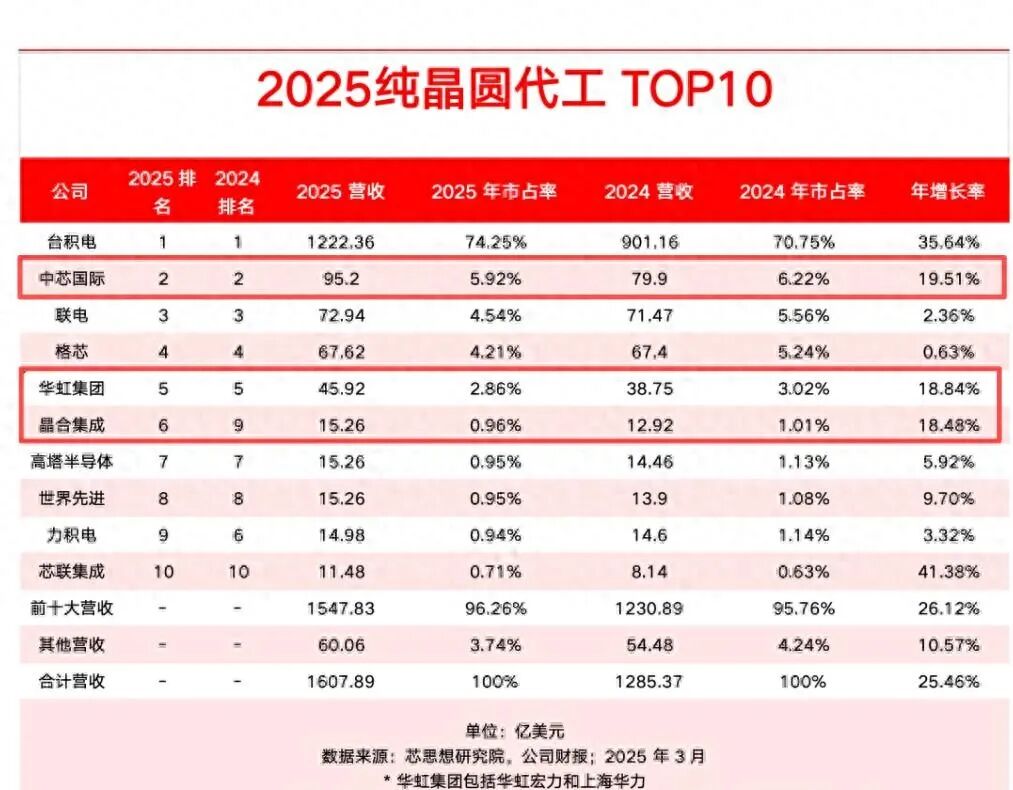
In terms of market share, these three major foundries accounted for more than 10% of the market share in 2024, but it dropped to 9.74% in 2025, a slight decline. The gap with TSMC is still large.
Overall, the rankings of SMIC and Huahong remained unchanged, but Jinghe Integrated jumped from the 9th place to the 6th place globally, advancing three places and achieving its best result in history.
In terms of growth rate, the average growth rate of the three major manufacturers, SMIC, Huahong, and Jinghe Integrated, is as high as 19%. This shows that although the process technology of the Chinese mainland's chip foundries is focused on above 7nm, the order demand is huge. The three major factories on the Chinese mainland have been continuously expanding production. In addition, there are too many orders, and everyone is operating at an overload. The machines on the production lines are almost smoking.
In terms of capacity utilization, for SMIC, as some production lines are for testing, as long as the utilization rate exceeds 90%, it is an overload. SMIC's average capacity utilization rate in 2025 was as high as 93.5%.
Huahong's average capacity utilization rate in 2025 was even as high as 106.1%, exceeding 100% every quarter. It is completely operating at an overload. And Jinghe Integrated's expected capacity utilization rate is above 103%, also operating at an overload.
The reason for the overload operation is that there are too many orders. However, the production capacity and process cannot keep up. Currently, domestic foundries are mainly concentrated on processes above 7nm. SMIC can achieve the 7nm process through multiple exposures with DUV lithography machines, and its monthly production capacity is expanding from 20,000 wafers to 100,000 wafers.
However, this is a different concept from TSMC's mass - production of 7nm chips using EUV lithography machines, which monopolizes the markets for AI chips and high - end mobile phone processors.
02
Using DUV lithography machines for multiple exposures to achieve 7nm has higher costs, complex processes, longer production time for a single wafer, slow yield improvement, and the cost is much higher than that of TSMC.
In addition to lithography machines, there is also the chip manufacturing process. In this regard, TSMC leads the world. It has been making early arrangements for each generation of technology and is not afraid of investing money. It is expected to invest $47.7 billion in 2026, exceeding the sum of the other nine major manufacturers. It has mass - produced 3nm and 2nm chips with a yield of about 80% and is currently working on the 1.4nm process. The Chinese mainland mainly focuses on the mature processes of 28nm and above, and the most advanced mass - produced process lags behind TSMC by 2 - 2.5 generations.
The core reason is not only the process gap. Mainly, mainland foundries cannot obtain high - end EUV lithography machines and are stuck outside the 7nm threshold.
Simply put, the core difference between mainland foundries and TSMC lies in the lack of an EUV lithography machine. TSMC can purchase a large number of ASML's EUV lithography machines to achieve large - scale mass production and expansion of advanced processes below 7nm, and it has captured the profits and production capacity of the mainstream mid - to - high - end markets.
If TSMC did not have EUV lithography machines, it would also be unable to achieve large - scale mass production of advanced process technologies.
SMIC, Huahong, and Jinghe Integrated are now waiting for a domestic EUV lithography machine.
Some time ago, Wang Yangyuan, the honorary dean of the School of Integrated Circuits at Peking University and one of the founders of SMIC, Zhao Jinrong, the chairman of NAURA Technology Group Co., Ltd., Chen Nanxiang, the chairman of YMTC, Liu Weiping, the chairman of Empyrean Technology Co., Ltd., and other nine industry veterans and academic giants jointly issued a statement calling for the creation of a Chinese - version ASML.
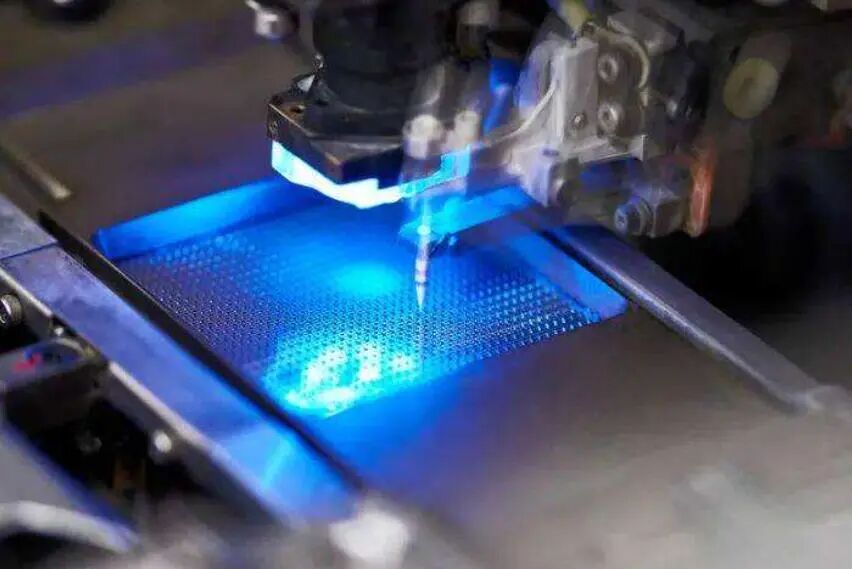
In recent years, domestic chip foundries have continuously made technological breakthroughs and increased production capacity, and the call for domestic substitution has become louder and louder. Therefore, more and more manufacturers are transferring their chip orders from overseas back to the domestic market.
However, the problem is that due to the inability to break through the EUV lithography machine technology, our three major foundries are always stuck in the mid - to - low - end markets. They cannot handle many orders. The demand is huge, and the production lines are overloaded, but they are unable to meet the demand. A large number of orders can only flow to TSMC, which has EUV lithography machines.
ASML's EUV lithography machine has 100,000 components and stands behind 5,000 suppliers. It is the culmination of all human industrial wisdom. The US ban on the sale of EUV lithography machines to China is to cut off the rope for China to climb the peak of science and technology.
03
"Since core technologies cannot be bought, begged for, or negotiated for, we can only 'work them out'."
"It's difficult to build a tower with scattered sand." The nine industry leaders straightforwardly pointed out the pain points of the industry. They suggested that through national - level overall guidance, a new win - win mechanism should be created in enterprise cooperation, and mechanisms for fault - tolerance, trial - and - error, and verification should be studied and formulated. This is the good recipe to solve this dilemma.
The appeals of semiconductor industry leaders show that our pain of being "choked" is real. We urgently need to develop a domestic EUV lithography machine in the core technology field, especially in semiconductors, which are heavy weapons for a major country. Because such heavy weapons for a major country cannot be obtained through market - for - technology or peaceful negotiations. Even if obtained, it is like seeking the skin of a tiger.
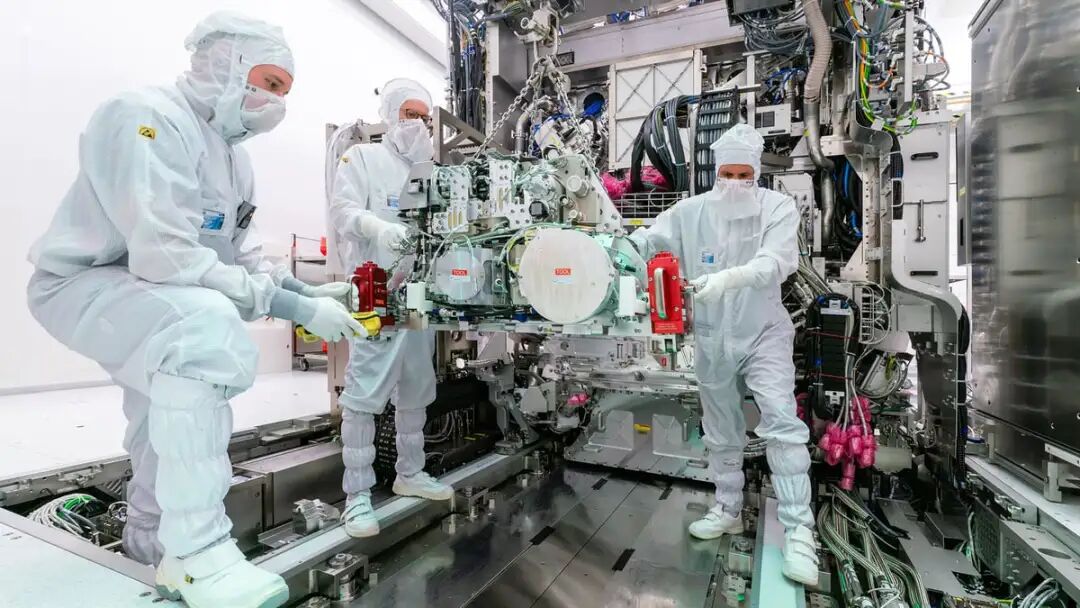
The market conditions for breaking through EUV lithography machine technology are already mature. Now China has made breakthroughs in key areas such as EUV laser light sources, mobile platforms, and optical systems, and the chip industry chain is also mature.
The current problem is not "whether we can do it" but "how to string these pearls into a necklace", that is, how to integrate the scattered technological breakthroughs into a complete industrial system. And after the lithography machine is developed, there is also a key problem: domestic manufacturers need to take the initiative to use it.
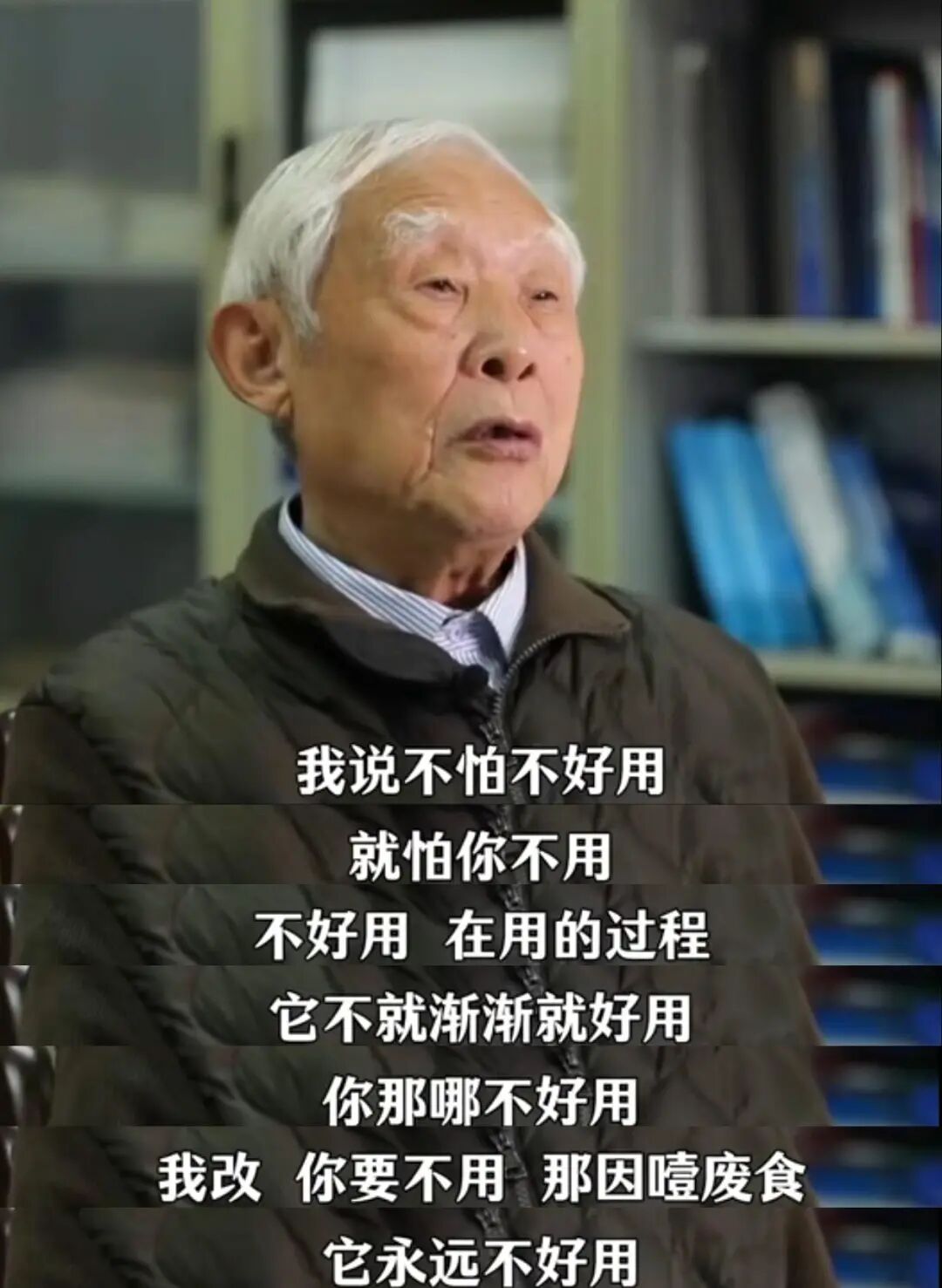
Academician Chen Guoliang of the Chinese Academy of Sciences previously said in an interview: "I put forward a slogan. Don't be afraid that domestic machines are not good to use. Just be afraid that you don't use them. Only by using them can you know whether they are good or not. If you say something is wrong, tell me and I'll fix it. If you don't use them, it's like giving up eating for fear of choking, and they will never be good to use." Academician Chen believes that the prerequisite for promoting the development of domestic equipment is to use it first. We cannot always buy foreign equipment just because the technology of foreign products is more mature and thus ignore the development of domestic equipment.
If China can bypass ASML's technological blockade and develop a domestic EUV lithography machine, and domestic enterprises switch to using domestic products, this will push China to make a key leap from a "science and technology power" to a "science and technology superpower".
If in the future, domestic manufacturers can use domestic chips for their mainstream products, the scale of SMIC, Huahong, and Jinghe Integrated is expected to double or even grow geometrically. Once this bottleneck is broken, Chinese chip foundries will not only occupy 3 out of the top 6 globally but will dominate the top ten, and their market share will directly exceed 50%.
Therefore, from the appeals of domestic chip industry leaders, we can see the signal of a group - based battle launched by the domestic industry for lithography machines, and the country has heard this call.
During the Two Sessions, the government work report clearly stated that for science and technology - based enterprises in key core technology fields, a "green channel" mechanism for listing and financing, mergers, and acquisitions should be implemented on a regular basis. This will, from the top - level design, remove obstacles for resource integration and growth. It will shift from guerrilla warfare of individual efforts to positional warfare of group - based battles, which will promote the coordinated operation of the entire industrial chain and launch a general attack on lithography machines more quickly. Once a breakthrough is achieved in EUV lithography machines, the global chip war will basically end.
This article is from the WeChat public account “Hotspot Micro - Review” (ID: redianweiping), author: Wang Xinxi. Republished by 36Kr with permission.