Haier Smart Home at AWE: The Critical Point of AI Eye 2.0 and "Unmanned Housework"
AI Enters the Home: The Tipping Point of Smart Homes
The smart home is not a concept that emerged out of nowhere.
Over the past decade and more, the home appliance industry has been almost continuously exploring around this direction. From the earliest internet-connected home appliances, to the later emerging whole-home smart systems, and to the scenario-based home appliances that more and more enterprises have begun to showcase in recent years, home spaces have been gradually reorganized by digital technologies.
The initial changes came from connectivity capabilities. Home appliances are connected to platforms via networks, allowing users to remotely check status and control devices. Later, interconnection started to form between devices, for example, the air conditioner automatically turns on when users get home, and the range hood automatically activates when cooking. After that, voice assistants were added to home systems, making the interaction between people and devices more natural.
But essentially, all these capabilities still remain at the level of "control" and "interconnection". What truly changes the development rhythm of smart homes is the addition of AI capabilities.
As large model technologies enter the consumer electronics sector, home appliances have begun to gain stronger environmental understanding capabilities. Devices can not only identify environmental changes, but also understand user behaviors, and participate in decision-making to a certain extent. Home spaces are gradually evolving from a simple combination of devices to a system that can understand daily life.
This change has driven smart homes to gradually move from "scenario interconnection" to a more complex system form. However, the critical leap from smart home to the smart home in the true sense is not that simple.
Shang Li, Tenured Professor at the School of Computing and Intelligence Innovation of Fudan University, believes that over the past decades, the way technology changes family life mainly relies on the upgrading of individual devices. Products such as refrigerators, washing machines, and air conditioners have continuously become more efficient, more energy-saving and smarter. With the development of AI, robotics and spatial perception technologies, homes are gradually evolving from a "collection of devices" to a continuously operating intelligent system.
He told 36Kr, "In such a system, the space can understand the living status of family members, devices can collaborate to complete tasks, and AI continuously learns and optimizes family lifestyles in the background. The future smart home is not just a smarter home appliance, but more like an intelligent partner that can accompany family life for a long time."
This is also one of the most noteworthy changes at this year's AWE.
When AI begins to penetrate into home spaces, smart homes are shifting from simple parameter upgrades to competition in system capabilities. The home space itself, besides being a combination of home appliances, is also a system that can understand the environment and participate in life decisions.
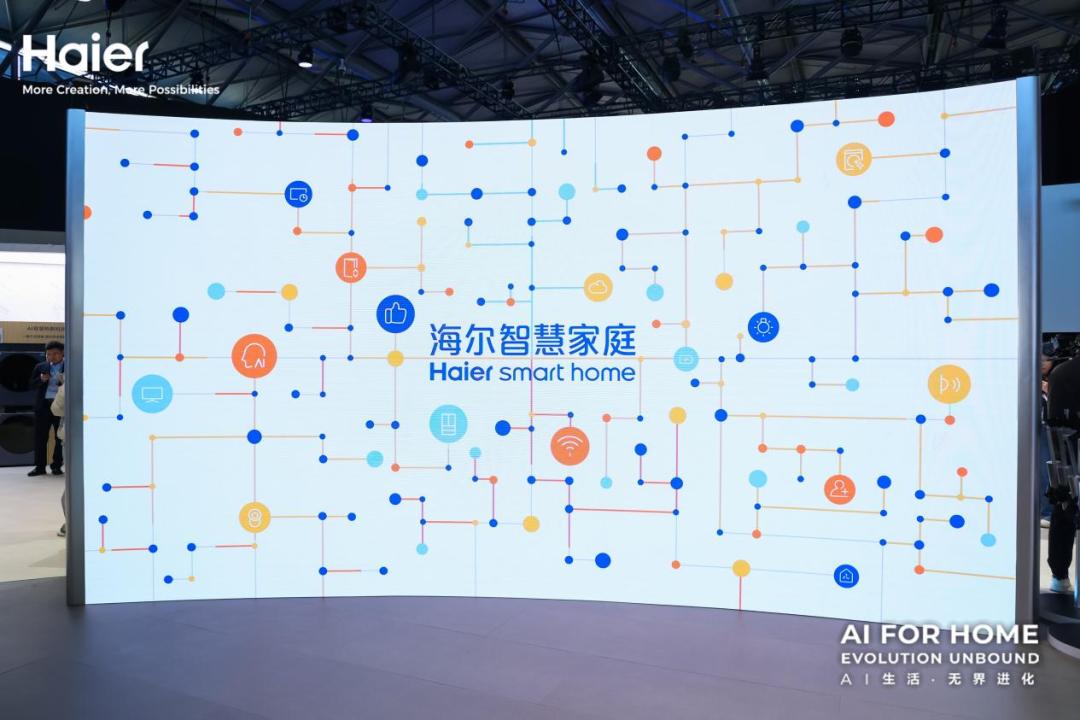
At the AWE site, the smart home system showcased by Haier is developed exactly around this logic. This year, Haier's core changes focus on three capabilities: the launch of AI Eye 2.0, the full layout of three major categories of home robots, and the comprehensive upgrade of the Smart Home Brain.
The three form a very intuitive system framework: Eye, Hand, and Brain. AI Eye is responsible for perceiving the home environment, the Smart Home Brain is responsible for understanding demands and making decisions, and robots undertake task execution.
It can be seen that home appliance enterprises represented by Haier have begun to further answer a question: after AI truly enters the home, can smart homes move from "assisting with housework" to a further goal - zero-manual housework.
This year's AWE may well be the inflection point where this change becomes clear.
From Home Appliances to Systems: How AI Life Achieves "Active Evolution"
"Any intelligent system requires three core capabilities: perceiving the environment, understanding and decision-making, and executing actions. When the three form a closed loop, the system can operate continuously and gradually learn users' living habits." From Shang Li's point of view, the components of a smart home are very clear.
Based on this assertion and combined with the exhibition experience, Haier's changes at this year's AWE are very intuitive.
In the past, home appliance pavilions were usually divided by product categories: refrigerator zone, washing machine zone, air conditioner zone, with each zone showcasing the capabilities of its own products. This year, the structure of Haier's pavilion has changed significantly. All exhibitions are centered on product suites, presenting a complete set of living spaces.
Different zones such as the kitchen, laundry space, air environment, cooking scenarios, and home robots are connected under the same logic, and devices form collaboration through a unified system. This display method itself conveys a signal: smart homes have moved from the upgrading of individual products to the evolution of system capabilities.
Behind this change lies the comprehensive evolution of Haier's smart home, which can be roughly understood as the evolution of three layers of capabilities: perception, decision-making, and execution.
AI Eye 2.0: Enabling Home Appliances to Truly "See the Physical World"
In the past smart home appliance systems, many devices actually did not know the environment they were in.
They can be remotely controlled and run according to set procedures, but their understanding of real life scenarios is still very limited. This is also the reason why the user experience of many so-called "smart home appliances" is unstable: devices can only execute commands, but hardly understand environmental changes.
The AI Eye is designed to solve exactly this problem. In 2025, Haier launched AI Eye 1.0, enabling home appliances to have visual capabilities for the first time.
AI Eye 2.0 further improves in recognition range, recognition accuracy and response speed. According to industry reviews, the technical capabilities of AI Eye 2.0 have also obtained multiple authoritative verifications. The Seeker suite equipped with this technology not only obtained the L4-level smart home appliance standard certification certificate issued by CHEARI (Beijing) Certification & Testing Co., Ltd., but also won the gold award in the 2026 AWE Appliance of the Year Award selection, becoming the only suite product in the industry to win the "Full-scenario AI Agent Gold Award". At the same time, its technological strength has also passed the professional verification of the China Association for Scientific Expedition.
For Seeker suite products equipped with this technology, such as refrigerators and washing machines, the recognition range of the AI Eye on the former has expanded from the original 230 types of food materials to almost all food materials, and can automatically recommend storage areas and match fresh-keeping environments.
In specific applications, this capability is embedded in different home scenarios. For example, in the fresh-keeping scenario, the Seeker refrigerator equipped with AI Eye can identify the type of food materials, recommend suitable storage areas, and automatically adjust the fresh-keeping environment according to the characteristics of food materials.
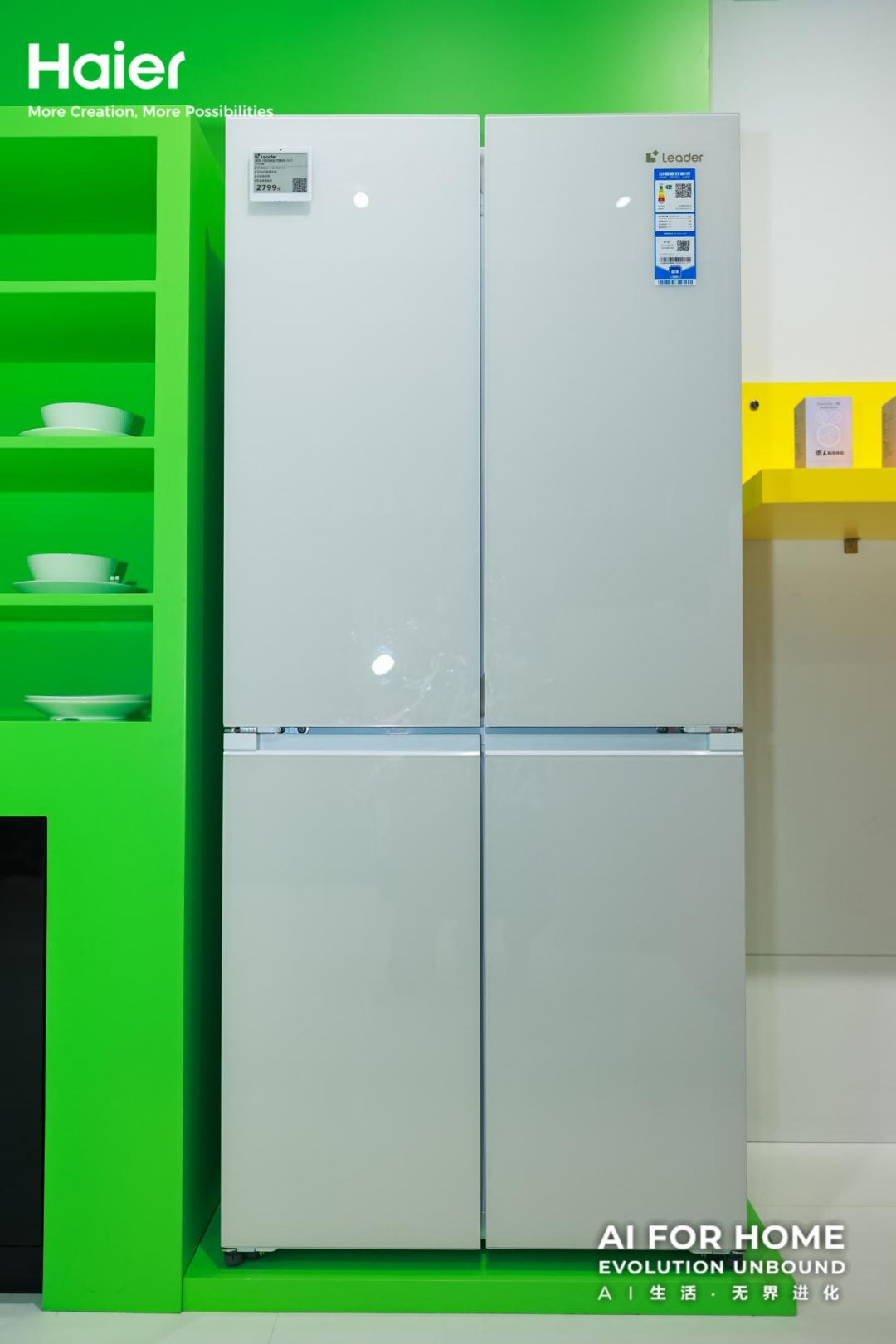
For another example, the Casarte Commander series refrigerator further expands the recognition range: it automatically creates a file once food is stored, tracks dynamically at millisecond level, and realizes food material management and reminder through visual recognition and voice interaction.
In the laundry scenario, Haier's integrated Laundry Home Smart Edition Seeker series uses AI Eye to identify the status of clothes, remind users of situations such as mixed colors, excessive foam or missed clothes, and optimize the laundry solution combined with voice interaction.
In addition, AI Eye 2.0 also brings more active execution capabilities. Devices can not only identify the environment, but also automatically make adjustments according to environmental changes.
In the common kitchen cooking scenario, the range hood and stove combination equipped with AI Eye can capture the dynamics of food materials in the pot in real time, realizing fire identification by looking at the pot and height adjustment by looking at fume. When AI Eye detects that the pot is about to boil over, it automatically reduces the firepower, and automatically increases the firepower again after the boiling stops, achieving boiling without overflow, improving cooking safety and freedom. The range hood can also actively identify the size of fume, automatically adjust the height, air volume and air pressure to intelligently purify fume. While retaining excellent performance, it also realizes the perfect integration of kitchen aesthetics and hardcore strength thanks to the full-embedded and fully hidden design.
The Seeker air conditioner displayed on site is also equipped with this technology. Combined with UWB breathing-level radar positioning technology with a detection distance of 8 meters, it can realize that the wind becomes soft when people approach, the wind blows towards people or avoids people, and automatically saves energy when no one is around, so users will not catch a cold and do not have to worry about wasting electricity by forgetting to turn off the air conditioner.
From the perspective of technical logic, this means that home appliances have begun to evolve from simple "see-passive reaction" to "see-actively participate in adjustment". This change also makes perception capability truly the basic capability of smart homes.
Household Robots: The Intelligent Evolution of Electrical Appliances Gains Execution Capability
The popularity of embodied intelligence is self-evident. The leap from home electrical appliances to household robots may come faster than we imagined.
In the traditional so-called smart home, smart home appliances play more of an auxiliary role, and all housework is still dominated by people. The core of embodied intelligence is to truly liberate human beings.
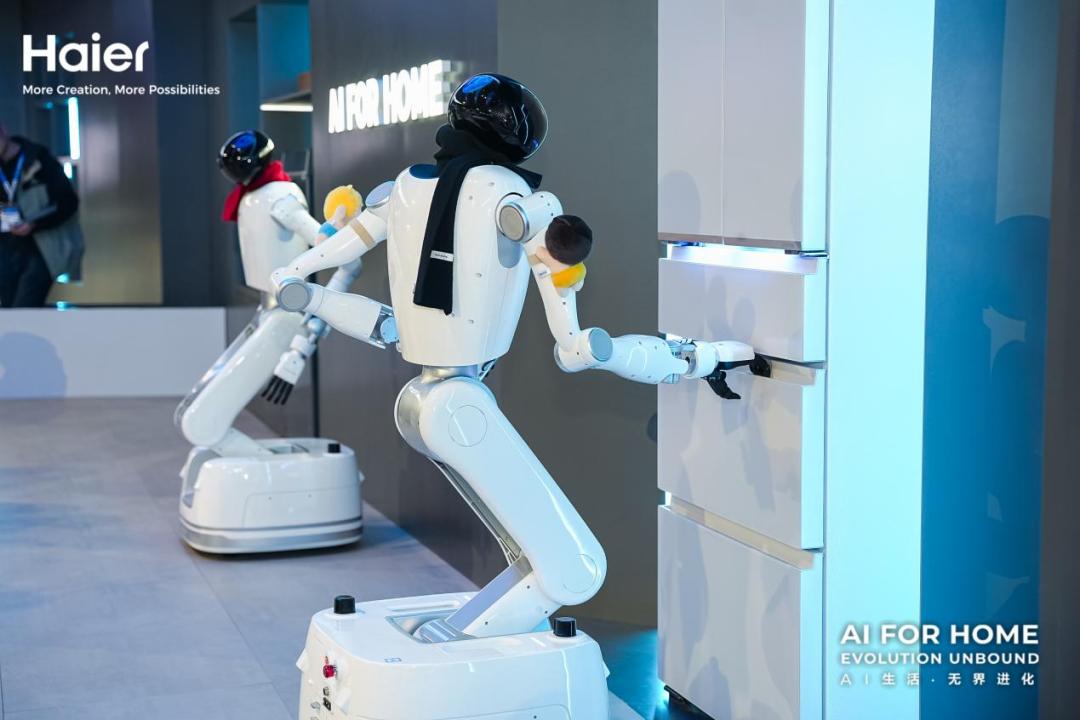
This year, Haier Smart Home also released three types of home robots: household robots, embodied cleaning robots, and companion robots. Among them, the Haierwa household robot is equipped with a VLA large model, which can accurately judge the material and posture of objects, put different food materials into corresponding areas through visual recognition, and synchronously match the best fresh-keeping mode to complete difficult housework such as taking and placing food materials and storing meals.
The Haierwa embodied cleaning robot even subverts traditional sweeping robots, realizing storage, dry and wet cleaning in 3D space, completing the upgrade from "tool" to "human substitute". Relying on AI visual capabilities, it can identify nearly a thousand kinds of household items and independently complete storage and cleaning. For dry and wet garbage, it will switch between vacuuming mode and mopping mode like a human; when encountering dead corners that are hard to reach, it can also extend to clean deeply, realizing "zero-manual cleaning housework".
The Haierwa companion robot is specially built by Haier for the elderly. It has thoughtful functions such as accurate fall detection and regular medicine taking reminder, connects with the family doctor large model to give health suggestions, and automatically contacts family members in case of abnormality. It can also control home appliances by voice, acting as a mobile control center for the whole house.
Smart Home Brain: The Decision-Making System of the Home
The dividing point between active and passive services lies in decision-making: who decides what to do next.
In Haier's smart home system, this role is undertaken by the Smart Home Brain.
The newly upgraded Haier Smart Home Brain this year runs on the smart home operating system UhomeOS. Through this system, devices in the home such as refrigerators, washing machines, air conditioners and kitchen appliances can be connected to a unified platform, and understand user demands through the vertical domain large model trained for home scenarios.
In order to make both people and AI understand the home space structure, Haier has also built a 3D digital space of the home, mapping the real home in the digital world through the Smart Home APP. Users can view and control home devices through the 3D home view, and the system can better understand the home environment based on spatial data.
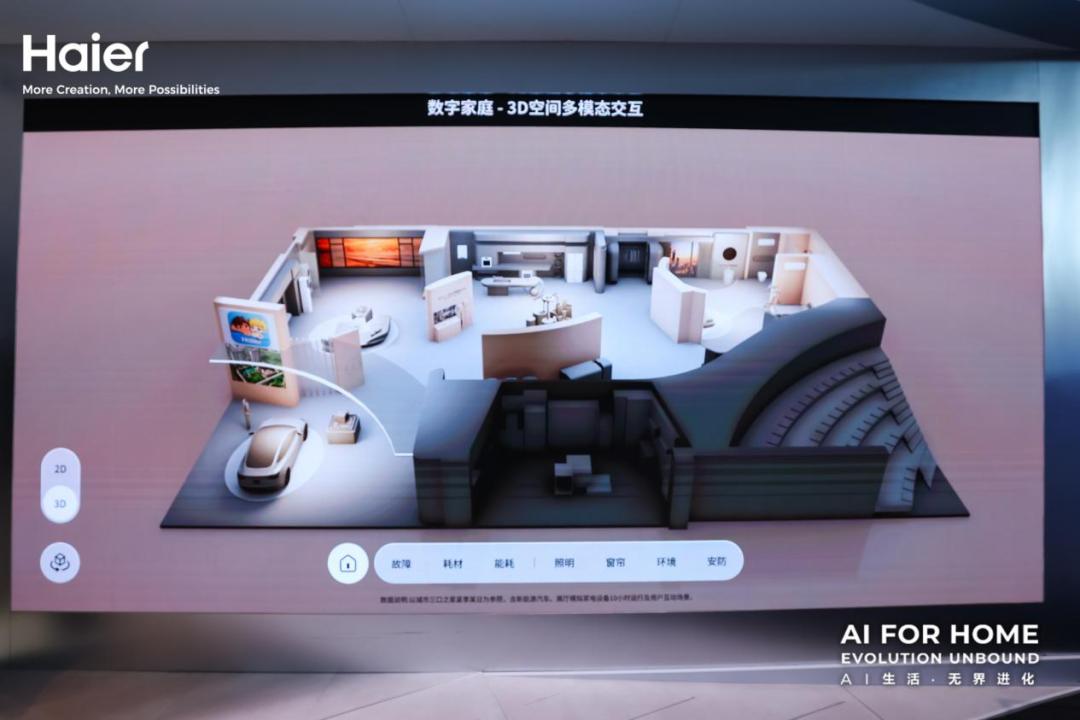
At the same time, Haier has also introduced a 3D digital twin interactive interface in the Smart Home APP. Users can view and control home devices through the 3D home view, upgrading from the past list-style control to an interaction method that is closer to the real spatial structure.
On this basis, the Smart Home Brain is responsible for understanding the space and planning tasks, while robots and home appliance devices undertake the execution role.
For example, in the scenarios showcased at AWE, kitchen cooking can trigger the interconnection of the range hood, stove and air system at the same time; in the laundry scenario, the system can identify the type of clothes and recommend a laundry solution; in the air environment scenario, the air conditioner, fresh air system and air detection equipment can form overall adjustment.
Combined with Haimily, the local computing power model for home use, Haier is actually building a "multi-robot and multi-brain collaborative" home intelligent system: the Smart Home Brain is responsible for understanding life and planning tasks, robots and home appliances undertake execution capabilities, and the network connects the entire system.
When more and more devices are connected to the same system, the home space gradually presents a new form: home appliances are no longer a simple series of single products, but form a complete "intelligent agent".
The Boundary of Smart Homes Begins to Connect to a Larger Life Ecosystem
From both industry and academic perspectives, the boundary of smart homes is expanding.
Looking only at the technical level, the smart home in the narrow sense is still only the capability upgrade within the home. But from the perspective of experts like Shang Li, smart homes are transitioning from spatial intelligence to companion intelligence. "In the past, smart homes focused on devices, while future systems will pay more attention to activities and tasks in the home space. The system needs to understand people's behaviors in the space and provide services through the collaboration of multiple devices."
If we imagine further into the future, "When AI, robotics and spatial perception technologies are further integrated, the home may become a real intelligent space. The space can understand people's demands, actively adjust the environment, and complete life tasks through various devices and robots."
This seems to coincide with Haier's strategic judgment. Haier is not even satisfied with the boundary of a single home space, but tries to build a more imaginative open ecosystem combined with its own business.
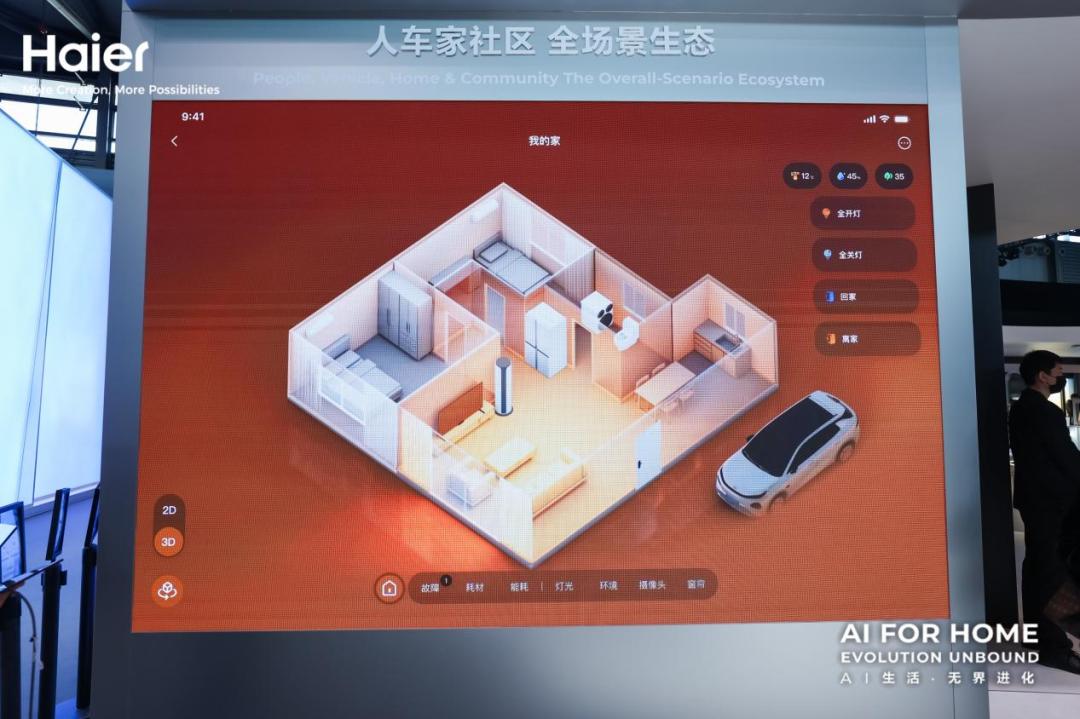
When AI begins to truly participate in family life, the home itself is becoming a new digital node. It not only connects home appliances, but also gradually connects to a larger living space. The "Human - Vehicle - Home - Community - City" system proposed by Haier is a typical expression of this extension.
You can imagine that when the home camera is connected to the community system, users can check the activities of their children in the community through the home system. Up to now, Haier has realized cooperation with Xiaodu smart glasses to achieve interconnection, and users can even remotely control home devices in external spaces.
In such scenarios, the home system has gradually become the core entrance connecting different spaces of life. It is no longer just an interconnection system between smart home appliances, but more like a continuously expandable life ecosystem.