Rooted in the underwater acoustics industry for 23 years, a doctor from the Institute of Acoustics of the Chinese Academy of Sciences starts a business, aiming to create an information blue ocean with cost-effective sonar | Exclusive report by 36Kr
Text | Azhi
36Kr learned that Zhejiang Shengwei Technology Co., Ltd., an enterprise providing solutions for marine information systems (hereinafter referred to as "Shengwei Technology"), announced the completion of an angel + round of financing of nearly ten million yuan. The investment was exclusively made by TusStar Venture Capital, and Yirong Capital served as the long - term exclusive financial advisor. The funds raised will be mainly used for product reliability optimization and production line construction.
Shengwei Technology was registered in November 2023 and officially started operation in March of the following year. It is a high - tech enterprise focusing on the research and development of underwater acoustic technology and marine informatization solutions. Its headquarters is located in Shaoxing, Zhejiang. Currently, it has a Beijing office and a wholly - owned subsidiary in Sanya.
Tian Tian, the founder of Shengwei Technology, has over 20 years of experience in underwater acoustic signal processing technology research and underwater acoustic equipment development. He graduated with a doctorate from the Institute of Acoustics, Chinese Academy of Sciences, and is a core member of the research team led by Academician Li Qihu. During his work at the research institute, he led and completed several major scientific research projects. Later, he joined the Third Research Institute of China Electronics Technology Group Corporation, founded the Underwater Acoustic Technology Research Department, and served as the department director, chief engineer, and chief expert. He expanded businesses such as underwater acoustic detection, reconnaissance, and communication from scratch and has nearly 10 years of management and industrialization experience.
Based on the core design concept of "front - end low - cost information perception equipment + back - end high - performance algorithm solutions", Shengwei Technology currently focuses on two major product segments: the miniature towed line - array underwater acoustic detection and reception system and the miniaturized deep - sea buoy. It is committed to achieving underwater acoustic detection and information acquisition in a large - scale sea area through a technical path of lightweight, low - cost, and multi - node networking, serving the needs of the national strategy of building a maritime power and underwater informatization construction.
The "Golden Window Period" of the Industry under the Guidance of Top - Level Strategy
The development of the marine industry is highly related to national strategies. As the foundation of marine informatization, underwater acoustic technology also originated from the urgent needs of national coastal defense. However, compared with European and American countries, China's marine industry started late, and basic scientific research has also gone through a long stage of catching up. In 2012, the report of the 18th National Congress of the Communist Party of China first proposed to "build a maritime power", which set a strategic goal for the development of China's marine undertakings.
The concentrated manifestation of this strategy at the industrial level is that a large number of "national team" forces that did not previously involve underwater business have begun to pour in.
In Tian Tian's view, 2015 was a landmark year. A clear sign is that groups such as China Electronics Technology Group, China Aerospace Science and Technology Corporation, and China North Industries Group Corporation began to enter the marine field to varying degrees. "I think that was a year when national needs exploded. The country made important deployments and plans in the marine field, and this strategic goal was directly translated into unprecedented resource investment."
In fact, Tian Tian joined the Third Research Institute of China Electronics Technology Group Corporation in 2015 to lead the underwater acoustic business. He described this as a "start - up within the system" process from scratch. As China's marine industry entered a decade of rapid development, the department led by Tian Tian grew from less than 10 people to more than 80 people, and the annual economic benefit increased from several million yuan at the beginning to hundreds of millions of yuan.
"The national strategic needs are huge and clear, but with the scientific research strength and talent reserve within the system at that time, it was difficult to fully undertake this historical task." Tian Tian observed that as the industry shifted from the initial extensive exploration to the rational focus stage, the organizational forms and functional divisions of participants also changed. Taking the underwater acoustic field as an example, in the past, the operation mode of the industry was more about each company bidding and competing for specific projects. But around 2022, "national team" institutions such as the Institute of Acoustics and the 715th Research Institute began to take on more of an organizer's role.
"Taking the Institute of Acoustics as an example, with less than 1000 people in the whole institute, when receiving important tasks and funds from the national level, it has to organize the available forces in the industry to complete the tasks together, which brings great opportunities to private enterprises. In addition, the continuous optimization of the military - civilian integration system also provides a clearer channel for private enterprises to participate in national defense construction."
Standing at such a historical turning point in the industry - from the national - led concentrated research to the systematic explosion with the in - depth participation of market and innovation forces, Tian Tian realized that the golden window period for entrepreneurship had arrived.
Reconstruct the Underwater Perception Logic with "Low - Cost + Multi - Node Networking"
Based on his past scientific research and industrialization experience, Tian Tian believes that traditional underwater acoustics focuses on the performance of single equipment, while modern marine informatization pursues system - level combat and network - collaborative capabilities. Large - scale, expensive, and isolated equipment systems are difficult to meet the needs of future large - scale, distributed, and systematic underwater information network construction. Therefore, the combination of underwater acoustic technology and network information system capabilities is crucial.
Shengwei Technology proposes "front - end low - cost information perception equipment + back - end high - performance algorithm solutions". Simply put, it disassembles and streamlines the single - set underwater acoustic detection systems that used to cost tens of millions and were bulky into miniaturized, low - cost perception nodes that can be deployed in batches. Through the networking and collaboration of a large number of nodes, it can achieve "area - like" coverage and continuous monitoring of a specific sea area, thereby reducing the deployment cost while surpassing a small number of high - performance single - point equipment in overall effectiveness.
Based on the above ideas, Shengwei Technology focuses on two major product segments: the (coastal) miniature towed line - array underwater acoustic signal detection and reception system and the (open - sea) miniaturized deep - sea buoy.
The traditional towed line - array technology is complex and costly, and is usually installed on large ships. Through technological innovation, Shengwei Technology has achieved low - cost and lightweight of this system, enabling it to be adapted to small and medium - sized ships and even unmanned boat platforms, reducing the threshold and application cost of underwater acoustic signal monitoring and identification. The deep - sea buoy aims to meet the long - term and concealed information monitoring needs of the deep sea and key areas. Through miniaturized design, it can reduce the difficulty of deployment and recovery. Combined with low - power consumption technology and networking capabilities, it can achieve long - term on - duty and periodic data transmission.
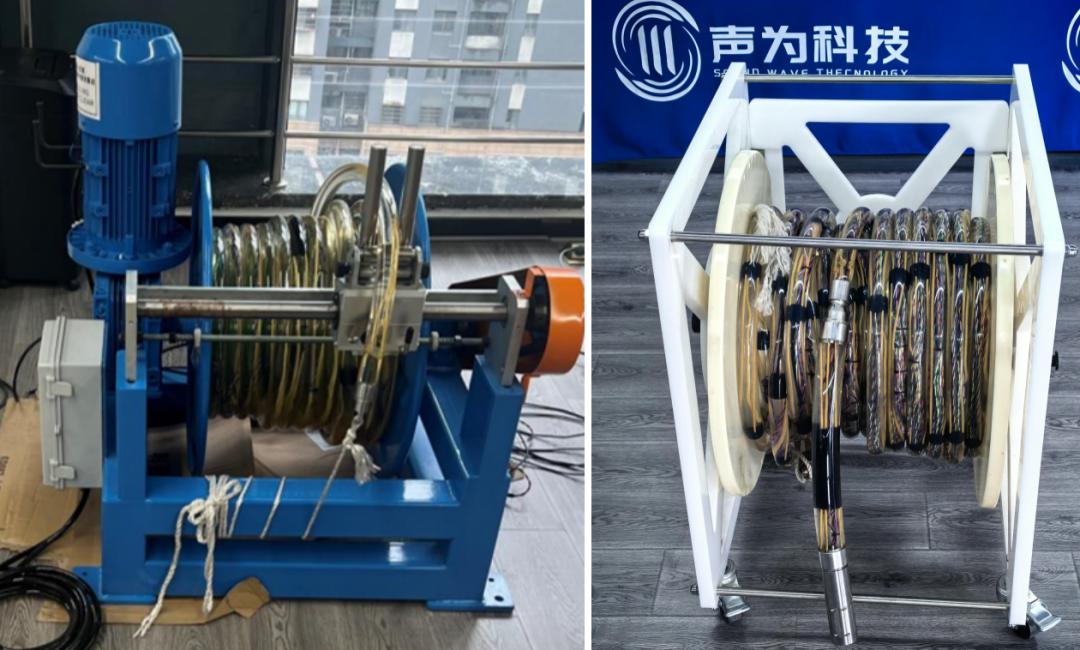
Shengwei Technology's micro - towed products and towed line - array products
These two types of products share a common goal: to build a distributed underwater information perception network that can be quickly deployed, flexibly networked, and with controllable costs.
In terms of product R & D progress, according to Tian Tian, compared with the first - generation system weighing over 700 kilograms, the weight of the second - generation miniature towed line - array underwater acoustic signal detection and reception system of Shengwei can be reduced to two or three hundred kilograms. "In the first half of this year, we will complete the sea trial of the new - generation miniature towed line - array and have received funding support from the Shaoxing Science and Technology Bureau. We are striving for a demonstration and verification project in Zhejiang Province, hoping to further complete the networking application demonstration of multiple sonar nodes."
In the aspect of deep - sea buoys, Shengwei Technology focuses on the differentiated features of miniaturization, lightweight, and deep - diving (below 1500 meters). "These keywords are contradictory in themselves. For example, it is often difficult to achieve deep - diving when making the equipment small and light, but this is also the direction of our technological research," Tian Tian mentioned. The team plans to complete the sea trial of the prototype in the second half of this year.
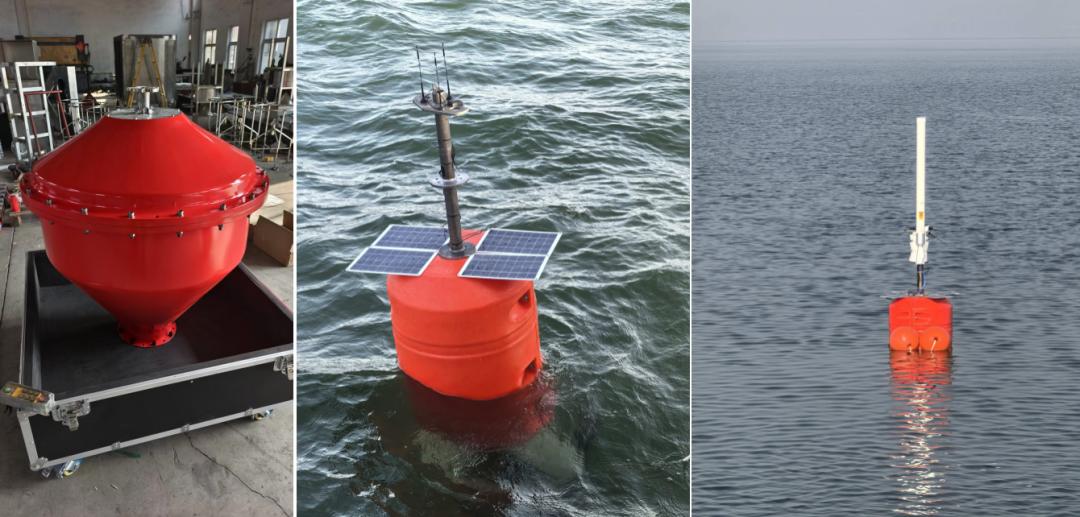
Shengwei Technology's buoy products
Open Up a Wider Range of Application Scenarios with "Cost - Effectiveness"
Returning to the most fundamental issue of large - scale product application: how to reduce costs? Tian Tian's answer is to improve "cost - effectiveness" without reducing the quality and specifications of materials.
According to physical laws, the larger the antenna aperture (size), the stronger the detection ability. When the equipment is made smaller, the detection ability will inevitably decline. The core technology of Shengwei Technology lies in through innovative array design, signal processing algorithms, etc., while reducing the system scale to a fraction of the original and significantly reducing the cost, making the decline rate of the detection ability much lower than the decline rate of the cost.
"For example, if we can use five sets of small sonars to cover the area originally covered by one large sonar, and the performance basically meets the requirements, but the total cost of these five sets is only one - quarter of the original large sonar, this is the improvement of cost - effectiveness we pursue."
In addition, the reduction of the system scale also means lower requirements for the carrying platform, which greatly increases the deployment flexibility and the coverage of application scenarios. There are a limited number of large ships in China, while there are a large number of small ships, which is conducive to achieving a wider coverage of marine information.
In terms of business model, Shengwei Technology adopts a model that combines "product sales + customized system integration and algorithm services", focusing on project - based cooperation. Currently, the main customers of Shengwei Technology are military research institutes, central state - owned enterprises, universities, and marine research institutions.
It is reported that the company is cooperating with several general units to promote the embedding of its products and solutions into a larger underwater information system for verification. In 2025, Shengwei Technology's sales revenue exceeded ten million yuan, and it plans to achieve a revenue of over 30 million yuan in 2026.
In terms of production capacity construction, Shengwei Technology's factory in Shaoxing is under construction, and it plans to complete the commissioning of the production line in the first half of the year. A comprehensive site integrating production, commissioning, and testing will be built in Sanya.
Currently, Shengwei Technology is in the process of a new round of financing.