Is the myth of the "10x engineer" shattered? Codes are free, but good taste is valuable.
AI is tearing our world into a "dual reality" with unprecedented force.
Investor Nikunj Kothari has found that he is living in two real - world scenarios:
One reality: Everyone is frantically using AI to restructure workflows, always anxious about falling behind and driven by the Fear of Missing Out (FOMO).
The other reality: Some still regard AI as a toy and don't take it seriously.
In the past, we often extolled the myth of the "10x engineer." They represented a height that people envied, tried to imitate, but rarely reached.
However, since the emergence of AI, a person collaborating with AI can approach this level.
The "10x engineer" is gradually changing from an unreachable ceiling to the new baseline in the industry.
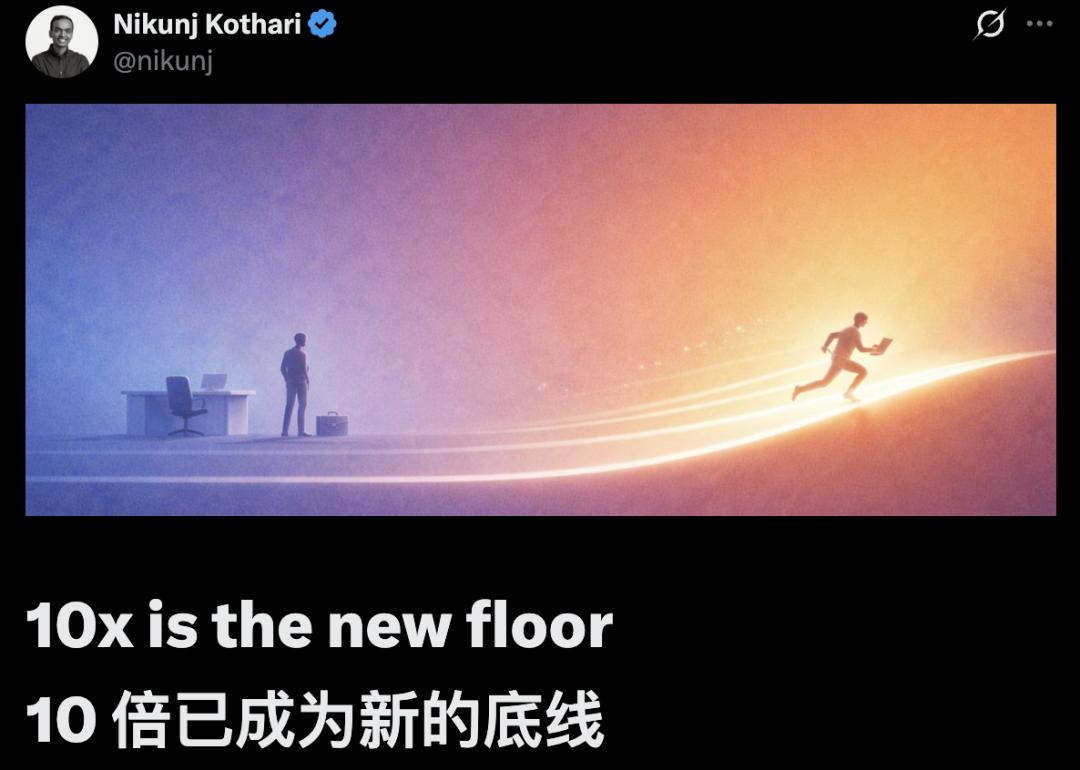
The "Dual Reality" World in the Wave of AI
The impact of AI has made Nikunj Kothari, a partner at venture - capital firm FPV Ventures, feel as if he is in a dual - reality world.
In one reality, founders are changing AI tools almost weekly, and by noon, they've already exhausted their token limits.
A solo engineer, commanding an army of agents, can easily deliver the same amount of code that a five - person team needed to handle last year.
Workflows are being rewritten repeatedly, and efficiency is constantly increasing. Yet, they still feel they're not fast enough and fear falling behind.
But in the other reality, when he sits across from executives of Fortune 500 companies, they still think large models are just toys. Some engineering vice - presidents haven't even opened Cursor.
These are people with decades of experience, yet they refuse to update their mental models. Their prior knowledge is stuck in the era when "large models couldn't even count the number of 'r's in'strawberry'."
Nikunj was surprised to find that people from these two worlds can sometimes be in the same place, like at the same dinner table.
At a recent dinner, he sat next to a vice - president of product.
This executive, with 16 years at a large company, an annual salary of $300,000, and well - managed teams, was found to have not done hands - on work for years when Nikunj asked him what he had done with AI.
In Nikunj's view, this product vice - president represents the type of people that American companies have valued most in the past half - century:
They arrive at work on time, produce steadily, and keep the system running. They are the largest group in the middle of the talent bell - curve.
In the past, the talent market generally followed a bell - curve distribution, with the largest number of people in the middle, mostly clustered around the average. Companies designed salaries and job levels based on this distribution.
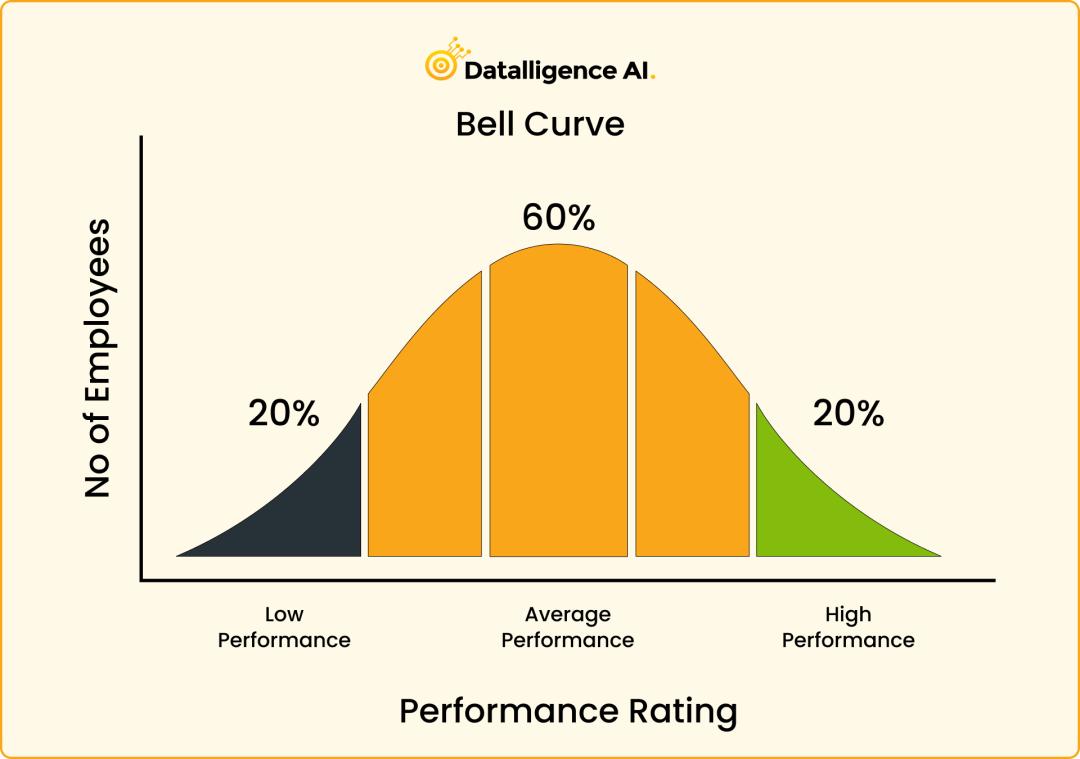
In the talent structure of the bell - curve, apart from the 10 - 20% low performers on the left and the 10 - 20% high performers on the right, the 60 - 70% average performers make up the largest group.
In the past, as long as you were stable and had strong execution ability, you could get a decent return and a certain promotion path in the middle of the bell - curve.
Under the impact of AI, the bell - curve is starting to collapse from the middle.
Nikunj has observed that the group in the middle of the bell - curve may have been caught up with or even surpassed by AI. The "execution ability" that ordinary white - collar workers were once proud of is losing its competitiveness in the face of AI.
Not long ago, Block laid off 4,000 employees at once, accounting for 40% of its total workforce.
Block CEO Jack Dorsey gave a very straightforward reason: A smaller team, equipped with AI tools, can do more and do it better.
Instead of panicking, Wall Street applauded Block's layoffs. After the layoffs, Block's stock price immediately jumped 24%.

https://www.citriniresearch.com/p/2028gic
This is why when Citrini published the paper predicting the great demise of white - collar workers, it triggered such a severe selling panic in global stock markets.
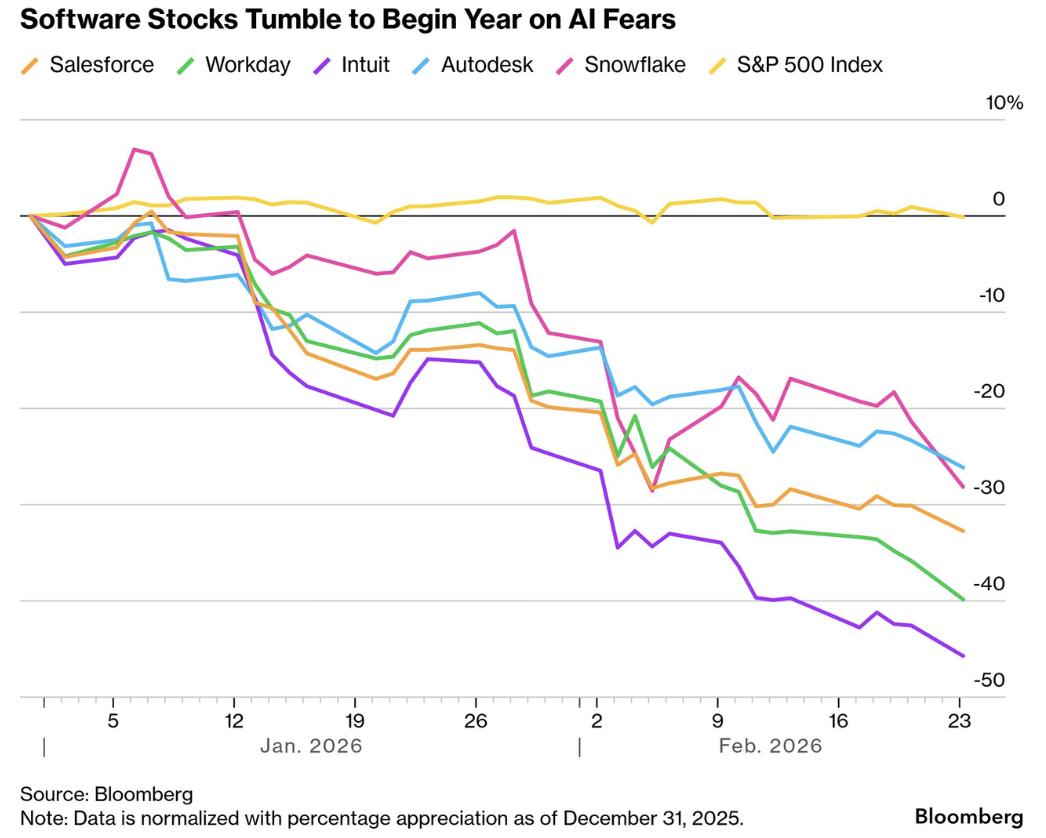
In the past, the "10x engineer" was always a mythical existence in startups. Now, this has been changed by AI. AI has raised the baseline, and a person collaborating with AI can already reach the level of a 10x engineer.
AI didn't first turn the mythical 10x engineers into 100x engineers. Instead, it raised the industry's baseline to the level of a 10x engineer, which is the right 20% range of the bell - curve, a position that only a few top - notch people could reach in the past.
Code Is Free, Research Is Everything
When the execution ability of white - collar workers is no longer highly valued, what is the most valuable now?
We may find the answer from the sky - high offers of Meta's Super Intelligence Lab.
It's reported that they're willing to offer up to $300 million in a four - year salary to top researchers.
Top quantitative investment firms are also offering $600,000 salaries to fresh undergraduate students who haven't even touched an investment portfolio.
Because a person who is good at reasoning in uncertainty is more valuable than five engineers who can only implement solutions.
In sharp contrast, writing code has become a "manual labor" that can be replaced by AI and is rapidly losing value.
Now, programming agents verified on SWE - bench are quickly taking over software engineer positions. Writing code has become a manual labor with clear benchmarks: passing tests and meeting specifications.
When anyone can create something at almost zero cost, the real gap becomes judging "what's really worth doing."
This is the fundamental difference between researchers and ordinary programmers.
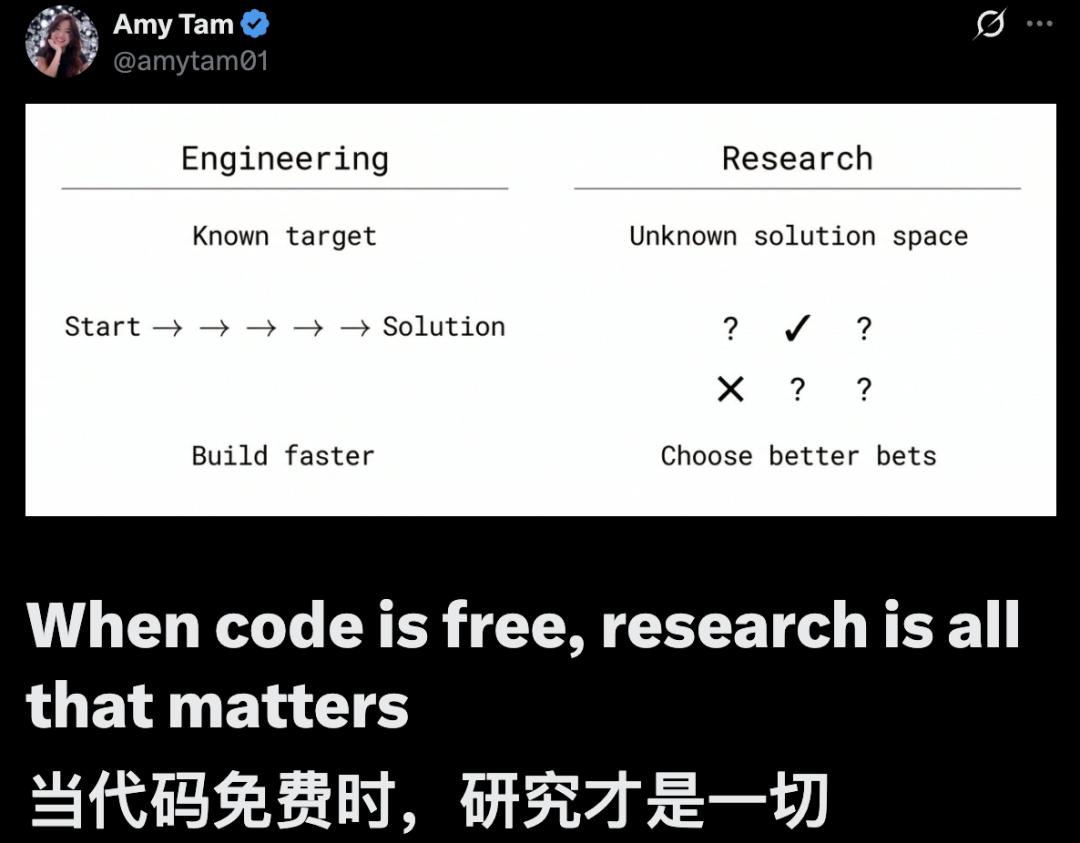
We can imagine this as a coin - tossing game in a room with one quadrillion biased coins. Your goal is to maximize the number of heads in the shortest time.
Almost all the coins may be "useless": they almost always land on tails.
Novices will toss the coins one by one, waiting for the occasional head. But top coin - tossers have an almost supernatural sense of certainty. They can keenly detect the slightest differences in the weight of the metal and the subtle misalignments during casting.
So, they'll toss many coins at once, and these coins will land on heads again and again. It may seem like luck on the surface, but in fact, it's the result of refined taste.
The taste mentioned here is exactly what AI doesn't have.
Because the most expensive training data will never appear in public papers on arXiv. Instead, it's hidden in the 100 absurd ideas that researchers discard before breakfast and in the countless failures behind the closed doors of the laboratory.
When a single model training costs hundreds of millions of dollars, a person who can select the correct loss function and improve data efficiency by a few percentage points has a "taste" that is priceless.
This "taste" of making judgments in uncertainty will become a transferable asset in the AI era and is also the most difficult ability to train and replace with automation.
What AI Transforms First May Not Be the Office
While white - collar workers are still anxious about unemployment in front of their computer screens, AI has extended its reach from the office to the broader physical world of mines, farms, and trucks.
Qasar Younis, CEO of Applied Intuition, which just raised $600 million in financing in June this year and has a valuation exceeding $15 billion, said in "Lenny's Podcast" that in the next 5 to 10 years, the real winners of this AI boom won't be software companies, but industries with blue - collar jobs such as agriculture, transportation, and mining.

Applied Intuition CEO Qasar Younis
In contrast, Qasar believes that platforms like Moltbook or OpenClaw, which excite developers, only touch a small part of society.
I like what's happening on these platforms, but to be honest, they mainly revolve around the developer community.
He believes that the biggest changes will come from adding intelligence to the machines already embedded in the real economy. That is, installing "brains" on existing physical machines.
Imagine the industries that support humanity's "survival base":
In agriculture, the average age of farmers is approaching 60, which means many will retire in the next decade, potentially exacerbating the labor shortage.
In the trucking industry, few people are eager to be truck drivers.
In mining and construction, there is a strong demand for talents with safety and autonomous operation capabilities...
For these blue - collar industries, AI is not the competitor that steals jobs as described in Citrini's paper. Instead, it's a helper, and these industries may ultimately benefit from this technology.
Due to the severe aging problem, Younis' company has been intensively testing self - driving trucks in Japan and promoting the application of AI in mining safety and efficiency.
The manufacturing industry is also waking up.
Daniel Diez, the chief commercial officer of Agility Robotics, said bluntly that global manufacturers can't find people for this job.
Jim Farley, CEO of Ford, also pointed out that AI - driven AR tools are helping technicians greatly improve the efficiency of truck repair.
In these industries, AI doesn't eliminate jobs but fills the huge labor gap.
Facing the uncertainty of traditional white - collar jobs, more and more clear - headed Generation Z employees are turning to skilled and blue - collar occupations.
The two realities mentioned by Nikunj are colliding at a speed beyond everyone's imagination.
He said that perhaps we've been calling it the wrong name from the start: AI shouldn't be called Artificial Intelligence; it should be called "Amplified Intelligence."
On one hand, it mercilessly eliminates mechanical laborers who only follow the rules and keep the system running. On the other hand, it magnifies the advantages of those with strong curiosity and initiative hundreds or thousands of times.
As ordinary people, in the wave of AI transforming the old era, the only survival guide is to stop being a cog in the execution layer and become someone who can harness and command AI.
References:
https://x.com/amytam01/status/2031072399731675269%20
https://x.com/nikunj/status/2031148258912080382%20
https://www.businessinsider.com/ai-biggest-winners-farms-mines-trucks-blue-collar-software-2026-3
This article is from the WeChat official account "New Intelligence Yuan", author: New Intelligence Yuan. Republished by 36Kr with permission.