NIO's stock price soared 15%, reversing a loss of 6 billion. This time, NIO has really bounced back.
One year ago, on March 21st, when Li Bin faced a net loss of over 7 billion RMB in a single quarter and first announced the goal of achieving profitability in the fourth quarter of 2025 during an earnings conference, even those most confident in NIO found it hard to understand where his confidence came from.
One month later, the LeDao L90 made its debut at the Shanghai Auto Show. Li Bin sat in the open front trunk to demonstrate the "fishing" scenario. I heard two colleagues beside me chatting: With such a strange design, it's really hard to see any hope for NIO to turn the tables.
However, to most people's surprise, the oversized "front trunk" almost became a synonym for technological advancement in pure - electric vehicles, attracting tributes from many competing products in the industry and gradually becoming a standard feature. In the second half of 2025, NIO increased its single - quarter delivery volume from 42,000 to 124,000 with two full - size SUVs equipped with front trunks as standard.
Meanwhile, the company achieved a remarkable turnaround, moving from a loss of nearly 6 billion RMB in the first quarter to a net profit of 720 million RMB in the fourth quarter.
As of press time, the stock prices of NIO on the Hong Kong and US stock markets have both soared by over 15%, and its market value in Hong Kong has returned to the 100 - billion mark.

Li Bin first demonstrated the "front trunk" function at the 2025 Shanghai Auto Show | Source: Video screenshot
Blockbuster + Hot sales = Profitability
Let's start with the conclusion: The core reason for NIO to turn a profit in the fourth quarter can be summed up in four words: both volume and price increase.
In the fourth quarter, NIO delivered over 124,000 new cars, about 37,700 more than in the third quarter. Interestingly, according to the delivery information released by NIO's official social media, the delivery volume of the new ES8 with an average price of over 400,000 RMB was around 40,000 in the fourth quarter. The gross profit per vehicle of this new model is close to 25%.
It was the large - scale sales of this high - gross - profit model that balanced NIO's accounts. As a direct result, the automotive sales revenue in Q4 soared by 12.4 billion RMB compared with the previous quarter; the average selling price (ASP) per vehicle increased by 33,000 RMB; more importantly, the gross profit margin of the whole vehicle was raised from 14.7% in the third quarter to 18.1%.
Let's do a simple reverse deduction: If NIO had only managed to "sell more", would the accounts add up?
Assuming NIO could only maintain the 14.7% gross profit margin level of the third quarter in Q4, even if it sold 124,000 vehicles, its gross profit would be about 1.06 billion RMB less than the actual amount. Subtracting this difference from the existing profit, NIO would still be one step away from achieving profitability. So, scale can indeed reduce costs, but it's also the sales proportion of high - premium models that helped NIO cross the break - even point.
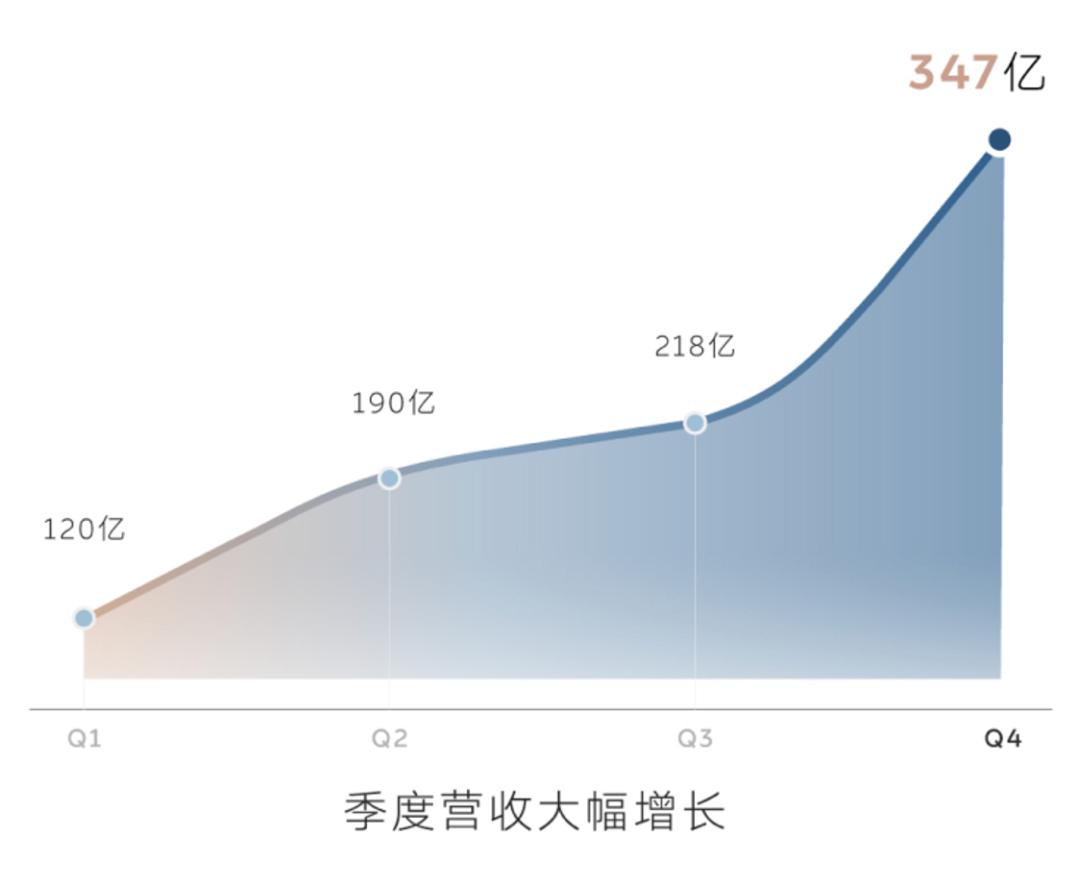
In 2025, NIO's single - quarter revenue increased significantly | Source: NIO
Now, let's look at the input side. If you only look at the whole - year picture, NIO's selling, general and administrative expenses (SG&A) in 2025 hardly changed. However, this actually masked a very crucial financial turning point that occurred in the fourth quarter - the "scissors gap" of cost - reduction and efficiency - improvement finally closed.
In the fourth quarter, NIO's two former "money - guzzlers" both saw rare double - digit year - on - year and quarter - on - quarter drops. The selling and administrative expenses decreased by 15.5% quarter - on - quarter and contracted by 27.5% year - on - year. This means that after the intensive early - stage channel construction of the three brands NIO, LeDao, and Firefly, NIO has survived the most money - burning "territory - expansion" stage. The management's drastic "organizational optimization" has started to show results, and the company no longer relies on extensive money - burning for volume but truly pursues operational efficiency.
Secondly, it's the R & D expenses (R&D) that really saw a significant cut. The R & D expenses in the fourth quarter decreased by 44.3% year - on - year. Looking at the whole year, it saved about 2.4 billion RMB compared with the previous year (a year - on - year decrease of 18.7%). This is not just about "tightening the belt", but a natural transition in the business cycle. It sends a very clear signal: The peak of NIO's multi - billion - level investment in underlying technologies (such as self - developed intelligent driving chips and vehicle platforms) in the early stage has reached a temporary peak, and it has now officially entered the "profit - harvesting period" where technologies are widely applied to vehicles and costs are amortized.
In summary, NIO's financial model for this wave of profitability is a precise combination: at the front end, high - gross - profit models have a blow - out sales volume to "generate blood crazily", and at the back end, it benefits from "structural cost control" after passing the peak of infrastructure and R & D investment to stop the bleeding significantly. With the increase in income and the reduction in expenditure, NIO finally crossed the break - even line in the fourth quarter for the first time in history.
No longer hiding the meat in the rice
If we carefully analyze NIO's sales volume in the fourth quarter, we can find an interesting phenomenon: Compared with the previous model of scattered sales among multiple models, the concentration effect of "blockbuster" models is now very obvious.
The three models, the new ES8, LeDao L90, and Firefly, together accounted for nearly two - thirds of the company's sales volume.

The third - generation ES8 achieved 70,000 deliveries in 160 days after its launch | Source: NIO
Regarding the birth of the blockbusters, the official statement is rather grand, comparing it to the "golden age" of pure - electric large three - row SUVs. However, in the author's observation, from a more fundamental and detailed level, NIO has really listened to the advice in these three models and made its systematic advantages pragmatically realized.
The first intuitive feeling is that the distance between NIO and its users has become much closer than before.
In the past, almost every NIO model first emphasized the advantage of "battery swapping". This easily created an information cocoon: because battery swapping is ultimately an "experience improvement" that requires time to feel, rather than a high - value appearance or a price - competitive image that can attract people at first sight.
So, in my opinion, NIO has actually fine - tuned its strategy. The third - generation ES8 has everything and is nearly 100,000 RMB cheaper than the second - generation model at the starting price. It's no exaggeration to say that all the second - generation ES8 owners around me have gone for test drives and are considering replacement; the LeDao L90, a three - row pure - electric SUV over 5.1 meters long, is only about 2,000 RMB more expensive than the Tesla Model Y; the small Firefly has not been connected to NIO's battery - swapping system yet (it has to wait for the fifth - generation battery - swapping station this year), but it still contributes a monthly sales volume of 6,000 - 7,000, far more than the entry - level "5566" models.
This "pragmatic" transformation in product definition has a very metaphorical physical manifestation: the front trunk.
In the past, NIO had a strong engineer culture and was used to hiding the best technologies and the most expensive aluminum alloy materials in the chassis and suspension. This approach was like "hiding the meat in the rice" - believing that those who understand cars would naturally appreciate it. However, in the extremely competitive Chinese auto market where consumers' attention is extremely scarce, it's difficult for the general public to perceive the "deliciousness" of this "meat" during a ten - minute test drive.
Now, NIO finally understands that good meat must be put on the table and shown clearly. The return of the front trunk, the intuitive expansion of space, and the tangible cockpit configurations are all strong evidence of NIO's product logic shifting from "self - indulgence" to "user - centric".
When the product no longer has obvious shortcomings and the "visible configurations" and the "invisible chassis/battery - swapping system" form a real synergy, NIO has finally forced itself into a long - awaited positive cycle.
Hold on to the "40,000 - unit lifeline"
At the earnings conference on the evening of March 10th, NIO's executives emphasized again that they hope to achieve the full - year Non - GAAP profit target in 2026.
To achieve this goal, NIO has set a sales growth target of 40% - 50%, which means the annual delivery volume should reach between 456,000 and 489,000, with an average of about 40,000 units per month.
This marks NIO's real "break - even lifeline" in 2026 - a monthly sales volume of 40,000 units. As long as it can maintain this delivery rhythm, NIO can completely bid farewell to the stage of relying on financing for survival and enter a healthy cycle where it can be self - sufficient by selling cars even if it continues to maintain high - intensity R & D investment.
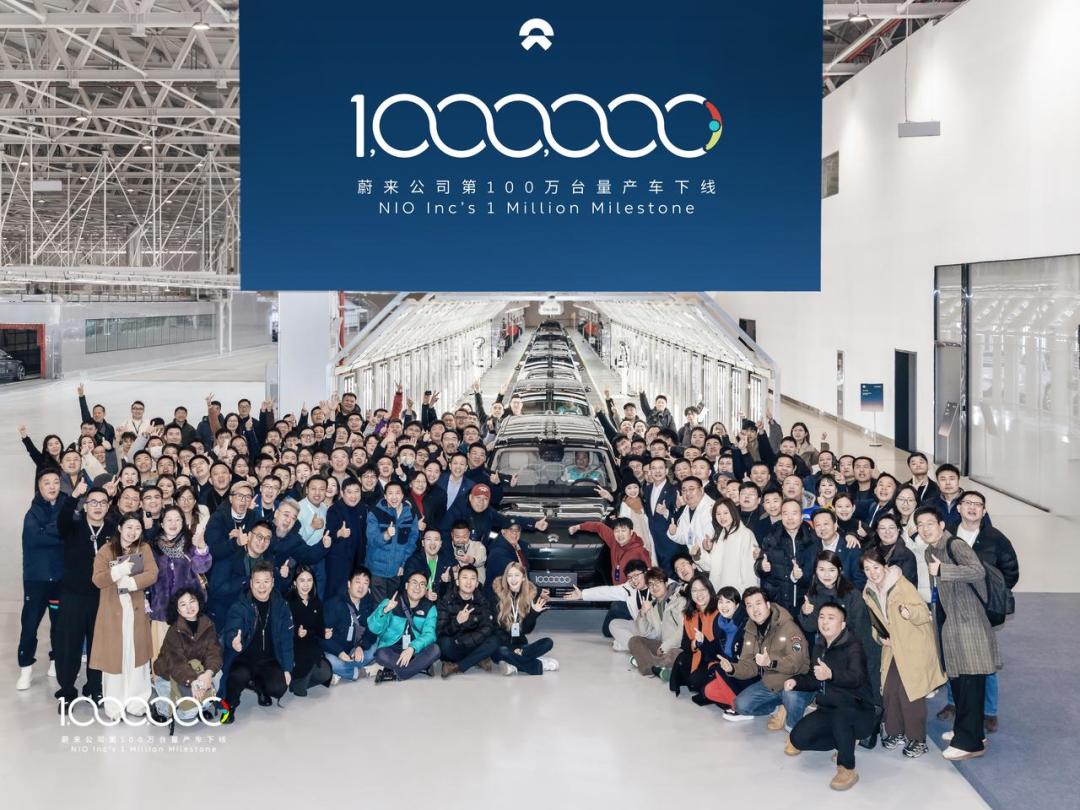
In January 2026, NIO completed the offline delivery of its 1 millionth mass - produced vehicle | Source: NIO
Of course, to turn the "monthly sales of 40,000 units" from a sprint into a norm, the external challenges are still very tough.
This year, NIO has three key models. One is the ES9, which adds advanced technologies such as the Tianxing chassis and steer - by - wire on the basis of the ES8; the other two are the large five - seat models ES7 and L80, which are moderately "fine - tuned" based on the existing two blockbusters. Judging from the product plans in the industry at present, almost every new model still faces fierce competition. In this field, the alternation between leading and lagging often lies in the definition deviation of one or two core products.
Before the Spring Festival, Li Bin used the philosophy in Go, "A good move is one without obvious tricks", to express his current thinking at a media conference. In his view, the intelligent electric vehicle industry is entering an "endless game without shortcuts", and meticulous calculation of execution and cost may be a more reliable and perceptible moat than the external brand halo.
After crossing the 1 - million - unit starting line, NIO is finding its own rhythm. The second half of NIO's journey has just begun.
This article is from the WeChat official account "GeekPark" (ID: geekpark), author: Cao Siqi, editor: Zheng Xuan, published by 36Kr with authorization.