Can Pop Mart and similar companies return to the A-share market?
Author | Wang Hanyu
Editor | Zhang Fan
On March 6th, Wu Qing, the Chairman of the China Securities Regulatory Commission, stated at a press conference on the economic theme during the Fourth Session of the 14th National People's Congress that a more precise and inclusive set of listing standards will be added to the Growth Enterprise Market (GEM). He also specifically mentioned actively supporting high - quality innovative and entrepreneurial enterprises in new consumption and modern service industries to issue and list on the GEM.
This statement is interpreted by the market as a signal that the GEM is opening its doors to new consumption and modern service industry enterprises.
For a long time before, due to the strict requirements of the listing standards of the A - share main board and the GEM on "profitability" and "hard - technology" attributes, a large number of leading companies in the new consumption field, such as Pop Mart and Miniso, had to "settle for the next best" and choose to list in Hong Kong. If this reform is implemented, it is expected to change the investment expectations in the primary market and drive the reshaping of the valuation of the A - share consumption sector.
Why doesn't the A - share market "want" consumer companies?
Looking back at the A - share IPO market in recent years, its sector structure shows an obvious characteristic of "emphasizing manufacturing and neglecting consumption".
According to the statistical data from Flush, in 2025, A - share IPO companies were mainly concentrated in the manufacturing industry, with as many as 100 companies, accounting for 86.21%. There were only 3 companies in the wholesale and retail industry, and only 2 companies in the information transmission, software, and information technology service industry.
This structure reflects to some extent the orientation of the regulatory authorities: Consumer companies usually have abundant cash flows, and their financing needs are not as urgent as those of technology companies. At the same time, some new consumption models are often questioned due to unstable profit models in the initial stage, which further reduces their priority for listing on the A - share market.
Looking at the current three sets of listing standards on the GEM, they all set relatively high thresholds for the profitability or revenue scale of enterprises. The first set of standards requires that "the net profits in the past two years are both positive and the cumulative net profit is not less than 100 million yuan". The second set of standards involves a combination of requirements for "market value + revenue + profit". Although the third set of standards relaxes the profit requirements, it still requires that "the market value is not less than 5 billion yuan and the revenue is not less than 300 million yuan".
For new consumption enterprises in the rapid expansion stage that have not yet achieved stable profitability, most of them are difficult to meet these requirements. Especially against the background of the overall slowdown of the A - share IPO rhythm after the "August 27 New Policy" in 2023, the limited listing quotas have further compressed the listing space for consumer companies.
At the same time, the Hong Kong stock market has become the first choice for a number of consumer star companies to conduct IPOs. Throughout 2025, a total of 119 new stocks were listed on the Hong Kong stock market, with a total IPO fundraising of HK$285.693 billion. Among them, optional consumption became the fifth - ranked industry in terms of IPO fundraising scale, with a fundraising amount of HK$4.931 billion.
Wind data shows that as of February 9th this year, there are still 67 consumer industry enterprises queuing up for listing on the Hong Kong stock market.
Why does the A - share market embrace "new consumption" again?
The regulatory authorities' specific mention of "new consumption" and "modern service industries" this time may mean a change in their attitude towards the consumer industry.
Although the A - share market has been relatively cautious about consumer companies in the past, a number of new consumption bull stocks have emerged in the Hong Kong stock market.
Take Pop Mart as an example. Although many institutions believe that its valuation is seriously underestimated, its stock price still performed brilliantly in 2025, with a cumulative increase of more than 110% and an annualized return rate of 112.79%. Guming also received high recognition in the Hong Kong stock market, with a cumulative increase of 157.24% since its listing in February last year and an annualized return rate of 192.61%.
The performance of these enterprises in the Hong Kong stock market proves that new consumption models not only have sustainable profitability but also can create substantial returns for investors. If such targets return to the A - share market, it is expected to increase channels for residents to increase their wealth and thus contribute to the long - term healthy development of the capital market.
On the other hand, the biggest beneficiaries of this reform of the GEM listing standards may be the leading new consumption enterprises that are already listed in Hong Kong, whose profitability has been gradually verified but whose value is underestimated.
Still taking Pop Mart as an example, as the leading enterprise in the current trendy toy industry, its valuation was suppressed for a long time before 2025. Last year, it also experienced a process of valuation regression from fanaticism to rationality. Currently, its valuation is still fluctuating downward, and the dynamic price - to - earnings ratio has fallen below 40 times.
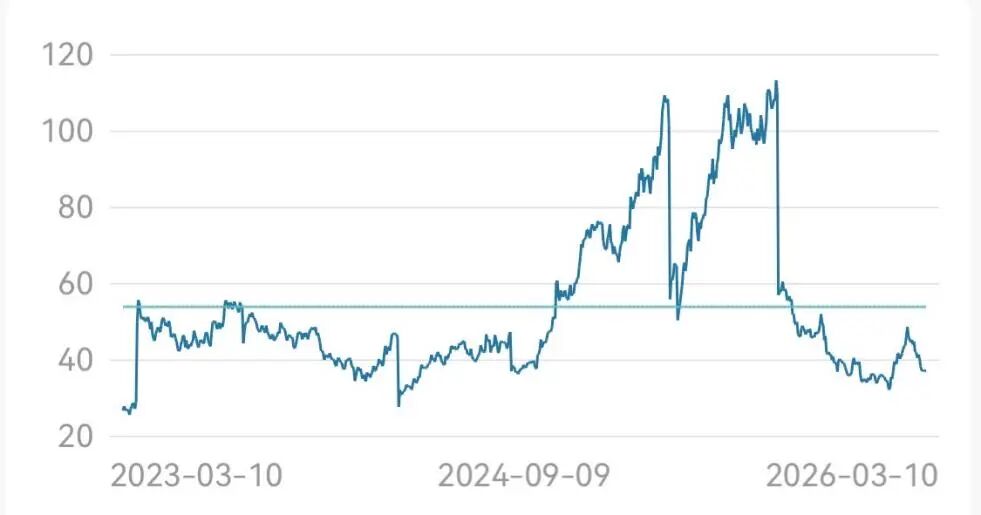
Changes in Pop Mart's H - share PE (TTM) in the past three years. Source: Wind
However, according to a research report from Puyin International, it believes that since the beginning of 2026, Pop Mart's domestic revenue has shown strong growth momentum. It is estimated that Pop Mart's domestic market revenue from January to February will increase by 130% - 160% year - on - year, and the absolute value of its revenue in the second to fourth quarters of this year will also maintain the scale of the first quarter. Therefore, the institution believes that Pop Mart's current valuation is seriously underestimated.
If a fourth set of standards is added to the A - share GEM in the future, allowing eligible enterprises to conduct secondary listings or spin - off listings, Pop Mart will no longer be restricted to a single capital market. It will have more options for capital operation during the stage of global layout.
Back in the front - line of the consumer market, as Generation Z becomes the main consumer force, the consumption paradigm is undergoing profound changes. New consumption forms such as self - pleasing consumption, quality consumption, and spiritual consumption not only drive economic growth but also give rise to new industrial chains. Supporting the listing of such enterprises helps to improve the industry structure of the A - share market. It also provides residents with investment channels to share the dividends of new consumption.
Broadening the exit channels and changing the expectations in the primary market
From the perspective of investors, if this reform is implemented, it will also have a profound impact on the investment logic in the primary market and the valuation system in the secondary market. These impacts are not only reflected in the change of capital flow but also will reconstruct the value evaluation framework of the A - share consumption sector.
In the past, in the primary market, investment institutions were often cautious about new consumption projects because even if these projects became industry leaders, they might not be able to list on the A - share market due to unstable profitability or too new business models.
The addition of inclusive standards to the GEM provides clear expectation guidance for the primary market. This will encourage investment institutions to be more willing to invest in early - stage and small - scale projects, supporting consumer innovation enterprises that are not currently profitable but have high growth potential. In the long run, this will stimulate the enthusiasm of social capital to invest in the new consumption field, forming a positive cycle of industrial innovation and capital appreciation.
In addition, the valuation of the A - share consumption sector is higher than that of the Hong Kong stock market.
From historical data, A - share consumer companies usually enjoy a higher valuation premium than their counterparts in the Hong Kong stock market. Currently, the price - to - earnings ratio of A - share consumer stocks generally exceeds 30 times, while that of Hong Kong consumer stocks is about below 18 times.
For example, the price - to - earnings ratio of Tsingtao Brewery in the A - share market is about 18 times, while that of China Resources Beer in the Hong Kong stock market is about 13 times. The price - to - earnings ratio of Beingmate in the A - share market is about 46 times, while that of China Feihe in the Hong Kong stock market is less than 12 times.
For some leading A - share liquor companies, such as Yanghe Co., Ltd., the current price - to - earnings ratio is about 37 times, that of Shuijingfang is about 32 times, and that of Shede Wine Co., Ltd. is as high as 111 times.
Due to the structural factor that the weight of optional consumption such as retail, catering, and clothing is higher in the Hong Kong stock market, its valuation level is often more elastic in response to the consumption recovery. While the A - share market is mainly composed of essential consumption, and its valuation is more resistant to decline.
The valuation difference between the two markets means that once new consumption enterprises gain access to return to the A - share market, their market value management space will be opened up, which is of positive significance for improving shareholder returns and attracting long - term funds.
For the A - share consumption sector, for a long time, the A - share consumption sector has been dominated by traditional blue - chip stocks such as liquor and home appliances. The valuation system is relatively fixed. The influx of new consumption enterprises will change this pattern.
In the future, as more leading new consumption enterprises listed in Hong Kong may return to the A - share market, the valuation structure of the A - share consumption sector will also face adjustment. Enterprises with real core competitiveness and growth potential will obtain reasonable valuations, while the valuation bubbles of individual stocks relying solely on concept speculation may be squeezed. The valuation system of the entire consumption sector will tend to be more healthy and reasonable.
*Disclaimer:
The content of this article only represents the author's views.
The market is risky, and investment should be made with caution. In any case, the information in this article or the opinions expressed do not constitute investment advice to anyone. Before making an investment decision, if necessary, investors must consult professionals and make careful decisions. We have no intention to provide underwriting services or any services that require specific qualifications or licenses for the trading parties.

Follow for more information