After BYD's flash charging, is NIO's battery swapping model still valuable?
After the Spring Festival, BYD high - key launched flash charging technology, mainly promoting the ability to fully charge an electric vehicle in 10 minutes. After the news spread, the most worried one in the "automobile circle" was NIO: once the flash charging technology is popularized, the rationality of NIO's battery swapping model will be greatly discounted.
So, will NIO be "iterated" by the technology? Taking the opportunity of NIO's 2025 financial report release, let's try to answer this question. The core views of this article are as follows:
Firstly, the rebound of NIO's performance is inseparable from the battery swapping model. The separation of WENENG from NIO is equivalent to setting up a moat for the listed company. In the short term, the impact of flash charging technology on battery swapping is relatively controllable;
Secondly, the recovery of the profit margin mainly relies on the optimization of supply chain management. The increase in the delivery volume has also reduced the consumption of marketing expenses;
Thirdly, the anti - involution environment is beneficial to automobile enterprises, but NIO needs to maintain the current situation, which tests its subsequent management skills.
What impact does flash charging have on battery swapping?
2025 (especially the second half of the year) was indeed a favorable period for NIO. On the one hand, the vehicle delivery volume was significantly higher than in previous years. On the other hand, the company's operating profit finally turned positive in Q4 for the first time since its establishment, and the management could hardly hide their joy on some occasions.

There are different explanations in the market for the sharp increase in NIO's delivery volume. For example, the LeDao series launched two major models, the L80 and L90, in the second half of the year, and the NIO ES8 and ES9 also made concentrated efforts at this time. However, in our opinion, none of these factors contributed as much to NIO as battery swapping.
At the beginning of NIO's battery swapping model, the market (including myself) thought that this was NIO using the expansion of its balance sheet to replace the cost on the income statement. Simply put, the heavy - asset model of battery swapping would increase NIO's fixed - asset scale, and this model that improved the user experience could bring relevant benefits.
If this model continued to develop, although NIO's battery swapping model could boost sales in the short term, its huge asset amortization cost would also increase the cost, which might not necessarily have a positive impact on improving the operating quality. This was also a risky move. However, later, through a series of operations, the management launched WENENG (a battery asset management company affiliated with NIO), getting rid of the above - mentioned potential burden:
Every time NIO sells a BaaS vehicle (battery leasing), it sells the battery to WENENG (WENENG is not included in NIO's financial statements), and lets WENENG provide battery swapping services. This is equivalent to transferring NIO's battery assets to WENENG, greatly reducing the pressure on NIO's balance sheet. Since then, NIO can enjoy the increased revenue brought by the user experience of the battery swapping model, but does not need to bear the corresponding asset amortization pressure in the financial statements. The design of this structure is really ingenious.
How much contribution does WENENG make to NIO?
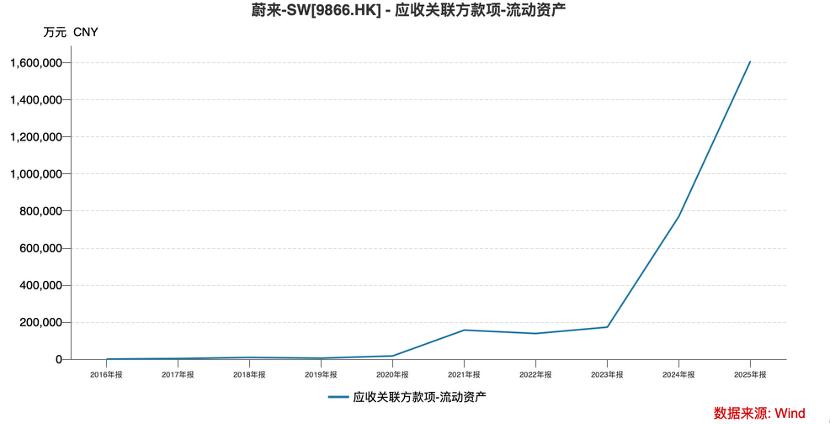
The accounts receivable from related parties in the financial statements mainly consist of the accounts receivable for the batteries sold by NIO to WENENG. It can be clearly seen that this data has skyrocketed exponentially after 2025. We can basically confirm that most NIO customers have chosen the BaaS car - buying model, that is, they only buy the car body (excluding the battery) when purchasing a car, and the battery is leased by paying a monthly rent. This model has the characteristics of a low car - buying threshold and low cost (the car insurance does not cover the battery part). Selling the car body and the battery separately is also a major innovation of NIO.
The significant increase in NIO's delivery volume in 2025 is of course related to the intensive release of its vehicle models. However, we cannot deny the contribution of the battery swapping model. Therefore, when BYD launched its flash charging technology, the "automobile circle" immediately began to worry about NIO.
In our opinion, on the surface, BYD's flash charging technology makes battery swapping no longer the only solution to the car owners' range anxiety, which indeed has a certain impact on NIO. However, based on the previous analysis, we believe that the impact of flash charging technology on NIO should be relatively controllable in the short term:
1) In addition to alleviating charging anxiety, the battery swapping model also has the advantage of lowering the car - buying threshold (after all, for those who choose NIO's BaaS service, the battery leasing cost is spread over the monthly rent, and the amount is relatively small). This is very attractive to young people and those who are eager to change cars, which is something that flash charging does not have;
2) In the above - mentioned process, NIO transferred the heavy assets related to battery swapping to WENENG. Even if flash charging affects the battery leasing business, its impact on the financial statements is relatively small (at most, it affects part of the accounts receivable from WENENG);
3) For users, the improvement of flash charging technology only gives users one more choice when facing range anxiety. It is difficult to say that one will replace the other in the short term (most of NIO's accounts receivable from WENENG should also be safe).
In terms of choosing the advanced nature of the model, the market also took some time to digest. For example, after BYD released its flash charging technology in early March, NIO's stock price immediately plummeted, which shows that a considerable number of people still think that the new technology will impact the original industry model. However, later, the market sentiment gradually stabilized, and NIO's stock price soared after the release of the financial statements, which also shows that the market has gradually digested the information and calmed down from excessive nervousness.
How does anti - involution affect NIO's profit?
Next, let's look at NIO's profitability issue.
If we look back at NIO in 2025, "cost reduction and efficiency improvement" was undoubtedly the key word.

The company's gross profit margin jumped to 13.62% that year, with the gross profit margin of automobiles being 14.6%. At the same time, the ASP (average selling price per vehicle) of automobile sales was declining. After the market competition became extremely fierce, it was difficult for enterprises to transfer upstream costs through price adjustment. The main driving force for the improvement of NIO's gross profit margin this time is the optimization of the supply chain and internal costs.
In the face of the fierce competition in the automobile industry, the prices of downstream complete vehicles are constantly being compressed, and the upstream supply chain has lost some bargaining power due to objective reasons such as the low PPI (producer price index of industrial products). When NIO's battery swapping model became successful and the delivery volume of complete vehicles increased sharply, this inevitably improved its pricing power over the upstream supply chain, and the gross profit margin began to improve.
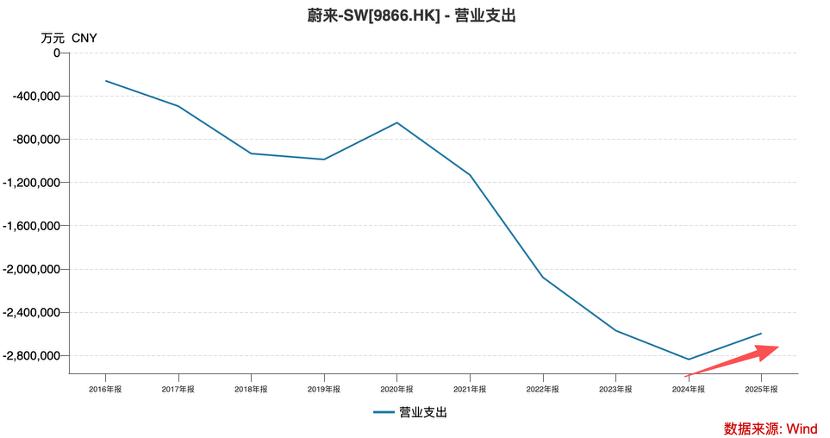
In addition, NIO's period expenses are in a compression channel. In Q4 of 2025, the selling, general and administrative expenses were 3.5 billion yuan, compared with 4.9 billion yuan in the same period of the previous year. This is the main driving force for the profit to turn positive in that quarter. Of course, this also confirms once again from the side that after the pressure of front - end vehicle delivery is relieved, the management is adjusting the expenditure structure and reducing unnecessary expenditures to maintain the positive operating profit as the main goal.
Many friends are also very concerned about the sustainability of the positive profit margin. Due to space limitations, I will only give some of our perspectives:
1) Since the end of last year, the senior management has been addressing the issue of disorderly competition in the automobile industry. Simply put, the model of price - cut competition among automobile manufacturers will be greatly curbed, which is of great benefit to maintaining the gross profit margin of automobile manufacturers;
2) In the short term, flash charging is still difficult to have a substantial impact on NIO's vehicle sales. Judging from the sales situation in the first two months of 2026, NIO's delivery volume is still on the rise, which creates good conditions for the continuous compression of period expenses;
3) In the short term, NIO's income statement will be in an improvement channel, but in the medium and long term, it still needs to rely on the industry's prosperity and the stable growth of its own sales volume. At that time, we need to more carefully observe the impact of flash charging on the battery swapping model.
Since its establishment, NIO has encountered numerous problems and has been on the verge of failure many times. Its products and the company have been in the spotlight for a long time, and it has finally waited for a good time in 2025. So far, the company's business model has been gradually improved, and the management of the supply chain has basically got on the right track. Next, we also hope that the company can maintain the current situation and keep the current development trend, which is worthy of the car owners and the majority of investors.