Jensen Huang joins hands with former OpenAI executives, and 1 gigawatt of super computing power will be available next year.
1 gigawatt, tens of billions of dollars.
Just now, Mira Murati, a former OpenAI executive and a legendary female entrepreneur in Silicon Valley, and her startup company reached a long - term "gigawatt - level" strategic cooperation with Jensen Huang, the helmsman of the four - trillion - dollar chip empire!

Jensen Huang, CEO of NVIDIA (left) and Mira Murati, founder of Thinking Machines Lab (right)

https://blogs.nvidia.com/blog/nvidia-thinking-machines-lab/
According to NVIDIA's official blog, NVIDIA will jointly deploy at least 1 gigawatt of the next - generation NVIDIA Vera Rubin system with Thinking Machines Lab.
The goal of this deployment plan based on the NVIDIA Vera Rubin platform is to start at the beginning of next year. This cooperation also includes jointly designing a training and inference service system for the NVIDIA architecture, and making it easier for enterprises, scientific research institutions, and the scientific community to access cutting - edge AI and open models.
This cooperation is not an ordinary procurement.
For Mira, this is her last - ditch effort after experiencing the power storm at OpenAI and the major upheaval in the founding team of Thinking Machines Lab.
For NVIDIA, it is another important move in Jensen Huang's chess game of hundreds of billions of computing power at the peak of a $4.4 - trillion market value.
Before this cooperation, NVIDIA participated in the $2 - billion seed - round financing of Thinking Machines Lab.
This strategic cooperation and investment with Thinking Machines continues the "computing power finance" of "NVIDIA investing money for customers to buy NVIDIA chips". It is another case of NVIDIA's continuous investment in its large - scale AI chip customers after OpenAI, xAI, and CoreWeave.
In this cooperation, this model is pushed to the extreme: NVIDIA's money is included in the $2 - billion financing of Thinking Machines before, and now it uses this money to buy NVIDIA's expensive computing power.
A Marriage Worth Billions of Dollars Behind "One Gigawatt"
According to the agreement between the two parties, at the beginning of 2027, Thinking Machines will officially launch at least 1 gigawatt of NVIDIA's next - generation Vera Rubin system.
What does 1 gigawatt mean?
It's not just about tens of thousands of cards or a few rows of cabinets.
According to Jensen Huang's previous statement, the construction cost of a 1 - gigawatt AI data center is about $50 - 60 billion, of which NVIDIA products account for about $35 billion.
This means that billions of dollars in real money are flowing behind this cooperation.
The protagonist of this 1 - gigawatt computing power investment is NVIDIA's next - generation flagship platform, the Vera Rubin system.
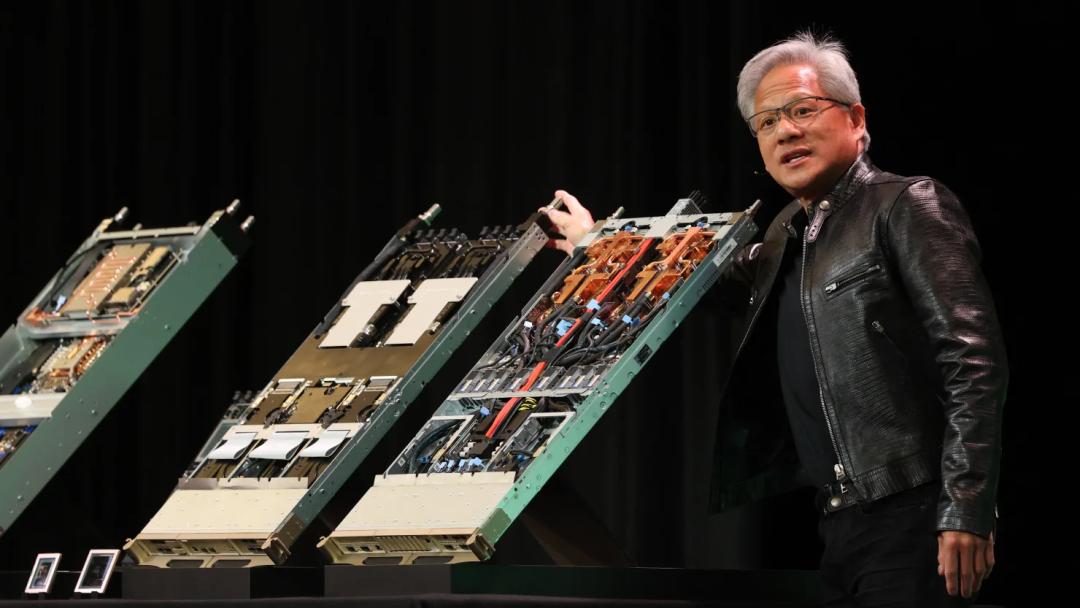
On January 6, 2026, Jensen Huang, the founder and CEO of NVIDIA, introduced the Vera Rubin AI platform at the International Consumer Electronics Show in Las Vegas.
Vera Rubin, a computing power monster composed of six brand - new chips working together, represents NVIDIA's most ambitious "leap in computing power" to date.
Compared with the previous - generation Blackwell platform, its inference token cost is amazingly reduced by 10 times, and the number of GPUs required to train the same MoE model is reduced by 75%.
According to NVIDIA's official blog, in this latest 1 - gigawatt agreement, NVIDIA added a "significant" investment.

By then, Thinking Machines will obtain a top - level computing power base to support the training of cutting - edge models. The two parties will jointly design a training and inference service system for the NVIDIA architecture, and make it easier for enterprises, scientific research institutions, and the scientific community to access cutting - edge AI and open models.
Startup Company Struggles for Computing Power Amid Executive Exodus and Turmoil
Why is Jensen Huang willing to bet such a large amount of resources on a company that has only been established for one or two years?
Actually, as early as the $2 - billion seed - round financing of Thinking Machines in July 2025, NVIDIA and its old rival AMD both appeared on the list of investors.
NVIDIA's bet on Thinking Machines is closely related to its co - founder, Murati.
The name Murati is not unfamiliar in the Silicon Valley AI circle.
She joined OpenAI in 2018 and was one of the soul figures of OpenAI.
She once served as the CTO of OpenAI and was deeply involved in the development of products such as ChatGPT, DALL - E, and the voice mode.
During the board coup at OpenAI in November 2023, she also briefly served as the interim CEO.
In February 2025, she left OpenAI and co - founded Thinking Machines.
Different from the narrative in the industry that blindly pursues "all - powerful and independent AGI", Murati chose an alternative entrepreneurial direction: AI should not only become more and more powerful, but also more understandable, customizable, and capable of collaborating with humans.
As Murati said in the cooperation announcement: "Let people be able to shape AI and truly use it for themselves, and at the same time, AI will in turn expand human potential."
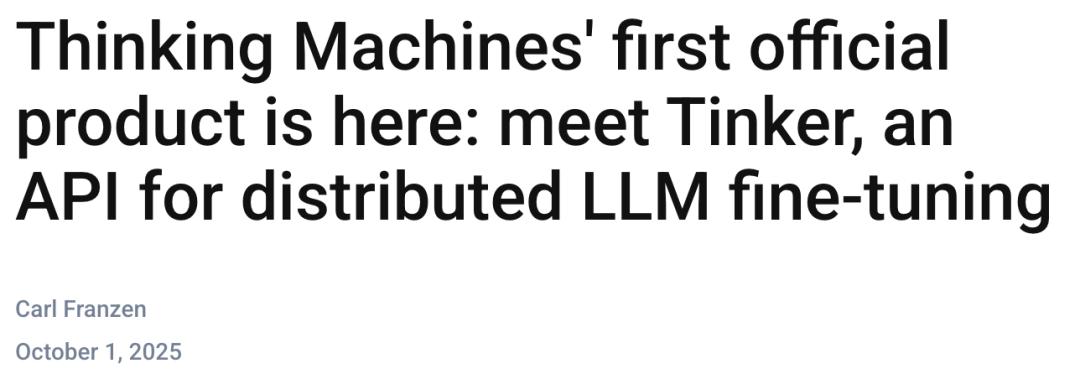
In October last year, Thinking Machines launched its first product, Tinker, an API aiming to enable enterprises to fine - tune and customize large models without building complex infrastructure on their own.
Since its establishment in February 2025, Thinking Machines has raised more than $2 billion in total, and its valuation has quickly exceeded $12 billion. The investors include Andreessen Horowitz, Accel, NVIDIA, and the venture capital department of AMD.
Its team size has also expanded from about 30 people to about 120 people, including heavy - weight figures such as John Schulman, a co - founder of OpenAI.
On the other hand, the cracks of turmoil have long appeared.
Shortly after Tinker was launched, the executive team underwent a major reshuffle.
Co - founder Andrew Tulloch left for Meta, and three other core figures, Barret Zoph, Luke Metz, and Sam Schoenholz, even made a U - turn and returned to OpenAI.
For a young laboratory that relies on "repeatable and reproducible AI results" to survive, the loss of core brains is undoubtedly a heavy blow.
At such a turbulent moment, this 1 - gigawatt computing power order is particularly crucial, undoubtedly declaring to the industry: We are still at the table, and we still have the best cards.
A Computing Power Race with No Turning Back
If you only regard this as a supply contract, you underestimate NVIDIA.
In this marriage, NVIDIA's role is extremely intriguing.
As a semiconductor giant with a market value of up to $4.4 trillion, it is injecting capital into its most important customers at an almost crazy speed.
This new deal with Thinking Machines is another case of NVIDIA's continuous investment in its large - scale AI chip customers.
OpenAI, xAI, CoreWeave, and now Thinking Machines. NVIDIA is selling shovels while giving money to gold - diggers.
This is exactly the concern of the outside world about the so - called "circular financing": NVIDIA invests cash in customers, and customers then use the financing to buy NVIDIA chips, and the funds circulate at high speed in a closed loop.
NVIDIA's money is included in the $2 - billion financing of Thinking Machines before, and now it uses this money to buy NVIDIA's expensive computing power.
Is this kind of play really healthy?
NVIDIA invests in customers with its huge cash reserves, and customers then use the raised funds to buy NVIDIA's chips. The funds circulate in a seemingly perfect closed loop, constantly pushing up the valuations and revenues of both parties.
Although NVIDIA insists that investment and revenue are completely independent and even issued a special memo to deny the accusation of supplier financing, the doubts of well - known short - selling institutions and some Wall Street analysts have not been eliminated.
But Jensen Huang doesn't seem to care about these doubts. In his view, this is a computing power arms race that allows no retreat:
By around 2030, global corporate AI infrastructure spending may reach as high as $3 - 4 trillion.
In the face of such a huge market, every investment and every order now is like a beach - landing operation.
The AI table is becoming more and more like a game for giants.
It is reported that OpenAI once gave up a strategic cooperation worth $100 billion and instead accepted a $30 - billion equity investment from NVIDIA. As early as 2025, there were rumors that it signed a historic $300 - billion computing power agreement with Oracle.
At this level, billions of dollars may just be the entry ticket.
Undercurrents Beneath the Prosperity
Currently, Thinking Machines is seeking a new round of financing, and its target valuation has soared to $50 - 60 billion.
NVIDIA's computing power order and additional investment at this time are undoubtedly providing a credit endorsement for this startup's "sky - high price".
Jensen Huang spares no praise for Thinking Machines. He says that Thinking Machines has a "world - class team" and is promoting the development of the AI frontier.
This statement is of course correct, but this "world - class team" has just experienced a major personnel upheaval, reflecting the cruelest side of AI entrepreneurship.
The departure of Andrew Tulloch, Barret Zoph, Luke Metz, Sam Schoenholz and others from the core team proves a cruel fact. Before the 1 - gigawatt computing power is officially in place, the talent loss and competition faced by Thinking Machines have reached a white - hot stage.
Money can be raised, the most advanced Vera Rubin chips can be bought, and a large amount of 1 - gigawatt electricity can be continuously supplied. However, the flow of talents that truly determine the direction makes the prospects of many AI startups like Thinking Machines full of uncertainties.
In the cooperation announcement, Murati mentioned that what she wants to do is not an AI oracle that is lofty and more and more like a black box, but a system that can be understood, shaped, and truly used by people.
NVIDIA's technology is the foundation on which the entire field is built. This cooperation accelerates our ability to build AI, allowing people to shape AI and truly use it for themselves, and at the same time, AI will in turn expand human potential.
Through Murati's words, we can see that what Thinking Machines is doing is, in a sense, a profound reflection on the current trend of large - model black - boxing and homogenization.
The cooperation between the two parties is not only about building computer rooms, but also about jointly expanding the channels for enterprises, scientific research institutions, and the scientific community to access cutting - edge AI and open models.
Pouring huge resources to light up that 1 - gigawatt large - scale network is not to create a god that replaces us, but to build a tool that makes us more powerful.
And the end of the computing power war is definitely not the infinite expansion of parameter scale, but the ultimate thinking about our own position as humans that we must face.
Reference materials:
https://techcrunch.com/2026/03/10/thinking-machines-lab-inks-massive-compute-deal-with-nvidia/
https://www.ft.com/content/a8853057-c0a3-46f6-817f-7a23e79ea4e2 - https://the-decoder.com/nvidia-and-mira-muratis-thinking-machines-lab-announce-long-term-ai-partnership/
https://blogs.nvidia.com/blog/nvidia-thinking-machines-lab/ - https://www.wsj.com/tech/ai/nvidia-invests-in-mira-muratis-thinking-machines-lab-db29dedb
https://www.aol.com/articles/ai-startup-thinking-machines-clinches-130534198.html
This article is from the WeChat official account “New Intelligence Yuan”. Author: New Intelligence Yuan. Republished by 36Kr with permission.