Has NIO turned a profit? How substantial is its profitability?
On March 10, NIO released its financial reports for Q4 and the full - year 2025.
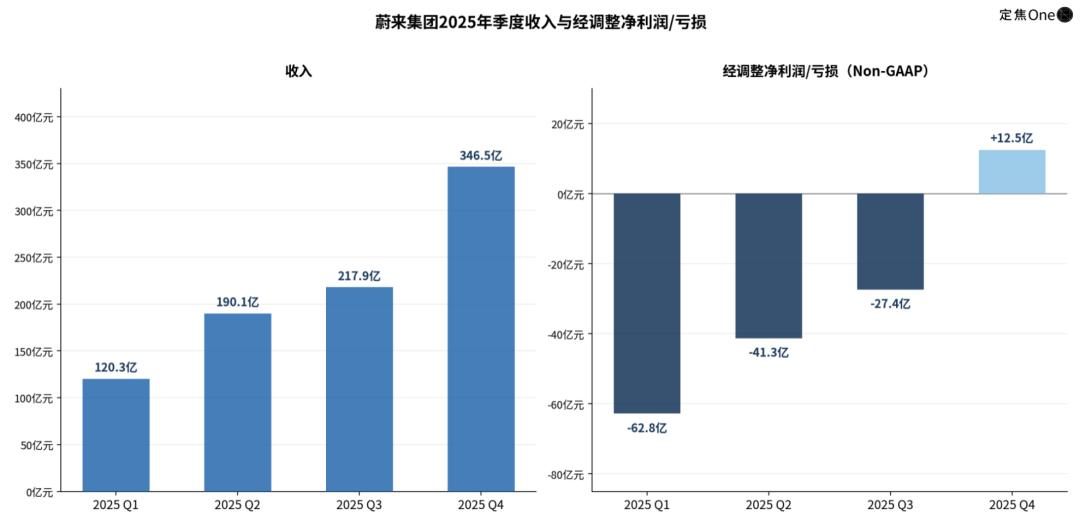
Let's start with the conclusion: NIO achieved single - quarter profitability in Q4 2025. The revenue in that quarter was 34.65 billion yuan, with a comprehensive gross profit margin of 17.5%. The operating profit was 810 million yuan, and the net profit was 280 million yuan. If factors such as equity incentives were excluded, the adjusted operating profit was 1.25 billion yuan, and the adjusted net profit was 730 million yuan. This was NIO's first time achieving positive single - quarter operating profit and net profit.
Looking at the full - year performance, NIO was still in a loss state: The full - year revenue was 87.49 billion yuan, a year - on - year increase of 33.1%. The comprehensive gross profit margin was 13.6%, which was significantly improved compared to the previous year. The operating level still had a loss of 14.04 billion yuan (adjusted operating loss of 11.51 billion yuan), and the full - year net loss was 14.94 billion yuan (adjusted net loss of 12.41 billion yuan), but it was significantly narrowed compared to the 22.4 billion yuan in 2024.
The release of this financial report coincided with the recent "debate on energy replenishment routes". Recently, BYD launched its second - generation flash - charging technology and planned to build 20,000 flash - charging stations this year. The responses from BYD's executives elevated the discussion to the "debate between gasoline and electric vehicles". Li Bin, the founder of NIO, responded that "no matter how fast ultra - fast charging is, it can't be faster than battery swapping", and listed various advantages of battery swapping, hoping that the market would believe in the future of battery swapping.
While the debate was still ongoing, the latest financial report gave a boost to NIO's stock price. After the release of the financial report, the stock prices of its US - listed and Hong Kong - listed shares both increased by nearly 15%. As of press time, NIO's market value in the US stock market was 14.154 billion US dollars (Hong Kong stock market value was 108.1 billion Hong Kong dollars).
The core of this article is to explore: What enabled NIO to turn losses into profits? Was it a "single - quarter sprint", or the beginning of a "proven business model"? Especially in 2026, when the debate between "flash - charging" and "battery swapping" is heating up, what does NIO's profitability mean?
NIO's Profits Still Come from "Selling Cars"
Let's answer the first question. What enabled NIO to make a profit in Q4 2025? It wasn't due to one - time gains to "beautify" the results. It mainly came from selling cars.
Sales volume was the foundation. In Q4 2025, the three brands of NIO delivered a total of 124,800 vehicles (67,400 vehicles of the NIO brand, 38,300 vehicles of LeDao, and 19,100 vehicles of Firefly), a year - on - year increase of 71.7% and a quarter - on - quarter increase of 43.3%. This was the highest single - quarter delivery volume for NIO and the quarter with the largest share in 2025 (326,000 vehicles), contributing 38% of the total deliveries.
However, volume alone was not enough. What really enabled NIO to cross the break - even line was the improvement in the profitability of each vehicle.
In Q4, NIO's automobile sales revenue was 31.6 billion yuan, with a cost of 25.9 billion yuan and a gross profit of 5.7 billion yuan. The gross profit margin of the whole vehicle reached 18.1%. This figure was 5 percentage points higher than the same period in 2024 and 3.4 percentage points higher than Q3 2025.

Why did the gross profit margin of automobiles increase so much in just a few quarters? Let's look at it in two stages.
The increase in the gross profit margin in Q2 and Q3 was mainly due to cost reduction. As the models on the NT3.0 platform (such as the new ES8 and new ES6) entered the mass - delivery stage, the cost per vehicle decreased from about 207,000 yuan at the end of 2024 to 188,000 yuan in Q3 2025, a reduction of nearly 20,000 yuan.
One of NIO's cost - reduction measures was to replace the expensive NVIDIA Orin - X chips with its self - developed NX9031 intelligent driving chips. Coupled with the higher parts commonality rate of the NT3.0 platform (NIO's latest vehicle technology architecture), the BOM cost of each vehicle was compressed.
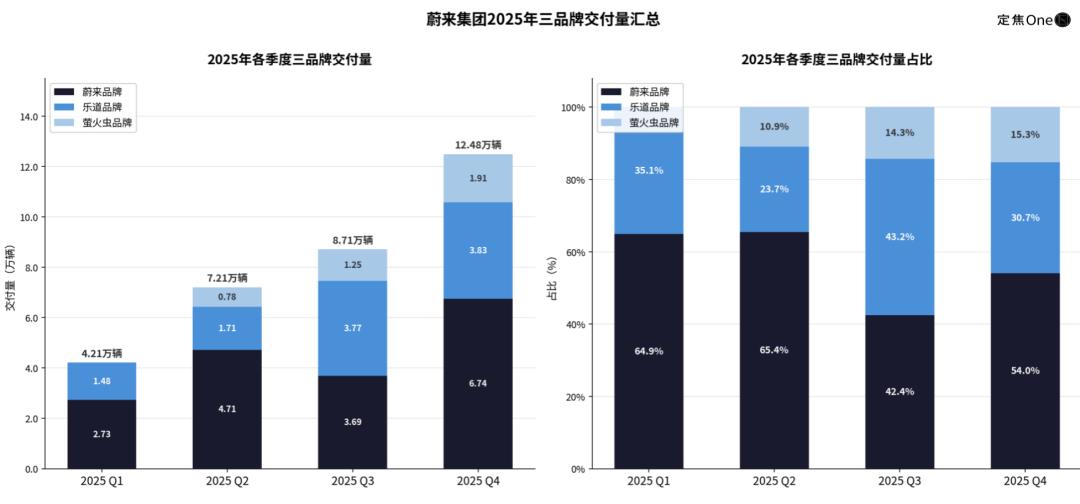
However, there was a problem in Q3: The delivery volume of LeDao (37,700 vehicles) exceeded that of the NIO brand (36,900 vehicles) for the first time, which pulled down the average price and limited the increase in the gross profit margin.
To make a profit in Q4, the product structure needed to be optimized. The NIO brand (with a starting price of over 300,000 yuan) became the sales leader again (accounting for 54% of the total delivery volume). Thanks to the mass delivery of the new ES8 (with a price of over 400,000 yuan), the average revenue per vehicle increased from about 220,000 yuan in Q3 to 253,000 yuan. As the revenue increased while the cost did not rise significantly, the gross profit margin reached 18.1%.
After raising the gross profit margin, the last hurdle was expenses.
NIO has always been criticized by the market for "spending too much". In 2025, NIO obviously started to tighten its belt.
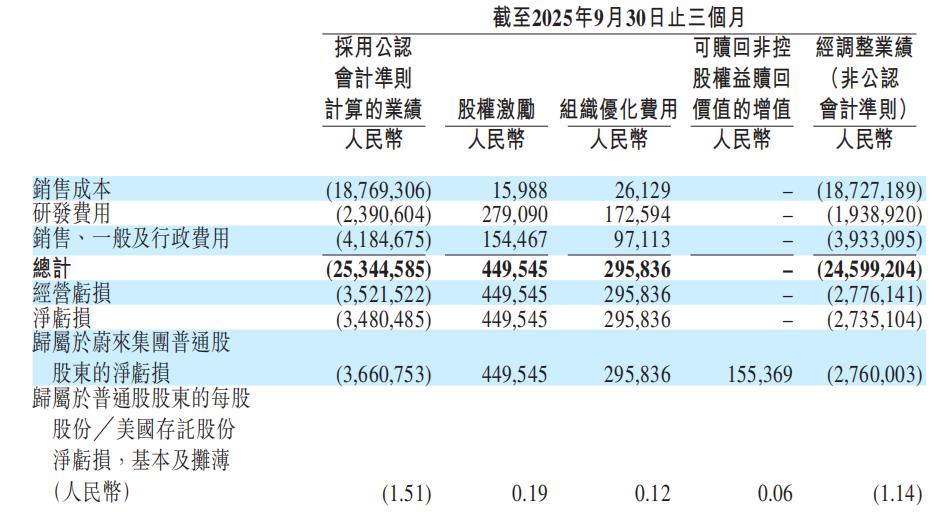
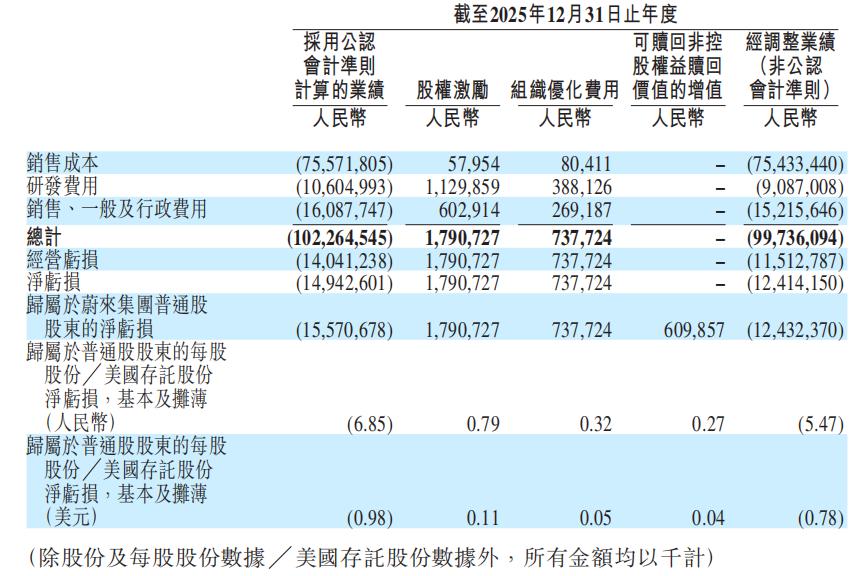
NIO listed the organizational optimization expenses in its full - year financial report, with nearly 300 million yuan in Q3. Source of the picture / NIO's 2025 financial report
The most direct action was organizational optimization. For this purpose, the total organizational optimization expenses for the whole year were about 740 million yuan (nearly 300 million yuan was recognized in Q3). Among them, the optimization expenses in the R & D department were 390 million yuan, those in the sales and administration department were 270 million yuan, and there were also 80 million yuan in optimization expenses for the cost of sales. The independent sales channel of LeDao was merged into the main NIO brand, which reduced the repeated investment in rent and manpower through channel sharing.
In Q4, the results of this round of adjustment finally showed up in the profit. The R & D expenses were compressed to 2.03 billion yuan, a year - on - year decrease of 44.3%. The sales and administration expenses dropped to 3.54 billion yuan, a year - on - year decrease of 27.5%. The total of these two expenses was 5.57 billion yuan, while the gross profit in that quarter reached 6.07 billion yuan. Coupled with about 300 million yuan in other operating income, the operating level turned positive for the first time.
Looking at the "account book" of each vehicle, it's easier to understand how NIO made a profit: In Q1, for each vehicle sold, NIO had to allocate 75,600 yuan in R & D expenses and 104,500 yuan in sales and management fees, but only earned a gross profit of 22,000 yuan. So, it suffered a net loss of 160,000 yuan for each vehicle sold. By Q4, the delivery volume reached nearly 125,000 vehicles. The R & D expenses allocated to each vehicle were compressed to 16,200 yuan, and the sales and management fees were compressed to 28,300 yuan. The total of these two finally became lower than the comprehensive gross profit of 48,700 yuan per vehicle. The operating profit per vehicle was about 6,500 yuan. After deducting the exchange loss (NIO recorded an exchange loss of 529 million yuan in Q4), it earned 2,300 yuan for each vehicle sold.
What the market was most worried about in the past was not just how much NIO lost, but whether it had a clear path to profitability. The Q4 financial report at least answered the outside world's questions: When the sales volume increases, the gross profit improves, and the expenses are controlled, there is a chance for profit to appear.
How High is the Quality of This Profitability?
Single - quarter profitability is of course a milestone for NIO, but to evaluate its quality, we need to look at it in the context of the entire new - energy vehicle market.
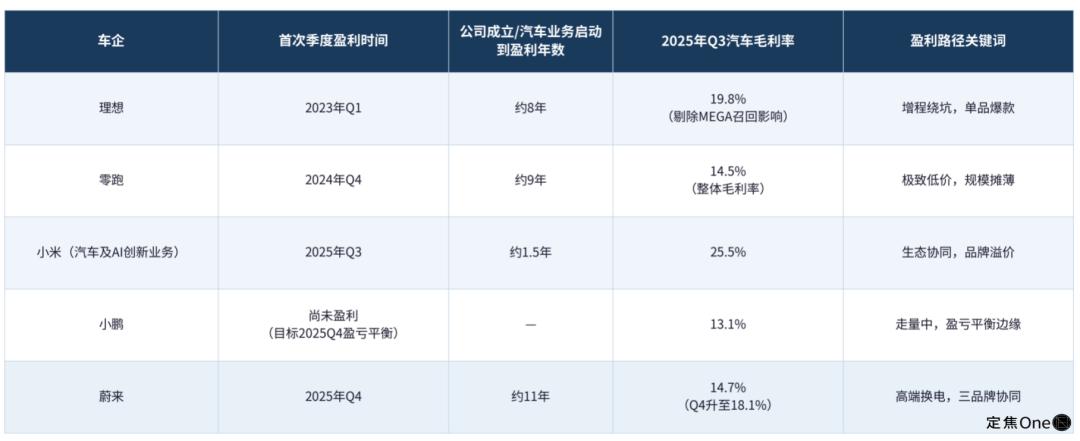
Since other new - energy vehicle startups have not released their Q4 financial reports yet, let's first look at the gross profit margin performance of each company in Q3 2025 under the same market environment.
NIO's automobile gross profit margin was 14.7%, higher than that of XPeng (13.1%), but lower than that of Leapmotor, which focuses on cost - effectiveness (14.5%), and there was a relatively large gap compared with Li Auto (19.8% after excluding the impact of the MEGA recall) and Xiaomi (25.5%).
This shows that before the scale effect in Q4, NIO's profitability from selling cars was not outstanding. However, when the scale crosses the break - even line, its high investment in R & D and brand may be converted into profit.
But why did NIO only achieve a slight single - quarter profit when its gross profit margin was approaching that of Li Auto?
The gap lies in the expenses.
During its normal - profit stage, Li Auto's gross profit margin was stable at around 20%, and its cost - control ability was leading in the industry. Leapmotor compressed its costs to the extreme and made profits through scale, achieving consecutive - quarter profitability. Xiaomi had the support of the entire group's funds and ecosystem and quickly achieved single - quarter profitability.
In contrast, NIO's comprehensive gross profit margin in Q4 was 17.5%, the R & D expense ratio was 5.8%, and the sales and administration expense ratio was 10.2%. The total of these two was close to 16%. That is to say, the gross profit margin just outperformed the most core expense ratio, and the profit margin was actually very thin.
NIO's expense ratio is difficult to reduce because it has a business model with high investment, emphasis on service, and emphasis on energy replenishment. The battery - swapping network, multi - brand operation, direct - sales and service systems lock in most of the fixed costs. This model puts more pressure on the company's scaling - up ability, capital, and operating efficiency.
Looking at the full - year performance rather than just Q4, this problem becomes clearer. In 2025, NIO still had a net loss of 14.94 billion yuan. The profit in Q4 only covered a small part of the losses in the first three quarters (about 15.2 billion yuan).
Single - quarter profitability proves that NIO has touched the threshold. Whether it can develop a stable profit model that can cover both peak and off - peak seasons and withstand annual fluctuations depends on future quarters.
NIO does have more cash on hand than in the middle of the year. The financial report shows that as of the end of 2025, NIO's cash and cash equivalents, restricted cash, short - term investments, and long - term time deposits totaled 45.9 billion yuan. However, the financial report also clearly indicated that as of December 31, 2025, the current liabilities still exceeded the current assets. NIO still cannot afford to be careless in short - term debt repayment and working - capital management.
What Does NIO Face After Achieving Profitability?
What does NIO face after achieving single - quarter profitability?
The challenges in Q1 are coming soon. NIO's delivery guidance for Q1 2026 is 80,000 to 83,000 vehicles. Although this figure represents a year - on - year increase of over 90%, compared with the 124,800 vehicles in Q4 last year, it shows a quarter - on - quarter decline of about 35%.
Part of the reason is seasonal. Q1 is the off - season for automobile sales, and the Spring Festival holiday shortens the effective sales days. When the sales volume drops, the dilution effect of various expenses is bound to be limited, and the operating profit per vehicle is likely to decline. Whether NIO can continue to make a profit in Q1 is a test of the sustainability of its profitability.

Source of the picture / NIO's official Weibo
The management set high expectations during the earnings call: achieving Non - GAAP profitability for the full - year 2026 and reaching a gross profit margin of 20% for the whole vehicle.
Whether this goal can be achieved depends largely on the performance of new models. The main brand's "5566" (ET5, ET5T, ES6, EC6) completed an upgrade in 20