The wall that blocked Doubao was pushed down by the "lobster".
While Doubao's AI mobile assistant is still in the works, three major mobile phone manufacturers, Xiaomi, Samsung, and Apple, are trying to take the lead. The key catalyst is the globally popular open - source multi - agent framework, OpenClaw.
Last week, Xiaomi launched a small - scale closed - beta test for its mobile AI Agent product, miclaw. According to the official introduction, this is an AI interaction test product built on Xiaomi's self - developed MiMo large model, aiming to explore the implementation path of the model from "conversation ability" to "system - level execution ability". Lei Jun couldn't hide his excitement. He posted three consecutive Weibo posts, calling miclaw the "Mobile Lobster".
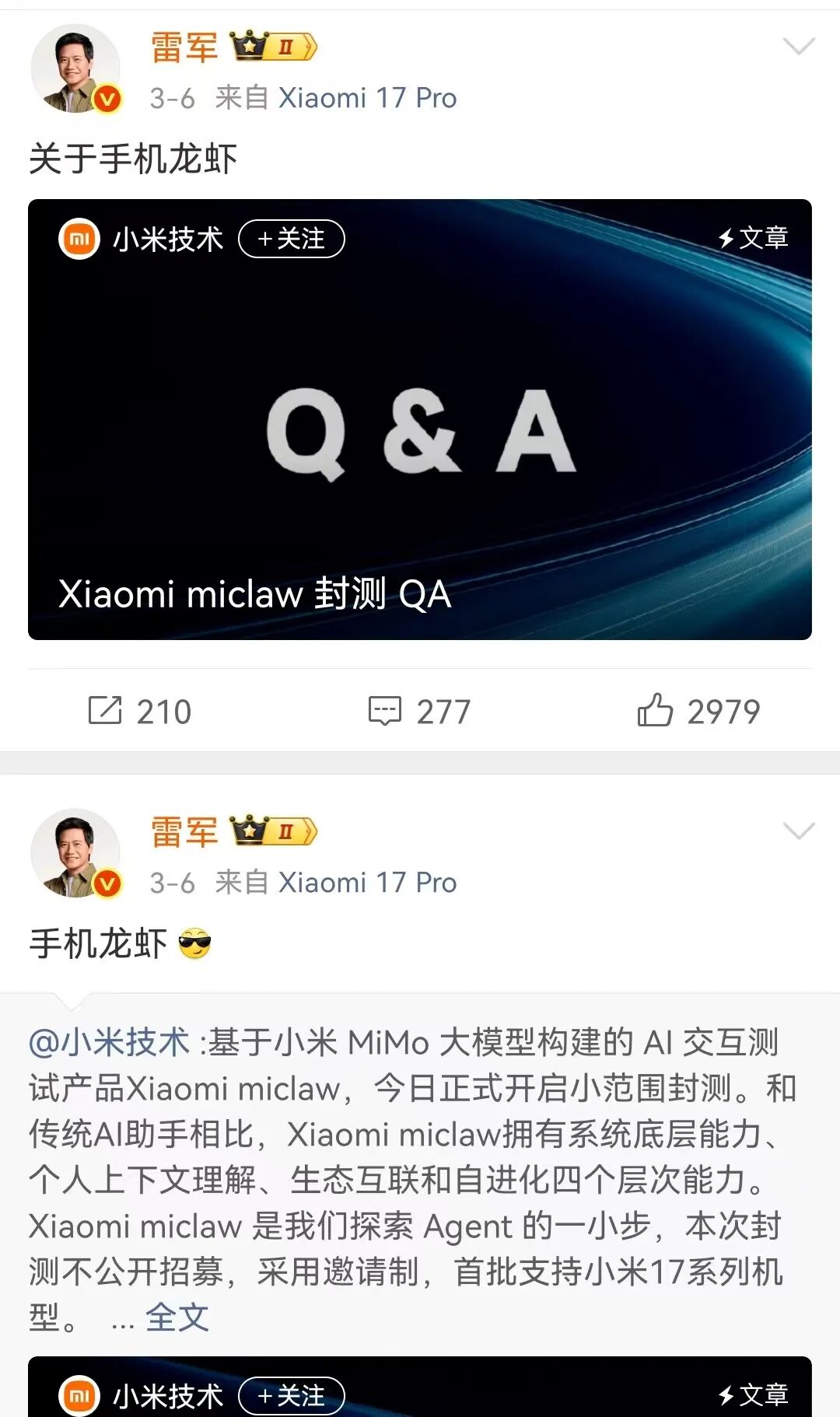
Samsung and Google are also trying to be the first to develop a mobile version of OpenClaw.
At the end of February, Samsung released its new mobile phone, the Galaxy S26. One of the biggest highlights of the new product is that it is equipped with Google's Gemini mobile agent, which can perform cross - app operations such as ordering takeout and hailing a taxi with a single click.
The combination of Samsung phones and Google Gemini on the mobile side has a very different technical path from OpenClaw on the PC side. The former requires users to actively issue requests, while the latter can actively seek tasks and complete them automatically. However, their ultimate goals are very consistent, which is to make AI more "useful" and capable of handling affairs.
If the "Mobile Lobster" is successfully developed, who will be the most threatened? It is very likely to be Apple, whose AI has been underperforming for years and whose Siri has never been able to live up to expectations.
Perhaps because it saw this clearly, Apple finally put aside its inherent arrogance at the beginning of 2026 and extended an olive branch to Google, announcing that its next - generation basic model will be built on Gemimi.
Apple's request for help from Google coincided with the one - month anniversary of OpenClaw's birth, and the global AI industry is about to enter the "Crayfish Moment". Apple, which has long served as the "searchlight" of the technology industry, still has a good sense of technology.
So far, Xiaomi, Samsung, and Apple have gathered on the mobile OpenClaw track, although their implementation methods and progress vary. These three companies are also the top three in global smartphone shipments in 2025.
More important than technology and products, OpenClaw has also proven a seemingly unsolvable problem:
How high is the general public's acceptance and trust in AI having access to personal data?
Before OpenClaw emerged, the AI industry and the entire tech circle generally believed that ordinary users pay special attention to personal information security and privacy and would not easily hand over sensitive data to software, let alone large AI models and agents in a black - box state. In the user agreements of AI companies, data security is one of the most important contents.
However, in the 100 days since the "Crayfish" swept the world, the myths and concerns about data security in the AI circle have been completely shattered by the "unscrupulous" OpenClaw with a heavy blow.
From the very beginning of its launch, OpenClaw has a natural rule: the more data and permissions users provide, the stronger and more comprehensive its capabilities will be. Tens of thousands of users flocked to it, proving with their actions that they are willing to cede a part of data control in exchange for more advanced AI technology, products, and experiences.
The users' clear stance, in turn, has prompted technology companies to make changes. Whether they are large, medium, or small companies, they are all rushing to embrace the "Crayfish" in all aspects.
In the past week, companies such as ByteDance, Alibaba, Tencent, Baidu, Dark Side of the Moon, and MiniMax have successively launched a series of OpenClaw - related services and products, such as cloud services that allow one - click deployment of OpenClaw, embedding OpenClaw in AI apps, integrating OpenClaw into instant messaging apps, and even developing OpenClaw - like products.
The full - scale integration of the "Crayfish" into major Internet products has brought about a new problem: Super apps have often used security as an excuse to keep potential competitors out. However, after opening the door to OpenClaw, the claim that "it is unsafe to integrate third - party services" is actually no longer tenable.
Just at this time, manufacturers such as Xiaomi and Samsung have begun to focus on mobile agents, and the Agent phone is taking shape. The barriers built by super apps in the name of security are being shaken by OpenClaw. Given time, the Agent phone is likely to replace super apps and become the super entrance in the AI era.
ByteDance originally had a chance to get this invaluable "early - bird ticket". However, under the siege from multiple parties, Doubao's mobile assistant has stagnated.
Now, this siege is loosening. Mobile phone manufacturers are riding on the wave of OpenClaw and moving forward at full speed, and ByteDance also has an opportunity to accelerate the development of Doubao's mobile assistant again.
01
After OpenClaw became popular on the PC side, the three major mobile phone manufacturers collectively rushed to the mobile "Crayfish" market. This battle may be another milestone for the AI industry after entering the OpenClaw era.
At present, the capabilities of the mobile "Crayfish" are far from being as comprehensive and powerful as those of OpenClaw. However, even when confined to their own software and hardware ecosystems, miclaw and similar products have still shown amazing potential, which is sufficient to prove the broad prospects of mobile Agent transformation.
However, all three manufacturers seem to be a bit cautious about how to tap this potential, as well as the intensity and method of tapping.
Companies like Xiaomi have their own characteristics in developing the "Crayfish", but they have currently imposed restrictions on themselves and are not as aggressive as Doubao's mobile assistant was before. It can even be said that they all seem to be waiting for the "passport" from super apps.
Among them, Xiaomi claims that miclaw focuses on verifying the execution ability of large models in Xiaomi's "full ecosystem of people, cars, and homes" system. The goal is to make the mobile phone a tool for AI. After understanding the user's intention and obtaining authorization, it can call on - side applications and ecological capabilities and can also independently select system - level tools to complete commands.
According to Xiaomi's introduction, miclaw has encapsulated the mobile phone's system capabilities into more than 50 system capabilities and ecological services, covering common communication, calendars, system tools, smart homes, scheduled tasks, etc.
For third - party applications, Xiaomi provides two integration methods:
One is MCP (Model Context Protocol), which is an open standard for AI tool integration. miclaw has implemented a complete MCP client, supporting standardized communication protocols, streaming responses, and asynchronous service discovery. Xiaomi says that in theory, the thousands of MCP tools already available on the PC can be directly integrated into the mobile AI.
The other is an open SDK. Third - party apps actively declare the tool capabilities they can provide, and Xiaomi miclaw dynamically discovers and calls them.
However, Xiaomi has not fully utilized the capabilities of miclaw.
For example, Xiaomi has clearly stated that there are no tools related to payment, transfer, or placing orders registered in the current version of miclaw's code. This means that without user confirmation actions such as fingerprint verification or password input, miclaw cannot perform slightly more advanced operations such as shopping and payment.
Compared with Xiaomi, the cooperation between Samsung and Google on the Agent has taken one more step, but it's just one step.
It is reported that Gemini on Samsung's new mobile phone can perform automatic cross - app operations using a GUI (Graphical User Interface) solution based on visual recognition and simulated clicks. This is similar to Doubao's mobile assistant, while miclaw does not have this ability.
At the same time, Google has also prepared "another leg" by launching the AppFunctions technical framework. Under this framework, developers can define function interfaces, and Gemini can call app functions. Compared with the GUI solution, this solution is much more conservative and stable, and it is also easier for app developers to accept.
This shows from the side that even powerful companies like Samsung and Google cannot force third - party apps, especially super apps, to accept the GUI solution and quickly integrate the agent.
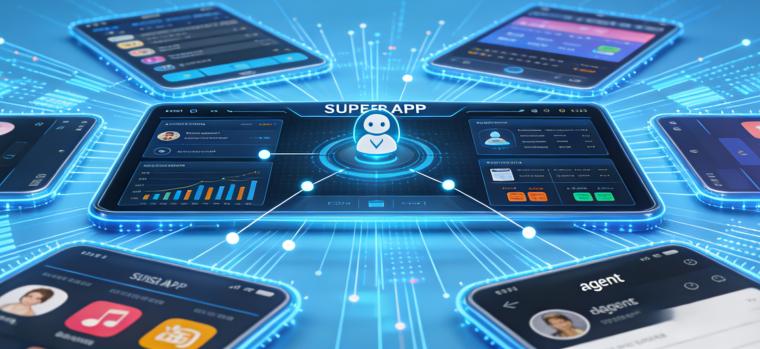
As for Apple, it obviously hopes to rely on Google to achieve a qualitative leap in the AI capabilities of the iPhone. However, at the same time, it will still focus on AI calling its own software and has not shown the attitude of letting AI control all apps.
This is not difficult to understand. Apple rarely promotes a third - party app vigorously and hopes to do everything by itself and come up with its own solutions. Even for office software where Microsoft has an absolute advantage, Apple has its own office suite to compete.
Under such a tradition, after entering the AI era, Apple is unlikely to allow the Agent on the iPhone to independently choose which apps to use. In the foreseeable future, Apple's AI will probably be an ultimate enhanced version of Siri, rather than a completely transformed Apple - version OpenClaw. This is in line with Apple's interests and is also the situation that super apps hope to see.
02
The caution of Xiaomi, Samsung, etc., may be because they don't want to over - stimulate third - party apps when the Agent technology is not yet mature and the entire closed - loop has not been fully run through. After all, the setback of Doubao's mobile assistant is a lesson from the past.
The question is, can the caution of miclaw and similar products win the "tolerance" and acceptance of super apps?
If it were in the past, the answer would probably be no.
Mobile agents naturally have a substitution effect on super apps, and they are a fundamental change that rewrites usage habits and entry logic. Even if miclaw and similar products are very "obedient", super apps have no reason to allow an additional competitor in the mobile phone.
However, the arrival of OpenClaw is quickly changing all this.
In the face of the wave of the times, super apps need to "raise crayfish" and must open the door to OpenClaw. In fact, that's what they are doing.
This creates a contradiction of "unequal treatment": since they are so actively accepting the "Crayfish", why do they reject similar domestic products?
At the same time, this move by super apps also points out a new path for others:
Only by adopting a technical solution similar to OpenClaw and building an Agent framework on the mobile side, rather than forcefully promoting GUI virtual clicks, can we avoid over - stimulating third - party apps and create a real Agent phone.
Xiaomi and Samsung have already seen this. Doubao's mobile assistant, which was once cornered, also seems to be seeing a glimmer of hope.
When this product was launched, it caused as much of a stir as the "Crayfish", but it has since followed a downward - sloping curve.
Both Doubao's mobile assistant and the prototype product of OpenClaw were unveiled at the end of November and the beginning of December last year. Although their technical principles are very different, their underlying logics are the same: to bypass complex apps/software and let AI work automatically.
One is for the mobile side, and the other is for the PC side. Doubao's mobile assistant originally had a chance to keep pace with OpenClaw. Moreover, backed by ByteDance, it has far better conditions and resources than the "Crayfish" developed by a retired foreigner.
Now, 100 days have passed. The "OpenClaw Moment" has become the hottest AI event globally, and all technology companies are desperately trying to gain an advantage, with a strong sense of FOMO.
However, Doubao's mobile assistant has had a rough fate. It was first blocked by various super apps, greatly reducing its functionality. Then, it was criticized by Ma Huateng in an internal meeting as "extremely unsafe and irresponsible", getting involved in a controversy over security and privacy.
There are many reasons for this situation, such as competition among large companies. From a technical perspective alone, the GUI solution of Doubao's mobile assistant was too advanced for the domestic technology industry in 2026.
Just at this time, OpenClaw has irresistibly knocked on the closed doors of super apps. From Feishu to QQ, from Enterprise WeChat to DingTalk, all well - known apps are rushing to integrate the "Crayfish" into their platforms.
The arrival of the OpenClaw Moment has also pointed out a new path for Doubao's mobile assistant.
An increasingly clear logic is that the Agent phone should not insist on an overly aggressive GUI solution, nor should it completely rely on apps to actively integrate (this is also the reason why Siri in the current version is underperforming). Instead, it should build a mobile version of OpenClaw, only providing the agent framework, and let the agent figure out ways to solve problems on its own.
Another potential benefit is that under the old technical path, Doubao's mobile assistant was very dependent on cooperation with mobile phone manufacturers. But if it switches to "raising crayfish on the mobile phone", its demand for hardware adaptation will decrease, and it may not even have to rely on the mobile phone manufacturers.
ByteDance has been quietly preparing.
Just this Monday, ByteDance's Volcengine launched ArkClaw, which claims to be easy to use and allows for easy "crayfish - raising". This is a cloud - based SaaS version of OpenClaw, and Tencent and Alibaba have also launched similar products. This move may imply a migration of the technical stack of Doubao's mobile assistant.
Since it became popular at the end of last year, Doubao's mobile assistant has not been updated and has been questioned because of its GUI solution. At the same time, the rise of OpenClaw has shown how AI can smoothly achieve the goal of "helping users handle affairs". The technical philosophy reflected in it is not only applicable to the PC side but also has great value for mobile agents. Fully learning from OpenClaw may be the next breakthrough for Doubao's mobile assistant.
03
From the perspective of large companies, the emergence of OpenClaw has put super apps in an unprecedented dilemma: It is difficult for them to continue to use user data security as an excuse to tighten the fence and keep competitors out.
Data security has always been part of the defense wall of super apps. Whenever a third - party tries to break through, super apps always use security as an excuse and close the door even tighter.
This kind of thing has happened repeatedly in the competition among the new BAT. In the past few years, when the trend of "inter - connectivity" was strong, super apps remained unmoved and only made some minor compromises.
At the same time, many users also more or less believe this, thinking that after super apps integrate other products and services, their personal information and behavioral data will be leaked to unreliable third - parties.
However, OpenClaw has broken this old concept. It proves that as long as the product is good enough and useful enough, the vast majority of users are willing to cede a part of their so - called "sense of security" to use new technologies and improve work efficiency.
Of course, the official OpenClaw and many industry insiders have issued warnings that there are currently a large number of loopholes in agents, and there are even many malicious