Stellantis, Stringing Together the Elegy of the European Automotive Industry
In 2003, at the campus recruitment fair of a university. The boys were wearing suits they weren't quite used to yet, and the girls were wearing the most popular light blue eyeshadow of the millennium.
"Guys, in the future, all good cars will start with 'B'. Mercedes-Benz, BMW, and BYD."
It is said that the person who said this was a BYD staff member who came to recruit talents.
As soon as the words were out, the students burst into laughter. In their hands, they still held the recruitment brochures they had finally got from the booths of Nokia and Siemens. There was always the longest queue in front of Nokia's booth. And if one could get into Siemens, there was a chance to go to Germany for training, which was the holy land of global industrial civilization.
In 2003, BYD's revenue was about 4 billion yuan, and its automobile business had just started. The company mainly survived by supplying batteries to mobile phone giants such as Nokia and Motorola. The profit was meager, and it was like working at the bottom of the value chain.
In a blink of an eye, it's 2026 -
On March 5th this year, BYD's second - generation blade battery and flash - charging technology were unveiled:
It can be charged in 5 minutes;
It can be fully charged in 9 minutes;
At minus 30 degrees, from 20% to 97%, it only takes 3 minutes more than at room temperature.
The global problems in electrification (slow charging and difficult charging at low temperatures) have been solved by a Chinese "battery + whole - vehicle" enterprise, and everyone thinks it is expected and quite reasonable.
At the beginning of the year, a Finnish company, Donut Lab ("Donut Laboratory"), claimed to have released the world's first mass - producible all - solid - state battery, which quickly attracted a lot of doubts: If Chinese battery enterprises can't solve this problem, can a European company do it?
In the public's perception, the bridgehead for new technology breakthroughs has quietly shifted between Chinese and European enterprises. However, the doubts about the "Donut" are just another piece of tabloid news on the media websites. What really embarrasses the European automotive industry is the explosion of Stellantis👇
On February 26, 2026, Stellantis N.V (Stellantis Group, hereinafter referred to as Stellantis) announced a net loss of 22.33 billion euros for the whole year of 2025.
In addition, in the early - February warning announcement, Stellantis announced a one - time non - recurring charge of up to 22.2 billion euros, which means that it has spent about 180 billion yuan related to its electric vehicle strategy. On the day the news broke, Stellantis' stock price plummeted by more than 23%, the largest single - day decline in the company's history.
Analyses of Stellantis' huge loss this time mainly focus on several aspects:
Firstly, it's an alliance of losers. Stellantis is a well - known European automobile manufacturer. It was formed in 2014 by the merger of Chrysler, whose sales were declining, and Fiat, which had weak growth. In 2019, it merged with PSA Group.
Today, Stellantis owns more than a dozen automobile brands such as Jeep, Maserati, Citroën, and Fiat. However, some analyses believe that the merger only brought a certain scale effect, and in essence, it was still a combination of the weak (lacking moats such as technology).
Secondly, it was slow to turn around. Stellantis' new energy vehicles have been far left behind by Chinese and American electric vehicles. At the same time, the former CEO, Carlos Tavares, the "cost killer", had extreme control over costs, squeezing the supply chain to the limit. As a result, Stellantis had a large - scale quality recall in 2025, and its brand credibility plummeted.
Thirdly, the "cash cow" dried up. The US market used to be Stellantis' strongest fortress, contributing most of the group's profits. It's not that American consumers have a European complex, but that Stellantis successfully incorporated Jeep and Ram these two tough - guy totems. The Wrangler, Grand Cherokee, and pickups won a large number of owners in the Midwest and the South. However, the increasingly high - pricing strategy combined with the declining reputation finally led to the loss of the North American market in 2025.
All the above analyses focus on the business level. But don't forget, business is just a very small dimension.
Stellantis' bubble burst in an instant, but the European automotive industry has been aging for decades👇
In 2003, during the campus recruitment, the European mobile phone giants were at their peak. But a decade later, almost all of them were wiped out: Siemens and Ericsson withdrew from the mobile phone market, and Nokia sold its mobile phone business.
Compared with China and the United States, Europe lost the mobile phone industry very early, and thus lost a large area of soil for high - frequency iteration and large - scale trial - and - error in battery, electronics, and intelligent technologies:
In terms of hardware, the demand for high - density, small - sized lithium batteries in Europe dropped sharply. In terms of software, it lost Nokia's Symbian and Ericsson's OSE. If these systems had evolved to the present, Europe could have had its own intelligent underlying operating system.
Similarly, a large number of European software and hardware engineers also left.
Today, looking beyond the problems at the enterprise level of Stellantis itself -
● A series of new energy policies that Europe formulated early but repeatedly postponed;
● The bankruptcy of Northvolt in Sweden;
● The steel furnaces in Germany that will never be lit again;
● The stagnant production lines in Romania and Turin;
● 92% of European electric motor magnetic steels depend on China...;
These scattered pieces of information in different industries, different countries, and different time periods are like scattered beads. "Starship Knowledge Manufacturing" strings them together, and you can see:
The chronic problems of the European automotive industry have penetrated into the most basic physical and resource levels, and no single enterprise can reverse the situation.
The structural disadvantages in upstream energy costs and the all - around defeat from talent to the supply chain in the mid - stream will eventually converge on the downstream end (automobiles).
Stellantis' financial report showing a huge loss of 2.23 billion euros is the car company's active choice to burst the bubble that was going to burst sooner or later. Behind it, a bigger bubble is on the verge of bursting - the European automotive industry itself.
One can tell the whole story from a small part.
The summer of the European automotive industry is over.
Stellantis is just the most appropriate observation sample at this moment.
The failure and backlash of the Brussels Effect
Europe is used to being a chess player, and its main strategy is to build high walls of standards.
But this time, the high walls of standards that Europe has often succeeded with have failed in the field of new energy vehicles.

In February this year, most of the 22.2 billion euros in expenses announced by Stellantis CEO Antonio Filosa were related to the electric vehicle strategy.
The multinational portal website investing described it as "quickly burning through cash".
Why does Stellantis spend money so fast?
Answer: It's forced to.
All this can be traced back to the EU's reuse of that often - victorious top - level design - the Brussels Effect.

The Brussels Effect was proposed by Anu Bradford, a professor at Columbia Law School. It accurately summarizes a kind of European alchemy -
Europe has a unique super - large market in the world👇
● It's not as wealthy as the US, but larger: In terms of population size, the EU has about 450 million consumers, far more than the 330 million in the US.
● It's not as large as China, but wealthier: The EU far exceeds China in terms of per - capita wealth and consumption ability.
Relying on a rich and large - scale single market, the EU can set standards for new products. In order to enter the European market and reduce compliance costs, global multinational companies' products will eventually choose to adopt EU standards globally.
For example, the General Data Protection Regulation (GDPR) is one of the most successful cases of the Brussels Effect. Internet giants can't design codes separately for users in different places. So, the "consent" pop - up windows and data desensitization rules of GDPR have finally become a global standard.
In the field of new energy vehicles, Europe is playing the same game.
As long as I set the strictest environmental protection and compliance standards, such as the Euro 7 emission standard and Fit for 55 (a package of greenhouse gas emission reduction plans), then, in order not to miss the large and wealthy European market, global electric vehicle enterprises (including the new energy vehicle industries in China and the US) will eventually follow European standards.
Once it has the power to define "good electric vehicles", Europe can stand at the top of the value chain and remain invincible.
Based on this idea, the EU has aggressively launched a series of policy combinations. "Starship Knowledge Manufacturing" roughly counts as follows👇
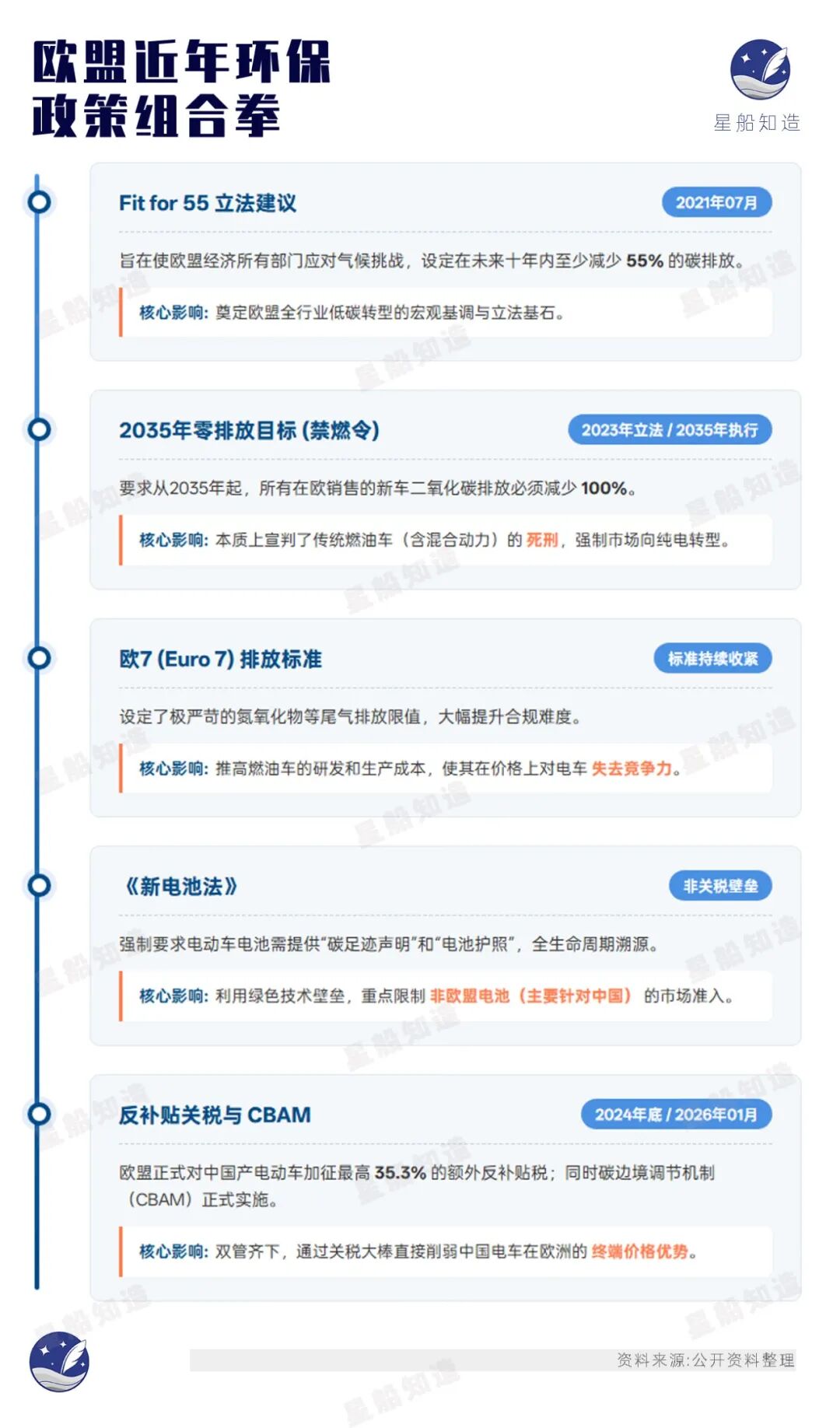
Once these environmental protection policies succeed, they can achieve three goals at once -
Firstly, it can lock in opponents and force global automobile manufacturers to play by European standards.
Secondly, it can get rid of energy dependence. Europe has always had a very high degree of external energy dependence.
Before the Russia - Ukraine conflict in 2021, Europe's crude oil consumption was 63.75 million tons, but the supply gap was as high as 47.74 million tons, with an external dependence of 74.9%.
In the future, environmental protection policies can enable Europe to gradually get rid of its dependence on fossil energy, especially when the geopolitical situation in Eastern Europe and the Middle East is unstable, and turn to rely on the green electricity it has vigorously developed.
Thirdly, it can force industrial transformation, making European giants such as Volkswagen, Mercedes - Benz, and BMW transfer the funds from the profitable internal combustion engine business to electrification, preventing them from being marginalized during the transformation.
source: unsplash
But this time, the script didn't go as planned.
When politicians in their offices passed a series of "2035 ban on fuel - powered vehicles" policies, they seemed to miss a question:
What if European electric vehicles can't be sold?
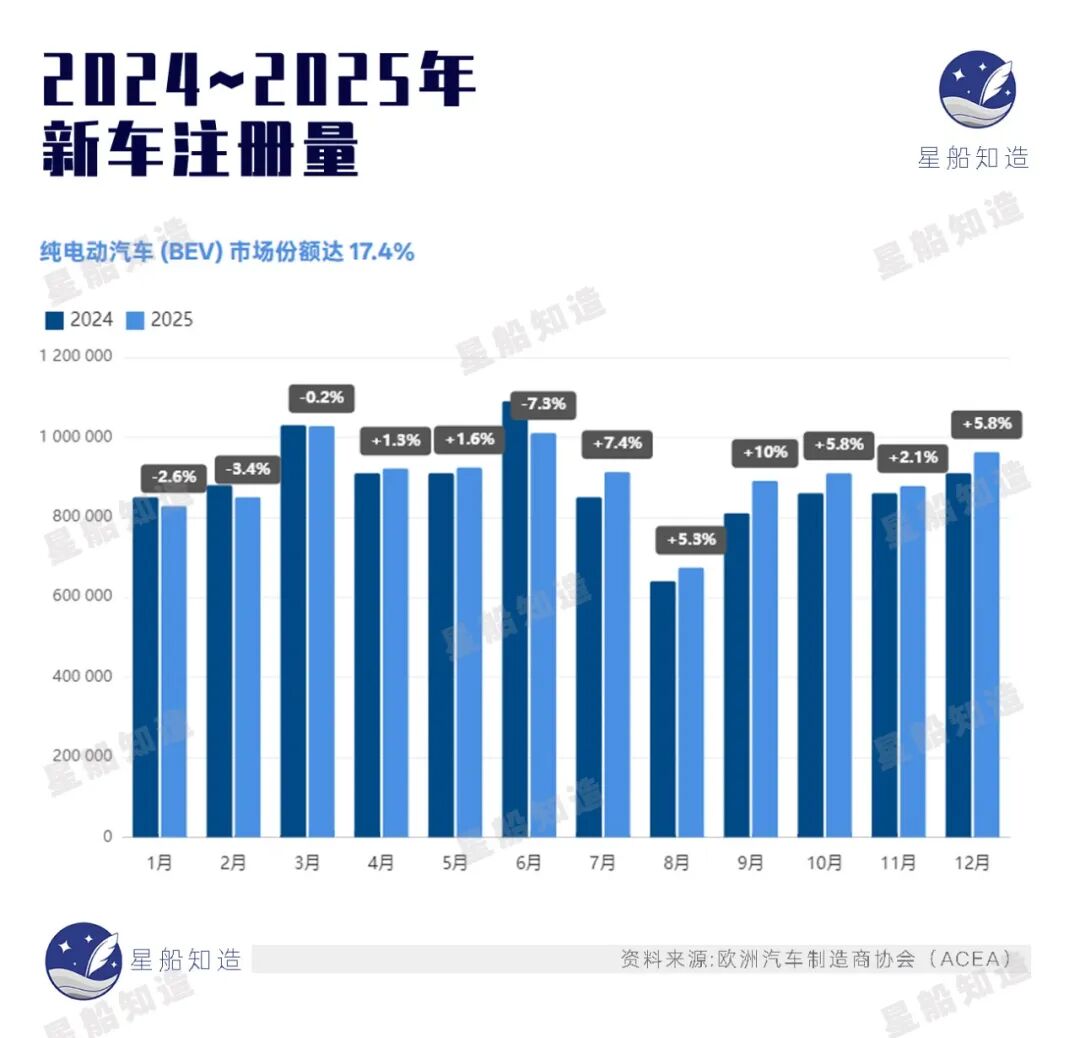
"Starship Knowledge Manufacturing" saw in the latest statistics of the European Automobile Manufacturers' Association (ACEA) that despite a series of policies strongly promoting it, in the whole - year new car registrations in Europe in 2025, the market share of battery - electric vehicles (BEV) only remained at 17.4%, far from reaching the "explosion point" envisioned by the EU's radical roadmap. See the following picture👇
By horizontal comparison, it is far left behind by China. The electric vehicle sales and the proportion of electric vehicles in all vehicle sales by country are shown in the following picture👇
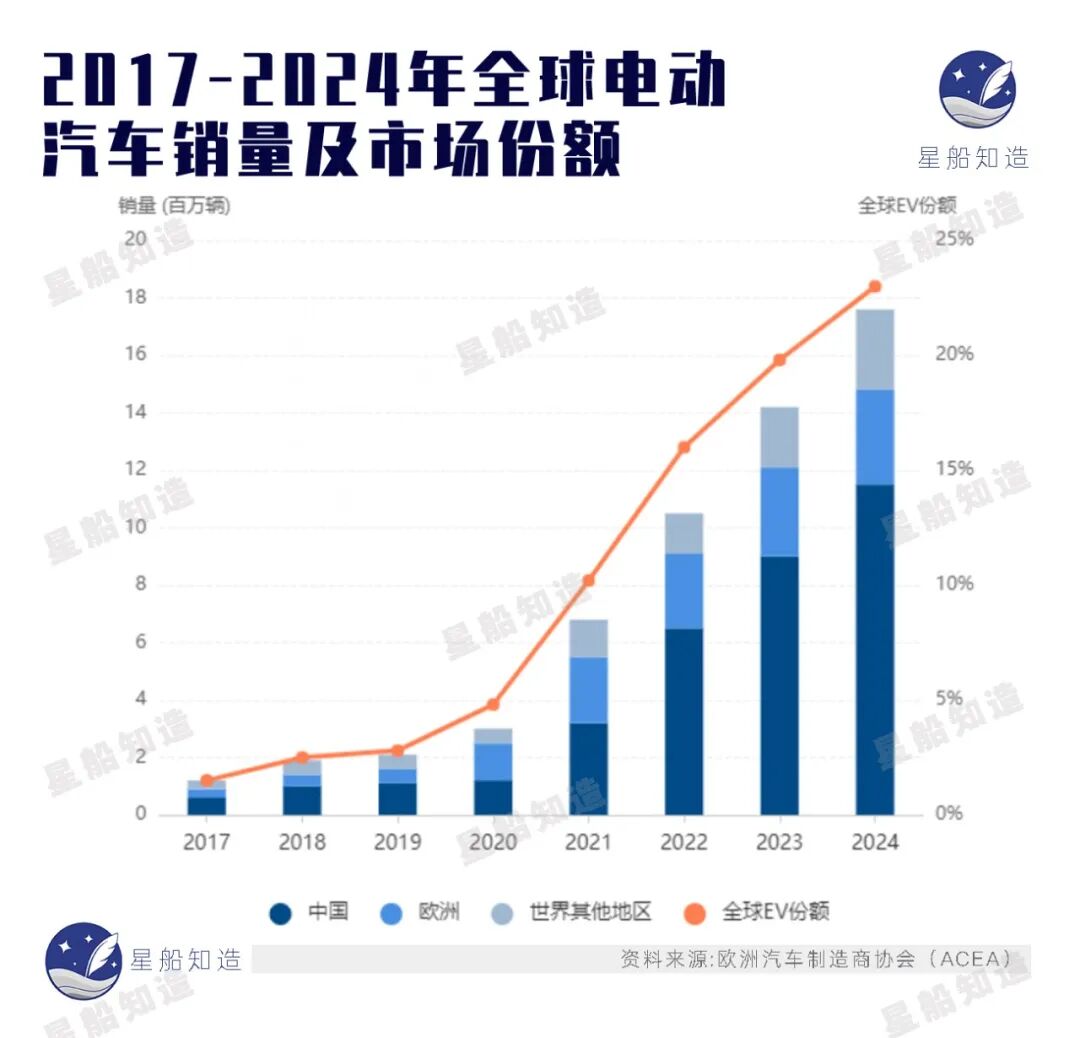
From the data in the above picture, it can be seen that Europe's environmental protection policies have not allowed European companies to occupy the European electric vehicle market - the market simply hasn't exploded.
Worse still, this time the Brussels Effect not only failed but also brought backlash:
Firstly, there is an outflow of profits.
In order to meet emission compliance, the average price of European electric vehicles has been pushed up to more than 40,000 euros. The market quickly responded:
In addition to the huge loss of Stellantis mentioned before, the operating profit of the Volkswagen Group in the first nine months of 2025 also plummeted by 58% year - on - year, only reaching 5.4 billion euros, and the operating profit margin dropped to 2.3%. At the same time, in addition to large - scale layoffs, the Volkswagen core brand group will also significantly reduce the number of board members from 29 to 19.
According to the plan, in the future, brands such as Skoda can only retain a minimalist team of only four people, "CEO + Finance + Sales + Human Resources", and the three key functions of R & D, procurement, and production will all be centrally managed by the headquarters in Wolfsburg.
For those car companies with poor electric vehicle technology and sales, in order to ensure environmental protection compliance, they have to spend a lot of money to share an "emission pool"👇
Pooling is a compliance mechanism in EU carbon - emission regulations that allows car companies to conduct "carbon - emission trading".
If a car company (such as Volkswagen) exceeds the average carbon - emission standard, it can pay another company with far lower carbon emissions than the standard (such as Tesla or Volvo) to form a "pool".
The EU will calculate this "pool" as a single company. As long as the average value in the pool meets the standard, the car