The Endgame of Japanese Mobile Phones: No "Tragic Heroes"...
Perhaps most people's impression of Japanese mobile phones is limited to Sony and Sharp, which is quite reasonable since they are currently the only two Japanese mobile phone brands still considered active. However, if we rewind the clock fifteen years, a high - spirited Japanese mobile phone company launched a brand - new flagship phone series in 2011 and gave it a name full of high hopes - Arrows, meaning "a powerful arrow". At that time, it was extremely popular. Having just acquired Toshiba's mobile business department, the new product name Arrows seemed like an infinite outlook on the future.
Fujitsu once launched the amazing LifeBook ultra - thin laptop series at the beginning of the 21st century and also led the development of the world's fastest supercomputer, "Fugaku". However, in the mobile phone market, with the iPhone's dominance and the three major domestic carriers' enthusiastic pursuit of Apple, the living space for Android flagships has been continuously squeezed. Meanwhile, in 2012, the Nvidia Tegra 3 processor used in the Arrows X overheated abnormally, which led to angry lawsuits from users and seriously affected the brand image. Since the launch of the Arrows brand, Fujitsu has been on a downward trend, and its market share has also been shrinking.
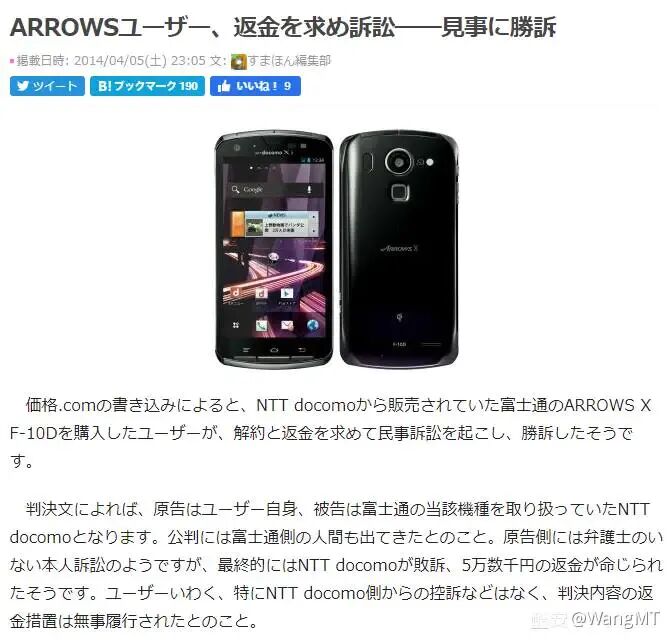
In 2015, Fujitsu's parent company made two major decisions: one was to shift the focus of its mobile phone manufacturing business to "Rakuraku", that is, the market segment for the elderly; the other was to split Fujitsu's mobile phone business. In 2016, FCNT officially started independent operation as a wholly - owned subsidiary of Fujitsu. At the same time, the mobile device manufacturing business of Fujitsu Peripherals Limited was spun off to form a new company, Japan E.M. Solutions (JEMS). Two years later, the Japanese private equity fund Polaris Capital acquired 70% of FCNT's shares. Fujitsu's influence has become almost negligible. However, FCNT still insists that the core manufacturing of most products is completed at the JEMS Kato Factory (Yashiro Plant) in Hyogo Prefecture. It is also the only mobile phone company still manufacturing and assembling in Japan. Although the Arrows 5G and Arrows NX9, launched in 2020, are both positioned in the high - end market, the gimmick of being the "Japanese general" still fails to boost sales.
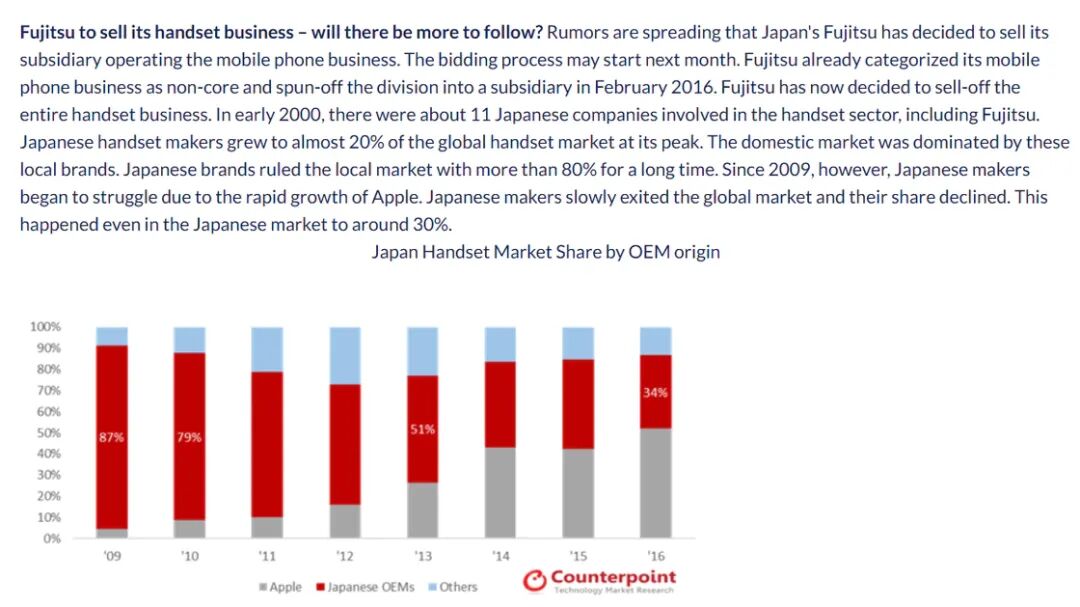
The iPhone's monopoly in the high - end market persists, and new players such as OPPO, Xiaomi, and Pixel are entering the market one after another. The impact of the pandemic on the market scale and semiconductor supply has made the situation even worse. So, in 2022, the Arrows N (F - 51C) was launched, featuring environmental friendliness and a long lifespan. An arrow has been shot and is about to reach its end.
Plastic Can Have a Premium Feel, but That's All
Environmental protection is a major selling point emphasized by this generation of Arrows flagships, and at least in terms of engineering, FCNT has achieved this. 67% of the total weight of the Arrows N is made of recycled materials. The back cover, internal anti - roll frame, and motherboard cover are made of recycled plastic, while the middle frame and lens frame are made of recycled aluminum. When I actually held it in my hand, the white SKU I had didn't look cheap because of the use of recycled materials. The plastic back cover is very smooth and has a fine matte finish, which feels smooth to the touch and prevents fingerprints. The Felica Logo, Docomo Logo, Arrows Logo, and the machine codename F - 51C are arranged in the center from top to bottom, which is also a characteristic of Japanese mobile phones. The lens boss is integrally formed from an aluminum plate. The main camera has a high - gloss aluminum frame, and the ultra - wide - angle lens and flash are also placed in the center. The entire deco is of a moderate size and well - organized. Compared with the flamboyant large - circle deco, it looks clean and restrained. The matte aluminum treatment of the middle frame also prevents fingerprints. The relatively wide thickness and the smooth arc transition between the middle frame and the back cover create a comfortable and fitting grip. The charging port is injection - molded, the speaker opening is in the center, and there are symmetrical antenna injection - molded strips. Of course, there is also the traditional hot - swappable SIM card slot without a card ejector pin in Japanese mobile phones. At least in terms of workmanship and ID design, it surpasses its competitors Sony and Sharp at that time.
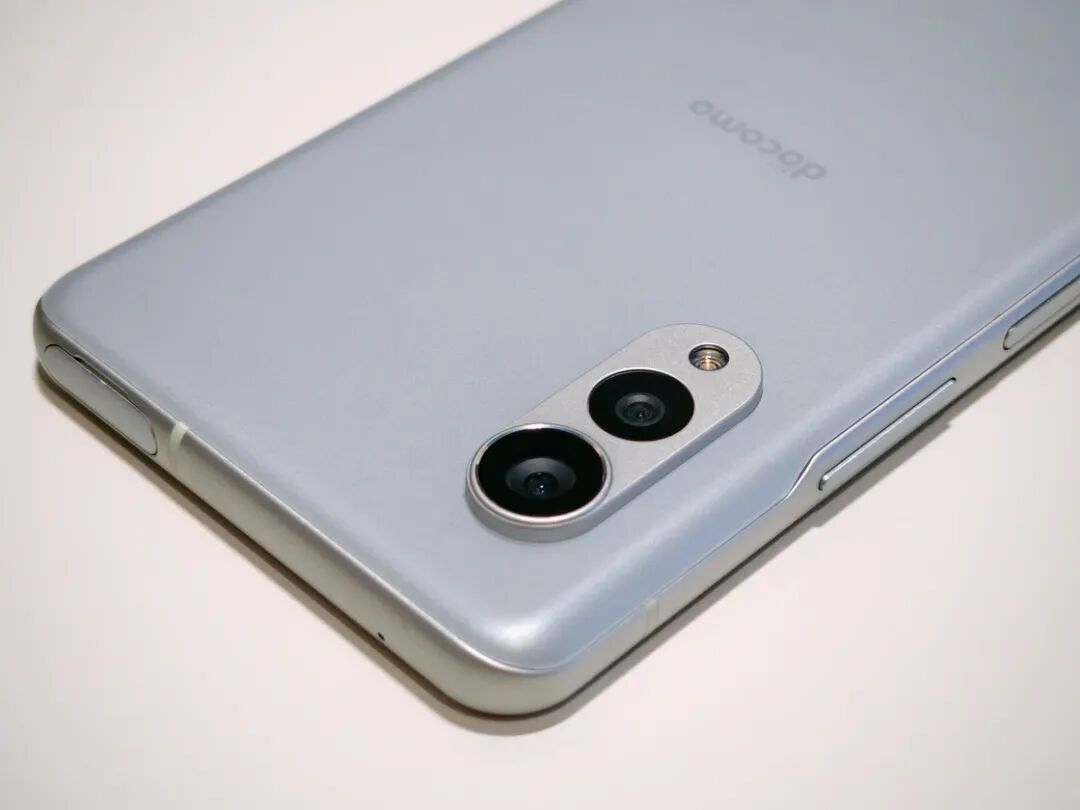
Close - up of the Deco
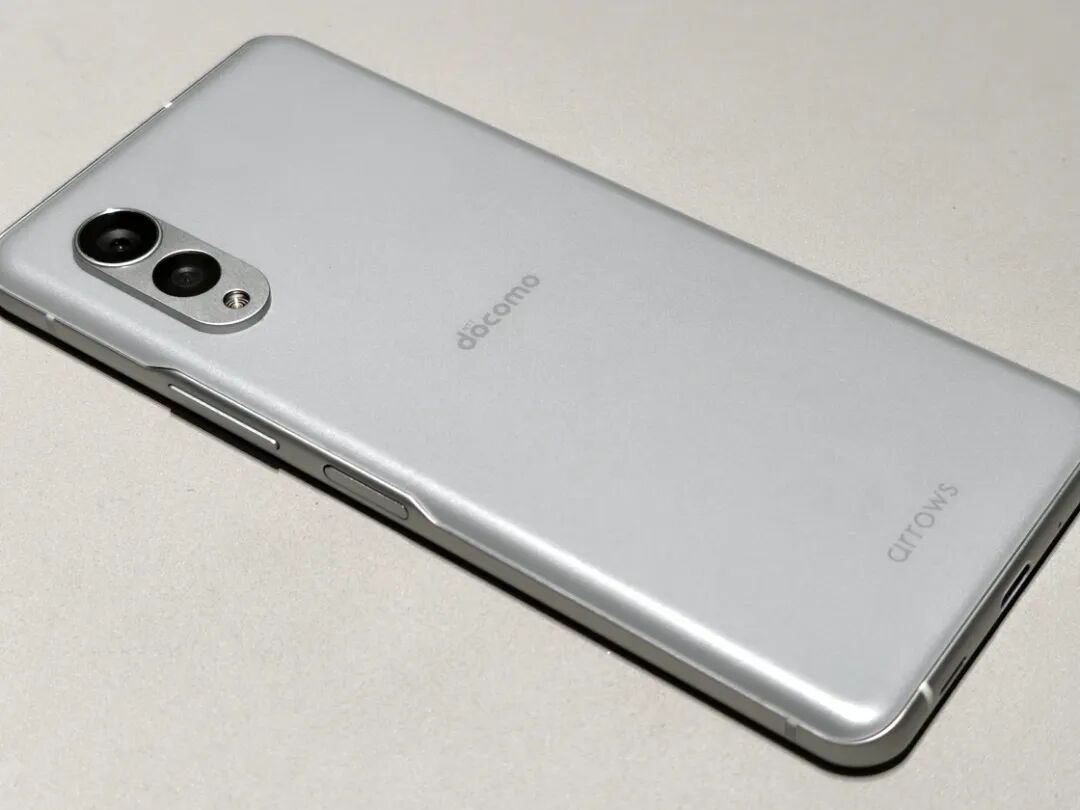
Back and Middle Frame Design
However, when you turn to the front, the premium feel disappears. Although the Arrows N is equipped with a 120Hz screen, it still has wide top and bottom bezels. What's even more annoying is that the top and bottom bezels are not the same width... It's a screen selection that drives OCD people crazy.
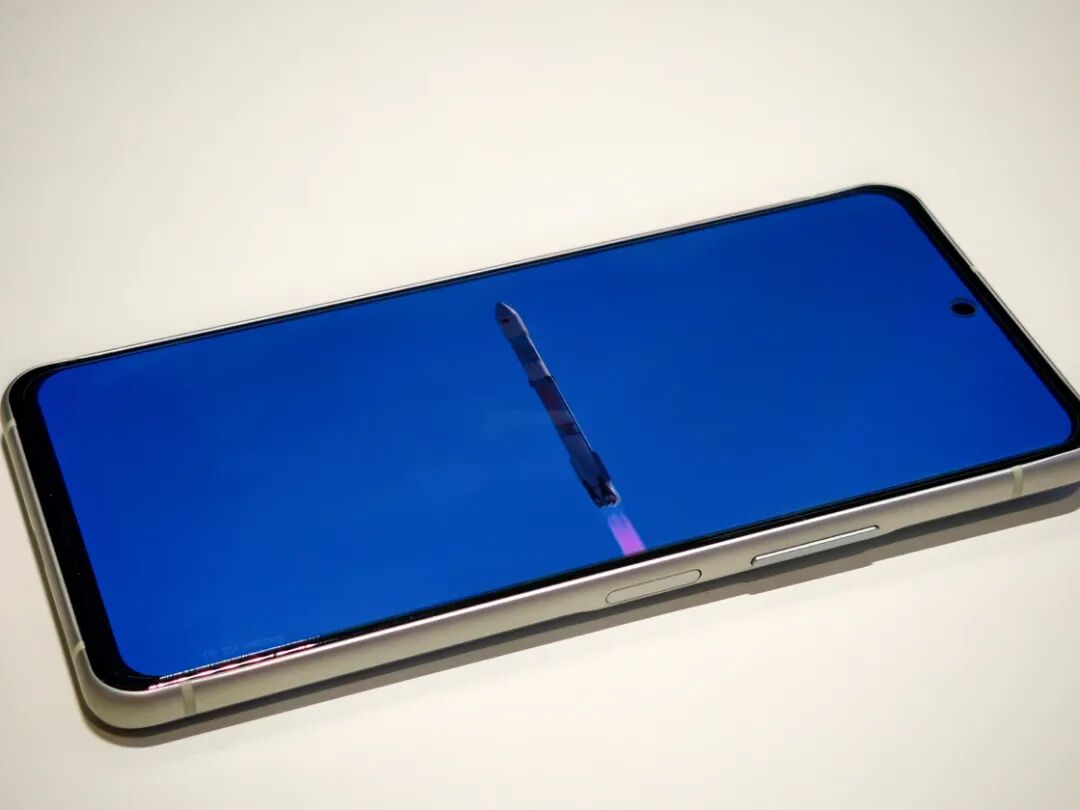
Front View. The screen supports Dolby Vision but not HDR.
Speaking of the environmental protection selling point, as mentioned above, the production and assembly of the Arrows N are all completed at the JEMS Kato Factory in Japan, which gives it the "noble" characteristic of being completely made in Japan. In addition, in terms of software, Arrows has also cooperated with Docomo to launch an environmental protection program called "Carbon Neutral". In short, it aims to achieve carbon neutrality by 2030 through environmental protection measures in multiple aspects such as mobile phone manufacturing and operator operations. In addition, the Arrows Portal also encourages users to charge their phones during off - peak hours to earn points.
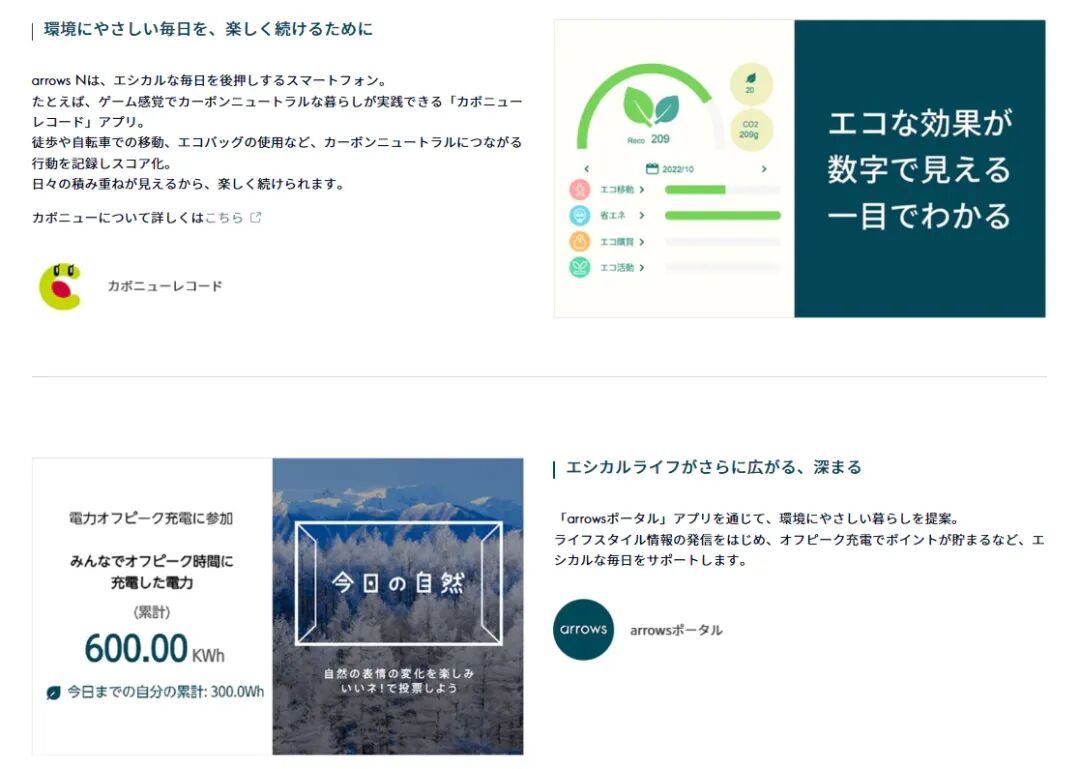
Details of the Promotion of the Carbon Neutral Program and the Portal on the Arrows N

Carbon Neutral Record Promotion Page
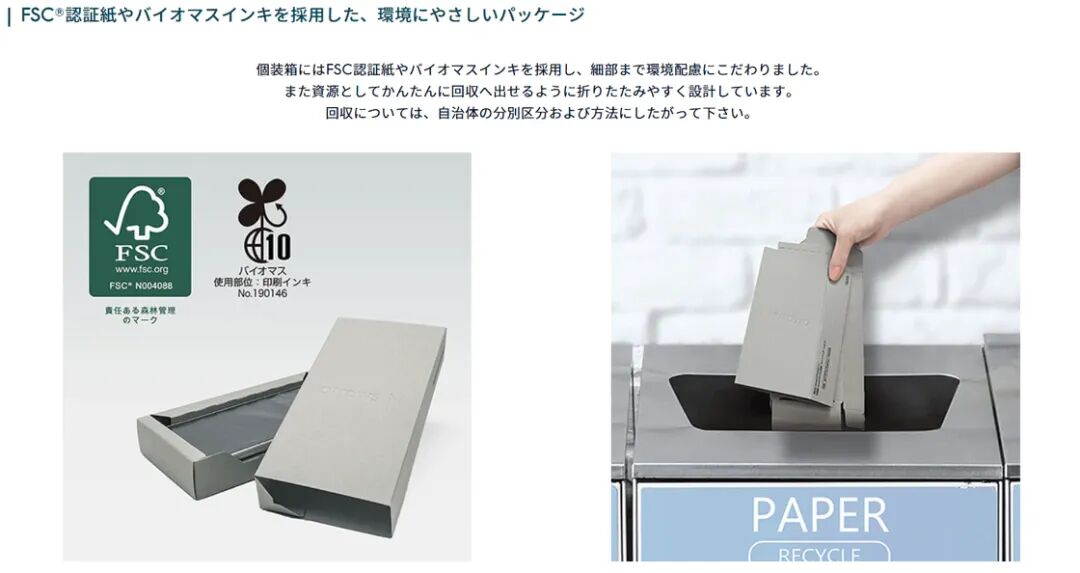
The packaging box of the Arrows N is also made of FSC - certified paper and environmentally friendly ink, and it is easy to fold for recycling. There is no charging head or charging cable in the box. As an environmental protection measure, it was implemented earlier than a certain company in California across the ocean. Part of the reason is that the sales channels for accessories are also the responsibility of the corresponding operators.
As a tradition of Japanese mobile phones, the Arrows N also supports IP68 dust and water resistance, allows the body to be washed with soap, and has passed the US military standard MIL - STD - 810H. However, since this second - hand phone is in almost perfect condition, I won't test its actual durability level.
Beyond the Concept, It's All Mediocre
Sometimes, one has to sigh at the strange thinking of Japanese manufacturers. They seem to hope that the environmental protection selling point can support the status of the Arrows N as a flagship. So, in the second half of 2022, they sold the Qualcomm Snapdragon 695 for 98,000 yen (equivalent to more than 4,400 RMB). In China, this price is around the starting price of a large - cup flagship, and you can buy a new flagship equipped with the Snapdragon 8 Gen 2 (such as the Xiaomi 13, OnePlus 11, iQOO 11...). Even in Japan, the Sharp AQUOS Sense 7/7 Plus, which costs only a little more than half of the Arrows N, also uses the same Snapdragon 695 SoC. The weak performance of an SoC like the Snapdragon 695 is a given fact. At that time, there were no chips like the Snapdragon 6 Gen 1 and 7 Gen 3 that used super - large cores at a low price. With only 2 A78 large cores + 6 A55 small cores, it was doomed to be unable to handle heavy - load scenarios even in 2022, not to mention that it had been a year since its release. Due to the shortage of semiconductor supply in Japan at that time caused by the pandemic, the actual Docomo contract version was not officially released until March of the following year, truly showing that it was outdated as soon as it was released.
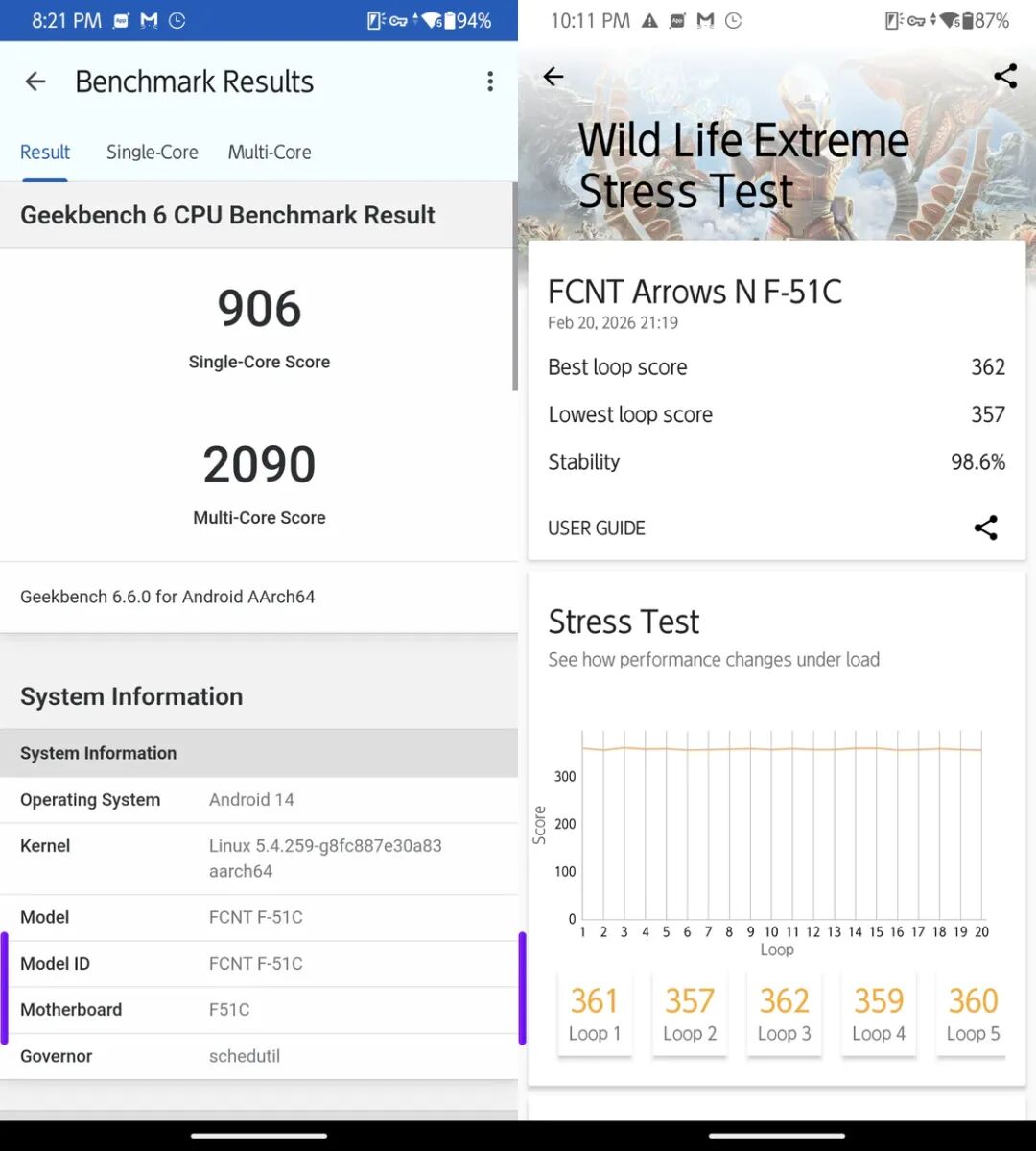
The scores of Geekbench 6 and 3DMark brutally expose the incompetence of this SoC. The only advantage is the excellent energy consumption ratio given by the TSMC N6 process. Coupled with the low peak performance ceiling, the battery life and continuous performance release of this phone are not bad. Under the WLE Stress Test, the phone hardly generates heat, and the stability is extremely high, although it can't get a very high score. It's worth noting that due to the weak support for instruction sets and graphics APIs, it can't even perform the relatively new STEEL NOMAD LIGHT test (lack of Vulkan support).
The weak performance is also reflected in the smoothness of daily use. However, thanks to at least 8G of LPDDR4X memory, there won't be frequent LMK killing of background applications due to low available memory. However, the desktop sliding often can't maintain a stable 120 frames, and the cold start of applications is forced to be locked at 60 frames, resulting in a significant sense of lag. After the Android 15 major version update, Lenovo even removed the non - linear animation of the cold start on this phone. Its treatment is even worse than that of Lenovo's cheaper G - series new phones. When installing large - scale games, the installation speed is also significantly slower than that of models with higher - performance chips. On the other hand, since it only supports WiFi - 5, the game download speed can only reach about 8 - 9M/s, and the network speed experience is just so - so.
For the relatively undemanding game Honor of Kings, the average frame rate of 47 frames is still playable, but there are frequent frame drops during team battles, which is consistent with the 1% Low frame rate of less than 30.
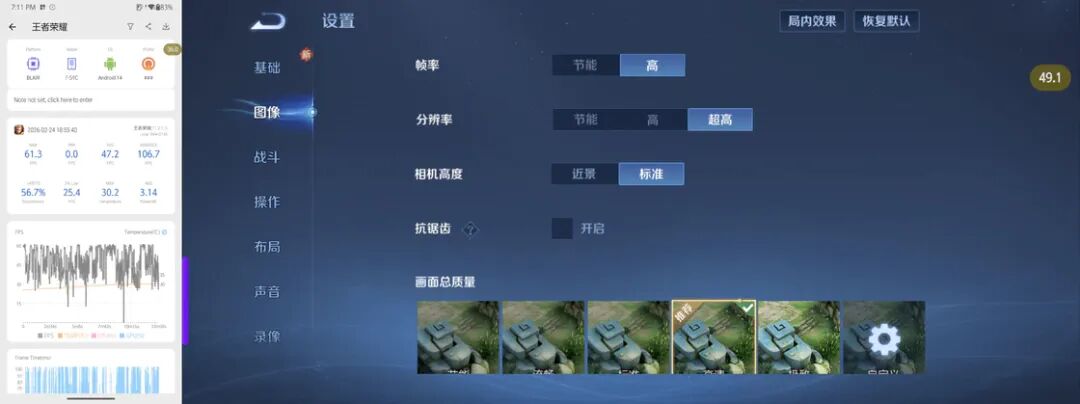
Honor of Kings with the highest frame rate and ultra - high image quality enabled
In the new game Arknights: Endfield, I really can't imagine that an SoC with two A78 large cores, when facing the lowest image quality, not only has a mosaic - like picture but also has an average frame rate of less than 10 frames when running on the map. During battles, the frame rate hardly exceeds 5 frames. The frame rate during battles is basically around 1, and it can only reach more than 20 frames when opening the map and menu. I originally wanted to test a dungeon, but this saved me the trouble.
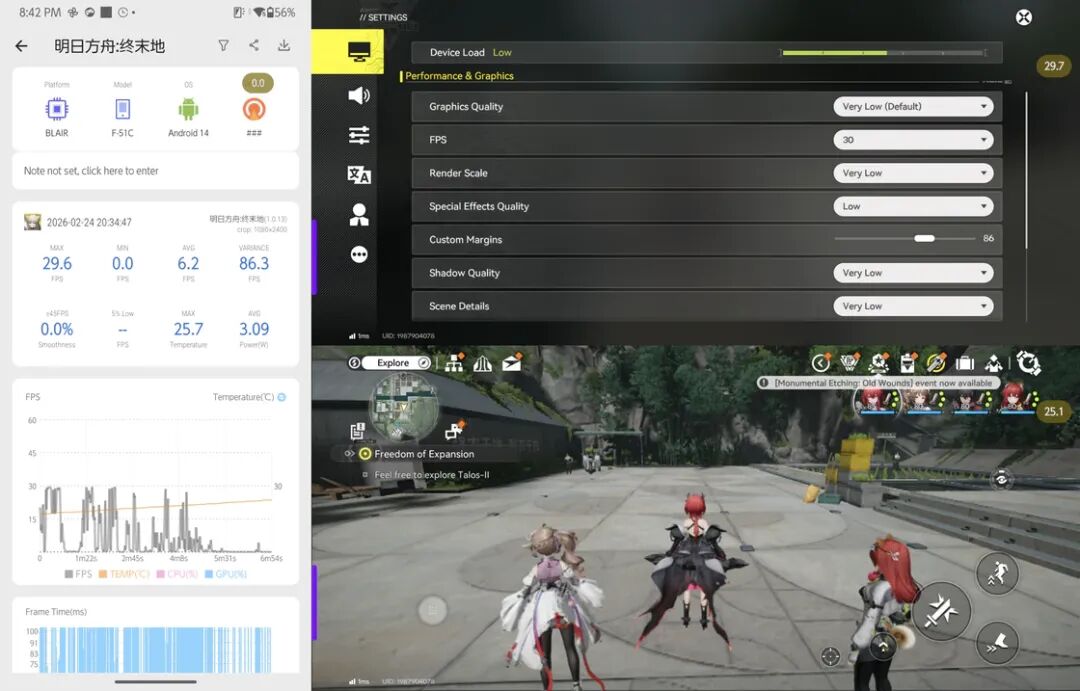
I'm so angry that I'm laughing
In terms of photography, I can at least think that FCNT has made some optimizations. The main selling point is the Photoshop Express Mode developed in cooperation with Adobe. After taking a photo, the image will automatically enter Adobe Photoshop Express for automatic post - processing, and the Adobe image - processing suite is also pre - installed in the system. However, the ideal is full, but the reality is skinny. Due to the weak performance of the SoC, the post - processing speed after jumping to PS is extremely slow. It takes half a minute for an image in automatic mode to be optimized, and the white balance of the processed image is abnormally warm. It's hard to say that it's better than the original image. On the other hand, even when using PS/Lr to post - process the photos, the 60 - frame - locked interface and the almost constant lag are far from the "You'll want to share it with people around the world" advertised on the product official website.
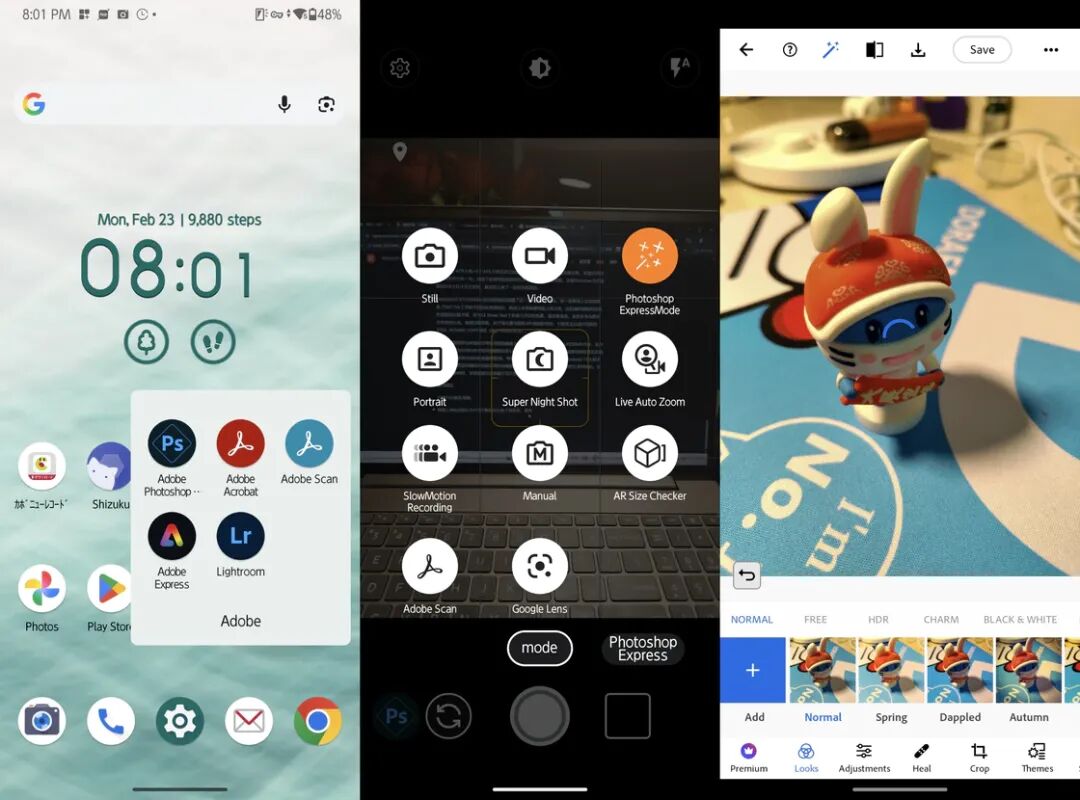
Adobe Suite
