On OpenClaw, an entire "AI hardware" ecosystem is emerging.
After using OpenClaw for some time, I found that it has rapidly changed my decision - making logic in daily shopping.
For example, I recently wanted to buy a sports watch. When I was hesitating about which brand to choose, the first thought that flashed through my mind was: Does it support connection to OpenClaw? If not, then I won't buy it.
Actually, my idea of buying a sports watch also originally came from OpenClaw.
Some time ago, I asked OpenClaw to help me set up a fitness plan. I told it the goals I wanted to achieve and asked it to remind me every day, and it did as I asked.
However, after each workout, it would ask me like a coach where I exercised, how long I exercised, and what the data was. It was very troublesome for me to manually input the data to it. If the data in the sports watch could be directly synchronized to OpenClaw for it to analyze and record on its own, it would be much more convenient. Moreover, with more data, its guidance for me and interpretation of my physical condition would be more comprehensive.
At this time, I realized that a key factor in my selection of a sports watch was actually whether it supported connection to OpenClaw and whether its API or software interface could be easily called by the Agent.
The OpenClaw craze has lasted for two months, and its impact on hardware products has begun to be concentratedly manifested.
It can be seen that more and more hardware products - from robotic dogs, robotic arms, to AI glasses, earphones, watches, and even open - source robots DIYed by developers - are starting to actively connect to OpenClaw.
In this new structure, OpenClaw is no longer just a software tool, but more like an AI operating system. It is responsible for understanding tasks, planning actions, and calling tools, while different hardware devices become its sensory organs and executive organs.
So, after taking stock, we found that a loose but rapidly emerging "OpenClaw hardware" ecosystem is taking shape.
01 OpenClaw Transforms Smart Hardware, and Wearable Devices Become the Mobile Entrance for Agents
The first commercial devices to connect to OpenClaw are various wearable products.
For example, the smart glasses brand Rokid.
Rokid has launched the "customized intelligent agent" function. Developers can connect the glasses to the locally deployed OpenClaw through the SSE (Server - Sent Events) communication protocol.
As an AI glasses, it has a camera, a microphone, and a display system, which can continuously collect first - person perspective information.
Theoretically, when developers connect OpenClaw to the intelligent agent interface of the glasses, the glasses become an interface for collecting vision and voice. OpenClaw is responsible for understanding and decision - making, and then returns the results to the user or calls tools.
This means that OpenClaw can understand the world that the user sees in real - time.
For example, when a user stands on the street of a strange city, the glasses capture the street view image. OpenClaw can recognize the environment, query information, and even help the user plan a route.
Similar attempts have also appeared in the Liweike AI glasses.
According to the official description, users can directly call OpenClaw through the glasses' voice to initiate tasks and command the AI to control the computer. For example, remotely command the computer to complete email processing, write daily reports, retrieve files on the computer, etc.
At this time, the glasses serve as a portable intelligent command center.
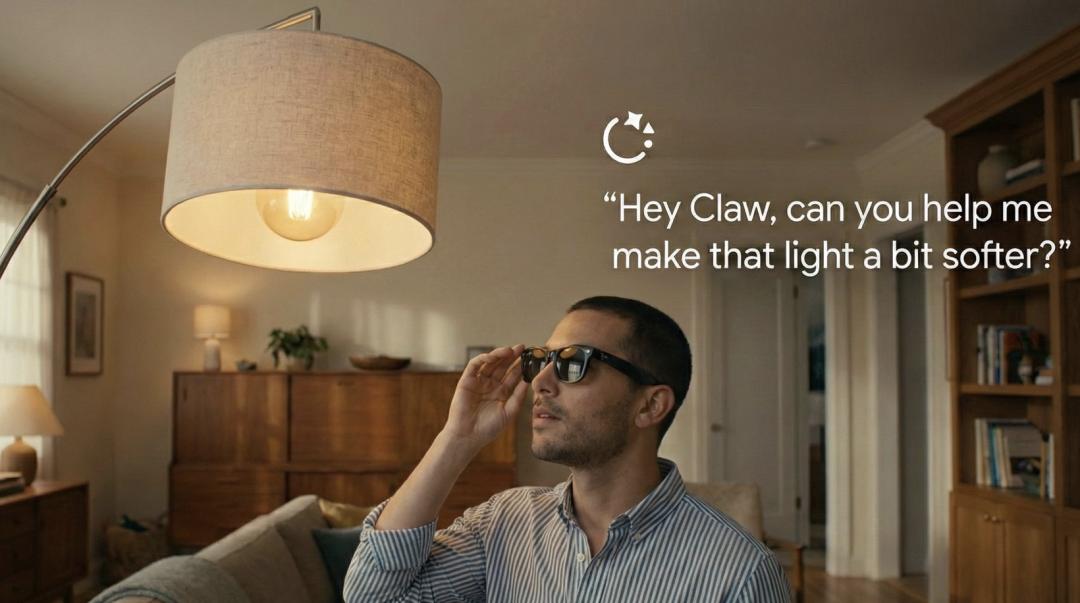
Also an AI glasses project, the project VisionClaw of developer @sseanliu in the GitHub community - a real - time AI assistant suitable for Meta Ray - Ban smart glasses, can help users perform real - world operations | Image source: VisionClaw
The same goes for Guangfan Technology, which recently announced the completion of a 300 - million - yuan seed - series financing. Dong Hongguang, the founder of Guangfan Technology, is a member of the startup team of Xiaomi Group and was responsible for building MIUI. Their recently launched AI earphones and watches have also been connected to OpenClaw.
When a user says a word through the earphones, such as "Help me book a flight ticket to Shanghai tomorrow", the device sends the voice input to OpenClaw, and the Agent then automatically completes a series of operations such as searching, price comparison, and placing an order.
Finally, the result can be displayed to the user through the watch screen.
In this process, the earphones and the watch are more like the input entrance and the display interface of the AI Agent. They all play the role of the mobile data entrance of AI in the physical world.
OpenClaw on Robots
Recently, the number of cases of connecting OpenClaw to robots and changing the way of robot control has been increasing rapidly.
For example, the Vbot robotic dog of Vita Dynamics, a rising star in embodied intelligence.
In the traditional architecture, robotic dogs often rely on preset programs or simple remote control. However, after connecting to OpenClaw, its capabilities have changed significantly: the robotic dog is no longer just executing fixed instructions, but can understand tasks.
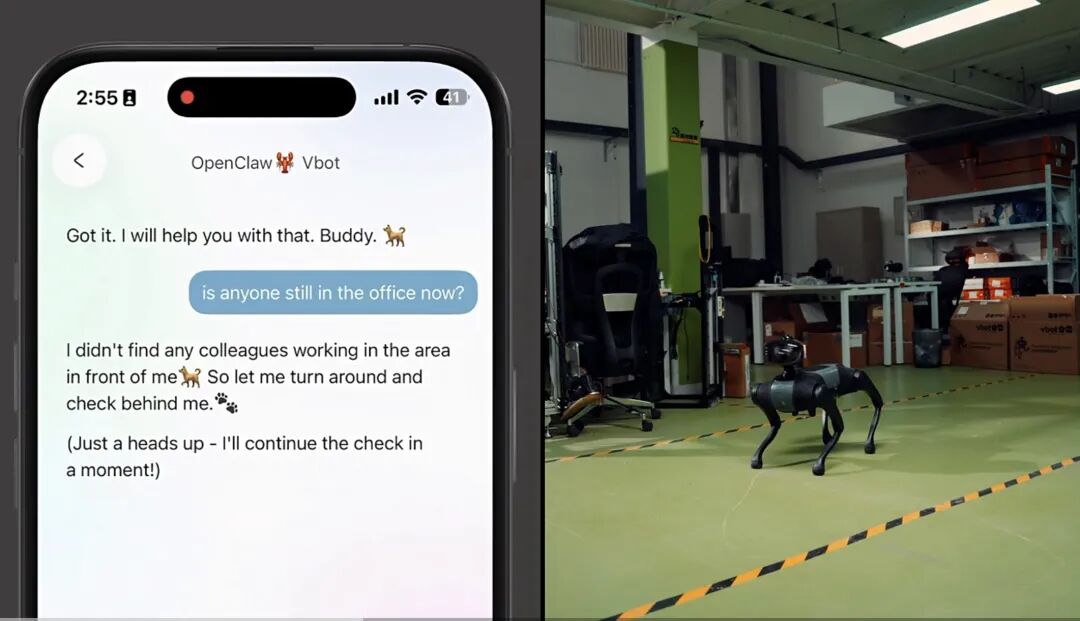
Making the robotic dog more proactive through OpenClaw | Image source: Vbot video screenshot
Users only need to give instructions through voice, such as "Patrol the living room once" or "Help me see if there is anyone at the door", and OpenClaw will complete a series of actions:
Understand the instructions, plan the tasks, call the robot control interface, and the robotic dog will execute.
In this process, OpenClaw acts as the task brain, while the robotic dog becomes the executive body.
Similar cases have also appeared in the field of robotic arms, such as the seven - axis robotic arm of Songling Robot.
Developers can connect the seven - axis robotic arm to OpenClaw and directly describe the actions of the robotic arm in natural language, such as "Grab the cup on the left". OpenClaw will automatically generate an executable code script, plan the task path on its own, and control the robotic arm to complete the action.
Theoretically, developers can create custom skills, such as "welding", "handling", etc., to enable the robotic arm to have expert capabilities in specific fields.
Therefore, with the help of AI, not only the development of software can be done by just speaking a few words, but also the hardware applications are following the same trend.
If robots in the past were a set of automated equipment, then after connecting to an Agent like OpenClaw, they start to be more like an "assistant" that can understand tasks.
This is also one of the reasons why many developers are excited:
AI Agents are having real physical execution capabilities for the first time.
The Real Imagination Comes from the Open - Source Ecosystem
However, what really makes the OpenClaw ecosystem expand rapidly is not the commercial companies, but the open - source developer community.
On GitHub, a large number of developers have started using OpenClaw to control various open - source hardware devices. For example, DIY open - source robotic dogs, Raspberry Pi robots, Jetson AI robots, smart home systems, etc.
There is a wide variety of them.
More importantly, the emergence of a series of small open - source projects is opening up imagination for "AI hardware".
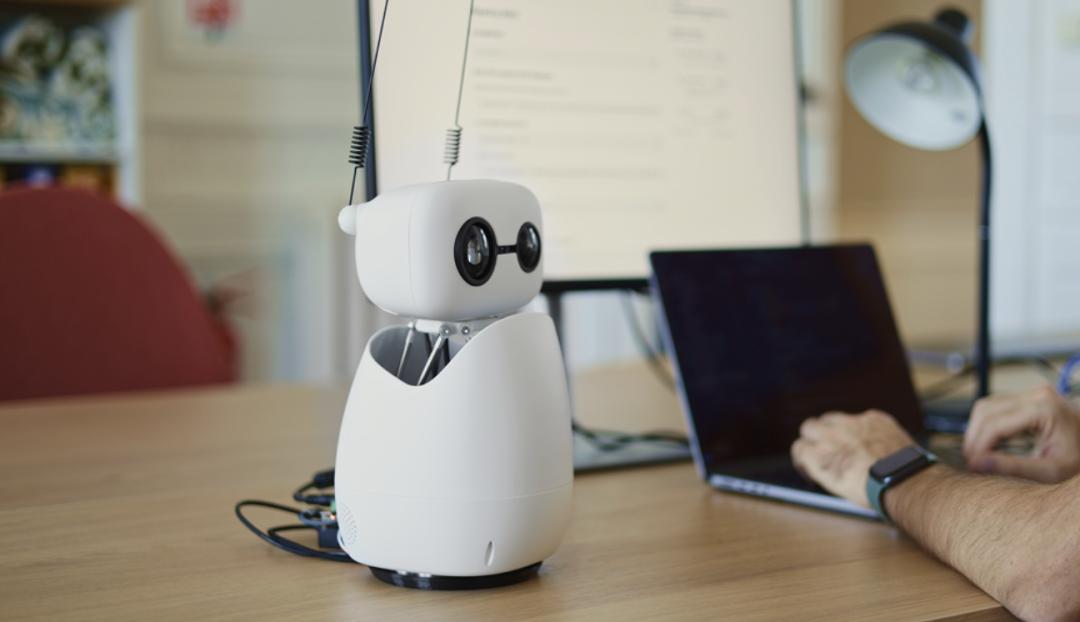
The open - source robot project Reachy Mini | Image source: Reachy Mini
For example, someone directly connected OpenClaw to the mature open - source robot project Reachy Mini, enabling remote voice control of it to perform various complex actions on software such as Telegram without even knowing code.
OpenClaw can read the robot's sensor data, such as camera images, depth information, or lidar data, and can also send control instructions to the robot, such as turning the head, twisting the antenna, recognizing people, etc.
Similarly, MimiClaw has also been quite eye - catching recently.
This project created by Chinese developers can fit OpenClaw onto a 10 - yuan ESP32 development board. It is developed in pure C language and can run directly on a single - chip microcomputer without an operating system (Linux) or a Node.js environment.
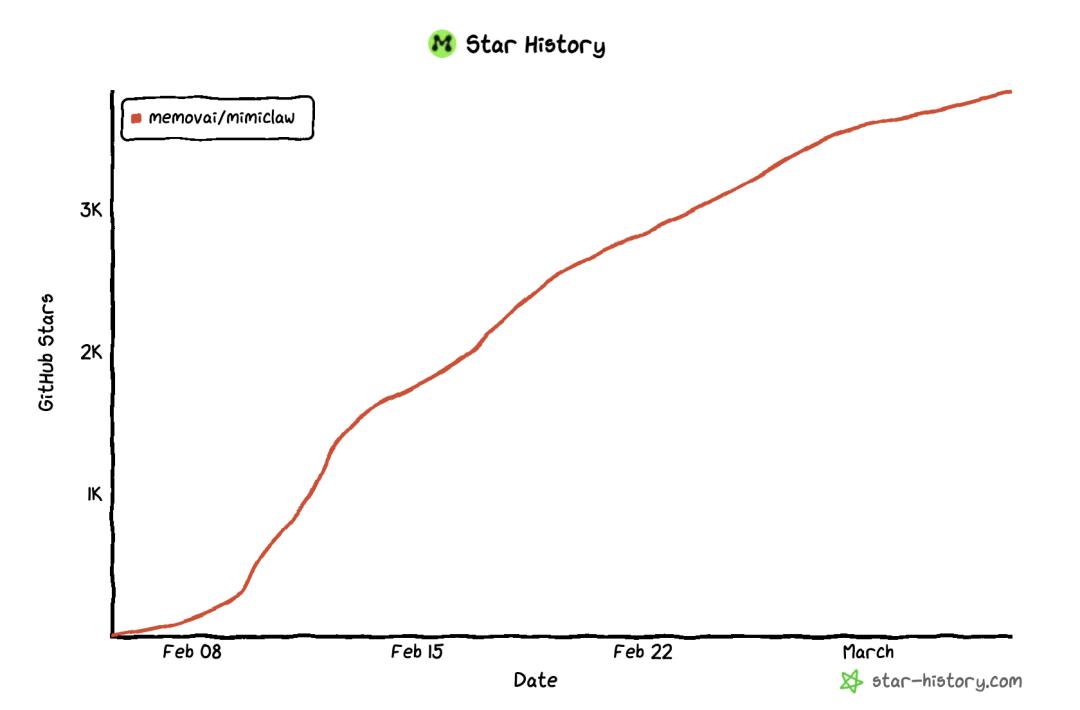
The star - growth data of MimiClaw on GitHub | Image source: GitHub
Users can use communication software such as Telegram to talk to it, call the cloud - based large - scale model, and MimiClaw has a local memory system (Markdown file storage), tool - calling, and autonomous scheduling capabilities.
Users don't need to buy expensive Mac devices to experience the physical version of OpenClaw.
Imagine, it actually opens up brand - new possibilities for mass - consumer - grade smart hardware.
Perhaps, an era of smart hardware with lower cost, high autonomy, strong privacy, and inter - connectable hardware Agents is about to begin?
02 Five Trend Predictions for "AI Hardware" after OpenClaw
One of the charms of OpenClaw is that it provides an open Agent framework, allowing various hardware to connect to the same "intelligent brain".
As a result, robotic dogs become the legs of AI, robotic arms become the hands of AI, glasses become the eyes of AI, and earphones become the ears of AI.
If we look at the recent wave of hardware connection around OpenClaw from a longer - term perspective, the changes it brings may not just be the popularity of an open - source Agent framework. The roles of smart hardware may also undergo more profound changes.
From the hardware form, interaction mode to industrial division of labor, a series of new trends have faintly emerged. Let's make a few predictions:
Smart Hardware Will Become More Proactive, and Efficiency Will Be Unprecedentedly Improved
OpenClaw is highly proactive. When this proactivity is connected to the physical world, the efficiency of hardware will also be improved unprecedentedly. For example, the Vbot robotic dog mentioned above, after connecting to OpenClaw, can be set with commands to actively greet people or remind children to drink water every 30 minutes.
Thus, hardware changes from a passive "tool" to an active "partner".
Similarly, in the past, a smart watch might only push a summary of physical data once a day. In the future, it may synchronize data every 30 minutes, transforming from a simple information provider to a companion or advisor for users.
Hardware "Decentralization", Unified Scheduling by AI
As mentioned above, open - source projects like MimiClaw are making the OpenClaw ecosystem penetrate into extremely low - cost hardware. In the future, more ordinary devices (such as glasses, earphones, robots) can instantly have the ability to be "OpenClaw Ready".
Then, the hardware is mainly responsible for executing specific actions, while the inference computing power calls the cloud "brain". Once this ability matures, robots, desktop devices, and wearable devices may all become the execution nodes of the Agent.
For example, AI can understand a vague instruction like "Get ready to watch a movie" and automatically execute a series of physical actions such as turning off the lights, lowering the curtain, and turning on the projector.
At this time, different hardware may share the same cloud "brain", and different hardware can be interconnected, waiting for the unified scheduling of the cloud - based AI to cooperate.
Mobile Phones May Also Become Just a Display Terminal
In the past decade, almost all smart hardware has been attached to mobile phones.
Watches, earphones, and glasses are essentially peripherals of mobile phones. However, in the Agent era, this structure may be broken.
When cloud - based AI can directly understand voice, visual, or environmental information through various "distributed hardware", the interaction between hardware and users will become more direct, such as voice interaction and tactile feedback (vibration).
At this time, many devices no longer need the mobile phone as an intermediary. For example, in - vehicle AI in the autonomous driving scenario, home robots, continuously running desktop devices, and all - day wearable assistants.
These devices can be directly connected to the cloud - based Agent instead of through the mobile phone. In other words, the mobile phone may degrade from the "control center" to just one of many terminals.
Completely Independent Hardware Categories May Explode
According to the previous deduction, in the future, hardware may no longer be an accessory to mobile phones.
A large number of hardware and software use cases are emerging around OpenClaw in various forms. There are even some previously non - existent demands. For example, AI Nas has recently become popular due to OpenClaw.
When various new demands can be systematically integrated, it may support the emergence of new hardware categories. Who will be the lucky one?
The Core Ability of Hardware Will Become Perception Ability
In the traditional smart hardware era, the product capabilities often depend on the device itself: computing power, algorithms, and functional modules.
However, after the emergence of the OpenClaw architecture, hardware is more responsible for "perceiving the world", while the AI Agent is responsible for "understanding the world".
In the future, the core value of hardware may no longer be the computing power of the device itself, but perception ability - including richer and more accurate sensor input and scenario data closer to the real world.
The sensors themselves may become more important.
If the core problem of smart hardware in the past decade was "how to make better devices", then the problem in the future may become:
How to make devices connect to a smarter AI.
When the Agent system starts to connect sensors, robots, and wearable devices, smart hardware is no longer just an independent terminal product, but also an interface for the AI system to interact with the real world.
Entrepreneurs and developers in the AI hardware field are all being involved in a brand - new competitive landscape.