Where will LIN Junyang go?

Written by | Huahua
On his last day, Lin Junyang posted a WeChat Moments status.
"I didn't know there were so many people in the world who love me until these days. Today is my last day. When everyone applauded for me, I really held back my tears," he wrote. "No matter what others say about me, at least in my heart, I truly feel that I've done my best for my brothers, for Alibaba Cloud, and for the group. Although I really didn't do many things well, I'm sorry."
The accompanying picture was a sharing link to a song: "Unfinished Ending".
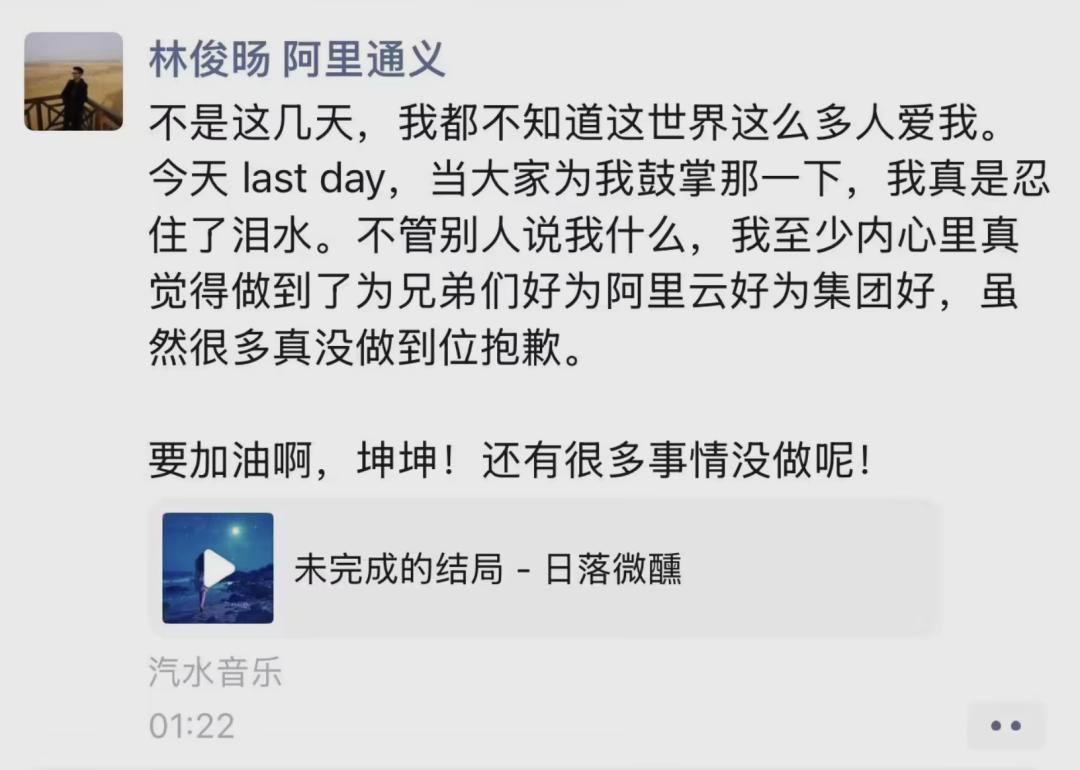
This was the third update on his WeChat Moments since he announced his departure. The first two were sharing "A Toast to Myself" when he announced his departure early on March 4th, and a brief statement to the team in the afternoon of the same day, saying that he "needed a rest".
Lin Junyang's last day wasn't entirely unexpected, but it still made many people sigh.
At 32, he's a master's degree holder in linguistics from Peking University and one of the youngest P10s at Alibaba. He single - handedly made Qwen achieve over 1 billion global downloads across all channels and over 200,000 derivative models.
A person like him is in high demand everywhere.
Actually, on the day he left, Yu Bowen, the person in charge of post - training for Qianwen, also officially left. Even earlier, Hui Binyuan, the person in charge of Qwen Code, joined Meta in January. Many core contributors, such as Li Kaixin, also bid farewell one after another.
This is a collective departure, not just one person's turn. What's curious is: Where will Lin Junyang go next?
1. ByteDance: Hints from Those Two Shares
In Lin Junyang's three WeChat Moments updates, the songs he shared twice were from the same app: Qishui Music, a ByteDance product.
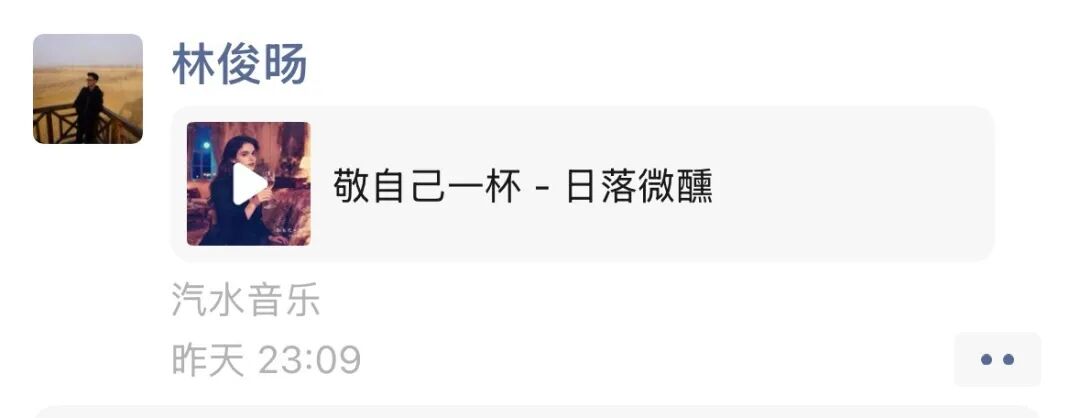
Is it just because he simply thinks it's good to use, or is he sending a signal in a certain direction? The answer may lie in ByteDance's corporate culture.
At the all - hands meeting of ByteDance in early 2026, CEO Liang Rubo announced the annual keyword: "Climb the Peak". He said that AI is at least as significant as the PC + Web era, and the top priority is to make the AI model capabilities rank among the top in the industry. One of the core strategies is to firmly increase the talent density.
How hungry is ByteDance for talent? On March 6th, they launched the largest - scale recruitment plan for interns to be converted into full - time employees in history, recruiting over 7,000 interns globally, with an overall conversion rate of over 50%. R & D positions are tilted towards the AI field.
The person in charge of ByteDance's large - scale model is Wu Yonghui, who came from the position of vice - president of research at Google DeepMind. He worked at Google for 17 years, and his leadership style is more open and more globalized. According to media reports, the overall scale of the Seed team he manages is maintained at around 1,500 people, and the training infrastructure has a training scale of over 200,000 GPUs.
Another characteristic of ByteDance is: Let the young people take the lead. Lin Junyang was born in 1993, exactly the kind of "young but highly meritorious" talent that ByteDance likes. And that music app is a ByteDance product. Sharing it twice at least shows that he doesn't reject ByteDance's products.
But the problem is that ByteDance's large - scale model architecture has already taken shape. Wu Yonghui is clearly in the top position. If Lin Junyang goes there, where will he fit in? Is there still a place for another genius in ByteDance's organizational structure?
2. Tencent's Hunger and Yao Shunyu
Tencent is more eager for AI talent than ByteDance.
From the end of 2025 to the beginning of 2026, Tencent underwent a major structural adjustment. Yao Shunyu, born in 1998, was appointed as the chief AI scientist, reporting directly to Tencent President Liu Chiping, and also serving as the head of the AI Infra Department and the large - language model department.
Yao Shunyu graduated from Tsinghua University's Yao Class with a bachelor's degree in 2014, went to Princeton University to pursue a doctorate in 2019, and joined OpenAI after graduating with a doctorate in 2024. He is the proposer of the underlying reasoning and planning framework for Agents.
Lin Junyang and Yao Shunyu are almost geniuses of the same level. In January this year, they had a dialogue on the same stage at the AGI - Next Frontier Summit, respectively expounding their understandings of the development path of AI.
But until now, Yao Shunyu is still adapting to Tencent's rhythm. The influence of Tencent's Yuanbao and Hunyuan large - scale models in the market is still not as great as that of Doubao and Qianwen.
When Ma Huateng reviewed Tencent's AI in 2025, his words became more and more serious: Tencent's AI actions were too slow, the infrastructure was insufficient, and the platform couldn't be worse than others'.
If Lin Junyang joins Tencent at this time, will he become Yao Shunyu's colleague or a potential subordinate? If two geniuses are in the same system, will they complement each other or consume each other?
This is a question that Tencent must figure out, and also a risk that Lin Junyang must weigh.
3. Silicon Valley: Google's Public Invitation
The most direct signal came in the afternoon of March 5th.
The day after the news of Lin Junyang's departure spread, Omar Sanseviero, a relevant person in charge of Google DeepMind's development team, publicly called out on the social platform: "If you're looking for a new place to build great models and contribute to the open - model ecosystem, please contact us."
This is an open, direct, and undisguised poaching attempt.
Will Lin Junyang consider it? It's very likely.
The reason is simple. Lin Junyang's departure this time is essentially a conflict between personal will and organizational will.
According to a report by Cailian Press, Tongyi Laboratory recently split the Qwen team from a vertically integrated model into multiple independent teams, including pre - training, post - training, text, and multi - modality. Zhou Hao, a former senior researcher at Google DeepMind, was brought in to take over the post - training work. Lin Junyang's claim that pre - training and post - training must be deeply coupled contradicts the new architecture.
Silicon Valley is different. In places like Google DeepMind, OpenAI, and Anthropic, geniuses can play a crucial role. Among the list of core contributors to Gemini, there are a considerable number of Chinese - American scientists.
Moreover, Silicon Valley is as hungry for talent as Chinese companies. Meta poached Hui Binyuan, the person in charge of Qwen Code, in January this year. This global battle for AI talent knows no national boundaries.
But for Lin Junyang, going to Silicon Valley means starting from scratch. Language, culture, visas, and connections are all new challenges.
Is he willing?
4. Entrepreneurship: The Most Free and the Most Cruel
There's another option, more exciting and more risky than ByteDance, Tencent, and Silicon Valley: starting his own business.
On the day Lin Junyang announced his departure, the investment circle was already paying attention. Investor Zhuang Minghao publicly stated that even if he wants to start a business, a talent of this level will definitely be snatched up in the first round.
This excitement isn't unfounded.
Looking back, AI technology leaders who left large companies to start their own businesses have set off rounds of financing booms. Jia Yangqing left his position as the vice - president of technology at Alibaba to found Lepton AI, which was acquired by NVIDIA for hundreds of millions of dollars in 2025.
Jing Kun left Baidu to found Genspark, which raised funds in three rounds in a year and a half and became a unicorn. ByteDance has spawned many star startups such as Bit Intelligence Road, LiblibAI, and Aishi Technology.
And the most direct reference is Yang Zhilin of Dark Side of the Moon.
Like Lin Junyang, Yang Zhilin is also a 90s - born genius and the technical soul of a core large - scale model. He has taken a completely different path. Since starting his business in 2023, Dark Side of the Moon has completed multiple rounds of financing. The latest round, a Series C financing of $500 million, has left the company with over 10 billion yuan in cash on hand. The list of investors is luxurious: Alibaba, Tencent, Sequoia, IDG, Xiaohongshu, and Meituan.
Yang Zhilin's words may express the feelings of entrepreneurs: "Our financing amount exceeds that of most IPOs. We're not in a hurry to go public in the short term. The initiative for future listing is in our hands."
The appeal of entrepreneurship to geniuses like Lin Junyang isn't just about money, but also about autonomy.
In large companies, the technical route has to follow the organizational will, and personal will must give way to process compliance and resource optimization. Lin Junyang's claim that pre - training and post - training must be deeply coupled conflicted with Alibaba's new architecture, and he finally had to leave.
Entrepreneurship means that he can build a team according to his own technical ideals, pursue the pure ideal of extreme open - source and zero - cost commercial use, and no longer has to explain to the product team why a certain technical direction is worth betting on.
But entrepreneurship is also the cruelest option. The transition from a senior executive in a large company to an entrepreneur is far more than just changing a business card. A technical genius has to become a CEO, learn to raise funds, build a team, and formulate strategies, and find a balance between business and technology.
Yang Zhilin has made it through this path, but many others have fallen by the wayside.
Will Lin Junyang choose this path?
If he does, the investors' money is already ready. There's a path that Yang Zhilin has blazed on the track, and a new entrepreneurial paradigm like the "one - person company" is emerging.
If he chooses, there may soon be another star AI startup.
But he also has to ask himself: Are you ready?
5. Lin Junyang Isn't Alone
Lin Junyang's departure isn't an isolated case.
Looking back, in early 2025, Hui Binyuan, the person in charge of Qwen Code, left to join Meta. Zhou Chang, the former head of large - scale model technology, was recruited by ByteDance. After Yan Zhijie, the person in charge of the Tongyi Voice team, left, Bo Lifeng, the person in charge of the vision team, also followed suit. Including Lin Junyang, this is already the Nth technical soul figure that Alibaba has lost in core AI positions.
If you look broader, you'll find a phenomenon: Top - notch technical geniuses seem to be flowing out of large companies.
Why?
The logic of large companies is large - scale, industrialized, and assembly - line operations. As the organization grows, KPIs become more detailed, and processes become more rigid, personal will has to submit to organizational will. This model is suitable for steady progress and commercialization, but not necessarily for geniuses.
What do geniuses need?
They need freedom and room for error. They're not unwilling to cooperate, but their way of creation is to break the rules and challenge the boundaries.
When a genius is put into an industrial assembly line, either he changes himself to adapt to the assembly line, or there will be constant friction between the assembly line and him. Lin Junyang chose the latter and finally left.
This isn't a problem unique to Alibaba; it's a common dilemma for all large companies. ByteDance has Wu Yonghui, Tencent has Yao Shunyu, and now Alibaba has Zhou Hao poached from Google.
Every large company is betting on geniuses, but every large company is also in a tug - of - war with them.
This article is from the WeChat official account "Beyond the Layout", author: Huahua. Republished by 36Kr with permission.