China is witnessing a storm of OpenClaw.
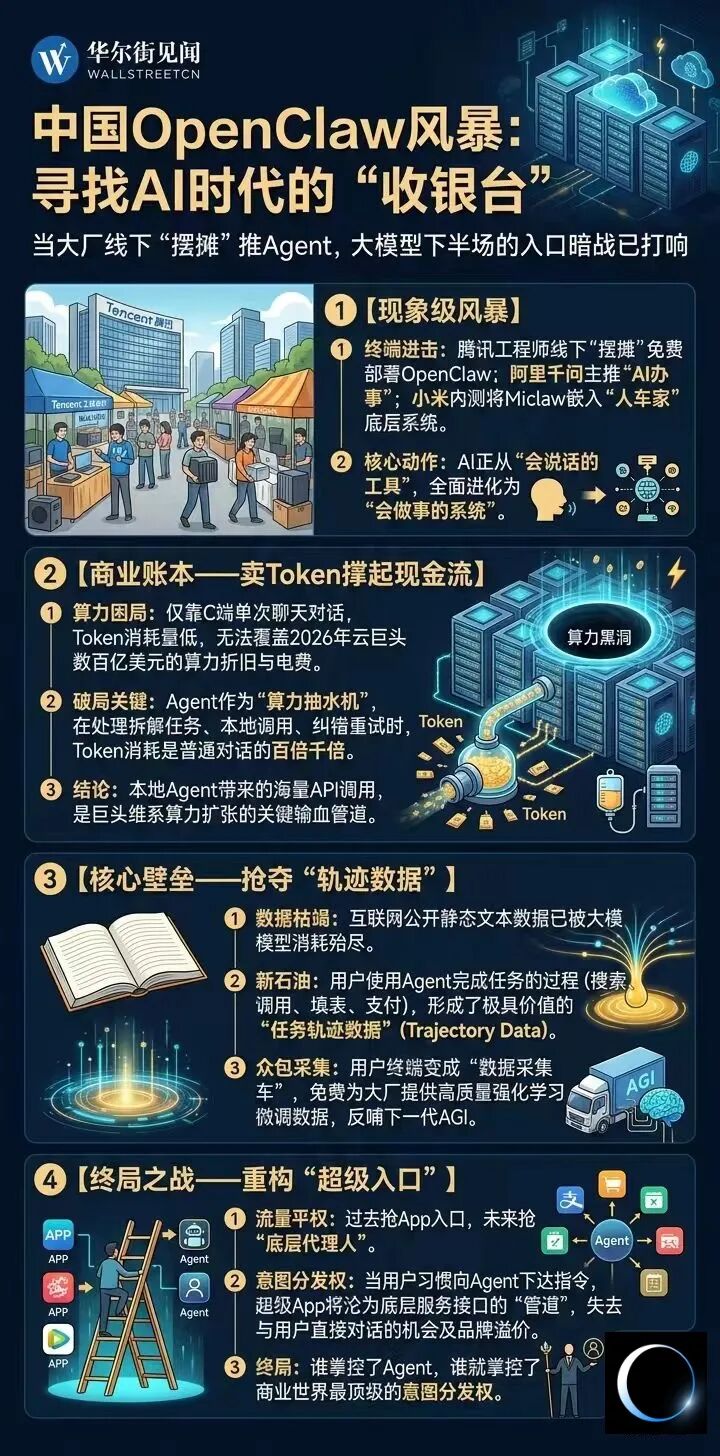
At the beginning of March, in front of Tencent's headquarters in Shenzhen, Tencent engineers set up stalls in the north square of the building like a bustling market, offering free installations of "Lobster" OpenClaw to users.
The queue stretched on and on. Some people carried NAS devices, some brought their MacBooks, and others carried mini - PCs, much like a gathering of geeks flashing Android systems a decade ago.
In fact, many large tech companies are intensively promoting their own "Lobsters".
Xiaomi has started the internal testing of MiclawAgent, aiming to embed the AI agent into Xiaomi's "full ecosystem of people, cars, and homes" system, enabling mobile phones, cars, TVs, and home appliances to become execution nodes for AI.
Cloud service providers have started "setting up stalls". As large terminal manufacturers begin to integrate agents into operating systems, this "Lobster" storm has kicked off the second half of the large - model era.
This is not just a simple competition among AI tools, but a covert battle for the next - generation "super entrance".
The Cash Flow from Selling Tokens
Currently, a dilemma faces all players: the simple "Chat" model cannot burn out a healthy business model.
In the past two years, domestic cloud service providers and tech giants have been engaged in a long - term arms race. Tens of thousands of high - end computing power cards have been systematically brought into data centers. In 2026, the combined capital expenditure of ByteDance, Alibaba, and Tencent exceeded $60 billion. However, if users don't make calls, the computing power will be hoarded in vain, incurring high depreciation costs every day.
The reality is that relying solely on the C - end user dialogue mode not only fails to consume such a large computing power reserve but also fails to generate revenue from users accustomed to free services.
When users occasionally ask AI to write an email or draw a picture, the amount of tokens consumed in such single - time interactions is low and cannot cover the depreciation and operating costs of the underlying large - scale computing power clusters. To make the expensive computing power work and generate real cash flow, the giants urgently need a "Token black hole" that can continuously and automatically consume computing power.
The emergence of locally deployed agents like OpenClaw plays this role.
When users issue complex instructions, OpenClaw will break down tasks, search the Internet, call local software, identify errors, and correct and retry on its own. Each step in this process sends requests to the cloud API interface. After running a complex task, the token consumption is a hundred or even a thousand times that of an ordinary dialogue.
An AI analyst told Wall Street News: "Chinese open - source models are adopted by OpenClaw mainly because of their high cost - effectiveness. Compared with overseas competitors, the low cost leads to more frequent API calls, which directly translates into cash flow for cloud service providers and avoids the waste of huge computing power investments."
This is why cloud service providers like Tencent are willing to offer manpower for free to "set up stalls" offline to help users deploy open - source agents, and Alibaba strongly promotes the integration of OpenClaw into the cloud. Each deployment is like burying a 24 - hour "computing power pump" in the user's local or cloud computer.
Regardless of whether the front - end runs an open - source model or not, as long as the APIs for inference and tool calls point to their own cloud services, a large number of tiny requests will eventually converge into considerable B2C and B2B cash flows. Under the current strict scrutiny of the capital market on the commercialization of large models, the API turnover driven by agents is the key blood - transfusion channel for the giants to maintain the expansion of computing power.
Mining Trajectory Data
Beyond the first - layer cash - flow ledger, the second - layer goal of the giants in promoting local agents touches on the ceiling of large - model development: the depletion of high - quality training data.
In the past few years, the core resources in the large - model competition have always been computing power and training data. However, as the model's capabilities continue to improve, another resource has become increasingly important: task trajectory data.
Currently, there is a consensus that high - quality public text data on the Internet (such as Wikipedia, news reports, and books and papers) has been largely "consumed" by various large models. If only these static texts are continuously fed, large models will only become more erudite "nerds" and cannot move towards true AGI.
What does the next - generation large model need? It needs to know how humans "take actions" in this digital world. This is the "task trajectory data" (Trajectory Data) that the industry is extremely eager for.
When users ask AI to complete a task, AI will go through a series of steps. From understanding the requirements to searching for information, then to calling tools, filling out forms, and completing payments, each action leaves a record. These records form a complete task chain.
For the Agent model, this kind of data is more valuable than ordinary text because it reflects the action logic in the real world.
This is precisely the data that the giants have the most difficulty obtaining. This data is hidden deep in countless fragmented software, closed apps, and corporate intranets. Even search engines with a large crawler ecosystem are helpless.
OpenClaw deployed on user terminals and the system - level Miclaw are like "data detectors" deep behind enemy lines.
Alan Feng, the community manager of OpenClaw in China, pointed out: "After users install OpenClaw, they often expect magical automation, but the real value lies in defining clear tasks. The feedback of trajectory data allows the model to continuously optimize, and manufacturers can use this to improve the agent's capabilities."
When users run an agent locally and let it perform operations on their behalf, the agent records every operation intention and software interaction trajectory of the user. The intensive promotion of agent applications by domestic large companies is essentially a distributed and unprecedented - scale data crowdsourcing.
Users think they are getting a free AI labor force, but in fact, in the process of guiding the agent and correcting its mistakes, users are providing the giants with the highest - quality fine - tuning data for reinforcement learning for free.
Once this "trajectory data" flows back to the cloud, it will become the core barrier for large companies to train the next - generation large - scale Agent models with strong logical reasoning and execution capabilities. This is like how Tesla collected real - world road condition data through millions of electric vehicles on the road and finally fed it back into its FSD autonomous driving algorithm.
An insider from Alibaba's Qwen project told Wall Street News: "The probability of China leading in the new paradigm is less than 20%, but through agent trajectory data, Alibaba can quickly iterate its model and narrow the gap."
Now, the giants are turning users' computers and mobile phones into "data collection vehicles" in the AI era. Whoever can master the most trajectory data will be the first to train a super - model with real "hands and feet".
From this perspective, large companies' promotion of local agents is not just for a new tool. They are still competing for the operation entrance in the AI era.
The Entrance War Repeats
China's Internet has actually experienced several typical entrance wars. In the early days, portal websites competed for homepage traffic; in the search era, Baidu became the information entrance; in the mobile Internet era, users' entrances became apps, and WeChat, Alipay, and Douyin gradually became traffic centers.
However, the emergence of AI is changing this structure.
Alibaba's Qianwen continuously invests in "AI - powered services", allowing users to place orders with just one sentence; Xiaomi is internally testing Miclaw and deeply embedding it into the underlying system of mobile phones. These actions send a signal: in the future, the interaction interface between users and the digital world will be re - constructed.
When users get used to expressing their needs with one sentence, the operation path will change. Users will no longer actively open a certain app but will hand over tasks to AI. AI will decide which platform to use, which service to call, and which payment link to complete.
Therefore, in such a system, the status of apps will change. They still exist but will mostly become service nodes. The real entrance is the agent that helps users complete tasks.
In this new context, "grabbing the entrance of apps" is already an outdated thing. The real war is to become the "underlying agent" that directly obeys users and controls the overall situation.
If a giant can make its agent dominate users' terminals, it will master the top - level power in the business world - the right to distribute intentions. It can easily direct take - out orders to its affiliated enterprises and guide travel demands to its payment ecosystem.
In this new "walled garden" built by agents, those once - powerful super - apps will become "pipelines" that only provide underlying service interfaces, completely losing the opportunity to directly communicate with users and the brand and traffic premiums.
This is why large companies are so sensitive to agents. Everyone hopes to become the platform that controls agents.
On the Eve of the Storm
The popularity of OpenClaw may just be a signal.
The real change is that AI is evolving from a "talking tool" to a "task - performing system". In the past two years, the core goal of the large - model industry was to improve intelligence levels, and now more and more companies are starting to think about another question: how to enable AI to have action capabilities.
Once AI can stably complete tasks, the structure of the Internet will change. Many applications may move to the background, and users only need to face an agent to complete most digital - life operations.
In such a world, the agent is like a new operating layer that connects users with all services.
Looking back at the history of technology, every platform - level change often starts with something seemingly insignificant. Android was initially just a system for geeks to flash, WeChat Official Accounts were just simple content tools when they first appeared, and mini - programs were more like lightweight web pages when they were first launched.
But these products later became new platforms.
If AI really enters the Agent era in the future, then today's OpenClaw is likely to be one of the first names to be remembered.
China's Internet may be on the eve of this storm.
This article is from the WeChat official account "All - Weather Technology" (ID: iawtmt), written by Chai Xuchen and edited by Song He. It is published by 36Kr with authorization.