For high-end pure-electric vehicles, automakers are desperately seeking the "key" to break the deadlock.
High - end pure electric vehicles priced over 300,000 yuan have clearly become the tough nut to crack in the new energy vehicle market.
Except for the new NIO ES8 with battery - swapping support, a large number of high - end star pure electric vehicles that automakers have high hopes for are doomed to a sluggish fate. A typical example is the Li Auto MEGA and the i8. A single fire accident directly led to a cliff - like decline in sales.
The Tesla Model S/X has been discontinued, and traditional high - end brands like BBA have yet to create a best - selling high - end pure electric model.
Even though Wenjie has become a representative of luxury new energy vehicles in China, the pure - electric version of the Wenjie M8 only sold over 8,000 units per month in the early stage of its launch, and its sales began to decline after two months. According to 36Kr, the Xiaomi YU7 max version costs nearly 350,000 yuan when it hits the ground, and its sales are also showing a sluggish trend, deviating from the internal expectations.
In the market below 300,000 yuan, pure electric vehicles have already swept the market. Two models of Xiaomi have achieved a stable sales volume of 40,000 units. In fact, the SU7 has become the best - selling model in the 200,000 - 300,000 yuan market, and the monthly average sales of Geely Xingyuan are even approaching 40,000 units. Not to mention Leapmotor, BYD, etc., which have supported half of the sales volume with low - priced pure electric vehicles.
36Kr has reported that even Li Auto, the leader in range - extender vehicles, internally believes that the market below 300,000 yuan will quickly turn to pure electric vehicles.
The economic efficiency of vehicle use and the smoothness of driving are the sharp weapons for pure electric vehicles to capture the market of fuel vehicles and even large - battery hybrid vehicles. Coupled with the increasing range and the popularization of facilities, pure electric vehicles can achieve "worry - free energy replenishment" in the core economic belts.
However, this rule doesn't seem to apply well in the high - end vehicle market.
"As long as range - extenders exist, high - end pure electric vehicles won't sell well," said a person in charge of a Hongmeng Zhixing store who has experienced how a range - extender saved a high - end vehicle. When the Henjie S9 only had a pure - electric version, only 30 - 40 units were delivered in Beijing every month. In April 2025, the Henjie S9 launched a range - extender version. "The monthly delivery immediately increased nearly five times, reaching nearly 200 units."
According to the data from CATARC, in 2025, the total sales volume in the Chinese market above 300,000 yuan was about 4.1 million vehicles, including about 1 million hybrid vehicles and only 300,000 pure electric vehicles, accounting for even less than 10%.
Automakers still haven't given up on this piece of the cake and are successively launching attacks on the high - end pure electric market.
Li Xiang revealed externally that a new pure electric model, the i9, will be launched in the second half of 2026; NIO will also launch a new model, the ES9, to further impact the high - end market. In addition, new models such as the BMW Neue Klasse iX3 and the Mercedes - Benz pure - electric GLC in the traditional camp will also be launched successively in 2026.
However, it can't be ignored that in the high - end new energy market, consumers still have some core concerns. If these pain points can't be fundamentally solved, then the optimistic narrative about high - end pure electric vehicles will lose its foundation.
Why are pure electric vehicles hard to compete with plug - in hybrids?
The key point in the high - end automobile market is no longer the competition between fuel and new energy vehicles, but the competition between pure electric and plug - in hybrid vehicles.
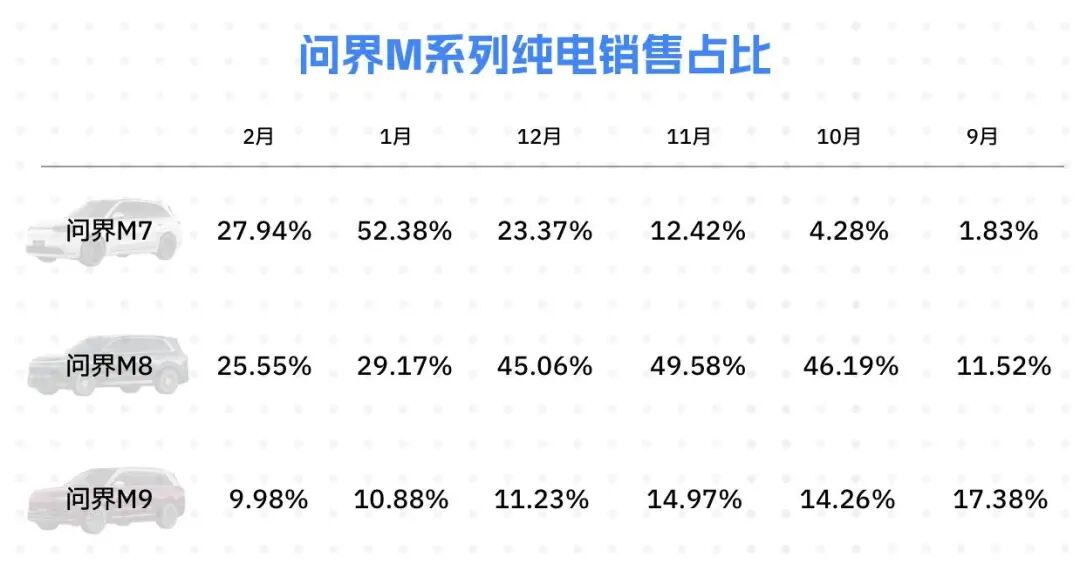
In the high - end market, the Wenjie M7, M8, and M9 have become an unignorable force with their excellent sales. All three models adopt a dual - line strategy of "pure electric + range - extender". 36Kr sorted out their sales data and found a phenomenon: the higher the price of the model, the smaller the proportion of consumers choosing the pure - electric version.
Data source: Bitauto
Looking at the entire new energy vehicle market, this rule still holds. In the price range of 300,000 - 500,000 yuan, the market share of pure electric models has remained at 10% for several consecutive years, while the plug - in hybrid models have achieved growth for three consecutive years.
For consumers, the advantages of pure electric vehicles are concentrated in two aspects. One is the lower vehicle - use cost from saving on electricity fees and simplified maintenance; the other is the quieter and smoother driving experience, as well as the electronic and electrical architecture that is more suitable for intelligent expansion.
Compared with fuel vehicles, the advantages of pure electric vehicles are indeed prominent. However, as plug - in hybrids gain market recognition, the industry is also investing more resources and innovation in plug - in hybrid systems.
Now, in terms of performance experience, plug - in hybrid models have also entered the "3 - second club", and their 0 - 100 km/h acceleration is no worse than that of pure electric vehicles. By installing larger batteries to increase the pure - electric range and strengthening the vehicle's sound insulation, when driving in pure - electric mode at low and medium speeds, the driving quality of plug - in hybrids is already very close to that of pure electric vehicles. And the remaining difference in vehicle - use cost is precisely the least sensitive aspect for high - end users.
While the advantages are being weakened, the challenges faced by pure electric vehicles are still severe.
Compared with ordinary cars, the premium of high - end cars lies not only in the brand value but also in providing users with a truly "worry - free" experience. Worry - free means no need to queue up and no need for frequent hassle, and being able to enjoy a leisurely driving freedom at any time and in any season.
As of 2026, pure electric vehicles still don't seem to have satisfied high - end customers in this regard.
In 2025, the ratio of electric vehicles to charging piles in the country reached 2:1. This figure seems good, but in fact, there is a structural imbalance. Most charging piles are highly concentrated in developed eastern cities, and there are still gaps in central and western provinces, rural areas, and along highways.
The "5 - minute charging for 500 - kilometer range" ultra - fast charging that manufacturers vigorously promote has not been popularized yet. By 2025, the total market share of such ultra - fast charging piles was less than 2.5%. This means that for the vast majority of users, the revolutionary energy - replenishment experience still remains in the future.
Automakers are trying to solve the problem through the technical path of "increasing battery capacity and charging rate". However, this also increases the safety risk of the battery.
In October 2025, a Li Auto MEGA suddenly caught fire on the streets of Shanghai, which was traced back to a problem with the battery coolant; in November, a Zeekr 009 ran over parts that fell from a truck in front on the highway, causing the battery cells to be squeezed and catch fire. After several battery combustion accidents, the market's concerns about the safety of high - end pure electric vehicles were reignited.
The advantages of large - battery plug - in hybrid vehicles are very obvious. A fuel tank can fundamentally eliminate users' anxiety about range and energy replenishment.
Secondly, in terms of the value retention rate, which is particularly concerned about in the high - end market, plug - in hybrid vehicles also show a more stable advantage than pure electric vehicles.
Data source: CAAM
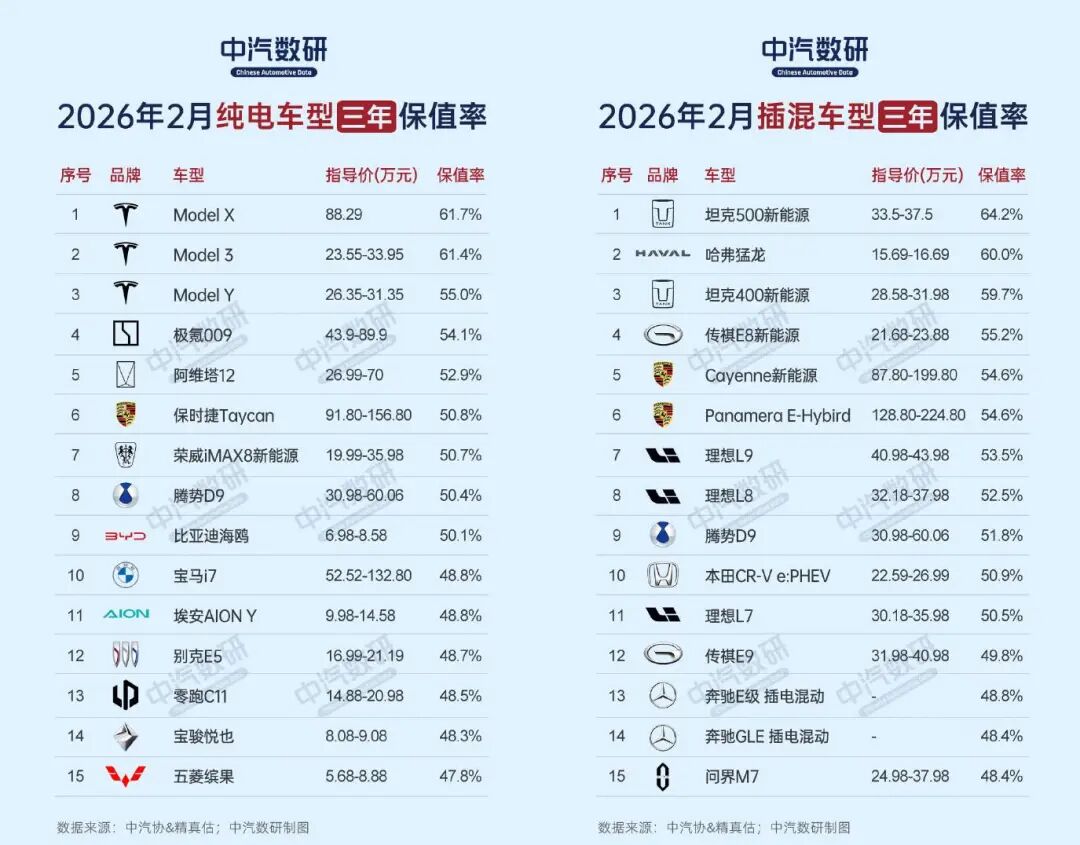
According to the data from CATARC in February 2026, in the one - year - old vehicle value retention rate list, the Wenjie M9 ranked first on both lists. However, the value retention rate of the plug - in hybrid model was 2% higher than that of the pure - electric model, with an actual price difference of about 10,000 yuan.
If the time is extended to three years, the gap is more significant. The value retention rate of the Li Auto L9 reached 53.5%, while pure - electric models in the same class failed to make it onto the list.
However, under the siege of a large number of large - battery plug - in hybrid vehicles, the new NIO ES8 has become an exception in the high - end vehicle market.
The inspiration from the breakthrough of the new NIO ES8
In the second half of 2025, NIO launched a new upgraded version of the ES8, with a price range of 406,800 - 446,800 yuan; under NIO's Baas battery rental program, the purchase price is 298,800 yuan.
In less than six months, the sales volume of this high - end pure electric new car exceeded 70,000 units, achieving an average monthly sales volume of over 10,000 units.
From December last year to February this year, the new NIO ES8 has occupied the top position in the list of new energy vehicles priced over 400,000 yuan for several consecutive months. Those ranked behind are either the rapidly rising Zeekr 9X or the Wenjie M8, the leader of luxury new energy vehicles. As is well - known, the latter two are large - battery hybrid vehicles with "fuel tanks".
To understand the sudden rise in sales of the new NIO ES8, we first need to see its market recognition foundation as a market pioneer.
As one of the first pioneers in the high - end pure electric market, the first - generation ES8, with a starting price of 498,000 yuan, a unique service system, and early market performance, has established a distinct image of a "500,000 - yuan - level high - end pure electric product" in consumers' minds.
"Battery swapping" is another core advantage of NIO.
The core infrastructure network composed of over 3,700 battery - swapping stations not only relieves the anxiety about energy replenishment. The NIO ES8 purchased by car owners in 2019 can also use the new batteries produced in 2026, and the safety inspection accompanying each battery swap also resolves users' long - term concerns about battery safety.
The high - quality brand image, the deep - seated trust brought by the battery - swapping system, the rich configuration and technology of the third - generation platform, and the price difference of 200,000 yuan have quickly released a large number of potential customers. By expanding the market downwards, the sales volume of the new NIO ES8 has been rapidly boosted.
This sales performance seems to give the industry hope for the breakthrough of high - end electric vehicles.
However, the market performance in the past six months is still in the observation window.
"We understand that price reduction is an important reason for the hot sales of the new ES8," several front - line NIO salespeople told 36Kr. Since the launch of the new ES8, the profiles of store visitors and order - placing users have been very different from before. "A large part of the new ES8 users are family users who originally recognized the NIO brand but thought NIO was too expensive before."
"If the price of NIO remained the same as before, many customers wouldn't buy it," a salesperson told 36Kr.
NIO's LeDao L90 has a similar strategy to the new NIO ES8. Relying on product strength, price difference, and battery - swapping advantages, it quickly made it onto the best - selling list.
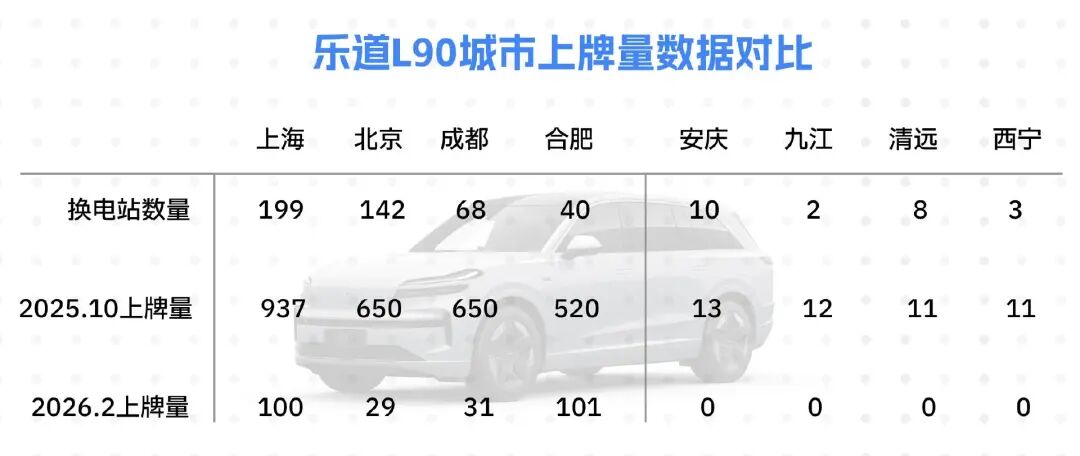
In October 2025, the LeDao L90 achieved a record - high sales volume of 11,700 units. 36Kr sorted out the sales volume and the number of battery - swapping stations in eight cities with the highest license - plate issuance of the LeDao L90 that month.
Data source: Chezhuzhijia
Obviously, the sales volume of the LeDao L90 is concentrated in cities with more battery - swapping stations. After a six - month sales period, the sales volume in top - tier cities has decreased sharply, and in cities with fewer battery - swapping stations, no one is even buying it.
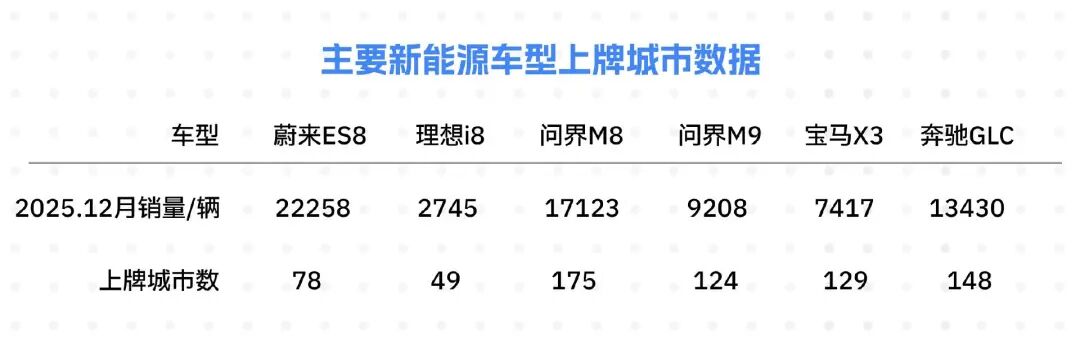
The sales volume of the higher - priced NIO ES8 also shows a similar trend, that is, the user group is moving towards cities with more convenient charging and battery - swapping facilities.
Data source: Chezhuzhijia
Under specific market conditions, pure electric models can indeed win the recognition of high - end users. However, its user group is still concentrated within a limited number of cities, which also reflects that the high - end pure electric vehicle market has not truly "broken through the circle" yet, and the breadth of consumption is still limited.
The road to breaking through the circle is surely not to be achieved overnight. And automakers are investing heavily in the construction of energy - replenishment facilities and the upgrading of battery technology in order to get a share of this market.
Heavy investment in energy replenishment: the key issues of high - end pure electric vehicles need to be solved
Generally speaking, the two key issues of high - end pure electric vehicles are energy - replenishment efficiency and safety. Regarding the former, leading automakers are launching large - scale offensives. Li Auto plans to build 4,800 ultra - fast charging stations by the end of 2026 and increase the proportion of stations in highway service areas to over 35%; BYD has even set a grand goal of building 20,000 flash - charging stations in a year.
In response to the concerns about the safety of high - end electric vehicles, automakers are also continuously strengthening the thermal diffusion and protection design of the battery system. Huawei recently disclosed the design of its Whale battery platform:
The new solution adopts a concept similar to that of an aviation "black box", using multiple communication and power - supply redundancies to achieve more complete and real - time battery data detection, improving the traceability of battery failures; it also improves the safety in key areas such as battery temperature difference control, waterproof sealing, bottom collision, and insulation design in the ultra - fast charging scenario.
In addition, Huawei specifically emphasized that it will not pursue CTB for the sake of extreme energy density. CTB is a design that highly integrates the battery and the vehicle body, eliminating the traditional battery box upper cover and combining the battery system with the vehicle body bottom, thereby optimizing cost and space and increasing the battery loading capacity.
According to 36Kr,