Part 3 of the Charging Pile Series - Ultra-Fast Charging: Does the Battery Degrade by 1% Every 7 Ultra-Fast Charges?
Wang Lei (pseudonym), an owner of a new energy vehicle brand in Beijing, has been feeling a bit anxious lately.
He purchased his current new energy vehicle at the beginning of 2024. Since he lives in an old community without the conditions to install a home charging pile, he can only use the super - charging station downstairs at his company to recharge during his lunch break every day. "The super - charging pile recharges very quickly and is very hassle - free. I plug it in before having lunch and unplug it when my lunch break is over. It doesn't take much time."
However, this comfortable life was disrupted during a battery health check a few days ago. Wang Lei said that the battery health of his electric vehicle is now less than 90%.
"I checked the information. For my model, the normal attenuation in two years should be around 5%, but mine has doubled directly." Wang Lei was very puzzled about this. After checking on social platforms, he thought the problem lay with the super - charging.
Wang Lei said, Most new energy vehicle owners who rely on super - charging for a long time have low battery health, while those who only use home charging piles generally have good battery health. Some even have an attenuation of less than 4% in three years.
In this "Year of the Super - Fast Charging Explosion", 900V platforms, 400kW, and even 600kW peak power are gradually becoming high - frequency terms at new car press conferences. However, behind the technological progress, hidden concerns are gradually emerging: With faster charging, how much battery life is left?
1. How Super - Charging "Overdraws" the Battery
To understand why super - charging damages the battery, we first need to understand what super - charging is.
Super - charging usually refers to direct - current fast charging with a charging power of over 250kW. The core of achieving "second - level energy replenishment" lies in the synergy of three technologies: liquid - cooled gun cables, intelligent temperature control, and high - voltage platforms. The liquid - cooled charging gun and cables can carry a large current of over 600A to avoid overheating and fusing; the intelligent temperature control algorithm with millisecond - level response can precisely adjust the cooling intensity, control the temperature difference of the battery cells within 3°C, and ensure the safety and lifespan of the battery; the 800V+ high - voltage platform significantly reduces the charging current and reduces transmission losses.
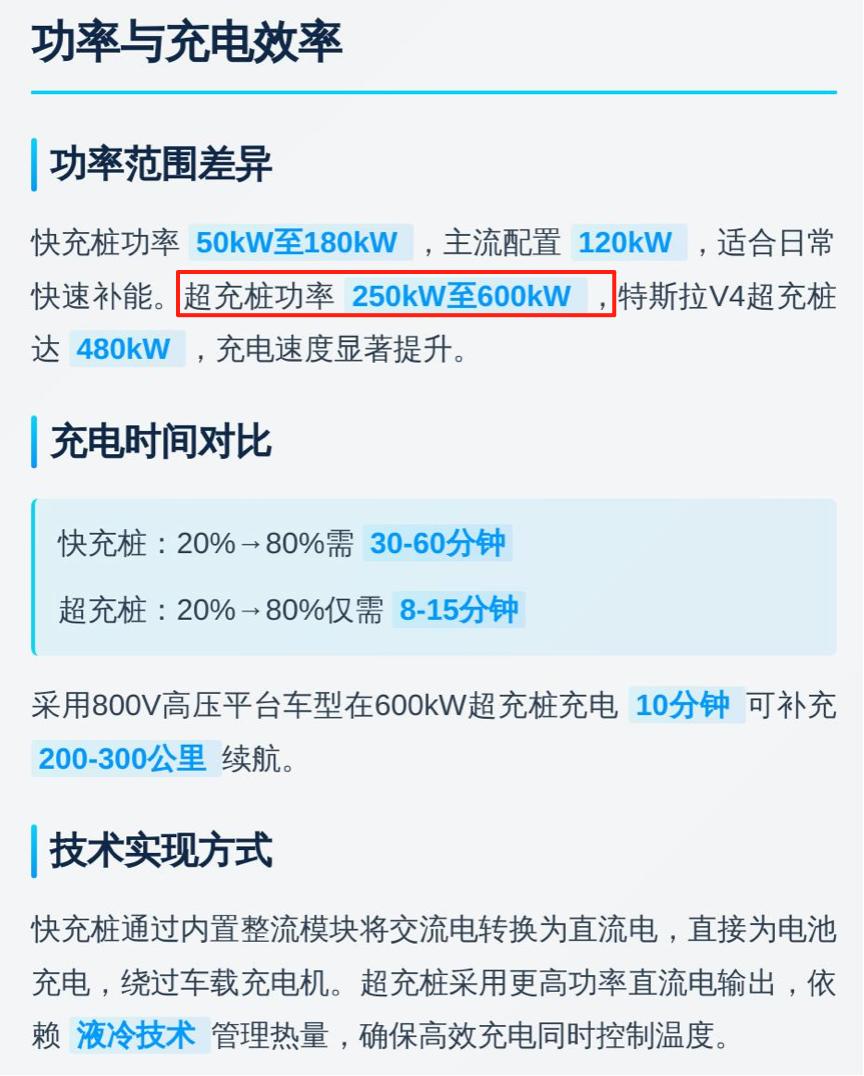
Picture/Comparison between fast charging and super - charging. Source/Screenshot from the Internet, New Energy Outlook
However, behind the high power lies a severe challenge to the electrochemical system.
A study by Geotab, a Canadian telematics company, on more than 22,700 new energy vehicles covering 21 models shows that the attenuation rate of batteries that are frequently charged with a power of over 100 kilowatts is about twice that of batteries that are mainly charged with low - power charging methods such as secondary charging piles.
This means that for vehicles of the same age (five years), those using super - charging are more likely to damage the battery life than those using slow - charging.
The latest research by the team of Academician Ouyang Minggao from Tsinghua University shows that the cycle life of batteries that are frequently charged with a super - charging power of over 120kW is 40% shorter than that of slow - charged batteries.
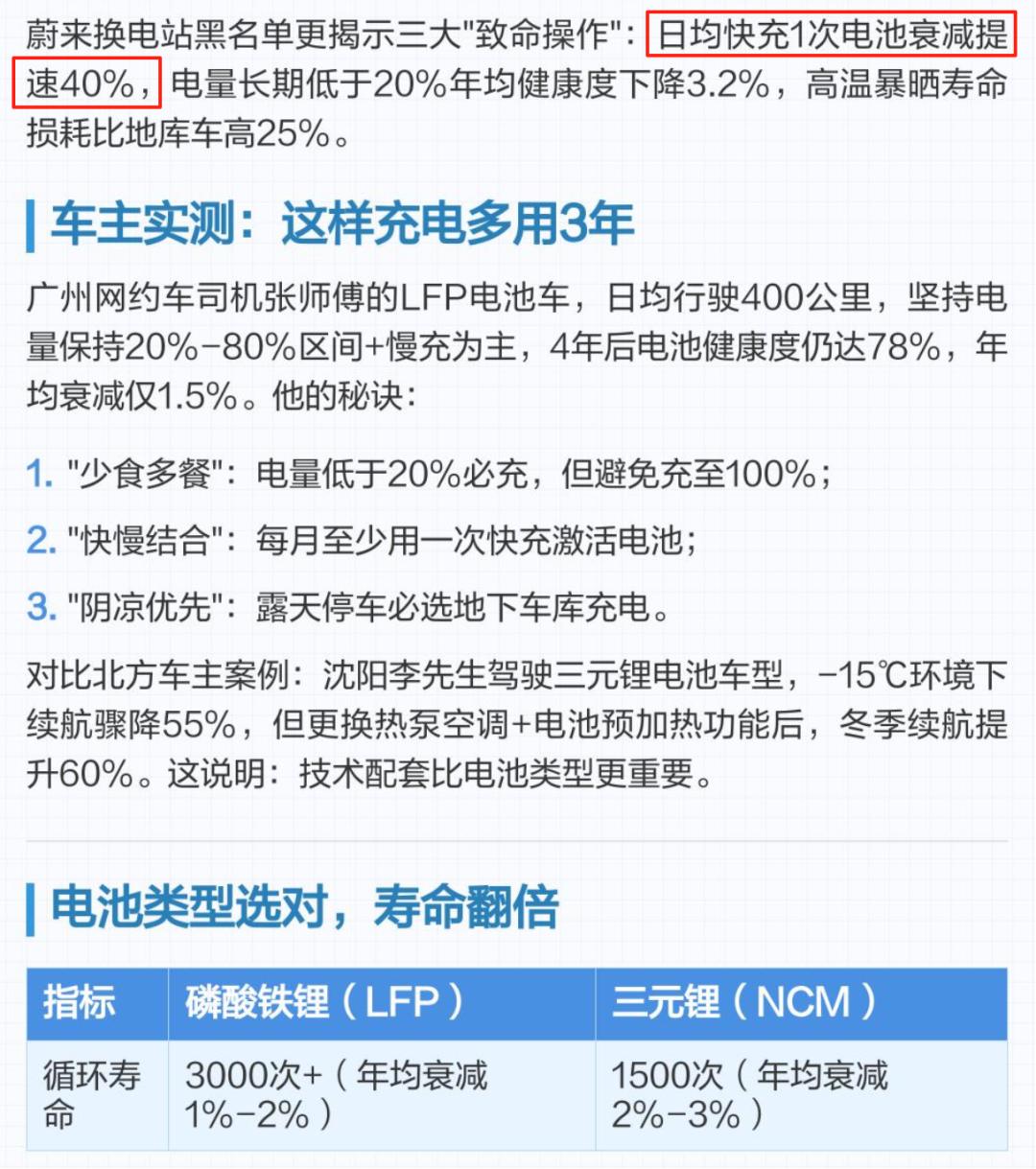
Picture/Three "fatal operations" in charging and actual measurements by vehicle owners. Source/Screenshot from the Internet, New Energy Outlook
Lu Chihua, a professor at the School of Automotive Engineering of Wuhan University of Technology, also said that according to the analysis of the current mainstream industry technology, the cycle life of on - board lithium iron phosphate batteries can reach 3,000 - 5,000 times, and that of ternary lithium batteries can also reach over 2,000 times. They can be used normally for 8 - 10 years.
"However, frequent use of super - fast charging is another matter. Experiments show that for pure electric vehicles that are two years old and have been fast - charged over 100 times, the battery health is about 85%, and the attenuation rate is accelerating."
The group of online car - hailing drivers is the most direct proof. The survey data from a third - party platform shows that for online car - hailing drivers of pure electric vehicles with a daily mileage of over 100 kilometers, the proportion of super - fast charging use is over 70%. The health of their on - board power batteries will drop from 100% when new to 85% within two years, with an average annual decline of 7.5%.
Master Xu (pseudonym) is a typical representative. He said that in order to have time to take large orders such as round - trips to the airport, he usually chooses super - fast charging to save a lot of time, but it really damages the battery. "I just found out when I took my car for after - sales maintenance recently that the battery health of my car is only 76%."
2. Invisible Protective Net: Car Manufacturers "Step on the Brakes" Where You Can't See
Since super - charging is so damaging, why do car manufacturers still promote it? Are they trying to deceive consumers?
Obviously, the answer is no. Many mainstream car manufacturers have already built an "invisible protective net" for power batteries through the BMS (Battery Management System) to find a balance between speed and lifespan.
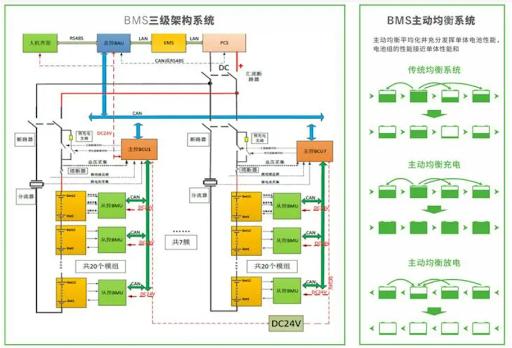
Picture/Illustration of the BMS three - level architecture system. Source/Screenshot from the Internet, New Energy Outlook
The logic of this protection mechanism is very clear. Only in the range where the battery has the strongest tolerance, when the battery level is between 20% - 60% and the temperature is maintained between 25 - 40°C, the potential safety margin of the graphite negative electrode is the largest, the lithium - ion insertion channel is the most unobstructed, and the risk of dendrite precipitation is minimized. Once it leaves this safe range, the BMS system will immediately and actively reduce the power, which is equivalent to quietly stepping on the brakes for the battery.
Many car manufacturers have also added a dedicated super - charging protection mode to the BMS. When the battery level is below 20%, the power is automatically limited to 60kW, and the charging speed continues to slow down when it reaches over 80%. This is not a technical limitation but a deliberate battery protection strategy.
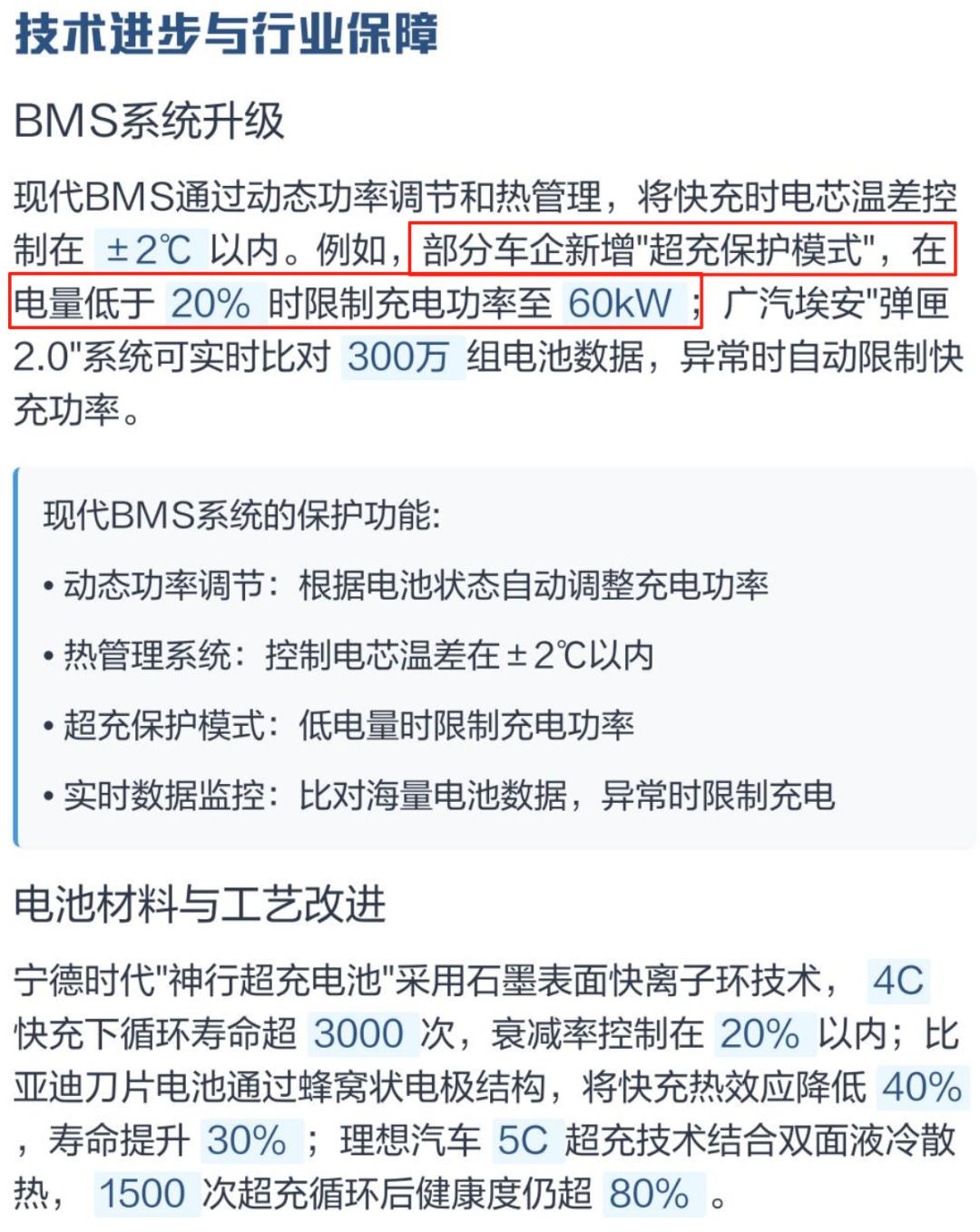
Picture/Technical advantages of the super - charging protection mode. Source/Screenshot from the Internet, New Energy Outlook
Mr. Guo, an owner of an Ideal MEGA in Shunyi, Beijing, has a deep understanding of this.
When he first used super - charging, he once thought there was a fault with the charging pile. Later, he understood the principle. It only takes more than ten minutes to charge the vehicle from 20% to 80%. The charging speed slows down significantly in the 80% - 90% range, and it enters a trickle state after 90%. It takes nearly twenty minutes to charge from 80% to full.
"I contacted the after - sales service and found out that this was intentional. This pulsed power distribution allows us to intuitively experience the extremely fast energy replenishment while strictly limiting high - load charging to the safest range of the battery, minimizing electrochemical damage."
There are many new energy vehicle owners who feel the same way as Mr. Guo.
Mr. Chen (pseudonym), an owner of a Tesla Model Y in Shanghai, who relies on super - charging for commuting for a long time, was initially very confused about the change in the charging curve. After asking in the owner's group, he understood the reason. "Fast - charging at low battery levels is to meet the need for traveling; actively slowing down at high battery levels is to protect the battery health."
Ms. Zhou (pseudonym), a post - 90s owner of a Zeekr 001, uses super - charging 2 - 3 times a week. At first, she was not used to the "fast at first and slow later" charging. It was not until she asked the maintenance master during a maintenance that she knew that the vehicle was actively protecting the battery. "This design is really considerate and responsible. It allows me to enjoy a fast energy - replenishment experience and silently reduces battery wear."
In addition to the vehicle - end protection, intelligent super - charging piles are also participating in the whole - process protection. At the beginning of charging, the current is large to quickly replenish the power. As the battery approaches full, the current gradually decreases to prevent over - charging.
3. It's Not That You Can't Use Super - Charging, It's That You Can't "Abuse" It
However, the protection of the BMS battery management system is not omnipotent. Although it can adjust the power within the safe range, it cannot interfere with the user's choice every time they plug in the charging gun. For the same vehicle and the same super - charging pile, some people experience an 8% attenuation in three years, while others lose nearly 8% in one year. The root of the difference often lies not in technology but in habits.
Mr. Liu (pseudonym), an owner of a Voyah Zhiyin, has a deep feeling about this. He is engaged in sales work and drives 150 kilometers per day on average. Super - charging has almost become a daily necessity. "At first, I just thought it was convenient and didn't think too much. When I had a battery check at the end of last year, the battery health was only 83%. The after - sales service said that at this rate, I would have to consider replacing the battery next year."
Mr. Liu began to review his charging habits: he often used the battery until it was below 5% before charging, always used super - charging, and left only after charging to over 90%, never stopping for slow - charging maintenance. "In short, I used super - charging like slow - charging. The battery couldn't stand it."
He later asked a online car - hailing driver who has been driving an electric vehicle for five years for advice. The driver told him an experience: Super - charging can be used frequently, but it cannot be abused. The core of not abusing it lies in three points - don't wait until the battery is depleted to charge, don't always charge to full, and have slow - charging maintenance every once in a while.
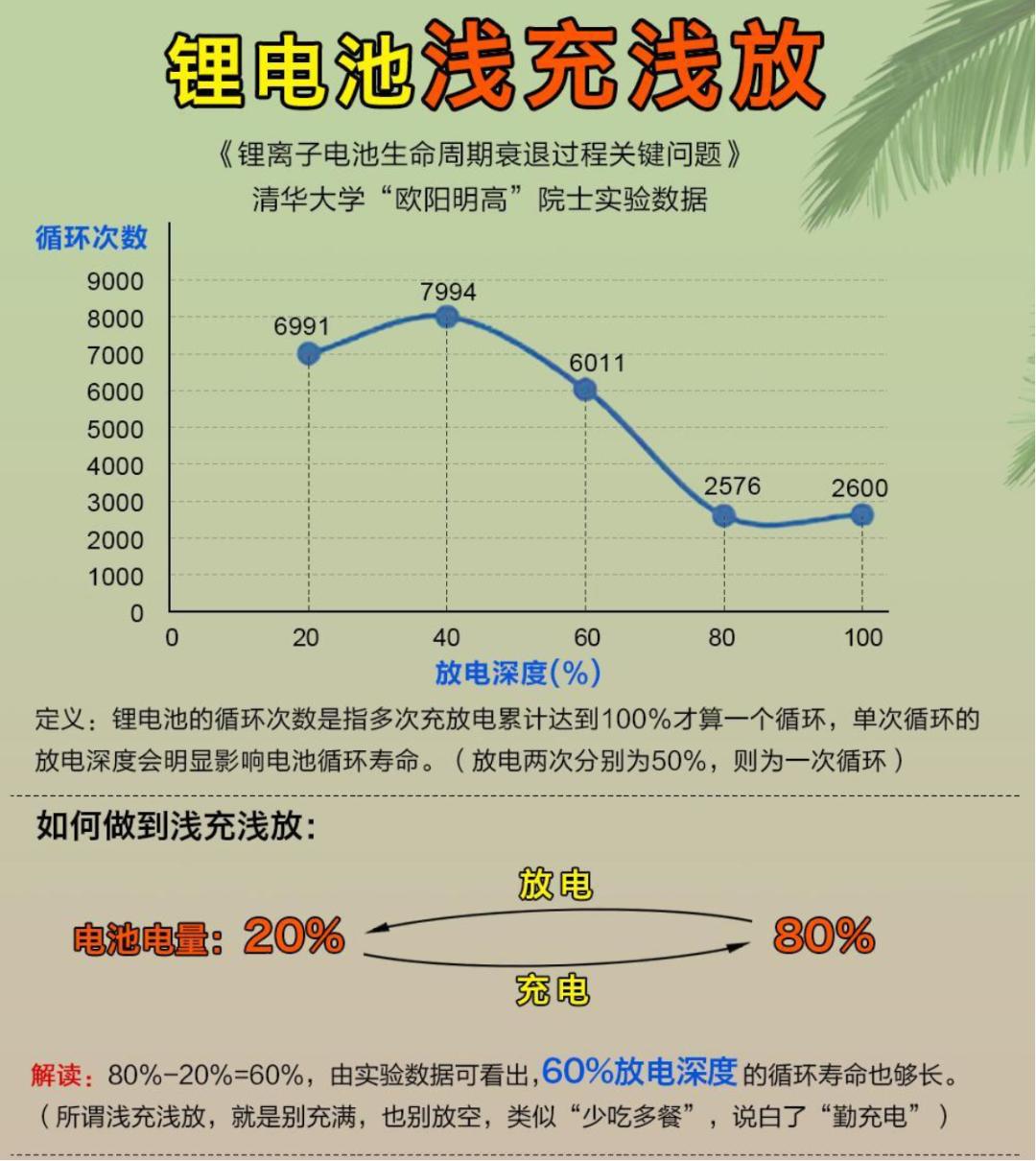
Picture/Lithium batteries need shallow charging and shallow discharging. Source/Screenshot from the Internet, New Energy Outlook
Many consumers with high battery health agree with the views of the online car - hailing driver. "Use slow - charging for daily commuting, and use super - charging for weekend outings or urgent trips. Also, try to keep the battery level above 20%."
"If you want the battery to have a long lifespan, you not only need to choose a high - quality battery but also do a good job in maintenance. I usually start charging when the battery level is above 20% and unplug when it reaches about 80%. In this way, the battery health hardly decreases."
Professor Qi Lu, the director of the New Energy Materials and Technology Laboratory at Peking University, said that vehicle owners should control the proportion of super - fast charging use to less than 40%. When time allows, they should use slow - charging as much as possible. In particular, they should avoid using super - fast charging when the battery level is below 10% or above 90%, as using super - fast charging in this range causes greater damage to the battery.

Picture/Differences between slow - charging, fast - charging, and super - charging. Source/Screenshot from the Internet, New Energy Outlook
Of course, in addition to consumers actively improving battery maintenance, the industry should also resolve the contradiction between power and lifespan at the root through material innovation and model innovation as soon as possible.
Currently, some battery companies have controlled the temperature difference of battery cells during fast - charging to about 2°C through the integrated design of water - cooling plates. Coupled with new electrolytes, the number of 4C - rate charging cycles can exceed 1,500 times, a 50% increase compared with traditional solutions.
The popularization of super - charging technology is intended to relieve energy - replenishment anxiety with efficiency, which is a good thing. However, for the convenience brought by technology, users need to have an understanding of its technical boundaries. The power dips hidden behind the charging curve and the active speed reduction of the BMS are essentially reminders to consumers: Super - charging can be used, but it cannot be abused. The safe range for super - charging is 20% - 80%.
This article is from the WeChat official account "New Energy Outlook", author: Youjian Editorial Department. It is published by 36Kr with authorization.