The Xiaomi version of OpenClaw is here. You can raise lobsters on your phone. The achievements of Luo Fuli have been implemented.
The "Lobster" for Xiaomi mobile phones is here!
According to a report by Zhidx on March 6th, today, Xiaomi officially launched a small - scale closed - beta test of the mobile - end system - level intelligent agent Xiaomi miclaw, which is similar to OpenClaw.
Recently, the open - source project OpenClaw has quickly become popular in the developer community. It demonstrates the amazing ability of large models to call tools and operate software to complete tasks. In the developer circle, building an intelligent agent assistant with OpenClaw is also jokingly called "raising a lobster". And the Xiaomi miclaw released this time by Xiaomi brings a similar concept into the mobile phone system.
Xiaomi miclaw is a mobile - end AI interaction test product built based on Xiaomi's MiMo large model. Its core goal is to deploy the execution ability of the large model at the mobile phone system level. Simply put, Xiaomi miclaw is a system - level intelligent agent that can 'operate the mobile phone'.
After obtaining user authorization, Xiaomi miclaw can call mobile phone system tools, application capabilities, and Xiaomi ecosystem devices, and automatically disassemble tasks and execute them step by step according to the user's vague instructions.
If the user says: "I'll take my friend Beibei home in half an hour. Prepare the house and give Beibei a warm welcome." The AI will automatically understand this requirement and link the home devices for preparation, such as adjusting the lights, curtains, and air - conditioner.
Judging from the currently disclosed architecture, the capabilities of Xiaomi miclaw mainly come from four levels: system underlying capabilities, personal context understanding, ecological interconnection, and self - evolution mechanism. After these capabilities are superimposed, the mobile phone is more like the 'body' for the AI to execute tasks.
However, Xiaomi also emphasizes that this is still a product in the exploration stage. It is still in the process of continuous optimization in terms of stability, power consumption performance, and the success rate of execution in complex scenarios. There may be fluctuations in execution efficiency or periodic failures in some high - complexity tasks.
This test adopts an invitation system and is not open to the public for recruitment. It only supports the latest Xiaomi 17 series models, including Xiaomi 17 Ultra Leica Edition, Xiaomi 17 Ultra, Xiaomi 17 Pro Max, Xiaomi 17 Pro, and Xiaomi 17.
It is worth mentioning that the MiMo large model behind this product was developed by Xiaomi's AI team, and its person - in - charge is Luo Fuli, a former core member of DeepSeek and known as the 'genius girl'. In November 2025, Luo Fuli announced on her WeChat Moments that she had joined Xiaomi and took the position of the person - in - charge of the MiMo large model. One month later, Xiaomi released the MiMo - V2 - Flash model, whose performance can already be comparable to DeepSeek - V3.2. This is the first important achievement of the MiMo system after her joining the team.
The launched Xiaomi miclaw can be regarded as a key attempt to implement the MiMo large model at the product level. Judging from the currently disclosed functions and architecture, Xiaomi miclaw is more like an important technological experiment by Xiaomi in the direction of mobile - end agents.
If this direction can be successful, the relationship between mobile phones and AI in the future may gradually change from 'users operating applications' to 'users setting goals and AI completing operations'.
01. From home devices to financial monitoring, see what the "little shrimp" can do in six scenarios
In addition to the home linkage scenario such as 'automatically preparing the environment when a friend comes home' mentioned above, in multiple cases announced by Xiaomi, Xiaomi miclaw also has multiple different types of usage scenarios. From home device management to health management, and then to information reminders and financial monitoring, all can be completed with just one sentence.
For example, saying "I'm at the Xiaomi Home. Check what consumables are lacking at my home", the AI can combine device data to judge the consumption status of the smart door lock battery, the side brush and filter of the sweeping robot, etc., and give the shopping priority.
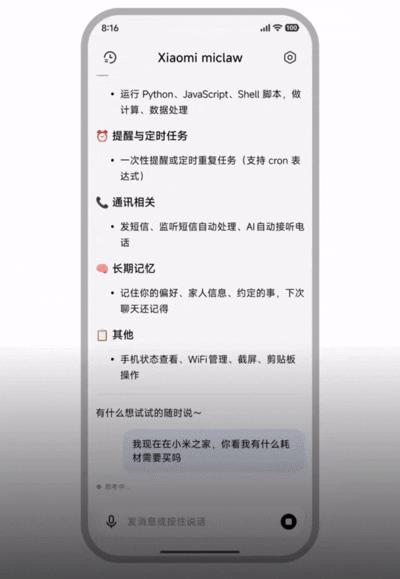
In the health management scenario, the user can directly say to the AI: "Look at the photos of the food I took in my photo album and help me lose 3 kg next week." The AI will first re - view the food photos in the user's photo album, identify each picture, and analyze the calories.
In addition to giving corresponding diet adjustment suggestions, the AI will further conduct a health assessment: calculate the basal metabolic rate, daily energy consumption, and healthy weight range based on the user's basic information.
Then the AI will give a more reasonable goal and formulate a specific diet and exercise plan. At the same time, the system will also generate an execution example, including the daily schedule, diet arrangement, and exercise plan.
On this basis, the AI can also link Xiaomi ecosystem devices, such as synchronizing the exercise goal to the Xiaomi Band, arranging the voice speaker to give health reminders, and using lights and schedule reminders to help the user establish a new lifestyle.
Some daily tasks can also be automatically completed by the AI. For example, if the user sets: "Wake me up at 7 o'clock tomorrow morning. If I don't get up, keep bothering me." The system will arrange various reminder methods according to the user's habits to ensure that the wake - up task is completed.
The system will first generate a complete wake - up process and link relevant devices for execution. For example, it will wake up the user on time at 7 o'clock and broadcast the weather information and the day's schedule at the same time; if the user doesn't respond, it can continue to remind through the speaker or trigger the 'natural wake - up' with the lights gradually getting brighter.
At the same time, the system will also prompt some execution conditions, such as requiring the user to confirm "I'm up" to the Xiaoai Speaker to enter the next process and ensuring that relevant devices are online.
The user can also let the AI play the role of a 'personal assistant'. For example, setting: "Give me a voice broadcast at 8:16 every morning to remind me of the day's schedule, and then search for 3 - 4 news items related to AI and finance. You can freely play with other content." After that, the AI will generate a voice broadcast regularly every day.
In the financial information monitoring scenario, the user can also directly put forward a requirement: "Can you help me monitor the price of spot gold? Broadcast it to me every two minutes." The AI will continuously track the relevant market conditions and give reminders.
02. The AI can "take action", built - in the mobile phone, and more than 50 system tools can be called
The most core ability of Xiaomi miclaw is to enable the AI to have the ability to directly operate the system.
An AI assistant running in a traditional application sandbox, even with a very powerful model, can essentially only answer questions or conduct searches. However, Xiaomi miclaw runs as a system application, has higher permissions, and can directly call mobile phone system functions.
Currently, Xiaomi has encapsulated mobile phone capabilities into more than 50 system - level tools, including functions such as application startup, system settings, and device control. After understanding the user's needs, the AI can independently select appropriate tools and fill in parameters to execute tasks step by step.
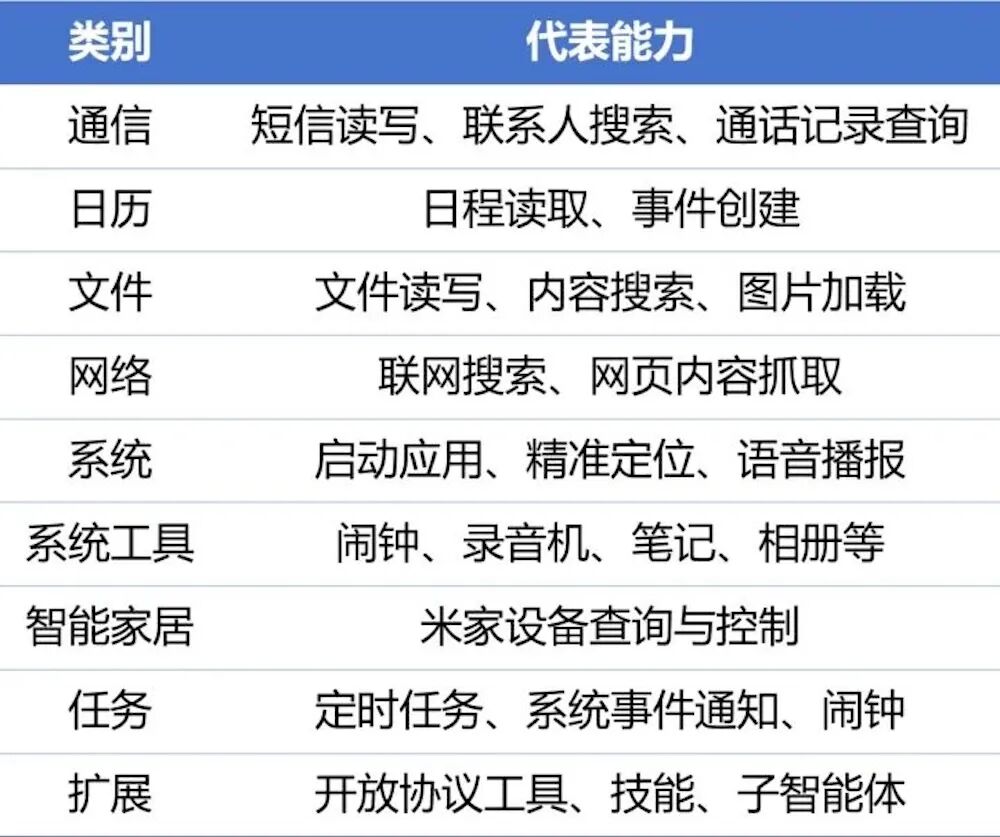
▲ Image source: Xiaomi Technology
For example, when the user puts forward a complex requirement, the system will enter an "inference - execution cycle", letting the model decide the calling order by itself: after the user inputs an instruction, the model first determines which tools need to be called and what parameters to pass at each step; after the tool execution is completed, the result is returned to the model, and the model continues to infer the next operation until the entire task is completed.
During the execution process, the user can also see in real - time which tools the AI is calling and which step the task has progressed to. This streaming execution method makes the process of complex tasks more transparent.
To avoid the interruption of long - task execution, the system also designs a three - level context memory mechanism to automatically retain key decision - making information in long conversations and multi - step operations. Even when performing more than 20 steps of complex operations, the AI can still remember the initial requirement without the user having to repeat it.
03. Evolving personal context: reading text messages, checking the calendar, and starting to understand the user's life
Another key ability of Xiaomi miclaw is personal context understanding.
Traditional AI assistants usually only understand the current input sentence, while Xiaomi miclaw, after obtaining authorization, can read various information sources in the mobile phone, such as text messages, calendars, or usage habits, so as to more comprehensively understand the user's life scenarios.
A typical case is automatic travel preparation.
When the user receives a ticket - purchasing text message saying "G1234 Beijing → Chengdu Friday 08:30", the AI can automatically recognize this as travel information and link multiple system tools: update the calendar, set a reminder, plan the departure time, etc. The entire process of 7 steps is automatically completed, linking 6 tools.
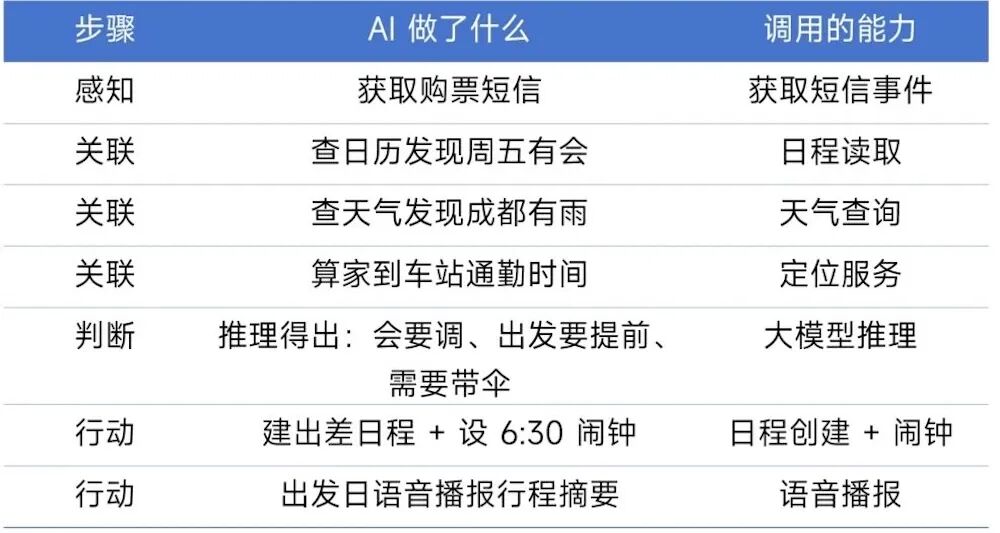
▲ Image source: Xiaomi Technology
Similar abilities are also reflected in the consumption scenario.
When the mobile phone receives a bank deduction text message, the AI will read the relevant text message records of the past 3 months and analyze them in combination with historical consumption information. If it finds that two video platforms are deducting monthly fees at the same time and the content has obvious overlap, the system will make a judgment and generate a consumption briefing at the end of the month, suggesting that the user cancel one of the subscriptions to reduce unnecessary expenses, saving about 400 yuan per year.
In terms of privacy, Xiaomi emphasizes that user data is processed locally first. Conversation history, user configuration, and skill files are all stored on the local device. The cloud only receives the current conversation information during inference and deletes it immediately after the inference is completed. For sensitive operations such as sending text messages and creating schedules, the system will also pop up a confirmation prompt before execution.
04. Connecting to the Mi Home IoT ecosystem, the AI links all - house devices according to the context
The capabilities of Xiaomi miclaw are not limited to the inside of the mobile phone.
In the third - level ability, the AI can connect to the Xiaomi IoT ecosystem to achieve unified control of smart devices. Currently, the Mi Home platform has connected more than 1 billion devices, and in theory, all of them can become tools that the AI can call.
For example, in the scenario of "home office mode", when an event like "10:00 important customer meeting" appears on the calendar, the AI will judge that the user needs a relatively quiet environment and automatically make a series of adjustments: the mobile phone enters the silent mode, the sweeping robot pauses its work, and incoming calls will also be distinguished according to the degree of urgency.
For example, the boss's call will be reminded by vibration, while low - priority calls such as those from couriers will be silently recorded. After the meeting ends, the system will automatically restore the original state of the devices and push a summary of missed calls and messages to the user.
Different from traditional smart homes that rely on fixed rules, Xiaomi miclaw will make dynamic judgments according to the context. For example, for the same 'there is a meeting' schedule, if it is just an internal weekly meeting, the system may only mute the mobile phone; if the schedule is marked as an 'important customer meeting', the AI may link more devices to create a quiet environment.
Its judgment basis includes not only the key information in the schedule but also the user's past meeting habits and the current operating status of home devices to decide which devices and operations need to be triggered.
In addition to Xiaomi devices, Xiaomi has also opened two expansion channels.
One is to support MCP (Model Context Protocol), which can connect a large number of existing AI tools on the PC side; the other is to release a third - party SDK, allowing applications to actively declare their capabilities for the AI to call when needed.
05. Enabling the AI to grow continuously, "sub - intelligent agents" appear in the mobile phone
Xiaomi miclaw also has a more imaginative ability: self - evolution mechanism.
In this system, the AI can not only use tools but also create new tools or ability modules. For example, it can record user habits through a file - level memory system, conduct task division through sub - intelligent agents, or dynamically connect to new MCP services to expand capabilities.
Each sub - intelligent agent can have independent prompt words and tool permissions. For example, one sub - intelligent agent is dedicated to managing schedules, and another is responsible for information summarization or news organization.
In addition, the system also supports running Python or JavaScript scripts in a sandbox environment, enabling the AI to have certain programming capabilities.
Through the superposition of these capabilities, Xiaomi miclaw can form a growth path: first adjust its own behavior, then expand the scope of capabilities, and finally precipitate experience through the memory system and gradually become more familiar with the user.
The Xiaomi technology team disclosed that these complex processes are not pre - written fixed rules but are formed by the AI's self - combination on the basis of basic tools.
06. Conclusion: Xiaomi also starts to test the waters with the Agent in the mobile phone
In the past year, AI has become a new entry point for mobile phone manufacturers to compete for layout. From voice assistants to generative AI, and then to increasingly complex system - level capabilities, mobile phone manufacturers are all trying to make AI penetrate deeper into the operating system.
Recently, the exploration in this direction has significantly accelerated. The open - source project OpenClaw has become popular in the developer community, allowing many people to directly see for the first time that large models can call tools and operate the system to complete tasks. In the consumer market, the phenomenon - level attention triggered by the Doubao mobile phone has also made the "AI mobile phone" a topic of public discussion.
In this context, Xiaomi miclaw is more like an attempt at the system level. It tries to directly embed the Agent ability into the mobile phone system, enabling the AI to call tools, connect devices, and participate in more actual operation processes.
Although at present, this is still an exploration in the early stage. But in the near future, the interaction between people and mobile phones may change dramatically.
This article is from the WeChat official account "Zhidx" (ID: zhidxcom), author: Jiang Yu. It