In 2026, will Apple soar to the sky or sink into the ground? What about Huawei?
While Huawei is soaring to new heights with high - end products, Apple is digging deep with low - end offerings.
The entry - level computer, the MacBook Neo, starts at 4,599 yuan. The brand - new Zunjie S800, equipped with an 896 - line lidar, starts at 728,000 yuan. That means selling one latest Zunjie S800 in the Hongmeng Smart Mobility ecosystem is roughly equivalent to Apple selling 158 of its latest laptops.
The MacBook Neo and the new Zunjie S800 were launched on the same day. These are the most eye - catching new products from Apple and Huawei in the spring of 2026, representing the divergence of these two tech giants: one is getting cheaper, aiming for a price - war - based dimensionality reduction attack; the other is getting more expensive, using radical technology to define the future.
At the Huawei Hongmeng Smart Mobility Technology Innovation Launch Event, Yu Chengdong previewed upcoming new models: a sports sedan, the Shangjie Z7, and a shooting brake, the Z7T. Visually, the purple - pink Shangjie Z7 bears a high resemblance to the once - popular Xiaomi SU7. It even came up with the slogan "More anticipated than the new generation". The outside world expects the Shangjie Z7 to be more attractive in terms of power and price.
Huawei also demonstrated its technological prowess by unveiling a new - generation dual - optical - path image - level 896 - line lidar, which is currently the highest - specification mass - produced lidar product globally. The models equipped with this new - generation lidar are the Zunjie S800 and the Wenjie M9, with prices 20,000 yuan and 10,000 yuan higher than their predecessors respectively.
On the same evening, Apple didn't hold an online spring launch event. Instead, it set Shanghai as the offline experience hub and directly launched new products on its official website. This is Apple's first launch event in the Chinese mainland. The more affordable MacBook Neo, iPhone 17e, mid - range products like the iPad Air and MacBook Air, and high - end ones such as the MacBook Pro and Studio Display were all included.
On the surface, while Huawei is soaring to new heights with high - end products, Apple is digging deep with low - end offerings.
But in fact, looking at the whole year of 2026, this is a parallel and dynamic equilibrium, and an increasingly intensified polarization of consumer spending. As Huawei has regained the top position in China's smartphone market in terms of shipments, it must prioritize the in - depth expansion of its products across all scenarios. Meanwhile, Apple is seizing the market during the memory supply crisis, lowering the entry threshold while increasing the premium on high - end products.
Both "digging deep" and "soaring high" are forms of offensive strategies, not passive defenses. Apple aims to attract new users with cheaper hardware prices and then strengthen its moat with higher - margin service revenues. Huawei's Hongmeng Smart Mobility, on the other hand, uses high - end products to break free from the downward - trending profit margins in the automotive industry and outperform competitors with its extreme technological premium capabilities.
If Apple's foldable phone launched in the second half of this year fails to match the impact that Huawei's Ultimate Design brought to the market two years ago, will the flag of the high - end tech market truly shift in consumers' minds?
1
Apple's Price Concessions and Dimensionality Reduction Attack
Affordable prices are Apple's strategy to expand its user base.
Similar to last year's iPhone 16e, this year's entry - level iPhone 17e also starts at 4,499 yuan. It features a 48 - megapixel single - camera, comes in three colors (light pink, white, and black), and offers two storage options (256GB and 512GB). Compared to the previous generation, it's about 1,000 yuan cheaper.
Even more eye - catching is the entry - level computer, the MacBook Neo, starting at 4,599 yuan. It comes in four colors, offers 256GB and 512GB storage options, and is powered by the same A18 Pro chip as the iPhone 16 Pro. This is also the first time Apple has used a smartphone chip in a computer product.
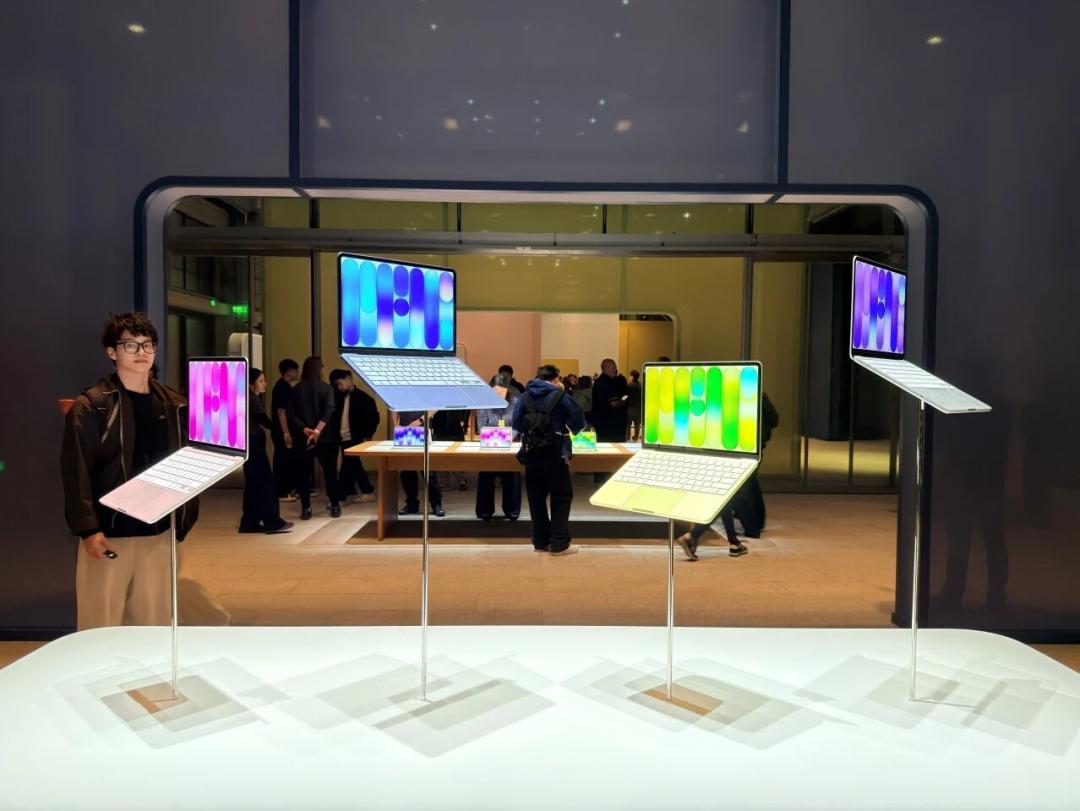
Posts like "How much has the MacBook Neo been cut down?" quickly became hot topics on social media. Users compared this "basic version" with Apple's previous MacBook Air, pointing out issues such as a smaller screen, reduced performance, and the lack of a Force Touch trackpad, suggesting it's more suitable for basic users like primary school students.
However, there were also different voices in the comment section. Some users believed this product is suitable for cost - conscious consumers, arguing that the MacBook Neo meets the most basic daily needs of ordinary people (such as surfing the Internet and writing documents). They also said that it doesn't have a productivity - related premium but is still being criticized.
It's obvious that Apple is using entry - level products for a dimensionality reduction attack. The Wall Street Journal commented, "People are feeling the pressure of rising prices. By removing some professional - grade features and offering brighter colors and a lower entry threshold, Apple may be able to capture market share from competitors that are forced to raise prices."
The sky - rocketing memory prices have put upward pressure on the prices of global consumer electronics.
But Francisco Jeronimo, vice - president of IDC, believes this presents an opportunity for Android users to switch to Apple's ecosystem and Windows PC users to switch to Apple computers: "Apple is on the offensive. They see the memory crisis as a golden opportunity to grab market share, as other smartphones at the same price range will face price hikes."
The price concessions are just the surface. The other side of the story may not unfold until the second half of the year. Apple's iPhone 18, to be launched in the fall, may be a more mainstream market product, and the first foldable phone, the iPhone Fold, will also be launched at a higher price.
By increasing the prices of high - end products to make up for the profit loss from low - end products, and narrowing the price gap with Android phones, Apple aims to capture market share from low - end Android smartphone manufacturers struggling with memory shortages. This might be Apple's market stance in 2026.
The Chinese market accounts for one - fifth of Apple's global revenue. In the fourth quarter of last year, Apple's revenue in China increased by 38% to reach 26 billion US dollars, mainly thanks to the sales of the iPhone 17.
The entry - level iPhone 17 models sold better than the more high - end Pro and Pro Max models. This is not only because of the more favorable pricing strategy of the iPhone 17 but also because the 5,999 - yuan price makes it eligible for national subsidy policies. Only with more affordable prices can Apple retain cost - conscious consumers.
In short, Apple in the Chinese market is no longer the giant that saw its sales decline for 18 consecutive months. Even Tim Cook summarized in the earnings conference, "The Chinese market had a great quarter. We are very satisfied with this." This might be one of the reasons why Apple chose Shanghai for its 2026 spring launch event.
Affordable prices are Apple's well - thought - out strategy to win the Chinese market.
2
Huawei's Premium and Upward Leap
The Zunjie S800, priced at 728,000 yuan, and the Wenjie M9, priced at 479,800 yuan, are high - end models in Huawei's Hongmeng Smart Mobility "Five Realms" series, both equipped with the world's highest - specification lidar currently.
In Huawei's tests, the new - generation dual - optical - path image - level lidar can detect the smallest target with a height reduced from 30 cm to 14 cm, and the maximum detection distance increased from 100 m to 162 m. In a night - time scenario, it can even detect the details of a puppy wagging its tail 55 meters away.
Don't underestimate this technological upgrade. Huawei's previous 192 - line lidar was already at the leading level in the industry. Now, increasing the number of laser beams to 896 not only showcases its hardware technology strength but also explores undefined technological standards with the most radical technology. This will undoubtedly outpace European and American counterparts in L3 and L4 - level assisted driving standards.
Of course, there is a divergence in the new - energy vehicle industry regarding lidar. Tesla, XPeng, and others have stated that they won't use lidar for assisted driving and rely more on pure - vision solutions for intelligent driving.
Therefore, in defining future technologies, Huawei's Hongmeng Smart Mobility may increasingly diverge from its competitors.
As the "Five Realms" of Hongmeng Smart Mobility are gradually equipped with this leading lidar, the goal is to take another leap forward in intelligent driving safety, widen the gap with competitors, and gain more brand premium space through long - term technological barriers.
Defining the future is more important than pursuing cost - effectiveness. As of March 2026, the cumulative deliveries of all Hongmeng Smart Mobility models have reached 1.28 million. Among them, the Zunjie S800 has accumulated over 15,000 deliveries in nine months since its launch and has ranked first in the domestic million - yuan luxury car sales for five consecutive months.
Compared to the extreme pursuit of safety and lidar technology, Huawei's Hongmeng Smart Mobility also made a splash by previewing new cars: the sports sedan Shangjie Z7 and the shooting brake Z7T. With their electro - purple - pink color, they look dynamic and fashionable. The coupe - style appearance also makes them highly similar to the Xiaomi SU7 and the Porsche Taycan. More importantly, their target users are young people.
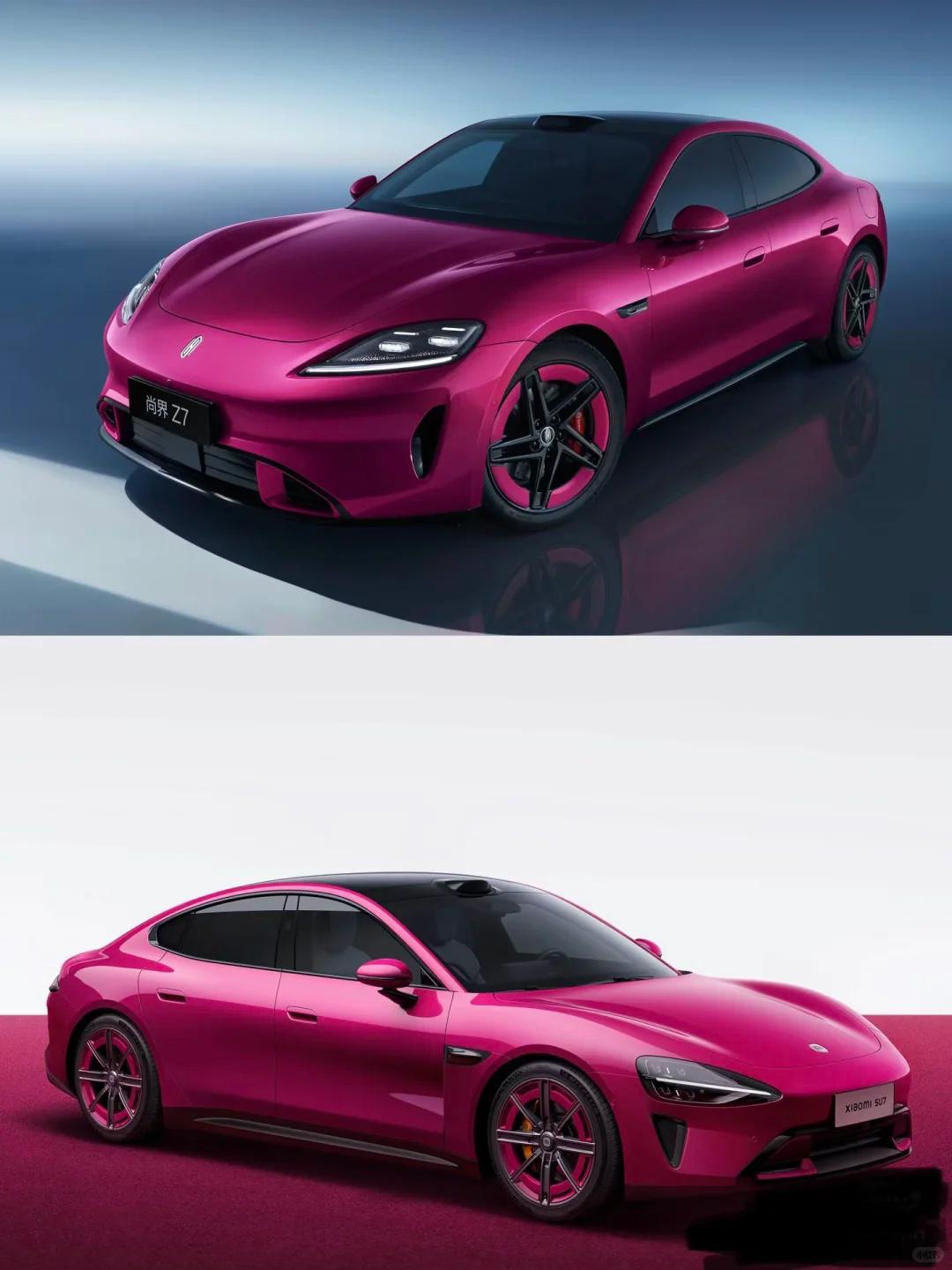
As soon as the Shangjie Z7 was launched, comments like "Porsche: I'm convinced by you two!" and "Learning from Xiaomi" quickly spread on social media. The specific price and performance parameters of the new car will be announced at the end of March. Xiaomi will also launch a new version of the Xiaomi SU7 in April. The sales performance of the two will be an important indicator of the competition between Xiaomi and Huawei.
The Xiaomi SU7 has become a phenomenal hit in the new - energy vehicle market. Since its delivery began in April 2024, the first - generation SU7 has accumulated 381,000 deliveries in less than two years. Can the Shangjie Z7 break the sales record of the Xiaomi SU7?
The answer might be no. As of now, the best - selling model in the Hongmeng Smart Mobility "Five Realms" is still the Wenjie series, which was the first to enter the market. The Wenjie M7 series has accumulated over 400,000 deliveries, accounting for over 40% of the total Wenjie deliveries. The Wenjie M9 has accumulated over 280,000 deliveries and is the sales champion among luxury SUVs priced over 500,000 yuan.
However, with the formal establishment of the "Five Realms" last year, Hongmeng Smart Mobility will experience more rapid development in 2026, with over 10 new models expected to be launched throughout the year, almost one new model per month.
New models such as the Wenjie M6 and the Zhijie V9 cover a wide range from family sedans, SUVs to hardcore off - road vehicles and station wagons, with prices ranging from 150,000 yuan to 1 million yuan. The high - frequency iteration of Hongmeng Smart Mobility means it aims to meet the needs of most niche markets. As the number of new cars in the domestic market is expected to increase to 173 in 2026, the competition in the automotive market this year will be more intense than last year.
3
Will 2026 Be Better?
Last year, Apple had a bumper harvest in the Chinese market and maintained its top position globally. Huawei ranked first in the Chinese smartphone market with a 16.4% shipment share. However, 2026 is destined to be a challenging year for both the consumer electronics and automotive industries.
IDC predicts that the global smartphone market will experience the largest decline ever this year, with shipments dropping by 13%. Additionally, some analysts believe that the cost of Apple's iPhone 18 Pro Max, to be launched this fall, will increase by 25%, mainly due to the rising costs of memory and chips.
Fortunately, Apple's service revenue continues to soar. Relying on user subscriptions and service commissions from merchants, Apple's service revenue exceeded 100 billion US dollars last year, becoming the company's main business pillar. Moreover, the service revenue has a gross margin of over 70%, more than twice that of the hardware business, which is unattainable for any Android manufacturer.
According to Apple's confirmed plan, Apple Intelligence and Siri will be launched in 2026. If they can successfully enter the Chinese market, it will surely be a major boost to Apple's service revenue. Before that, Apple uses cheaper products to attract new users continuously and then earns high - margin service revenue to strengthen the stability of its closed ecosystem.
Similar to the industry cost challenges faced by Apple, Huawei's Hongmeng Smart Mobility also has to deal with the continuously declining profit margins in the automotive market.
Last year, 34.4 million cars were sold in the Chinese market. However, data from the National Bureau of Statistics shows that the profit margin of the automotive industry in 2025 was 4.1%, a 0.2 - percentage - point decline from 2024, reaching a 15 - year low. It's a typical case of "increasing volume but decreasing profit" as the average profit margin of national large - scale industrial enterprises was 5.31% during the same period.
Therefore, high - end models priced between 500,000 and 1 million yuan are the key for Hongmeng Smart Mobility to break free from the profit - margin quagmire. As the 896 - line lidar is first used in the Wenjie M9 and the Zunjie S800, it means that consumers with the highest purchasing power will pay for Huawei's R & D costs first. As the scale effect of car sales kicks in, this black - tech will gradually be popularized in other models, thus spreading the overall technology cost and forming a positive cycle.
While Huawei is soaring to new heights with high - end products and Apple is digging deep with low - end offerings, both are proactive strategies of these giants. Will Apple and Huawei have a better 2026? It all depends on who takes the initiative and whose offensive is more effective.
This article is from the WeChat official account "Blue Hole Business" (ID: value_creation), written by Zhao Weiwei, and published by 36Kr with authorization.