Robots are revolutionizing the kitchen.
The year 2025 in the Chinese catering industry ended in a long - lasting public opinion battle between Jia Guolong and Luo Yonghao. However, as the year 2026 began, the debate about pre - made dishes and freshly stir - fried dishes continued.
The answer to "What are pre - made dishes" was given in the national standard solicitation draft released on February 6th this year. However, there are still obvious differences between consumers and the industry in their understanding of pre - made dishes and even central kitchens. This has also made the issue of on - site stir - frying in restaurants more prominent.
For all catering business owners, there has formed an "impossible triangle" among manual on - site preparation without using a central kitchen, large - scale expansion, and operational efficiency. The fierce takeaway war and the continuously decreasing per - customer spending have led to varying degrees of decline in the gross profit margins of listed chain catering enterprises in the past five years.
However, stir - frying robots are quietly bringing some variables to the catering industry.
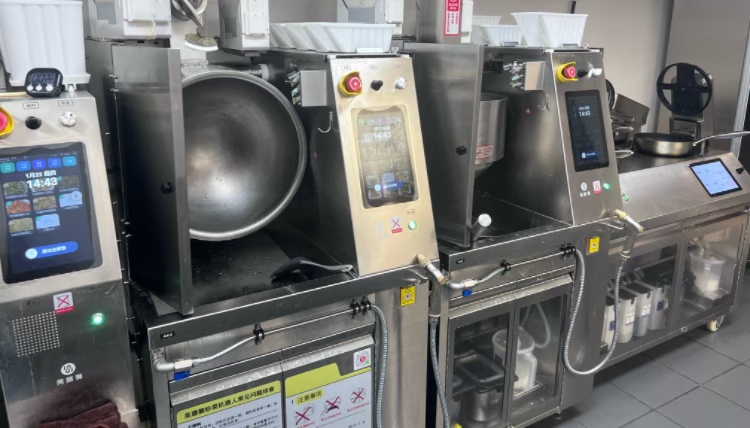
With the rise of a group of domestic stir - frying robot companies such as Xianglu Robot, Utech Smart Kitchen, and Zhigu Tianchu, these intelligent devices have penetrated into thousands of restaurants, and a new revolution is taking place in the back kitchens of Chinese catering.
Financing situation of some stir - frying robot companies. Chart produced by: Jiemian News, He Miao
Yang Jiancheng, the founder and chairman of Xianglu Robot, and his founding team have a background in technology and the Internet. Their relevant work experience at Meituan has also given the team experience in dealing with a large number of catering business owners and enabled them to understand the difficulties of the catering industry.
"When we talked about stir - frying robots before 2021, most people neither understood nor believed in them," Yang Jiancheng told Jiemian News. In the early days, many people wondered if the dishes cooked by robots were edible and if they could be cooked properly. The concept of stir - frying robots has been proposed for more than a decade, but it has not achieved good implementation results in large - scale catering chains. Moreover, due to the high price, catering business owners still doubt the labor - saving effect of these robots.
However, the long - standing problems of unstable employment in catering restaurants and the difficulty of large - scale employment of experienced chefs have remained unsolved for many years, and the contradictions have become more prominent during the large - scale expansion of catering stores. Meanwhile, the R & D and AI application of stir - frying robots have reached a certain level of maturity after several years of refinement and accumulation.
"The year 2025 is the first year of stir - frying robots, which is a consensus in the entire industry," said Geng Kaiping, the founder of Shenzhen Zhigu Tianchu, to Jiemian News. In 2018, this company started to engage in the R & D and exploration of commercial application scenarios of stir - frying robots.
One of Geng Kaiping's judgment bases comes from the change in cost. The upstream components used in stir - frying robots have seen a large - scale cost reduction with the development of the robot industry, which has also promoted the arrival of the commercial inflection point.
From technological breakthrough to mass production and application, the threshold that stir - frying robots need to cross is achieved through the process improvement through repeated communication between robot companies and catering customers and the continuous accumulation of recipes in the large - scale model.
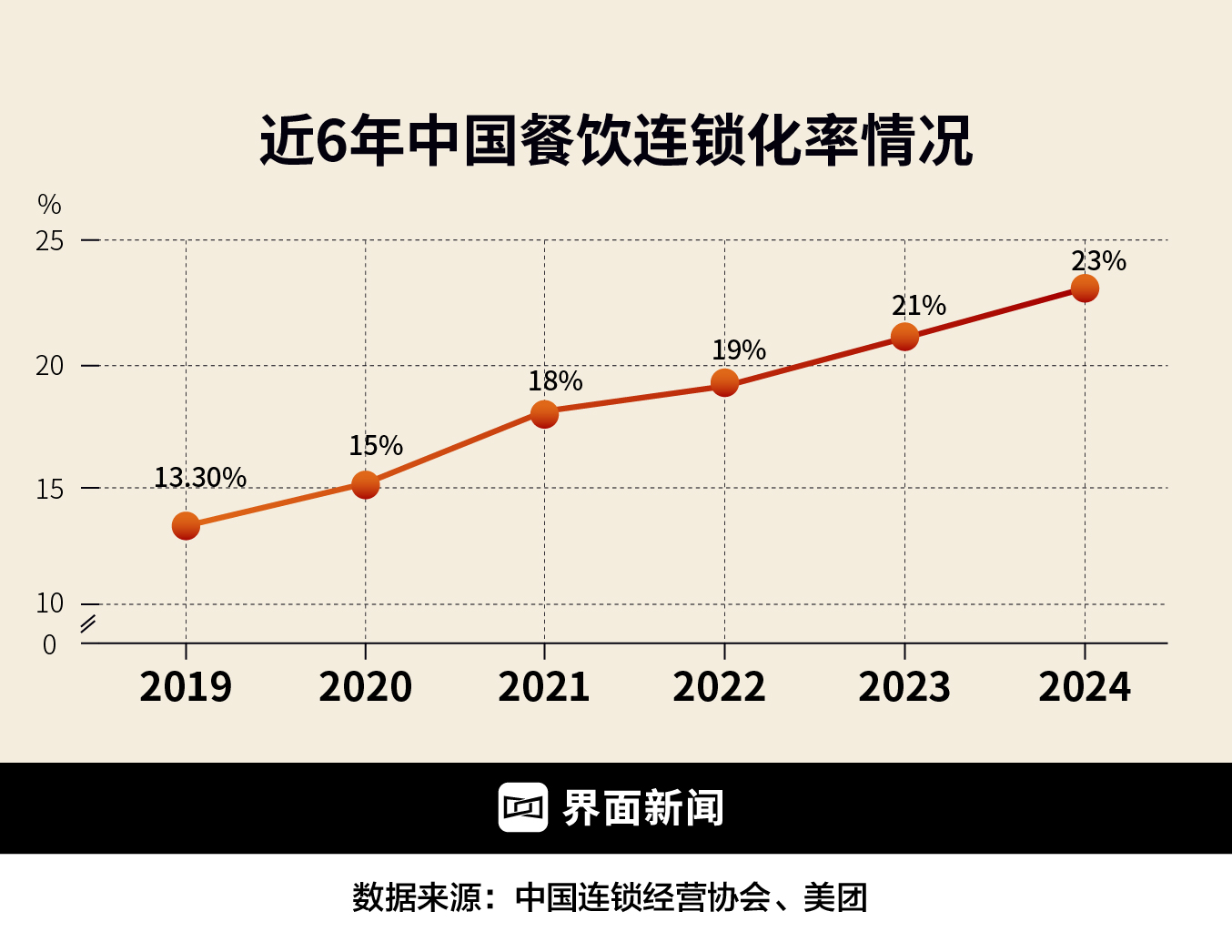
The situation of the chain rate of Chinese catering in the past 6 years. Chart produced by: Jiemian News, He Miao
Just like the martial arts secret books needed to achieve great success in martial arts, what stir - frying robot companies need to do is to transform countless recipes of the eight major Chinese cuisines into the language of machine learning. To reproduce a stir - fried dish, its production process needs to be transformed into quantifiable logic - converting the heat control into the linkage of pot temperature, power, and time; transforming the wrist movements of stir - frying and tossing the spoon into the speed, angle, and frequency of the mechanical trajectory; and converting the experience of ingredient feeding sequence into precise output in milliseconds and 0.1 - gram levels.
Monitoring data from the industry institution Aowei Cloud Network shows that in 2023, there were 25 brands of cooking robots in the online market, and the number is still increasing. Currently, most products on the market integrate visual recognition, temperature control systems, and multi - axis motion control, which can achieve functions such as precise ingredient feeding, heat control, and automatic stir - frying.
However, just like different sects in the martial arts world, stir - frying robots also have different technical routes in terms of basic structure to match different scenarios.
For example, they can be roughly divided into "drum - type" and "non - drum - type". The former mainly includes Utech Smart Kitchen, Zhigu Tianchu, Buting Technology, Changshan Intelligence, Pengman Technology, etc., which are suitable for stir - frying large - portion dishes; while the latter mainly includes Xianglu Robot, Black Pineapple Technology, etc., which use a fixed pot and planetary stirring and are suitable for small - pot and quick - stir - frying.
The R & D logic of stir - frying robots is to be infinitely close to human chefs, but at the same time, they need to pass the test of stability.
Yang Jiancheng said that Xianglu Robot has set two core indicators for stir - frying robots to reproduce human chefs: the taste of the same dish cooked by ten thousand machines is consistent, and the taste of the same dish cooked by one machine for ten thousand times is consistent.
There are many technical details hidden in this. When stir - frying Mapo Tofu, the rotation speed of the mechanical arm needs to be controlled to avoid crushing the tofu. Through precise control algorithms and advanced sensor technology, precise ingredient feeding has also been achieved. For example, the "hollow drum effect" problem of pepper powder and the flow fluctuation problem of lard at different temperatures have been solved.
Returning to the matter of stir - frying itself, being able to cook dishes in batches with robots is one aspect, but the key is still how to make the dishes more delicious. For example, how can the so - called "wok hei", the soul mentioned in countless debates about pre - made and freshly stir - fried dishes, be restored?
In fact, the wok hei, which is difficult to describe in traditional recipes, can still be disassembled from a scientific perspective.
In the view of Meng Junxian, the general manager of Zhuhai Utech Smart Kitchen, the so - called wok hei is the comprehensive result centered on the Maillard reaction, superimposed with caramelization, high - temperature stir - frying, and aroma volatilization.
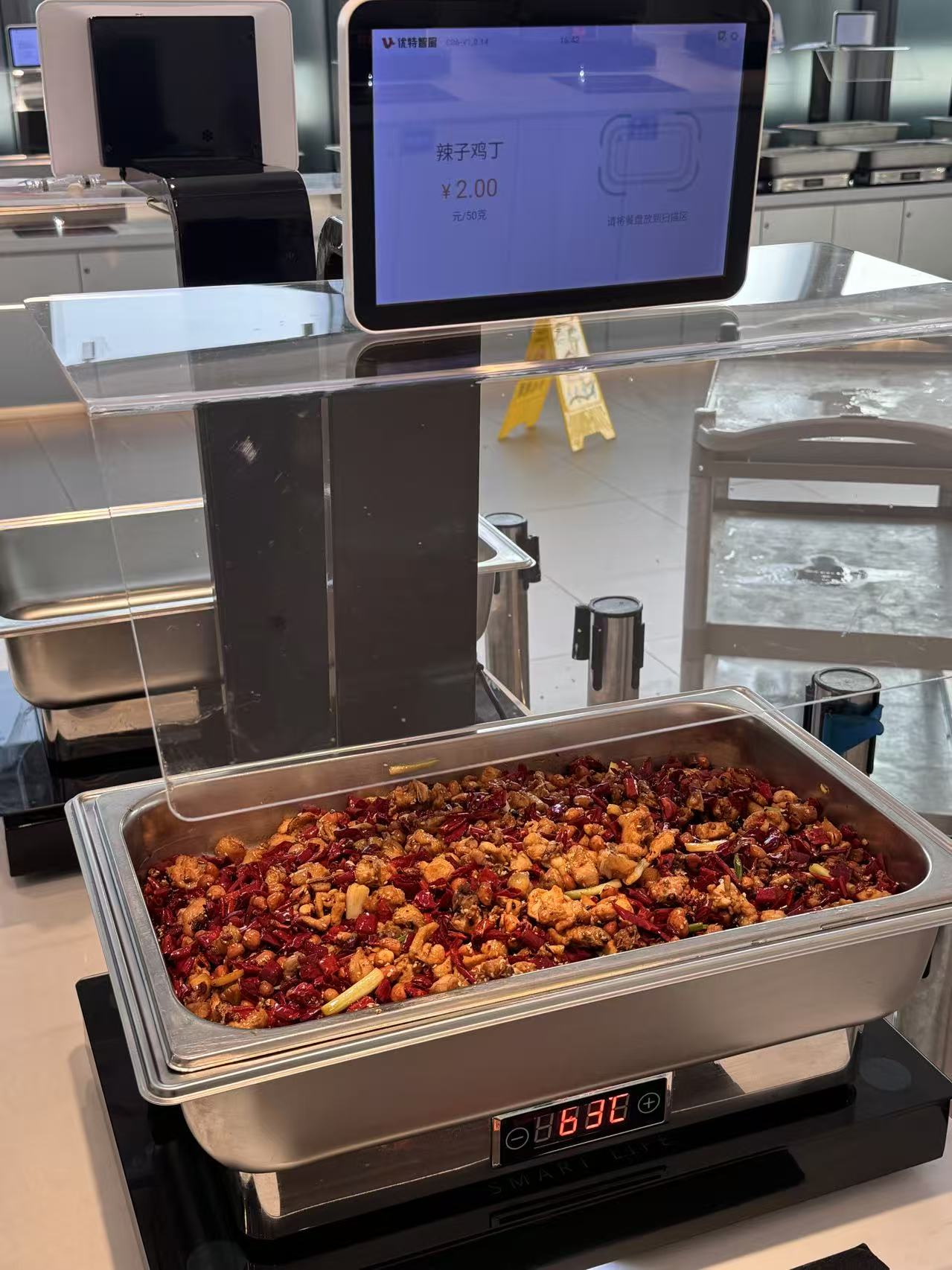
Utech Smart Kitchen canteen. Photo taken by: Jiemian News, Lu Yibei
"From a technical perspective, the essence of wok hei is heat exchange, which is related to four parameters: power, heating area, heating frequency, and contact material," he told Jiemian News. In traditional cooking experience, dishes stir - fried in an iron wok taste better because the physical properties of the iron wok are more likely to produce the Maillard reaction.
Therefore, Utech Smart Kitchen also spent three years researching and developing a "nitrided iron wok" suitable for the drum of the stir - frying robot. It has high hardness and wear resistance and can better produce the Maillard reaction.
However, for any technology from R & D to mass production and application, the core still lies in finding suitable scenarios and customers. Well - known large customers in the catering industry have played a demonstration role as "seed users" in the promotion of stir - frying robots.
Stir - frying robots have taken root in a group of chain catering and enterprise group meal back kitchens first.
Xiaocaiyuan has applied stir - frying robots in 660 stores across the country and emphasized in its IPO prospectus that it plans to invest 100 million yuan to purchase about 2,000 more devices. Laoxiangji has been using intelligent stir - frying robots in some stores since 2023. As of the end of August 2025, 451 restaurants have adopted automatic equipment including intelligent stir - frying robots, intelligent steamers, and intelligent chicken soup stoves. Xiangcunji publicly announced in 2024 that it would close its central kitchen, and currently its stores use a model of on - site stir - frying by both manual labor and stir - frying machines. Big Pizza, which is seeking an IPO on the Hong Kong Stock Exchange, also widely uses automated equipment such as chain ovens and stir - frying robots in its stores. As an investor in Xianglu Robot, JD.com's Qixian Xiaochu stores will also be equipped with this company's stir - frying robots as standard and plans to open 10,000 stores in three years.
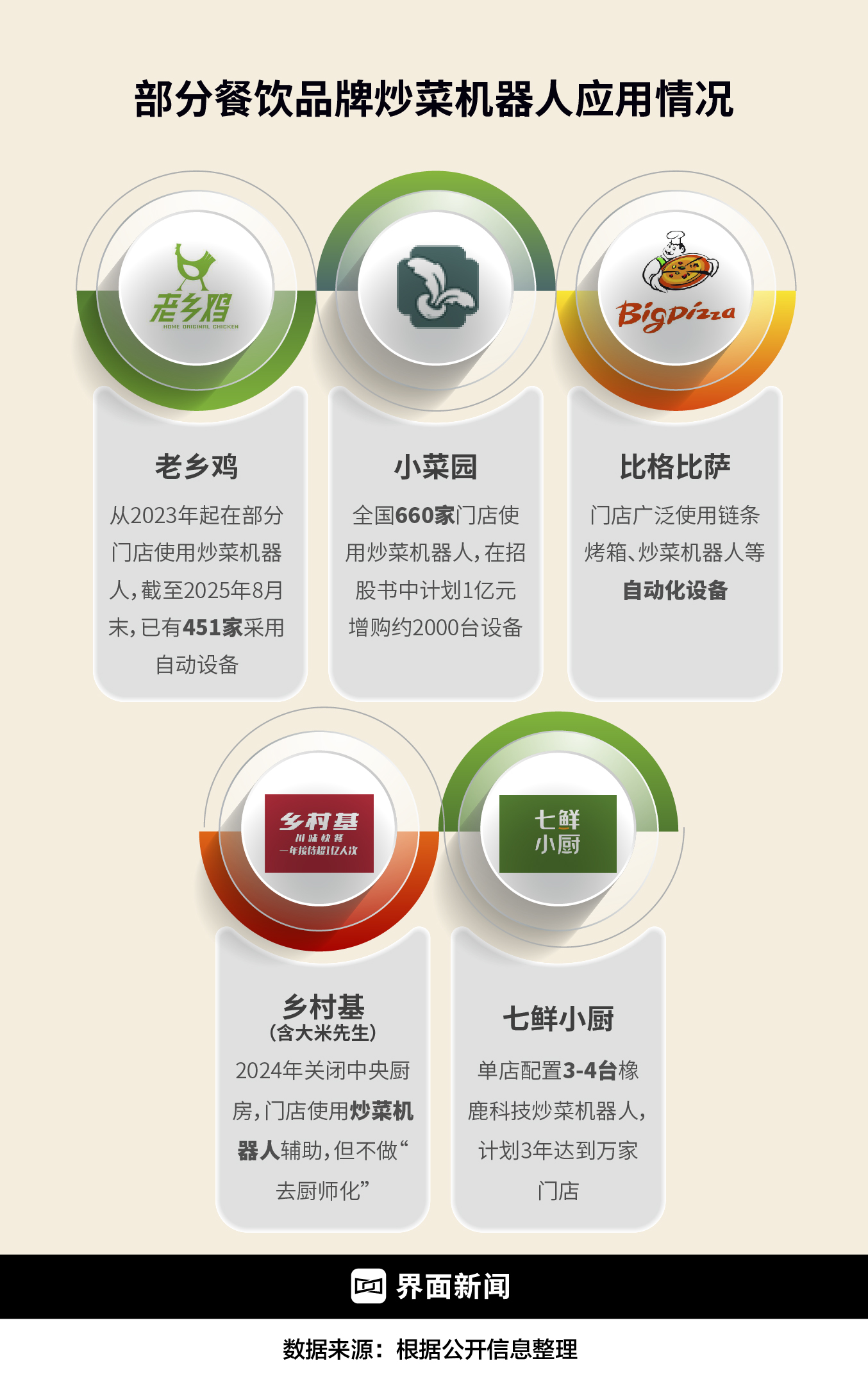
Application situation of stir - frying robots in some catering brands. Chart produced by: Jiemian News, He Miao
The back kitchens of enterprise canteens are another application scenario for stir - frying robots. Their main demand is to efficiently prepare a large number of employee meals and ensure stable meal delivery. The equipment of Zhigu Tianchu has been installed in the employee canteens of enterprises such as Foxconn and Muyuan.
For affordable chain catering, the most crucial purpose of introducing stir - frying robots into the back kitchen is still to save labor and ensure stable and efficient meal delivery. In an environment where the pre - made dish route is difficult to succeed and the market generally prefers freshly stir - fried dishes, using stir - frying robots to achieve large - scale and standardized meal delivery while being able to promote the signboard of freshly stir - fried dishes has become a compromise choice.
Jiemian News saw in a Laoxiangji store that in the transparent back kitchen, employees were using drum - type stir - frying robots to cook, and one person could control two devices.
"The dishes suitable for intelligent equipment cover most core categories of Chinese fast food, such as scrambled eggs with tomatoes, classic braised chicken with edamame, stir - fried pork with chili, and Mapo Tofu. These home - style stir - fried and braised dishes have relatively fixed cooking processes, clear matching of main and auxiliary ingredients, and can present flavors without complex manual techniques," Laoxiangji told Jiemian News in an interview.
The special features of Laoxiangji's use of intelligent equipment to make such dishes are reflected in two major dimensions: precise control and flexible adaptation.
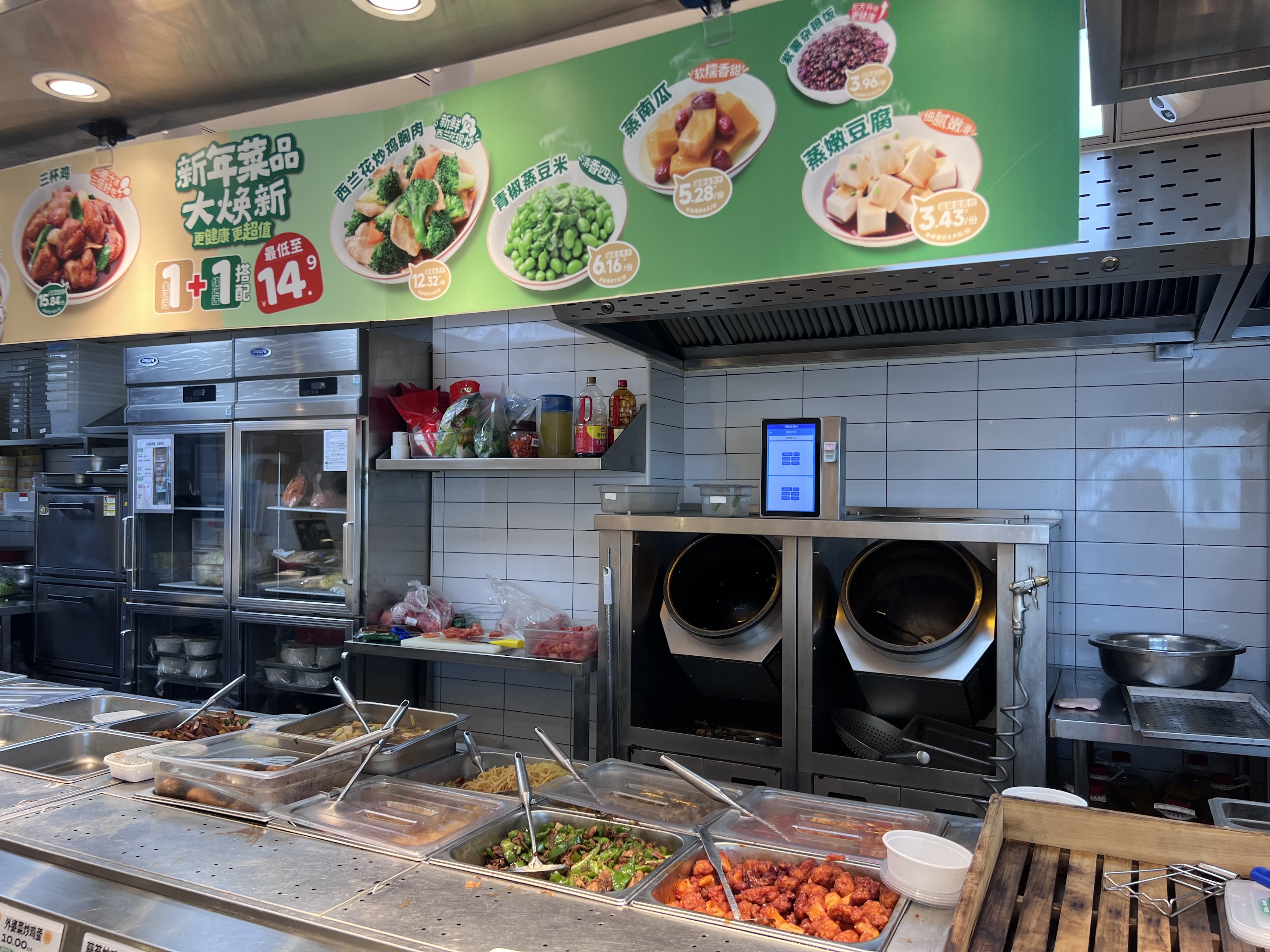
Stir - frying robot equipment in Laoxiangji's back kitchen. Photo taken by: Jiemian News, Ma Yue
Laoxiangji explained to Jiemian News that the equipment is equipped with multiple sensors and intelligent temperature control algorithms, which can digitally fix key parameters such as oil temperature, seasoning ratio, and stir - frying duration, avoiding the randomness of manual operation. In addition, through the cloud - based recipe management system, the headquarters can fine - tune parameters such as seasoning dosage and stir - frying heat according to the taste differences in different regions, generate region - customized recipes, and remotely push them to the stores. This not only maintains the unified quality baseline across the country but also caters to the preferences of local diners, achieving a balance between standardization and localization. At the same time, the equipment also supports "small - batch, multi - batch" production to ensure that the dishes are freshly cooked during peak hours, further guaranteeing the stability of the taste.
Yang Jiancheng said that the Meishan Lion of Xianglu Robot brings the "985 effect" to the catering industry, that is, the dish restoration rate exceeds 90%, labor efficiency is increased by 80%, and energy consumption is saved by 50%. In an ideal state, one operator of a stir - frying robot plus two devices is almost equivalent to three master chefs. Currently, the price of a single stir - frying robot of Xianglu Robot ranges from 30,000 to 100,000 yuan.
The key is that the revolution brought by robots to the back kitchen is not only in the way of stir - frying but also in the reshaping of kitchen positions. Chefs have become operators.
Geng Kaiping, the founder of Zhigu Tianchu, told Jiemian News that in the canteen of a leading company in the audio - visual and lighting industry that his company serves, which supplies meals for 2,000 people, there were originally more than 60 employees in the front and back kitchens. After using 10 stir - frying robot devices, only about 20 people are needed, and the other employees have been transferred to other positions.
Laoxiangji told Jiemian News that traditional chefs need to take care of multiple links such as ingredient cutting, stir - frying, and seasoning, while the intelligent kitchen clearly divides the positions according to the SOP into the pre - processing position and the equipment operation position.
It is inevitable that human chefs will face challenges brought by robots. Under the trend of integrating industry, academia, and research, how to better train a new generation of chefs in the current wave of intelligent equipment has also become a new challenge for many vocational schools.
Yang Jiancheng recalled that when he gave a speech in Shanghai at the end of last year, teachers and students from Nanjing Tourism College came to the scene specifically to consult face - to - face about the future career development path of chefs and how to carry out intelligent chef courses in the school.
Currently, close cooperation with vocational schools has become a strategy for many stir - frying robot companies to penetrate into the catering industry. For example, Utech Smart Kitchen participated in writing a textbook "Fundamentals of Intelligent Cooking" for secondary vocational colleges. General Manager Meng Junxian revealed to Jiemian News that a textbook on intelligent stir - frying robots for junior colleges will be published in June this year.
More teachers and students in chef vocational schools are starting to deal with this surging change.
After participating in a stir - frying robot competition last semester, Liu Zijian asked the students this question: Will you be replaced by machines in the future? How do you feel?
The students' answers impressed him deeply. The students said that most chefs work in an environment with high - level oil fume inhalation, and occupational diseases are inevitable. If there are machines now, let the machines do the high - intensity work, and they can control the machines, which is just a change of role.
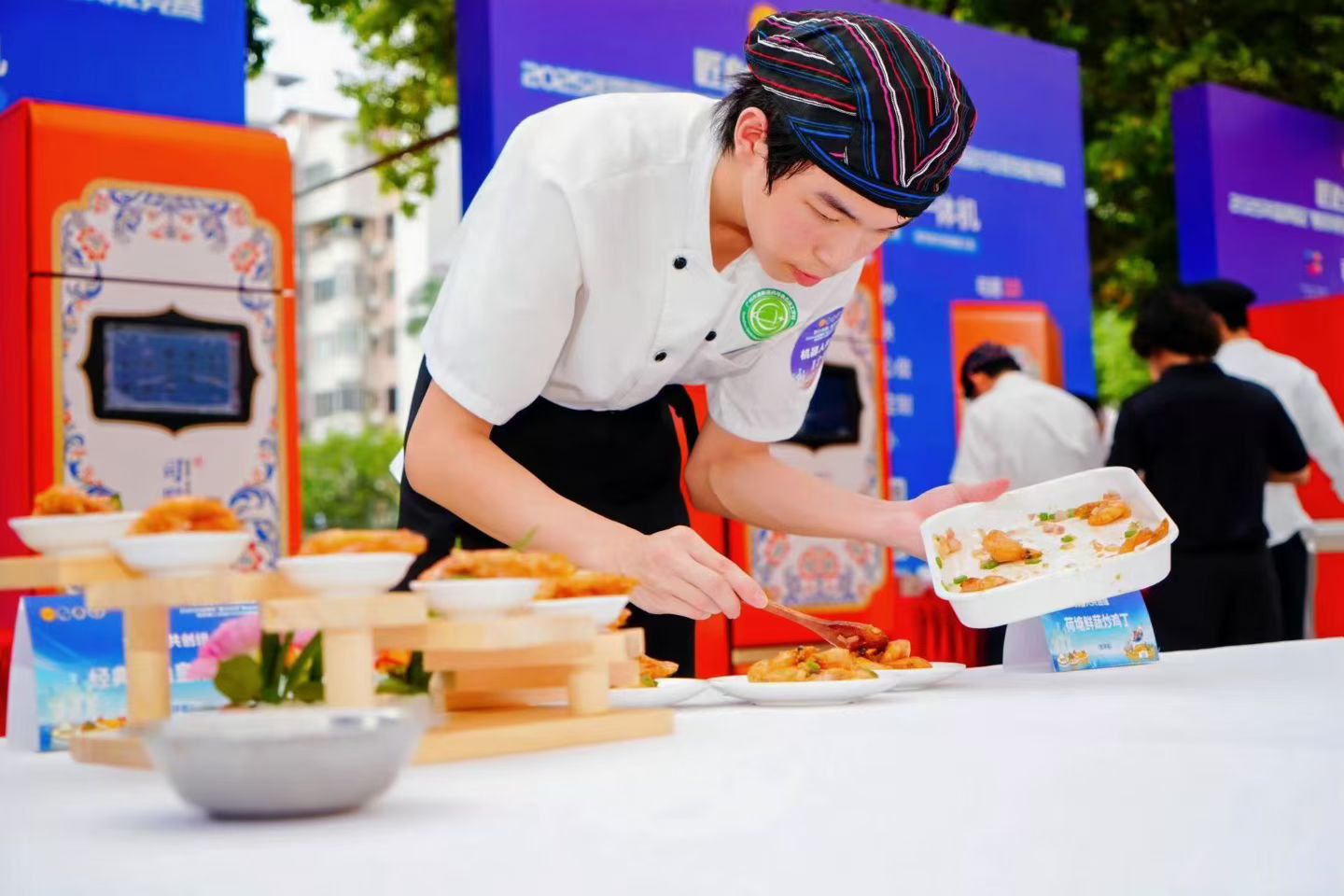
Scene of students from Guangzhou High - tech Medical and Food Technical School participating in a stir -