At MWC, Xiaomi showcased another path for the second half of the AI era.
When you step into Fira Gran Via in Barcelona this year, you will find that AI is the most pervasive and prominent theme of the event.
MWC (Mobile World Congress) 2026 has set its theme as "The IQ Era", explicitly pointing to "intelligence". Centered on this theme, operators, terminal manufacturers, chip and cloud service providers and other exhibitors have all started to demonstrate AI in more tangible ways: stronger end-side capabilities, faster real-time translation, smarter image processing, and more assistant-like interactions.
In this AI-centered wave of exhibitions, Xiaomi has set the theme of its booth as "The New Wave of AI", and organized all displays with a structure that fits daily life scenarios: AI Today (intelligence in devices at your fingertips) and AI Tomorrow (intelligence integrated into mobility and home spaces). From the system-level AI capability HyperAI of the Xiaomi 17 series, cross-device collaboration HyperConnect, the mobility intelligent space presented by SU7 Ultra (with a lap record of 7 minutes 04.957 seconds at the Nürburgring Nordschleife), to the home scenario exploration driven by the self-developed foundational large model MiMo, the core highlighted at the booth is a continuous experience spanning from smartphones to cars, and then to smart homes.
Such a layout makes Xiaomi share similarities with other manufacturers while also demonstrating a distinct development path.
The similarity lies in that Xiaomi also provides a combination of hardware, system and AI capabilities, allowing visitors to see how AI improves the efficiency of imaging, translation, creation and connectivity. The difference is that while many manufacturers are still demonstrating the boundaries of AI through single hardware products or individual chatbots, Xiaomi has also showcased the way for large-scale AI operation in the new era — AI + Hardware + Ecosystem.
Up to now, Xiaomi's "full human-car-home ecosystem" has connected more than 1 billion devices, covering over 200 product categories and reaching 95% of daily life scenarios, with its smartphones having over 740 million global monthly active users.
In the view of Lu Weibing, Partner and President of Xiaomi Group, the first half of AI competition focuses on model parameters and computing power, while the second half requires combining model capabilities with specific scenarios, which is precisely Xiaomi's advantage: bringing AI out of the screen and integrating it into smartphones, cars and home spaces. "Letting AI move from the virtual world to the physical world is Xiaomi's biggest advantage."
The AI competition is undergoing changes
If we divide the AI wave of the past three years into stages, the keywords of the first half are almost highly consistent: model parameters, training cost, inference speed, and evaluation performance. Whoever has a larger model, stronger computing power, and higher ranking on the leaderboard has become the most intuitive competitive indicator in the industry. From the GPT series to various open-source models, technological breakthroughs have constituted the most dazzling narrative line in this stage.
But the focus of discussion has shifted.
This signal is even more obvious at this year's MWC. As the intelligence of the models themselves gradually approaches the ceiling and the gaps between them keep narrowing, the focus of competition has turned to whether these capabilities can truly enter daily scenarios.
Entering the second half, three major transformations are taking place.
First, can AI be used across devices? Capabilities that perform well on smartphones will lead to fragmented experiences if they cannot be extended to tablets, computers, vehicle infotainment systems and home devices. Today's users no longer live within a single screen, but move between multiple terminals. Whether AI can seamlessly continue across different devices is an important criterion for testing its maturity.
Second, can AI understand real scenarios? From text conversation to image recognition, and then to environmental perception, if AI only stays at the input-output level, it is difficult to truly change people's lifestyles. The truly meaningful progress is that AI can combine cameras, sensors and behavioral data to make judgments about the environment and respond proactively.
Third, can AI continuously accompany users? It is no longer a one-time tool call, but exists continuously throughout the daily routine — from checking the smartphone in the morning, to the commute, and then back home, to ensure a coherent experience and always-on intelligence.
Such industry trends will magnify the advantages of Chinese enterprises infinitely at this stage.
As the world's largest mobile internet market, China has matured digital payment and commercial closed loops, high penetration rate of smart terminals, and highly active user data. In such an environment, Chinese AI manufacturers can more easily polish and verify their products repeatedly in real scenarios.
In this transformation, Chinese enterprises as a whole have entered the leading echelon, and a number of Chinese technology companies have gradually formed their clear implementation directions: Alibaba promotes AI implementation based on its commerce and cloud ecosystem, ByteDance applies AI around its content production and distribution system, and Tencent embeds intelligence into social and collaboration scenarios.
Xiaomi has taken another path — relying on the "full human-car-home ecosystem", integrating AI into smartphones, automobiles and home devices, so that intelligence can truly land in daily life.
The first three are more oriented to the extension of the digital world, while Xiaomi is more starting from the physical world: smartphones, automobiles and home devices form a continuous life trajectory.
Integrate AI into terminals, and then into daily life
All along, in the global AI competition landscape, Xiaomi does not win by a single hit model, but combines model capabilities, hardware scale and long-term accumulation of real scenarios to form a complete chain from underlying capabilities to end products, and then to daily life.
The starting point of this chain is the development of model capabilities.
In 2024, Xiaomi officially entered the field of foundational large models. By 2025, the MiMo language model, multimodal model, speech model and embodied model have been successively released and open-sourced; in February 2026, Xiaomi launched the Hybrid Sparse Attention Architecture HySparse for the Agent era, which finds a new balance between efficiency and cost. With versions such as Xiaomi MiMo-V2-Flash entering the global top tier of open-source models in multiple comprehensive evaluations, Xiaomi is no longer just a player at the application layer, but has begun to have its own foundational model base.
More importantly, MiMo has been positioned as a unified capability source serving multiple terminals from the very beginning, as Lu Weibing shared in the interview: "Last year, we completed a very good layout for large AI models, including large language models, large speech models, and large multimodal models." Xiaomi's large models need to provide inference capabilities for smartphone imaging and interaction, provide speech and perception support for vehicle infotainment systems, and lay the foundation for environmental understanding in home scenarios.
When the functions of different devices can be interconnected, the intelligent experience can be extended across multiple terminals, thus reducing the sense of fragmentation for users.
The implementation of model capabilities cannot be separated from real terminals.
At Xiaomi's booth, this structure is clearly split. On one side of the entrance is the experience area centered on personal devices, where visitors can experience image enhancement, AI writing, real-time translation and cross-device collaboration on site; on the other side is the concentrated presentation of automobile and home scenarios, from SU7 Ultra to the interactive demonstration of home spaces, putting intelligence into a larger physical space.
In the AI Today section, Xiaomi focuses the intelligent experience on the devices that users interact with most frequently — smartphones. HyperAI, image enhancement, AI translation and cross-device collaboration constitute the basic form of "intelligence at your fingertips". Taking the Xiaomi 17 Ultra as an example, its 1-inch main camera combined with LOFIC HDR technology and AI scene analysis maintains excellent details and dynamic range even under complex lighting conditions. At the same time, HyperAI provides capabilities such as image enhancement, AI writing, speech recognition and conversational translation, while HyperConnect enables photos, videos and smartphone screens to be shared instantly across different devices, making the intelligent experience extend naturally between multiple terminals.
Intelligence continues to extend from handheld devices to the AI Tomorrow section. The mobility scenarios demonstrated by SU7 Ultra allow AI to participate in driving, perception and space interaction. Also exhibited alongside it is the Xiaomi Vision Gran Turismo concept electric supercar, which makes its physical world debut at MWC. This futuristic model built for the "Gran Turismo" series presents the design language of "shaped by wind" with a water-drop shaped cockpit and sculptural aerodynamic structure, and also materializes Xiaomi's imagination of the future mobility form at the booth.
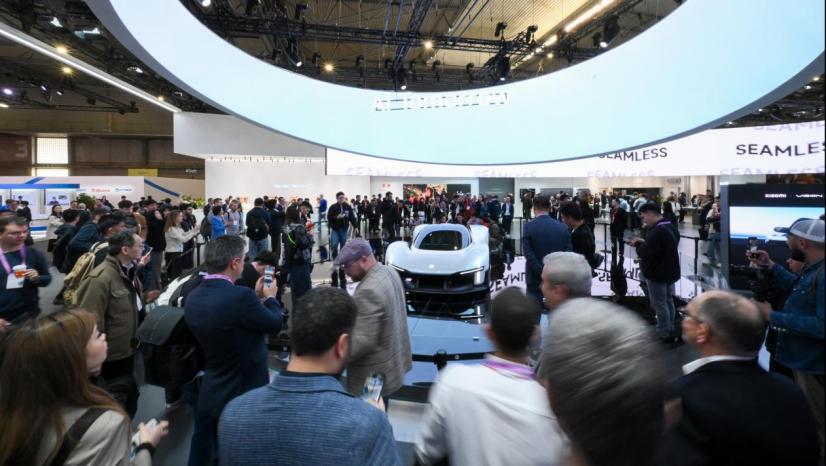
Different from a single AI hardware, Xiaomi's terminal system itself covers personal devices, mobility spaces and living spaces, where intelligence can extend along this trajectory.
Scale not only brings user base, but also brings real data and usage feedback; new capabilities can be quickly implemented, and feedback in turn promotes model optimization, forming a self-reinforcing cycle.
The combination of models and hardware endows Xiaomi with capabilities that other AI manufacturers do not have — the ecosystem.
The "full human-car-home ecosystem" itself fits the real daily routines of users. Users plan their itineraries on the smartphone, continue to use the same account and voice assistant in the car, and the devices automatically switch scenarios when they get home.
In this context, Miloco, the large model-driven whole-house intelligent system that was first displayed overseas at MWC 2026, has become one of the specific manifestations of this strategy.
Built on the MiMo model capabilities and the huge scale of IoT devices, Miloco enables Xiaomi's intelligent capabilities to enter home spaces, participating in environmental understanding and device interconnection. Users can express their needs through conversations without manually setting complex rules; after the camera recognizes behavioral changes, the system automatically triggers lights, air conditioners or cleaning devices; multiple devices form interconnection according to scenarios and adjust their status automatically.
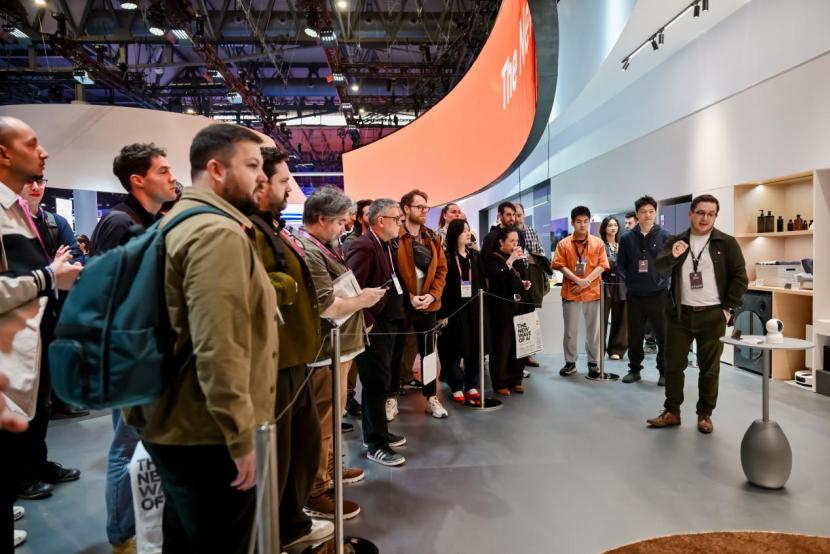
From the model base to the scale of terminals, and then to the collaboration of life scenarios, Xiaomi presents a three-in-one form. Different from companies that only provide one AI device or one chat interface, Xiaomi is more like building an intelligent path that runs through daily life, allowing model capabilities to truly enter smartphones, cars and home spaces. The "full human-car-home ecosystem" has landed from imagination and continues to operate in the real world.
Xiaomi's ecosystem, a "Chinese path" for AI
As the industry enters the application period, the differences between various AI manufacturers have gradually become clear.
Alibaba is more rooted in commerce and enterprise scenarios, expanding large model capabilities around e-commerce and cloud infrastructure; ByteDance relies on its content distribution and creation ecosystem to enable AI to improve production efficiency and content generation capabilities; Tencent focuses on social and collaboration systems to embed intelligence into communication and office processes. Most of these paths take place in the digital world — centering on the flow of information, traffic and services.
In contrast, Xiaomi's exploration is closer to the physical space. Smartphones, automobiles and home devices are not the "super assistant entry" that everyone chased in the past, but the real carriers that users touch, drive and live in every day.
Such a choice not only responds to users' real and continuous life needs, but also is built on Xiaomi's years of ecosystem accumulation.
Over the past decade, Xiaomi has been laying out around hardware and ecosystem. Starting from smartphones, to building an IoT system covering more than 200 product categories, and then entering the field of smart vehicles, Xiaomi's core competence has always been to implement complex technologies on a large scale and replicate them in the global market. With 740 million monthly active smartphone users and over 1 billion connected IoT devices, these numbers represent Xiaomi's terminal network that has been operating stably for many years and real scenarios with continuous feedback.
Since 2024, Xiaomi has focused on investing in large models as a new underlying capability. The MiMo series models have been fully developed from language to multimodal, speech and embodied directions, and have ranked among the top tier in the open-source system. At the same time, underlying capabilities such as chips, operating systems and robots continue to advance.
After the AI competition enters the application period, the significance of this layout is magnified.
The technological exploration period is gradually coming to an end, parameter scale is no longer the only criterion, and all AI manufacturers must think about how to embed model capabilities into the real world stably and continuously? How to run on real terminals? How to collaborate in manufacturing links, mobility scenarios and home spaces?
These are exactly the areas that Xiaomi has long been good at.
Around the world, at the critical point when the first half moves to the second half, there are not many manufacturers that have self-developed model capabilities, end-side hardware scale and cross-scenario ecosystem integration capabilities at the same time. Xiaomi's path is built on long-term hardware accumulation and global channel expansion, and superimposed with continuous investment in AI in recent years, giving it a unique position in the application of physical space.
The investment further demonstrates Xiaomi's determination. In 2025, Xiaomi invested about 7.5 billion RMB in the AI field, accounting for a quarter of its total annual R&D budget; it plans to invest a total of 200 billion RMB in R&D over the next five years. The MiMo series models continue to be open-sourced, and architectural explorations such as HySparse are trying to find a balance between efficiency and cost. "Xiaomi has made huge investments in the most underlying areas, whether it is chips, AI, operating systems or robots, and these technologies have strong commonality," Lu Weibing said in the interview.
Whether it is the past accumulation, future investment, or current ambition, Xiaomi's actions are all pointing to the answer to one question: when AI becomes a basic capability, can Chinese technology companies form new competitive advantages in the application of the real world?
In the past, Xiaomi's advantages came from large-scale manufacturing and global channel capabilities; today, these accumulations are beginning to combine with self-developed model capabilities; in the future, this combination may release influence in more life scenarios.
If the keywords of the first half are catching up and breakthrough, the keywords of the second half are closer to integration and implementation. In this change, Xiaomi's path is not only related to the strategic choice of one enterprise, but also provides a sample for the position of Chinese technology companies in the global AI competition.
With past accumulation, current layout and future imagination space, this path is still unfolding.