AI godfather Demis Hassabis: From a chess prodigy to a Nobel laureate, one of the smartest people Stephen Hawking ever met
Undoubtedly, Demis Hassabis is a person worthy of being told.
Over 40 years, he has grown from a chess prodigy to a scientist and entrepreneur standing at the forefront of the AI wave. Hassabis has shown people a possibility: one can possess both top - notch scientific insight and business execution ability, can pursue the ultimate goal of AGI while winning the Nobel Prize, and can always maintain a quest for the essence of intelligence in an era when technology is driven by capital.
In October 2024, Demis Hassabis, the founder of DeepMind, an AI company under Google, won the Nobel Prize in Chemistry. In November 2025, DeepMind under his leadership released Gemini 3, leading the multimodal ranking list. In February 2026, Hassabis made a judgment at the Davos Forum: there is a 50% probability of achieving artificial general intelligence (AGI) before 2030, and by then, science and human health will be greatly promoted.
In May 2017, AlphaGo defeated Ke Jie, becoming the first AI robot to beat a world Go champion. It was developed by the team led by Hassabis. In the same month and year, Zhou Jiangong, the founder of Weijin Research, met Hassabis on - site in Wuzhen. That was the only exclusive interview with Hassabis by domestic media, and the friendship between the two was thus forged.
Recently, Zhou Jiangong translated Hassabis' biography, Demis Hassabis: The Brain of Google's AI. This made him even more convinced that Hassabis is different from many technology leaders of this era: Hassabis is more like a scientist from Cambridge, with a curiosity about the ultimate mysteries of the universe, approaching the goal called AGI step by step.
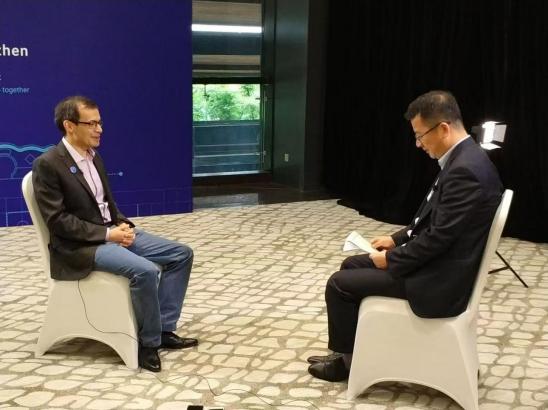
△In 2017, Hassabis was interviewed by Zhou Jiangong in Wuzhen. Image source: Provided by Zhou Jiangong
01
The Polymath from Cambridge: Above the Prodigy, There Is Something Even Rarer
Born in 1976, Hassabis had a childhood that could be called a "genius - making" one. He started learning chess at the age of 4 and beat adults within two weeks. He became the captain of the British under - 11 chess team at 9. At 13, he reached the level of an International Chess Federation master and ranked second in the world.
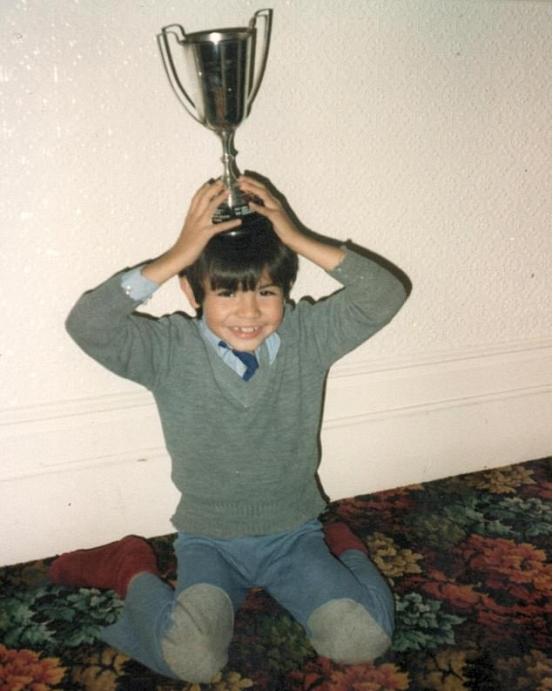
△At the age of 9, Hassabis served as the captain of the England U11 chess team. Image source: ©Demis Hassabis
At the age of 8, Hassabis used the £200 he won from a chess competition to buy his first computer and began teaching himself programming. At 11, a Reversi game program he wrote defeated his younger brother. At 16, Hassabis entered the Computer Science major at the University of Cambridge but was advised to take a one - year break due to his young age. In the same year, he joined the game studio Bullfrog Productions and participated in the development of the classic game Theme Park, which sold millions of copies and introduced AI elements for the first time.
When Hassabis was on an exchange program at the Massachusetts Institute of Technology (MIT), he found that the intelligent agents he implemented in game design were far ahead of the research in the concept stage in MIT laboratories.
In 2005, Hassabis returned to University College London to pursue a doctorate in neuroscience, researching the brain's hippocampus and episodic memory. His research results were named "Breakthrough of the Year" by the Science magazine in 2007. Zhou Jiangong told a reporter from Time Weekly that Hassabis is a polymath who can integrate many disciplines such as games, neuroscience, and computer science.
"When talking to Hassabis, you will feel a strong sense of acumen. It's not because he speaks English, but because he switches between different disciplines so quickly that you often can't keep up," Zhou Jiangong said. Hassabis spans multiple fields and conducts in - depth research in each field rather than just making general remarks. The well - known theoretical physicist Stephen Hawking once said that Hassabis is one of the smartest people he has ever met. And during Hassabis' post - doctoral research at MIT, his supervisor professor also predicted that he would surely win the Nobel Prize in the future, and this prediction later came true.
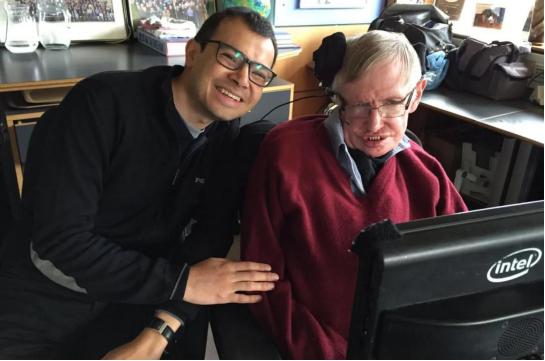
△In 2017, Hassabis took a photo with Stephen Hawking. Image source: ©Demis Hassabis
This ability to transcend one's own field may be related to the educational influence he received. Since childhood, Hassabis has been guided not to follow the rules but to stick to his own path. Zhou Jiangong told a reporter from Time Weekly that being a prodigy is just a very short part of Hassabis' life. What really defines him is his belief in AGI, his passion for science, and his concern for human destiny.
02
DeepMind's Journey: From Building the "Machine of God" to Winning the Nobel Prize
In 2010, the time was finally ripe. Hassabis co - founded DeepMind with Mustafa Suleyman and Shane Legg. DeepMind has only one mission: "Solve the problem of intelligence and then use it to solve all other problems."
At that time, Stephen Hawking and Elon Musk established an anti - AI alliance. Hassabis had a four - hour in - depth conversation with Hawking in person, and finally convinced Hawking that AI would make the world a better place. Elon Musk became an early investor in DeepMind.
In December 2013, DeepMind, which was only four years old and had a team of less than 20 people, shocked the world with a new software. Through continuous trial - and - error and learning, this program demonstrated strong learning and complex - task - handling abilities in three classic Atari games. After watching the demonstration, Google immediately decided to acquire DeepMind for £400 million, which was the largest acquisition in Europe that year.
Many outsiders at that time thought that Hassabis' decision to accept the acquisition was wrong. But Zhou Jiangong believes that Hassabis made the right choice: "He is a person with a scientist's temperament. He needs a good research environment, sufficient funds, and enough computing power. Google can provide him with the best in these aspects."
After the acquisition, Hassabis launched the Go project AlphaGo, which combines human brain neurons and big data. Go is known as the most complex game invented by humans, and AI scientists had been researching it for decades without a breakthrough. In March 2016, AlphaGo defeated the world - class Go player Lee Sedol 4:1, and the whole world was excited. In May 2017, Zhou Jiangong witnessed with his own eyes that AlphaGo defeated Ke Jie 3:0 in Wuzhen. After the game, the Go community generally recognized that AlphaGo's playing strength had comprehensively exceeded the top - level of human professional players. Zhou Jiangong told a reporter from Time Weekly: "Reinforcement learning can reach super - human levels in the field of artificial intelligence. Defeating Ke Jie in China accelerated the popularization of artificial intelligence in China and inspired entrepreneurship and innovation in this field."
Hassabis has never stopped at games.
In 2018, DeepMind launched the AI system AlphaFold, which can predict protein structures, opening a new door for medical research. In 2020, AlphaFold cracked almost all known protein structures, and its database contains more than 200 million kinds of proteins. In May 2024, AlphaFold 3 was released, which can predict the structures and interactions of almost all biomolecules such as proteins, DNA, and RNA with unprecedented accuracy. In October of the same year, Hassabis won the Nobel Prize in Chemistry for his contribution to "protein structure prediction."
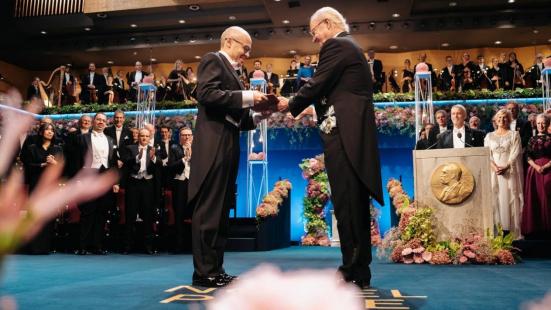
△Hassabis received the Nobel Prize in Chemistry medal and certificate at the award ceremony in Stockholm Concert Hall, Sweden. Image source: ©NobelPrize.org.
Some people compare Hassabis with Francis Crick, who discovered the DNA double - helix, and Richard Feynman, who changed the paradigm of physics. This is the top - tier in the history of science.
Zhou Jiangong said that Hassabis is essentially a scientist. He has both confidence and perseverance, as well as the humility and self - reflection of a scientist, which is a very rare quality. "When GPT - 3 was launched, Hassabis realized that he had made a wrong judgment. He always believed that reinforcement learning was the only way to achieve AGI, and large - scale language models were only in the third tier in his original ranking. As a scientist, his confidence was hit, but it was very helpful for his growth."
In April 2023, Google merged its two major AI laboratories, Google Brain and DeepMind, and put them under the unified leadership of Hassabis. This was a major change in the organizational structure, but in his view, it was the only way for Google to regain its leading position in the field of AI.
In November 2025, Gemini 3 was officially released, showing a "qualitative change" in logical reasoning and multimodal interaction. In January 2026, DeepMind's research results were published in the Nature magazine. Its AlphaGenome AI tool can model and decode 98% of the human genome and can more accurately predict the impact of any gene mutation on the human body, with an accuracy rate of up to 90%.
Regarding when AGI will arrive, Hassabis adheres to his judgment made years ago. He believes that there is a 50% probability of achieving AGI in 2030. However, Hassabis has extremely high standards for the definition of AGI. He believes that AGI must have the ability to "propose scientific hypotheses," rather than being just an AI "test - taker" that can only get high scores. Regarding Elon Musk's claim that "the singularity is approaching," Hassabis clearly opposes it: "It's too early to say that." Zhou Jiangong believes that leading AI laboratories such as OpenAI define AGI as creating economic value in the cognitive field that reaches or exceeds the human level. Hassabis' definition of AGI has higher standards than Musk's and also includes dimensions such as AGI's understanding of the physical world and its ability to continuously learn.
03
Across the Pacific: The AGI Race and China's Position
Hassabis maintains a clear - eyed observation of the global AI landscape.
Regarding the rise of Chinese models such as DeepSeek, he believes that China may be only six months behind the United States in AI frontier technologies, rather than one to two years. Teams represented by DeepSeek and Alibaba are developing at a speed that exceeds the earlier expectations of the Western industry. "They are rapidly approaching the technological frontier," Hassabis said frankly. "The current gap may be only a few months."
This judgment is basically consistent with Zhou Jiangong's observation.
Zhou Jiangong said that the gap between China and the United States at the model level is narrowing. Some say it's six months, and some say it's a quarter. "China is not lagging behind in the combination of AI and hardware, AI and manufacturing, and is even leading the United States in many aspects, forming its own characteristics." Zhou Jiangong believes that AI can be combined with hardware, manufacturing, and consumer electronics. "There may be a dozen or so enterprises competing in one track in Shenzhen, which is much more vibrant than in the United States." However, at the computing - power level, China still lags behind by one or two generations, which is a major shortcoming.
Hassabis has a more ambitious vision - to establish an international AI cooperation institution similar to CERN. As early as 15 years ago when he founded DeepMind, this goal was written in his roadmap.
Hassabis believes that when AGI is approaching, the world's best minds should sit together and jointly address the challenges in a scientific and rigorous manner. "Because the security risks of AGI are global. Even if a company or a country does everything perfectly, if the rest of the world lacks a minimum level of security standards, it will still be in vain."
On May 27, 2017, AlphaGo played the last game against Ke Jie. After a long - drawn - out game, Hassabis showed no sign of fatigue on his face, only calmness after concentration. He has been on this path for more than 40 years. From having an epiphany in front of the chessboard at 11 to becoming a chess master at 13; from developing games at 16 to shocking the world with AlphaGo at 42; from winning the Nobel Prize at 48 to now leading DeepMind to pursue the ultimate goal of AGI.
What Hassabis wants to explore is the essence of intelligence and the ultimate answer to reality. What exactly is time? Where does consciousness originate? These questions may be left for humans after the advent of AGI to answer. And what Hassabis is doing now is to make that day come earlier and safer.
This article is from the WeChat official account "Time Weekly" (ID: timeweekly), author: Wang Ying, editor: Peng Yanfeng, published by 36Kr with authorization.