After OpenClaw reached the top, Agent quietly killed the "application".
This is definitely the most dizzying growth curve in the history of open-source software.
In just three months, OpenClaw's Star count on GitHub reached the top in history. It not only directly surpassed the 240,000-star milestone that React had accumulated over 13 years but also left the 40-year-old Linux kernel behind, becoming the "number one in the history of software projects."
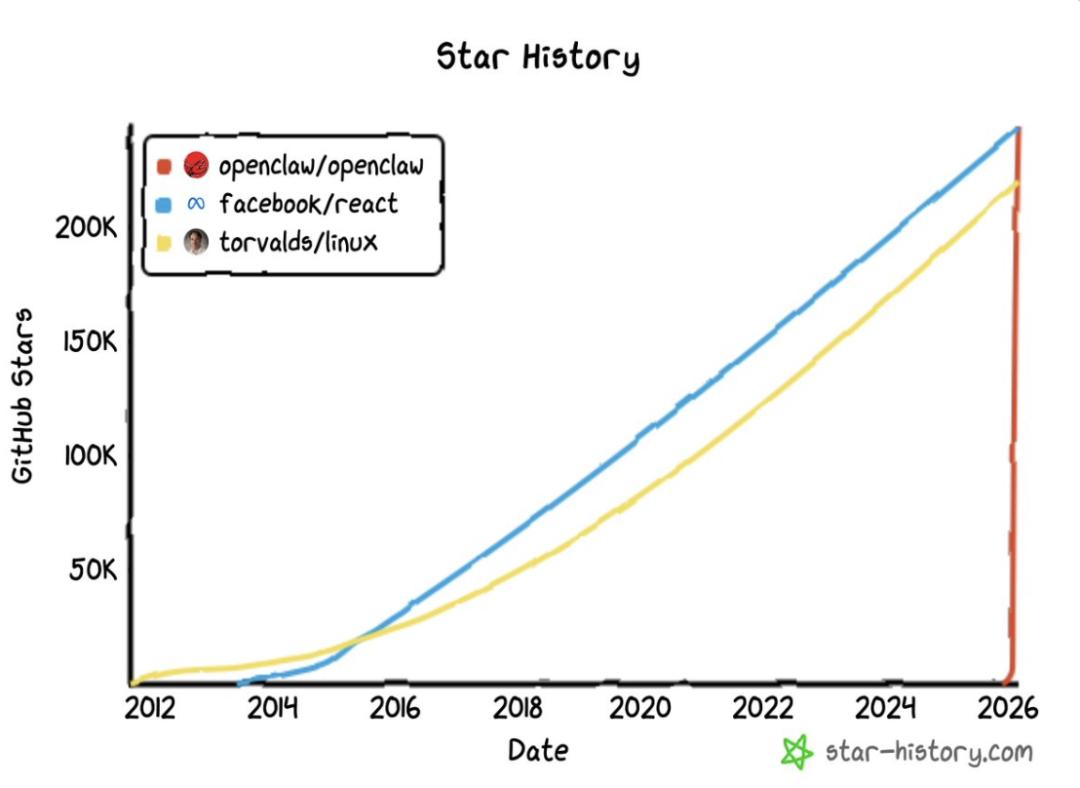
Star represents popularity, attention, and a signal, but it does not equal code quality, nor does it equal commercial value, let alone technological maturity. The development team of OpenClaw itself also admits that this product "is still in an extremely early stage and is not even perfect." But this is precisely the most thought-provoking aspect of this matter.
There is an analogous moment in history: In 2017, the market value of Bitcoin exceeded that of Berkshire Hathaway under Warren Buffett for the first time. At that time, no one dared to assert that Bitcoin would definitely win, but everyone realized that the cracks in the old order were clearly visible. The fact that OpenClaw's Star count reached the top has a similar quality.
In the past two years, the core narrative of the large model competition has been an intellectual competition - whoever scores higher on evaluation benchmarks such as ARC and SWE-Bench is closer to AGI. The parameter scale, inference depth, and completion rate of complex tasks constitute the coordinate system of the entire industry. By the end of 2025, this narrative had begun to show signs of fatigue: The models are getting stronger and stronger, but most users still use them by opening the chat box, asking a question, and waiting for an answer.
OpenClaw represents another possibility. Its interaction mode is not limited to the chat box. It has an Agent framework that can run continuously in the background and autonomously complete multi-step tasks. It can write code, debug, call tools, read files, and iterate, all without humans constantly staring at the screen. When users have an inspiration without a computer, they can send instructions to the Agent on their mobile phones to retrieve data and conduct experiments, and then check the results when they return.
All of this was detonated around the Spring Festival red envelope war. At the beginning of 2026, the keywords of almost all model manufacturers had switched to "Agentic." Tencent Cloud and Alibaba Cloud quickly launched the one-click deployment service for OpenClaw. Recently, several domestic model manufacturers have successively launched products that are comparable to or compatible with OpenClaw. Yuezhianmian launched the cloud version of Kimi Claw, and MiniMax followed suit by releasing MaxClaw. In the face of the definite gold rush, they want to take this opportunity to become the most reliable "shovel seller" in the Chinese AI circle.
The domestic technology circle has thus entered a new round of competition in the narrative of capabilities, and OpenClaw has become the most eye-catching flagpole. The machine execution ability it demonstrates, as well as the developers' tolerance for the autonomous execution results of AI, have led to another iteration of the model paradigm at the beginning of this vibrant and chaotic 2026. Chinese open-source models and cloud infrastructure are biting tightly at this structural window in an extremely hungry manner.
After the fire, the threshold is the best business
On social platforms, OpenClaw has been elevated to the altar by a large number of ordinary people who have never been exposed to programming. What they see are demonstration videos: With a natural language instruction, the AI autonomously completes a market analysis report or independently builds a simple website. That sense of fluency has hit the long-suppressed expectations of many people.
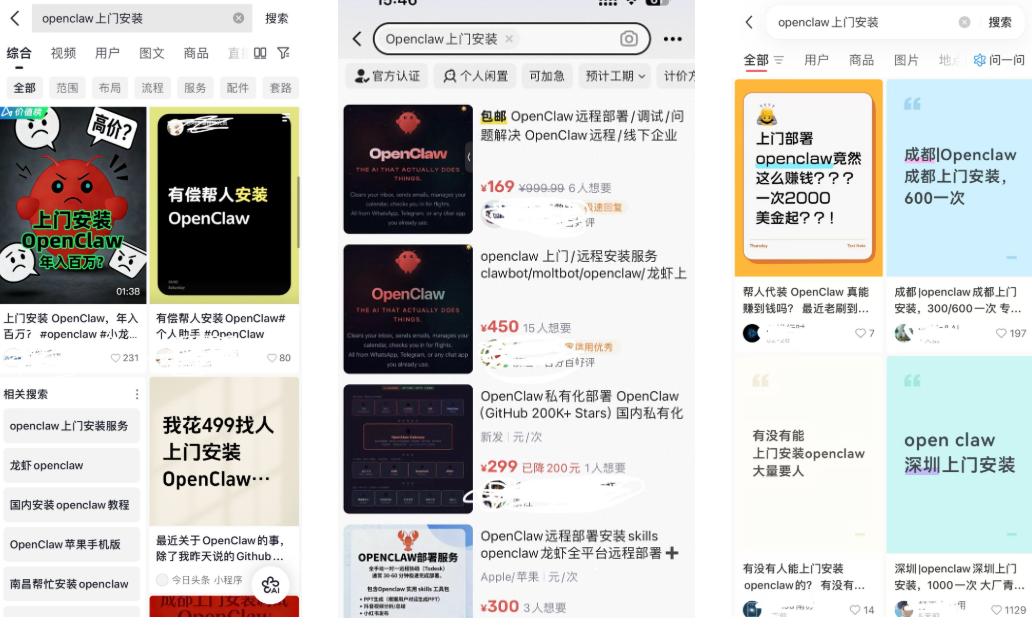
But the gap in reality begins at the installation stage. In theory, the open-source nature of OpenClaw allows everyone to deploy their own Agent. In fact, a complete deployment requires: a server that can stably access the external network, the configuration of a Docker environment, SSH remote connection, correct permission management, the application and filling of an API Key, and the last step that is often underestimated - precipitating a set of exclusive knowledge bases and Skill systems for one's own business scenarios.
Each step is a threshold, and each step will discourage a group of people. Most people don't want to touch these boring command lines and are even less willing to bear the potential risks of privacy leakage and security.
This large number of people has thus created a huge market gap, and the first to rush into this gap are not large companies but grass-roots entrepreneurs. On a developer project aggregation platform verified by Stripe for official income, there are already 126 entrepreneurial projects based on OpenClaw, and they are ranked in real-time according to the verifiable income in the past 30 days. The data is cruel: Among the top 30 projects with the highest earnings, more than 17 are doing the same thing - one-click cloud hosting. The top three with the highest income all belong to this category.
OpenClaw Pro and Donely are representatives of this model. Their product logic is very simple. Users don't need a server, Docker, or SSH. With a single click, the OpenClaw instance runs, and then they pay monthly. The entry points are spread to instant messaging platforms such as Telegram, Discord, and WhatsApp, and the threshold is pushed to the extreme.
This has created an interesting economic phenomenon. In the case of open-source underlying technology, the value does not automatically flow to those who write the technology but to those who solve the "last mile" problem. Helping users bridge the distance from "wanting to use" to "being able to use" has become the real commodity.
However, OpenClaw is an amplification tool that amplifies the upper limit of the user's own ability. It can make those who can use it more efficient, but for those who can't, it is just a black box with complex configurations, ambiguous semantics, and uncontrollable outputs. Many programmers started various tests after successfully deploying OpenClaw locally. They found that OpenClaw can indeed complete many things, but it is difficult to find "rigid demand scenarios where it can play a significant role." The tens of thousands of Skills in the community are not all useful. They are of uneven quality, and the technical content of some Skills is even lower than writing a script by oneself.
"Not knowing the usage scenarios" can be explained as a psychological threshold, but Token consumption is a real economic threshold. The Token consumption logic of OpenClaw is fundamentally different from that of traditional question-and-answer AI. In the dialogue mode, when the user stops asking questions, the consumption stops; while in the Agent mode, the machine can run the process continuously in the background.
Taking OpenClaw as an example, Token consumption mainly comes from three sources: The first is multi-round self-correction. A programming task may go through dozens of rounds of "writing code → running → reporting an error → modifying → running again," and each round is a complete model call.
The second is the infinite expansion of the context. In order to let the Agent "remember" the previous operations, each call has to carry the complete conversation history. Users' actual measurements show that the context of an active session can quickly expand to more than 200,000 Tokens.
The third is the cascading trigger of the tool chain. When the Agent processes a task of "help me organize emails and create to-dos," it may trigger 5 to 10 API calls, each carrying the complete context.
The cost sensitivity is sharply magnified at this moment. Some overseas users have complained on social media that an improperly configured automated task can burn through $200 in API fees in a day. Running OpenClaw full-time 7×24 hours and calling the Claude API costs between $800 and $1,500 per month. For individual users and small teams, this is almost unsustainable.
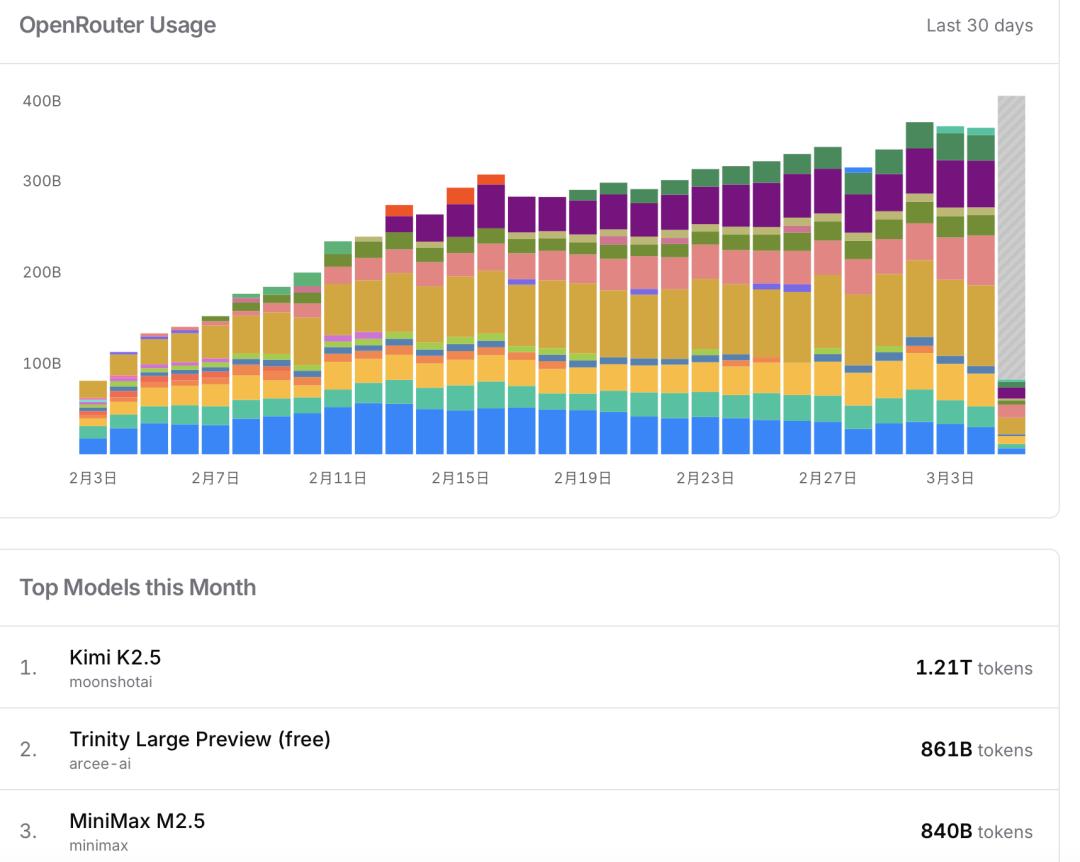
The background data of OpenRouter also confirms this madness. The latest data shows that OpenClaw is already the largest single application on OpenRouter, and its Token consumption accounts for a significant proportion of the platform. Token consumption has changed from "per time" to "by traffic," and the cost curve of AI usage is becoming sharply steeper.
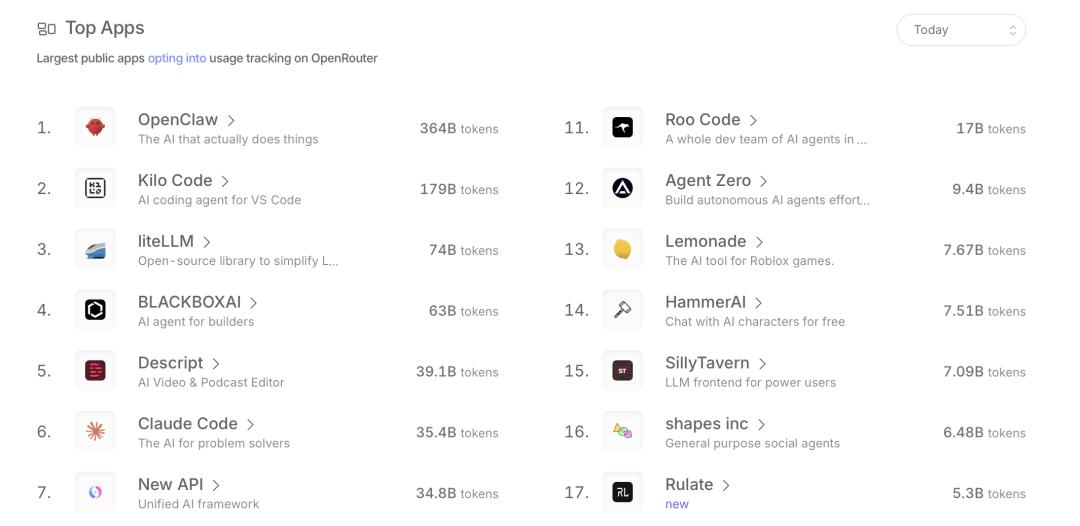
Jeff Dean, a scientist at DeepMind, mentioned a judgment framework in an interview in February: From dialogue to Agent, the consumption logic of Tokens has undergone a fundamental structural change. This leap in consumption scale not only means higher commercial barriers but also will drive a new round of expansion cycle for the entire AI infrastructure, from inference chips to cloud computing capacity and then to application scenarios.
But for private deployment, the ceiling of Token cost is clearly visible. This dooms the limitations of private deployment of OpenClaw and also leads to the next question: Who will take over those users who cannot afford the cost of private deployment but want to use the Agent's capabilities?
The alternative to SaaS and the end of "applications"
Facing the market upsurge triggered by OpenClaw, domestic manufacturers have generally taken actions along two paths. The first path is the "SaaS-based Agent service" represented by Yuezhianmian and MiniMax.
The essence of Kimi Claw is a virtual machine remotely opened for users. Yuezhianmian has not done any additional encapsulation of OpenClaw. It has completed the steps of deployment, configuration, and environment setup for users and then provides an entry point accessible via a browser. Users don't need to deploy locally and can use the full functions of OpenClaw by clicking in.
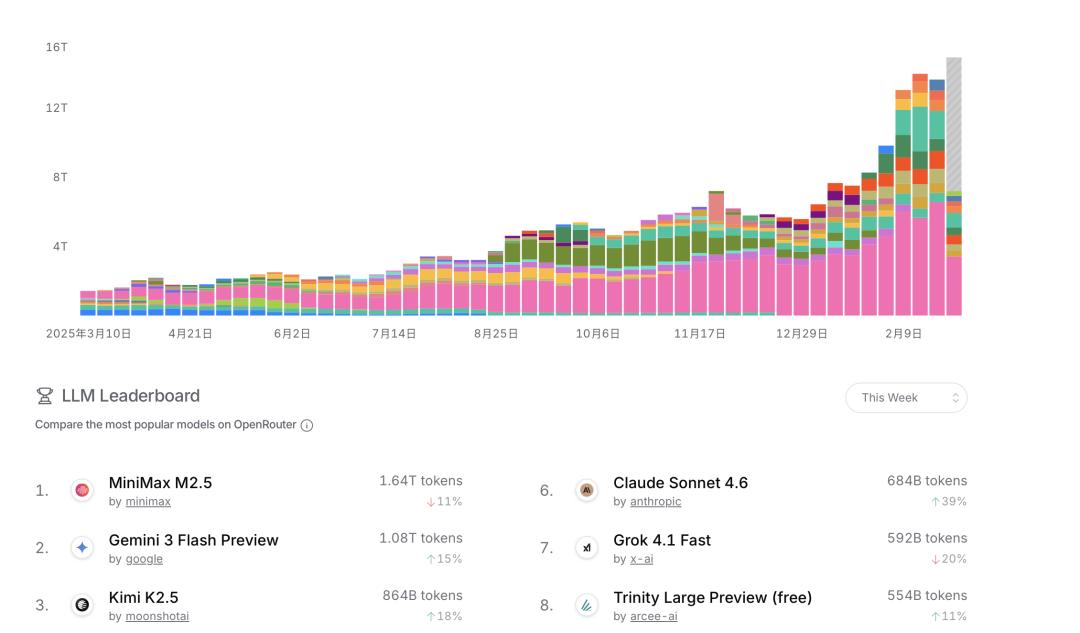
MaxClaw, launched by MiniMax on February 25, takes a similar but more radical approach. MaxClaw is based on the MiniMax M2.5 model - with a total of about 230 billion parameters, and only about 10 billion are activated in a single inference. This sparse activation architecture makes its API price very competitive.
The cloud-based OpenClaw products of these two companies are essentially providing Agent services in a SaaS way. Although they are less scalable than the original OpenClaw, they are cheaper, easier to use, and don't require users to tinker with the environment. Ordinary users and small and medium-sized enterprises don't have cutting-edge requirements. Their demand scenarios are just to let the AI help check emails, organize documents, set up reminders, and query information, rather than building a fully automated enterprise-level Agent workflow.
The commercial returns of Kimi K2.5 in this wave have already emerged. OpenRouter data shows that Kimi K2.5 is the model with the highest call volume for OpenClaw. Driven by the sharp increase in global paying users and API call volume, the cumulative income of Kimi K2.5 in the past 20 days has exceeded the total income for the whole year of 2025 less than a month after its release.
After the 1.30 version, the official OpenClaw also set Kimi K2.5 as the "first official free main model," where the interests of the open-source community and the model manufacturer are briefly aligned. SimilarWeb data shows that Kimi's monthly traffic reached 33 million last month, and the proportion of traffic from China dropped from 77% in the past to more than 60% - OpenClaw has become an unexpected springboard for Kimi to go global.
The second path is the "cloud infrastructure positioning" represented by Alibaba Cloud and Tencent Cloud. The logic of cloud providers is more long-term and more conservative. The "one-click deployment of OpenClaw" service they provide is an entry point. When individual users and small and medium-sized enterprises start to deploy Agents, what they need is not only the API of the model but also cloud servers, storage space, network bandwidth, integration with messaging platforms (Feishu, DingTalk, WeCom), a secure sandbox environment, and a whole set of infrastructure. These are exactly what cloud providers are best at.
Users who come because of OpenClaw today may come because of other Agent products tomorrow. But as long as users get used to deploying Agents on their platforms, these users will become long-term bound customers. What cloud providers are doing is to occupy the position in advance, establish user habits, and build an ecological barrier - The business of selling shovels is often more stable and more profitable than that of gold diggers.
According to "New Position," if we jump out of the perspective of single-product competition, we will find that OpenClaw is not just a tool but also a manifestation of a workflow thinking.
The "2025 AI Usage Report" jointly released by OpenRouter and a16z shows that the output Tokens generated by the Agent-driven workflow - the model autonomously executing multi-step tasks - have exceeded half of the total output of the platform. This is a structural change: The usage paradigm of AI is shifting from "human-machine dialogue" to "machine self-circulation."
When the Agent can complete work for people across a bunch of interfaces, the "App" layer, which is designed for humans, will gradually degenerate into a "data and action interface for the Agent." Users no longer "use" your product, but their Agents "call" your product for them. The more standardized tools, such as email, calendar, task management, and file storage, are more likely to be rewritten by this logic first.
This may have a deeper impact on the business model than expected. In the past, the essence of AI entrepreneurship was human resource outsourcing: The core business model was to charge by person-year or person-day and conduct customized development for customers. But when OpenClaw levels the gap in programming ability, a person who doesn't know code can also achieve complex technical development with the help of an Agent, and the traditional model of customized development algorithm companies won't work anymore.
Of course, the more profound impact is at the organizational level. When companies are thinking about using OpenClaw to replace employees in writing code, some employees who understand the business and can deploy OPC are also thinking in the opposite way: Since I can start a business and be my own boss with just myself and a "lobster" (referring to OpenClaw), why should I be employed by the company? If the most useful people in the company leave, the human resource advantage and competitive barrier established by hiring programmers in the past will no longer exist.
OpenClaw and the Agentic workflow it represents offer a new possible answer in the organization of the entire workflow. And once this possibility is taken seriously by enough people, the tension it generates will no longer be limited to technical discussions but will spread to the reorganization of the professional structure, organizational design, and even the labor market.
In this world reshaped by AI, some people choose to go to San Francisco to pan for gold, some choose to sell shovels in Silicon Valley, and some choose to start anew in this complex Eastern system. The global war of Agents has just fired its first shot.
Conclusion
GenAI and Agent are not two eras but two layers of the same system. The dialog box of ChatGPT defines the interaction mode of GenAI, and the chat-driven Agent framework like OpenClaw is defining the interaction mode of Agentic AI. The former will eventually fade away and become the backend; Agents like OpenClaw will become the front end of everything.
However, "New Position" predicts that on the premise