Gallium oxide: On the verge of a breakthrough
Recently, Japanese manufacturer Novel Crystal Technology announced the start of delivering samples of 150mm (6-inch) gallium oxide (β-Ga₂O₃) wafers for next-generation power semiconductors. This move marks a crucial step for gallium oxide, as an ultra-wide bandgap semiconductor material, towards large-scale mass production.
It is reported that NCT has defined its subsequent development roadmap: delivering samples of 150mm β-Ga₂O₃ epitaxial wafers in 2027, achieving full-scale mass production in 2029, and further developing and supplying 200mm (8-inch) β-Ga₂O₃ wafers in 2035. By gradually improving the gallium oxide product matrix, NCT aims to seize the opportunity in the next-generation power semiconductor market.
This development has also refocused the industry's attention on the industrialization process of gallium oxide (Ga₂O₃) materials.
Gallium Oxide: The "King of Cost-Effectiveness" among Fourth-Generation Semiconductors
Ga₂O₃ is a single-crystal material and the fourth-generation wide bandgap semiconductor material after Si, SiC, and GaN.
As a highly anticipated next-generation power semiconductor material, gallium oxide is not a newly discovered material. However, it is only in recent years, with the continuous increase in the performance requirements of power devices in high-voltage scenarios such as new energy vehicles, smart grids, and photovoltaic inverters, that its excellent material properties have come into the spotlight.
It is understood that the bandgap of gallium oxide is as high as 4.9eV, far exceeding that of silicon (1.1eV) and higher than that of silicon carbide (3.2eV) and gallium nitride (3.39eV). This ultra-wide bandgap characteristic means that electrons need more energy to transition from the valence band to the conduction band. Therefore, gallium oxide has characteristics such as high voltage resistance, high temperature resistance, high power, and radiation resistance, making it particularly suitable for high-power electronic device applications.
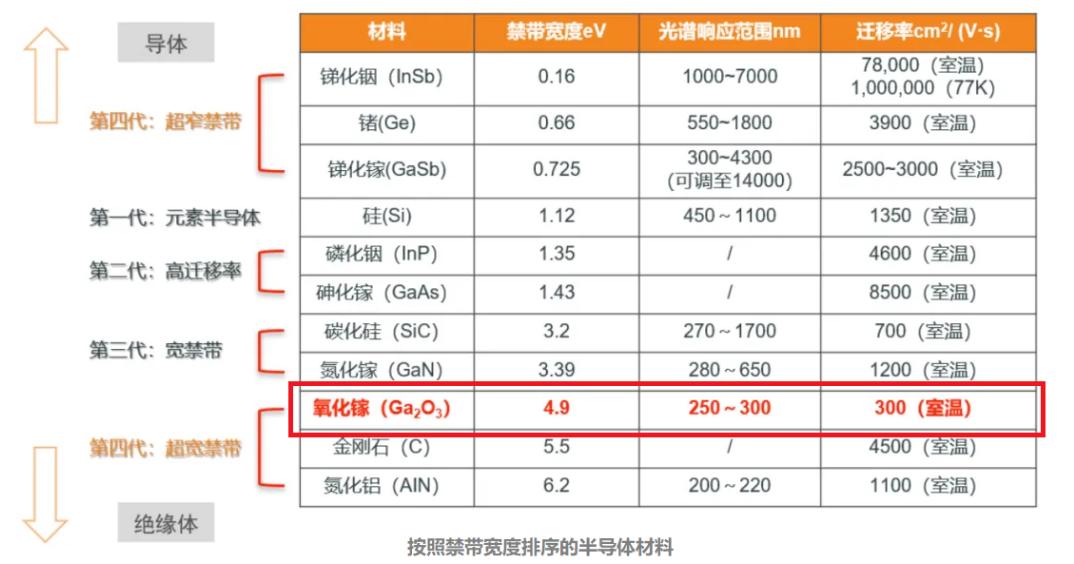
What is even more remarkable is its astonishing breakdown field strength. Research shows that the theoretical breakdown field strength of gallium oxide can reach 8MV/cm, more than twice that of silicon carbide and gallium nitride. This means that under the same voltage withstand requirements, gallium oxide devices can be made smaller in size and higher in power density, saving supporting heat dissipation and wafer area, and further reducing costs.
In addition, the growth process of gallium oxide single crystals is relatively simple. Different from silicon carbide, which requires high-temperature and high-pressure synthesis, gallium oxide is the only wide bandgap semiconductor that can be grown by the low-cost "melt method". This means that the cost of its wafers can theoretically approach that of sapphire or even silicon, significantly reducing production costs, completely solving the pain point of the high cost of third-generation semiconductors, and paving the way for its future industrialization.
These characteristics will give gallium oxide revolutionary advantages in the field of power electronics. This is also the key for it to break through the current technical bottlenecks of SiC and GaN, enabling it to win the reputation of the "king of cost-effectiveness" among semiconductor materials.
It is worth noting that gallium oxide has five different crystal phases, namely α, β, γ, δ, and ε, and these crystal phases can transform into each other under specific conditions. Among these five crystal phases, β-Ga₂O₃ is the most stable at room temperature and normal pressure, with a unique crystal structure and excellent physical and chemical properties. It has great potential, especially in the fields of power electronics and optoelectronics, and is the current focus of research and application of semiconductor materials. The other crystal phases are regarded as metastable phases. By adjusting the temperature conditions, these metastable phases can be transformed into β-Ga₂O₃, and this process is reversible under certain conditions, but usually requires the application of high pressure.
Currently, globally, the research and commercialization of gallium oxide are accelerating.
Global Race for Ga₂O₃ to Seize the Opportunity
NCT: Leading the Way for Gallium Oxide into the "6-inch Mass Production Era"
For a long time, the diameter of β-Ga₂O₃ wafers has generally remained at 100mm (4 inches), unable to meet the large-scale mass production requirements of existing power device production lines. To break through this bottleneck, based on its mature 4-inch wafer production process, NCT successfully developed 150mm (6-inch) β-Ga₂O₃ wafers using the EFG method (Edge-defined Film-fed Growth). The EFG method uses the siphon effect of the capillary pores inside the mold to guide the growth of the melt, with advantages such as fast crystal growth speed, high production efficiency, and easy realization of large-size crystal growth, providing core technical support for the successful development of 6-inch wafers.
As mentioned above, NCT announced the official delivery of samples of 150mm diameter β-Ga₂O₃ wafers. This breakthrough marks that gallium oxide materials have officially entered the threshold of large-size mass production, paving the way for the large-scale application of next-generation power semiconductors.
Looking back at its recent development process, we can see that in 2025, NCT's layout in the field of gallium oxide accelerated comprehensively, with breakthroughs in multiple aspects such as devices, epitaxy, and crystal growth.
In April 2025, NCT globally launched the all-gallium-oxide-based Planar SBD device, providing verification samples in the form of Research Sample (RS) - grade products for scientific research and early applications, and launched two electrode specifications to meet diverse testing needs, providing valuable device evaluation opportunities for industry customers.
In August, NCT reached a cooperation agreement with Kyma Technologies in the United States to jointly develop high-quality Ga₂O₃ epitaxial wafers, targeting the commercial application of multi-kV power devices. The two sides integrated their technical advantages in substrate production and epitaxial growth, committed to promoting the industrialization of large-area, low-defect epitaxial wafers, and providing key material support for high-voltage power electronics markets such as electric vehicles, renewable energy, and aerospace.
In November, the company launched the (011) series of high-quality epitaxial wafers, with the epitaxial thickness increased from 20 μm to 30 μm, the carrier concentration precisely controlled at 2–5×10¹⁵ cm⁻³, and the defect density reduced to 5 pcs/cm², reaching the leading level in the industry, laying a technical foundation for the performance breakthrough of high-end power devices.
In December, in a project supported by NEDO (New Energy and Industrial Technology Development Organization of Japan), NCT successfully developed the Drop-fed Growth (DG) method - a new crystal growth technology that does not require expensive iridium crucibles. This process continuously supplies the raw material melt in the form of droplets, reducing the manufacturing cost of β-Ga₂O₃ substrates to one-tenth of the traditional method, taking a crucial step towards the low-cost and large-scale development of the material.
Based on the above technical accumulation, NCT has defined its industrialization roadmap for the next few years: starting to deliver samples of 150mm β-Ga₂O₃ epitaxial wafers in 2027 to provide a more complete material solution for device development; officially starting full-scale mass production in 2029, when the DG method will be introduced to significantly reduce costs and enhance product competitiveness; and planning to develop and supply 200mm (8-inch) β-Ga₂O₃ wafers in 2035 to further connect with mainstream semiconductor production lines and promote the large-scale application of gallium oxide materials in a wider range of power electronics scenarios.
From the breakthrough in wafer size to the improvement of epitaxial quality, from device research and development to the innovation of crystal growth methods, a series of breakthroughs by NCT have proved that gallium oxide is not out of reach. It is continuously consolidating its leading position in the global gallium oxide industry through systematic innovation.
With the delivery of 6-inch wafers in 2026 and the implementation of the low-cost DG method in 2029, gallium oxide is expected to open a new era of more energy-efficient and high-performance electric power in the fields of electric vehicles, ultra-fast charging piles, and aerospace, injecting strong impetus into the global power semiconductor industry towards a future of higher efficiency and lower losses.
While NCT is accelerating the industrialization of gallium oxide, the global layout of the gallium oxide industry chain has entered a white - hot stage. Enterprises and research institutions in many countries such as Japan, the United States, Germany, the United Kingdom, South Korea, and China are all making efforts, forming an industrial pattern of differentiated competition.
Japan's FLOSFIA: Focusing on the α-Ga₂O₃ Technical Route
As a pioneer in the research and development of gallium oxide technology, Japan shows a vibrant development trend led by leading enterprises and with diverse innovation entities. In addition to NCT, FLOSFIA has taken a unique approach, focusing on the α-Ga₂O₃ technical route and achieving substantial breakthroughs in key device fields.
In mid - 2025, the company was the first to achieve the operation of a normally - off device based on a p - type layer structure in an α-Ga₂O₃ MOSFET and completed the verification under relatively high current conditions, breaking through the core structural problem that has long restricted the practical application of gallium oxide devices. At the end of the same year, FLOSFIA advanced its R & D focus to the mass production level, completed the verification of 4 - inch wafer manufacturing technology, and simultaneously solved the key problems of reliability and consistency of diode devices, laying the foundation for the stable production of subsequent product lines.
Japan's Mitsubishi Electric: Driven by National - Level Strategy
Mitsubishi Electric in Japan has also gradually increased its layout in the field of gallium oxide.
In March 2025, Mitsubishi Electric demonstrated its research results on gallium oxide materials at its Advanced Technology R & D Center and announced the official launch of the research and development of gallium oxide (Ga₂O₃) materials. It is reported that this gallium oxide material technology has been adopted by the New Energy and Industrial Technology Development Organization of Japan (NEDO) in its "Project for Cultivating Important Technologies for Economic Security / Development of Materials Technology for High - Power and High - Efficiency Power Devices and High - Frequency Devices" since June 2024 and will continue to be promoted with the support of NEDO.
This move not only demonstrates Mitsubishi Electric's strategic determination to layout the next - generation wide bandgap semiconductors but also further enriches the layout dimension of Japan's gallium oxide industry, forming a development trend of enterprise collaboration and government - enterprise linkage.
In addition, enterprises such as Kyocera and Namiki Precision Jewel in Japan have long been deeply involved in the EFG crystal growth technology, providing important technical support for the industrialization of gallium oxide and improving the segments of Japan's gallium oxide industry chain.
USA's Gallox: The Pioneer in the Commercialization of Gallium Oxide Devices
The United States focuses on academic incubation and technology commercialization, relying on the strength of research institutions and start - up enterprises to gradually seize the opportunity in the commercialization of gallium oxide devices.
In August 2025, Gallox, a company incubated by Cornell University, was successfully selected for the Activate Fellowship 2025 project. As the world's first company to commercialize gallium oxide devices, its founder, McCandless, has long been engaged in research related to gallium oxide semiconductors during his doctoral studies at Cornell University, with profound technical accumulation. Compared with traditional semiconductor materials, gallium oxide has the potential for lower energy consumption and higher performance in power devices, mainly targeting high - power application scenarios such as data centers, drones, aerospace, space technology, and electric vehicle charging.
The successful selection of Gallox not only reflects that gallium oxide devices are gradually entering the field of engineering and commercialization but also highlights that hard - tech entrepreneurship starting from academic research has become an important path for the implementation of advanced semiconductor materials.
In addition, as early as 2023, the cooperation team of the U.S. Air Force Research Laboratory and Kyma Company successfully developed a gallium oxide MOSFET with a withstand voltage of more than 2000 volts, with significantly improved performance parameters compared with traditional devices, laying a solid foundation for the research and development of gallium oxide devices in the United States.
In Europe, with Germany and the United Kingdom as the core, through the leadership of research institutions and the coordinated efforts of enterprises, focusing on the epitaxial and engineering technologies of gallium oxide materials, a complete R & D and industrial system is gradually being built.
Germany's IKZ and NextGO Epi: Accelerating the Application of Power Semiconductors
Among them, the Leibniz Institute for Crystal Growth (IKZ) in Germany, as the core research institution, launched the EFRE project "G.O.A.L. - Gallium Oxide Application Laboratory for Power Electronics" in September 2024 and announced the latest progress in April 2025. With the full deployment of key equipment and technical capabilities, the practical value of this project is gradually emerging, focusing on the construction of the 2 - inch wafer layer structure system, introducing AIXTRON industrial - grade epitaxial equipment, and jointly promoting the engineering development of 2 - inch gallium oxide epitaxial technology with other technical units.
In the future, IKZ plans to establish itself as a research partner and material supply node for gallium oxide epitaxial wafers within the EU, jointly promoting the R & D of larger - size materials and devices with research institutions and enterprises in the Berlin - Brandenburg region.
In terms of enterprise layout, in May 2025, NextGO Epi, a company incubated by IKZ, was officially established in Berlin, Germany. This company, which focuses on the large - scale manufacturing of high - quality β-Ga₂O₃ epitaxial wafers, uses metal - organic chemical vapor deposition (MOVPE) technology and is committed to providing gallium oxide - based epitaxial wafers with significant cost and performance advantages for key fields such as electric vehicles, rail transit systems, and renewable energy infrastructure.
Different from other enterprises' single - point technical breakthroughs, NextGO Epi focuses on the key industrial link of gallium oxide epitaxy, systematically filling the gap in the transition from materials to devices, and providing practical support for gallium oxide to enter the next - generation power electronics applications from the material side.
In addition, the new hetero - epitaxial technology developed by the Fraunhofer Institute in Germany has significantly improved the quality of gallium oxide thin films, laying a foundation for the development of high - electron - mobility transistors and further improving the technical layout of Germany's gallium oxide industry.
UK's CISM: Building a Research Platform to Promote the R & D and Implementation of Gallium Oxide
The United Kingdom takes the construction of research platforms as a breakthrough point to gradually enhance its R & D strength in the field of gallium oxide.
In April 2025, the Centre for Integrated Semiconductor Materials (CISM) at Swansea University in South Wales, UK, established the first platform in the UK that can grow high - quality gallium oxide thin films on 4 - inch substrates. This platform uses the newly put - into - use AIXTRON Close - Coupled Showerhead (CCS) deposition system, funded by a £2.7 million strategic equipment project of the Engineering and Physical Sciences Research Council (EPSRC) of the UK, and is deployed in the newly built Oxide and Chalcogenide MOCVD Laboratory. It has now become a national - level R & D hub for gallium oxide thin - film research in the UK, with research directions covering power electronics, deep - ultraviolet light detectors, and transparent conductive oxide (TCO) applications.
In June 2025, CISM signed an agreement with Space Forge, a UK microgravity manufacturing company. The latter became the first entity enterprise to move in and can use the center's complete semiconductor processing and characterization equipment to conduct research on gallium oxide manufacturing in a microgravity environment. With the successive implementation of the equipment platform and research cooperation, the attention of gallium oxide in the UK's power electronics research system has continued to increase, and its application prospects in high - performance power devices are being further explored.
South Korea's PowerCubeSemi: Sprinting for IPO and Leading the Race in Gallium Oxide Mass Production
South Korea focuses on industrial mass production and capital market layout to promote the rapid implementation of the gallium oxide industry, trying to extend its advantages in the field of memory chips to the field of compound semiconductors.
It is reported that in December 2025, PowerCubeSemi, a gallium oxide manufacturer, is accelerating its listing process. The company has completed a pre - IPO financing of 6 billion won and plans to apply for listing on the Korean Growth Stock Market (KOSDAQ) in 2026.
As the world's first company to operate a large - scale gallium oxide mass - production wafer factory, Power