Galliumoxid, kurz vor dem Ausbruch
Recently, the Japanese company Novel Crystal Technology (NCT) announced that it has started supplying 150 - millimeter (6 - inch) gallium oxide (β - Ga₂O₃) wafer samples for the next - generation power semiconductors. This step marks an important milestone in the mass production of gallium oxide as an ultra - wide - bandgap semiconductor material.
It is known that NCT has already set a clear path for further development: In 2027, 150 - millimeter β - Ga₂O₃ epitaxial wafer samples will be delivered. In 2029, full - scale mass production is set to begin, and in 2035, 200 - millimeter (8 - inch) β - Ga₂O₃ wafers are planned to be developed and offered. In this way, the product portfolio of gallium oxide products will be completed, and an edge in the next - generation power semiconductor market will be gained.
This development has also refocused the industry on the industrialization process of gallium oxide (Ga₂O₃).
Gallium Oxide: The "King of Cost - Efficiency" among the Fourth - Generation Semiconductors
Ga₂O₃ is a single - crystal material and belongs to the fourth - generation wide - bandgap semiconductor materials after Si, SiC, and GaN.
As a promising material for the next - generation power semiconductors, gallium oxide is not new. Only in recent years, with the increasing requirements for the performance of power semiconductors in high - voltage applications such as electric mobility, smart grids, and photovoltaic inverters, have its excellent material properties come into the spotlight.
It is known that gallium oxide has a bandgap of 4.9 eV, much higher than that of silicon (1.1 eV), silicon carbide (3.2 eV), and gallium nitride (3.39 eV). This ultra - wide bandgap means that electrons need more energy to jump from the valence band to the conduction band. Therefore, gallium oxide has properties such as high - voltage resistance, high - temperature resistance, high power, and radiation resistance, which make it particularly suitable for applications in high - power electronics.
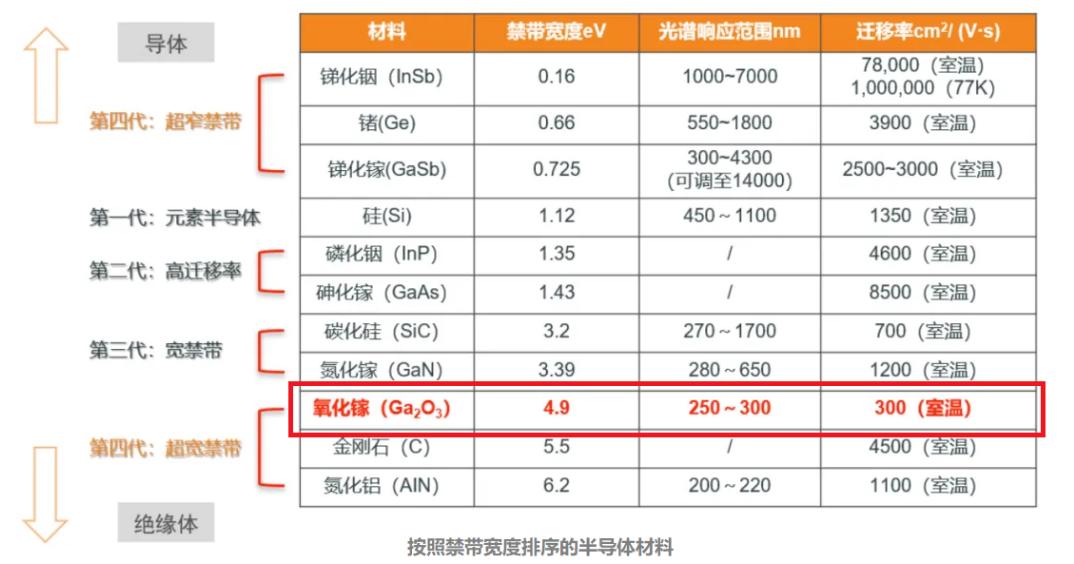
Notably, it has a high breakdown field strength. Studies have shown that the theoretical breakdown field strength of gallium oxide can reach up to 8 MV/cm, more than twice that of silicon carbide and gallium nitride. This means that at the same voltage resistance, gallium oxide devices can be made smaller, the power density is higher, the required cooling and wafer area can be reduced, which further lowers the cost.
In addition, the growth process of gallium oxide single crystals is relatively simple. In contrast to silicon carbide, which must be synthesized under high temperature and high pressure, gallium oxide is the only wide - bandgap semiconductor material that can be grown using the cost - effective "melt method". This means that the wafer cost can theoretically be close to that of sapphire or even silicon, which significantly reduces the manufacturing cost, solves the problem of the high cost of the third - generation semiconductors, and paves the way for future industrialization.
These properties give gallium oxide a revolutionary advantage in the field of power electronics. This is also the key to why it can overcome the technological bottlenecks of SiC and GaN, and has earned it the reputation as the "King of Cost - Efficiency" among semiconductor materials.
It should be noted that gallium oxide has five different crystal phases, namely α, β, γ, δ, and ε, which can transform into each other under certain conditions. Among these five crystal phases, β - Ga₂O₃ is the most stable at room temperature and normal pressure, has a unique crystal structure and excellent physical and chemical properties, and has great potential especially in the fields of power electronics and optoelectronics. It is currently the focus of research and application of semiconductor materials. The other crystal phases are considered metastable phases. By adjusting the temperature conditions, these metastable phases can be transformed into β - Ga₂O₃, and this process is reversible under certain conditions, but usually requires the application of high pressure.
Currently, the research and commercialization of gallium oxide are being accelerated worldwide.
The Global Race for Ga₂O₃: Gaining the Edge
NCT: The First Company to Bring Gallium Oxide into the "6 - Inch Mass - Production Era"
For a long time, the diameter of β - Ga₂O₃ wafers was limited to 100 millimeters (4 inches), which did not meet the mass - production requirements of existing power semiconductor production lines. To solve this problem, based on its mature 4 - inch wafer production technology, NCT successfully developed 150 - millimeter (6 - inch) β - Ga₂O₃ wafers using the EFG method (Edge - defined Film - fed Growth). The EFG method uses the capillary action in the capillaries of the mold to guide the growth of the melt. It has the advantages of fast crystal growth, high productivity, and easy realization of large - crystal growth, and provides the technological basis for the emergence of 6 - inch wafers.
As mentioned above, NCT announced the official supply of 150 - millimeter β - Ga₂O₃ wafer samples. This breakthrough marks the beginning of the mass production of large - sized gallium oxide and paves the way for the large - scale application of the next - generation power semiconductors.
Looking at NCT's recent development, we can see that in 2025, NCT accelerated its expansion in the field of gallium oxide and achieved multiple breakthroughs in devices, epitaxy, and crystal growth.
In April 2025, NCT presented a whole gallium - oxide - based planar SBD device for the first time in the world. It is offered in the form of Research Sample (RS) products for research and early applications as validation samples, and two electrode specifications are provided to meet diverse test requirements. This gives industry customers the opportunity to evaluate the devices.
In August 2025, NCT entered into a partnership with the US company Kyma Technologies to jointly develop high - quality Ga₂O₃ epitaxial wafers, aiming to promote the commercial application of power semiconductors in the multi - kV range. Both sides integrate the technological advantages of substrate manufacturing and epitaxial growth and are committed to the industrialization of large - area, low - defect epitaxial wafers to supply important materials to high - voltage power electronics markets such as electric mobility, renewable energy, and aerospace.
In November 2025, the company presented the (011) series of high - quality epitaxial wafers. The epitaxial thickness was increased from 20 μm to 30 μm, the carrier concentration was precisely controlled at 2 - 5×10¹⁵ cm⁻³, and the defect density was reduced to 5 pcs/cm², reaching the industry - leading level and laying the technological foundation for improving the performance of high - power semiconductors.
In December 2025, within the framework of a project supported by the NEDO (New Energy and Industrial Technology Development Organization), NCT successfully developed the Drop - fed Growth (DG) method - a new crystal growth technology that does not require expensive iridium crucibles. This process continuously supplies the melt in the form of drops, which can reduce the manufacturing cost of β - Ga₂O₃ substrates to one - tenth of the traditional method and is an important step for cost - reduction of the material and industrial scaling.
Based on these technological achievements, NCT has set an industrialization plan for the next few years: In 2027, the supply of 150 - millimeter β - Ga₂O₃ epitaxial wafer samples will begin to provide a complete material solution for device development; in 2029, full - scale mass production will start, with the introduction of the DG method to significantly reduce costs and improve product competitiveness; in 2035, it is planned to develop and offer 200 - millimeter (8 - inch) β - Ga₂O₃ wafers to improve the connection with mainstream semiconductor production lines and promote the large - scale application of gallium oxide in broader power electronics applications.
From overcoming the wafer size to improving the epitaxial quality, from device development to innovation in the crystal growth method: NCT's series of breakthroughs prove that gallium oxide is not an unattainable goal. Through systematic innovation, NCT continuously strengthens its leading position in the global gallium oxide industry.
With the supply of 6 - inch wafers in 2026 and the implementation of the cost - effective DG method in 2029, gallium oxide has the potential to initiate a new era of energy efficiency and effectiveness in the fields of electric mobility, super - charging stations, and aerospace, which is even more efficient than SiC, and gives new impetus to the global power semiconductor industry to move towards a future with higher efficiency and lower losses.
While NCT is accelerating the industrialization of gallium oxide, the global gallium oxide industry landscape has already reached a fierce race. Companies and research institutions from Japan, the United States, Germany, the United Kingdom, South Korea, China, and other countries are going all out, and a differentiated competition has emerged.
Japanese Company FLOSFIA: Specializing in α - Ga₂O₃ Technology
As a pioneer in the research and development of gallium oxide technologies, Japan shows dynamic growth with leading companies and a large number of innovation actors. In addition to NCT, the company FLOSFIA has taken its own path and specialized in α - Ga₂O₃ technology and achieved significant breakthroughs in key devices.
In mid - 2025, the company realized a normally - off device operation in an α - Ga₂O₃ MOSFET for the first time based on a p - type layer structure and validated it under higher current conditions, overcoming the core problem of the structure that has long hindered the practical application of gallium oxide devices. At the end of the same year, FLOSFIA shifted the research to the mass - production level, validated the technology for manufacturing 4 - inch wafers, and at the same time solved the key problems in the reliability and consistency of diode devices, laying the foundation for the stable production of the product line.
Japanese Company Mitsubishi Electric: Driven by National Strategy
The Japanese company Mitsubishi Electric has also expanded its activities in the field of gallium oxide.
In March 2025, Mitsubishi Electric presented the results of its research and development of gallium oxide materials at its Institute of Advanced Technologies and announced the official initiation of the research and development of gallium oxide (Ga₂O₃) materials. It is known that this gallium oxide material technology has been taken over by the NEDO (New Energy and Industrial Technology Development Organization) since June 2024 under the "Project for Promoting Important Technologies for Economic Security / Development of Material Technologies for High - Performance and - Efficiency Power Devices and High - Frequency Components" and is continued with the support of the NEDO.
This not only shows Mitsubishi Electric's strategic determination to focus on the next - generation wide - bandgap semiconductors but also the further expansion of the Japanese gallium oxide industry, and a synergy system between companies and the government has been developed.
In addition, Japanese companies such as Kyocera and Namiki Precision Jewel have invested for many years in the EFG crystal growth technology, thus providing important technological support for the industrialization of gallium oxide and completing the segmentation of the Japanese gallium oxide industry chain.
US Company Gallox: A Pioneer in the Commercialization of Gallium Oxide Devices
The United States focuses on academic promotion and technology commercialization and uses the power of research institutions and start - up companies to gain an edge in the commercialization of gallium oxide devices.
In August 2025, the company Gallox, founded by Cornell University, was successfully admitted to the Activate Fellowship 2025 program. As the world's first company to commercialize gallium oxide devices, the founder McCandless worked on the research of gallium oxide semiconductors for many years during his doctoral studies at Cornell University and has a solid technological foundation. Compared with traditional semiconductor materials, gallium oxide has the potential for lower energy losses and higher performance in power semiconductors and is mainly suitable for applications in data centers, drones, aerospace, space technology, and electric - vehicle charging stations.
The successful admission of Gallox to the program not only shows that gallium oxide devices are gradually coming into the scope of engineering and commercialization but also that the start - up approach based on academic research has become an important way for the implementation of advanced semiconductor materials.
In addition, the team from the US Air Force Research Laboratory and the company Kyma had already successfully developed a gallium oxide MOSFET with a voltage resistance of over 2000 volts in 2023, whose performance parameters are significantly improved compared with traditional devices and lays the foundation for the research and development of gallium oxide devices in the United States.
In Europe, Germany and the United Kingdom, as core countries, focus on the epitaxy and engineering technologies of gallium oxide materials, with research institutions leading the way and companies collaborating to build a comprehensive research and industrial system.
German IKZ and NextGO Epi: Accelerating the Application of Power Semiconductors
The Leibniz Institute for Crystal Growth (IKZ) and NextGO Epi are accelerating the application of power semiconductors...