Stop focusing on cost-cutting in old business. The cost of using AI to do new things is much lower than that of doing old things.
Every household is conducting AI pilot projects, but very few are actually making money. Why do companies spend a fortune to set up an AI team, only to end up losing money in most cases?
"In this changing era, I suggest that everyone do more pioneering things and less conservative things."
"AI talents are very expensive. If you set up an AI team to save the money of a group of cheap workers, you'll most likely end up losing money."
Ren Xin, an instructor at Hundun Innovation and an investor in the AI field, pointed out sharply that focusing on "cost reduction and efficiency improvement" in existing businesses is destined to lead nowhere. In 2026, AI productivity will explode further. Everyone will be able to equip themselves with 100 programmers, and AI will turn software into "documents that everyone can edit"...
The underlying logic of the workplace, organizations, and business has been reconstructed.
From how to reshape organizations and products through the "Three - step Method of Forced Application" to how entrepreneurs can target the four major AI - native opportunities, Ren Xin outlines a clear AI gold - mining map in this article.
Abandon the old paths. Stop competing for your neighbor's business. Go to the vast bottom - tier market to discover your new business continent.
The following is Ren Xin's wonderful sharing.
The biggest dividend in 2026: Everyone can be equipped with 100 programmers
In 2026, the biggest dividend I know is having an AI programmer colleague.
In the past, only programming experts could make good use of AI to help write programs and build systems. But this year is different. Ordinary people can do it too.
Not long ago, Karpathy, a great figure in Silicon Valley, posted a tweet saying that previously only 20% of his code was written by AI, and he had to write 80% by himself. But in the past few weeks, the situation has changed dramatically. Now, 80% of his code is written by AI.
In the past, we might have regarded AI as a "Zhuge Liang" and talked to it when we had difficult life problems. But we wouldn't organize it to do work for us because it couldn't use Excel or Word. But now, it can do everything.
The recently popular OpenClaw is a typical example. My partner sent more than 8,000 messages to it in five days. Now, whenever he has something to do, he hands it all over to AI.
He equipped AI with a Mac Mini and let it decide what software to install and what skills to learn. AI installed a bunch of tools and downloaded a lot of experience packages. Then he said, "Try this job." AI would do it on its own, call various software. If it couldn't do well, it would write a piece of code and try again. If it still couldn't do well, it would reflect and try a different method.
So now, AI can write code, use software, and reflect on itself. It's like having a programmer colleague for everyone, capable of doing everything.
Having a programmer sitting next to you means having a "magic power". You just need to talk to it in plain language, and it can get the job done for you. Moreover, this is already happening on everyone's computer.
Let me give you a real - life example. I have a friend named Yu Yi. She is a very avant - garde person, one of the first people to "go crazy" in this AI era. She is extremely obsessed with AI. She runs her own video account, and most of the videos on it are generated by AI. Her follower - growth rate is amazing.
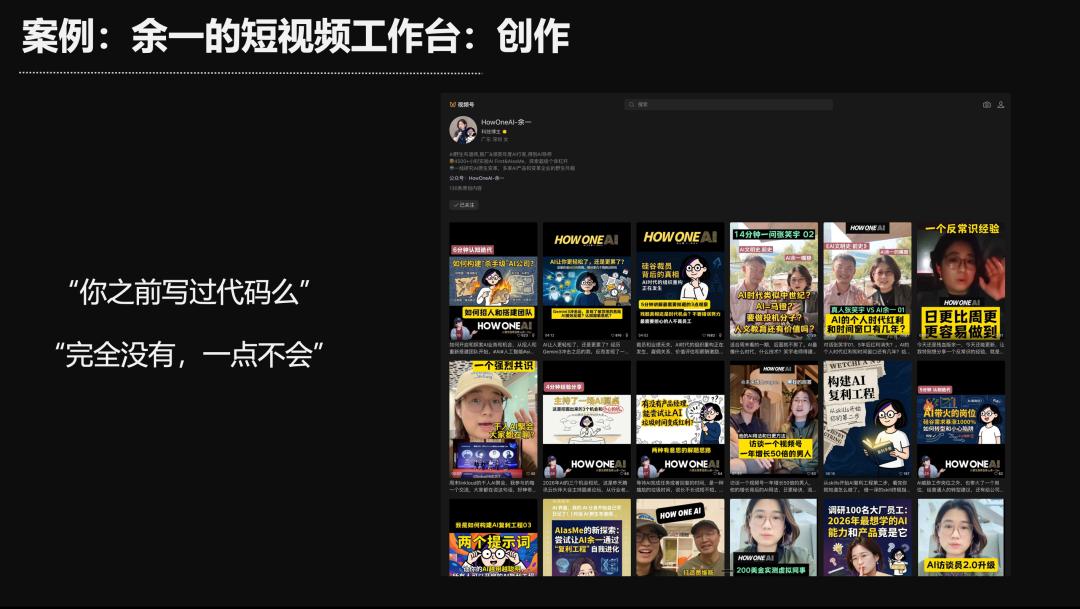
Now, it's a world where words turn into actions. This reminds me of our parents' generation. At that time, there was a special department in the company called the computer office, and there was a group of people dedicated to operating computers. Even typing was done by a special person. Because in that era, once the words were written on a piece of paper, they couldn't be changed, and what was printed by the computer was a fixed thing.
But in our era, it's hard to imagine that someone can't type. Moreover, we assume that documents can be modified. For example, for a Feishu document, we can make a copy and change a few words.
And software is becoming like a document.
In the past, software was like "printed paper", fixed, and only programmers could modify it. But now, AI has turned software into a "document". Everyone can create it, distribute it, and modify it into the version they need. Software has already become like this, not in the future, but now.
This is the biggest dividend in 2026. If you start using it in advance, you can enjoy this huge dividend.
So what's the challenge here? Actually, there's only one - mindset.
Many people make excuses: "I don't understand technology." But you don't need to understand technology. You just need to talk in plain language. The second excuse is "I need to study first." Don't study. Learn when you encounter problems. When you're stuck, ask AI: "I'm stuck here. What should I do?"
When you encounter problems, solve them specifically and learn as needed. We still have a hoarding habit, wanting to hoard knowledge and cognition, but it's actually useless. Learn only when there's a problem. Otherwise, all learning is just an escape from reality. Learning without a problem is an escape from reality. So the biggest challenge is just the mindset.
Andrej Karpathy (formerly a research scientist at OpenAI) said in 2023 that the best programming language is English. Now, the best programming language is Chinese - just speak Chinese directly.
Let me give you a personal example. My child is eight years old this year. He started using AI to write games when he was seven. In this photo, he's in a ramen restaurant, using an iPad without a keyboard to write a tower - defense game for himself to play.
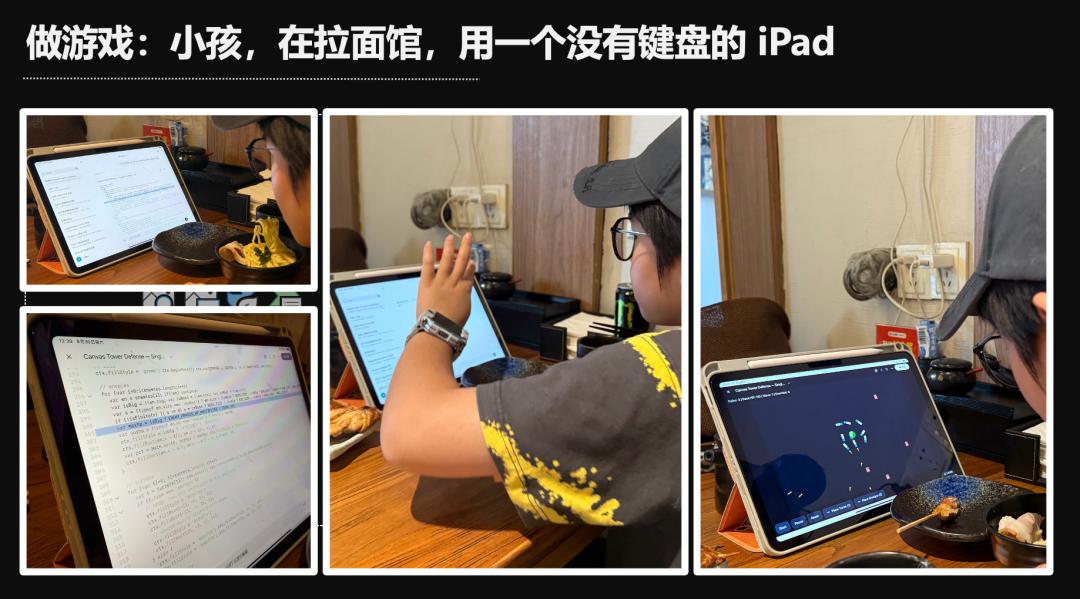
He just says with his mouth: "Make the turret bigger." "Why are the bullets so slow?" "It's too easy to win. It's boring. Increase the difficulty." Just by saying these things, the game gradually gets better and becomes playable. It's that simple.
If an eight - year - old child can write a playable game in a ramen restaurant using an iPad without a keyboard, you definitely can too. If you spend two hours installing the software, you might end up equipping yourself with 100 programmers.
The rules of the game in the workplace and enterprises have completely changed
1. The three bottlenecks for organizations to implement AI
What kind of organizations can't promote AI?
From my observation, for so - called super individuals around me, it's really easy to increase efficiency by five or ten times. But for large organizations, the situation is completely the opposite. The larger the organization, the more difficult it seems to promote AI.
According to the surveys by McKinsey and MIT (Massachusetts Institute of Technology), this is also the conclusion. Every household is conducting AI pilot projects, but very few are actually making money. Because the objects of these reports' surveys are mainly large companies.
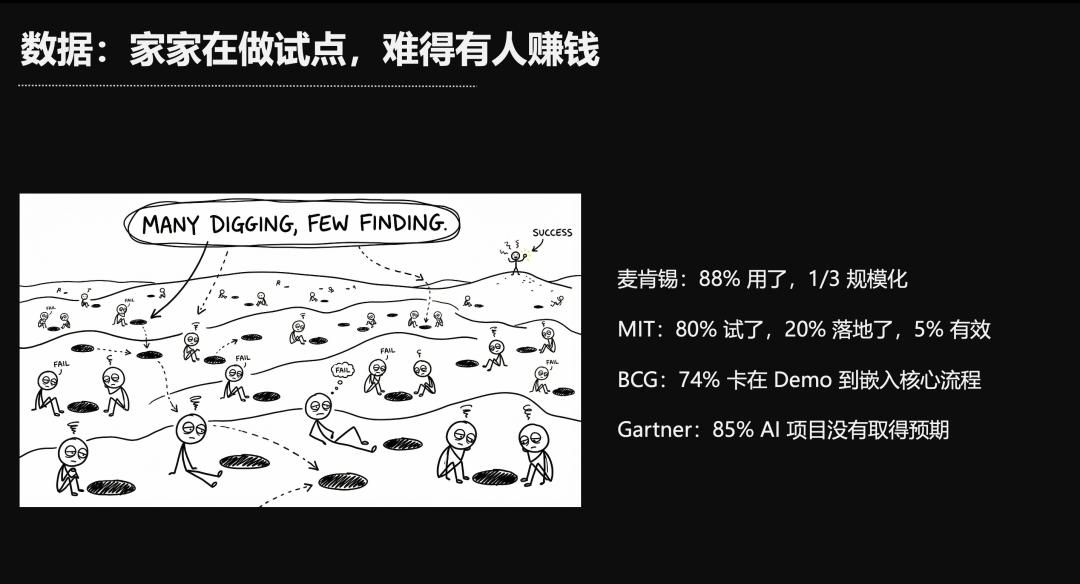
So where exactly is the problem? I've summarized it, and there are mainly three aspects.
The first bottleneck lies with the bosses. Many traditional big bosses don't use AI themselves, but they've watched too many AI videos and read too many official account articles. Just watching without using leads them to have two extreme cognitions of AI: either unrealistic fantasies or completely out - of - touch feelings.
The second bottleneck is the mindset of the organization. Employees will think that if AI can do their jobs, doesn't it mean that AI can replace them in the eyes of the boss? So, from the perspective of the organization, promoting AI seems to be naturally against the interests of many people, facing a lot of resistance.
The last bottleneck is the actual difficulties. When using AI, there are also many real - world problems. You'll find that the things it gives are fabricated, and you have to check them one by one. All these accumulations will become the "technical debts" to be repaid in the future.
2. How to solve these three bottlenecks?
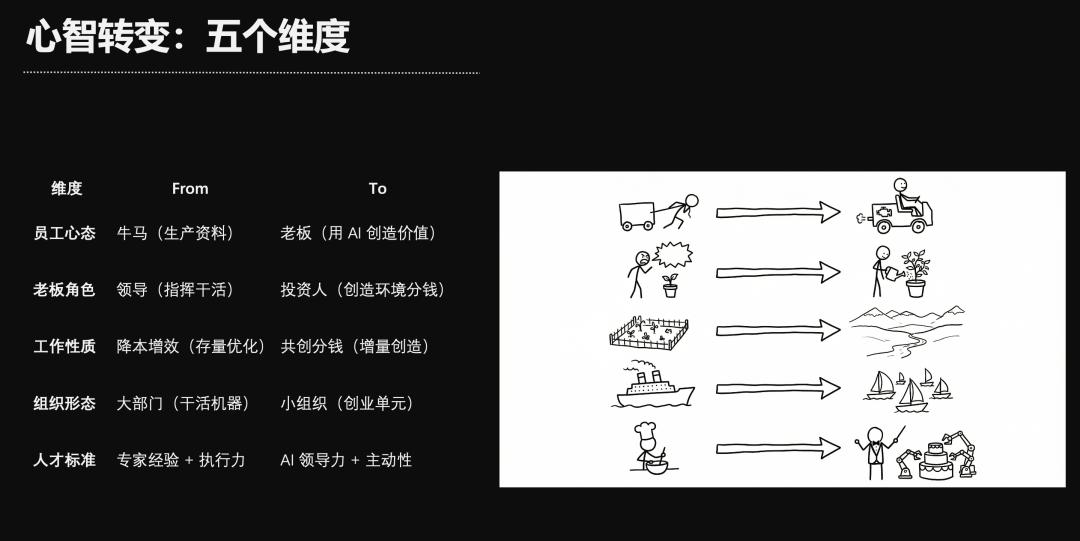
First, let's look at the bottleneck of the organization's mindset. To solve it, we can only let everyone change their positions, and everyone needs to re - sort out their concepts. Both employees and bosses need to do this.
Many employees have been trained to see themselves as workhorses or cogs since childhood. In essence, they see themselves as a kind of production material. When you see yourself as a resource, it's like being a "natural organic cherry tomato" in the vegetable market. Now, there are all kinds of greenhouse tomatoes on the market, which are cheap, so your price naturally won't go up. And now, there are also artificial tomatoes. You can buy a ton for one dollar, and the taste is even better. Isn't your "natural organic cherry tomato" even harder to sell at a good price?
So, when you see yourself as an organic cherry tomato, AI is your competitor. Whether you're replaced or not, you can't ask for a high price.
Therefore, all employees must change their thinking and see themselves as bosses, at least the bosses of themselves. At present, your best strategy should be to use AI to cultivate your own "direct - line" troops. Whether the boss promotes me or not, I'll call myself a director. I'll use AI well to create value.
Don't see AI as your competitor. Just think that AI is ten additional headcounts for me, helping me recruit ten programmers, ten data analysts, ten writers, ten painters... and giving me a lot of budgets. What can I do with them? Exchange them with the company for more bonuses, opportunities, promotions, and salary increases. If I lead a team of 100 people and create huge profits, and the boss doesn't promote me or give me a salary increase, I can leave with these 100 people.
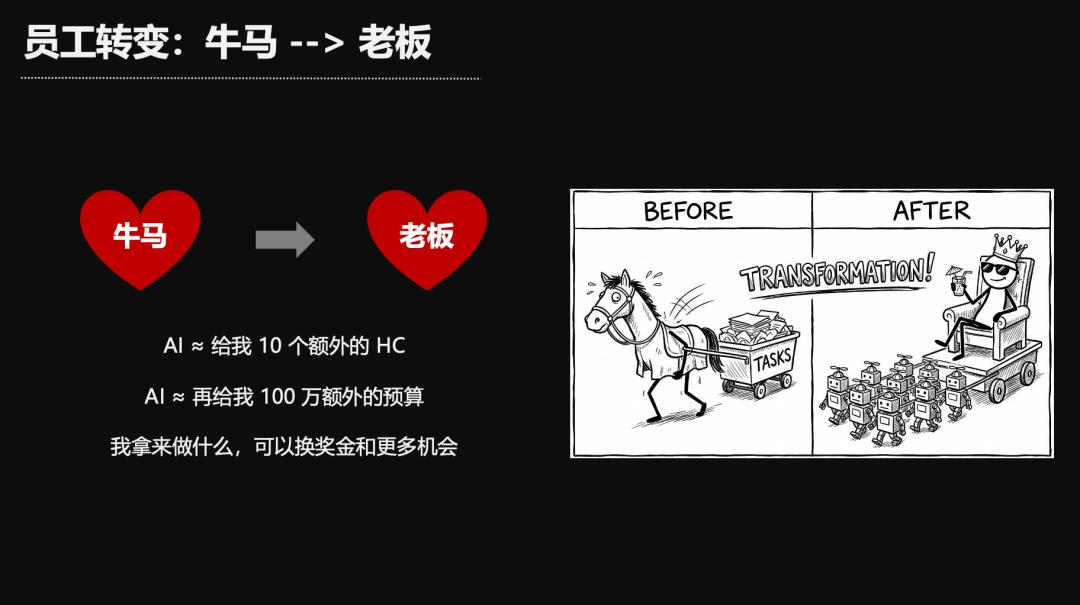
Employees' thinking needs to change, and bosses' thinking also needs to change. For bosses, they should think from the perspective of investors. If you want to do a good job in organizational transformation, you must convey clear enough information to the company.
In this changing era, I suggest that everyone do more pioneering things and less conservative things. This era is too volatile. Don't focus on cost reduction and efficiency improvement in your original work.
Moreover, cost reduction and efficiency improvement are not as easy as people think. AI talents are very expensive. If you set up an AI team to save the money of a group of cheap workers, you'll most likely end up losing money. Unless you can open up a new market through AI or bring value - added in the capital market, this thing is not worth doing at all.
Here, we need to correct a common misunderstanding: the cost of doing new things is actually lower than that of doing old things. Many people think that doing old things is cheaper - I'm familiar with it, I have a foundation, and everything is ready. However, the opposite is true. Why is that?
Because old businesses often have a heavy historical burden. You need to connect with the old system, which may take three months and face a lot of internal resistance. But with the help of AI, you can build a brand - new system in three days.
When the professional ability of AI has surpassed that of a senior expert with 14 years of experience, the rules of the game in the workplace and enterprises have completely changed. Why are hard - working "old oxen" becoming more and more dangerous? Why can't bloated large departments promote innovation?
3. The three - step method for AI implementation
Specifically, how can we make full use of the advantages of AI? I divide it into a three - step method.
Step one: Break down tasks and use AI for efficiency improvement. If someone can't handle a task, break it down into small tasks that they can handle. If he is the child of the leader and can't organize a course, asking him to move a chair, he should be able to do it.
Step two: Reshape the process with AI according to the goal. If you think he can't handle the whole thing, is it because of a lack of professional skills? Then, according to this goal, ask him what he thinks should be done, and then cooperate with him. Redesign the whole process around him.
Step three: Give full play to AI's super - ability and subvert traditional strategies. Directly abandon this goal. If he is the child of the leader, we should give full play to his strengths instead of focusing on his weaknesses. Think subversively to create competitive advantages. The key is to make full use of AI - what would the effect be if each job was equipped with 1000 times the manpower?
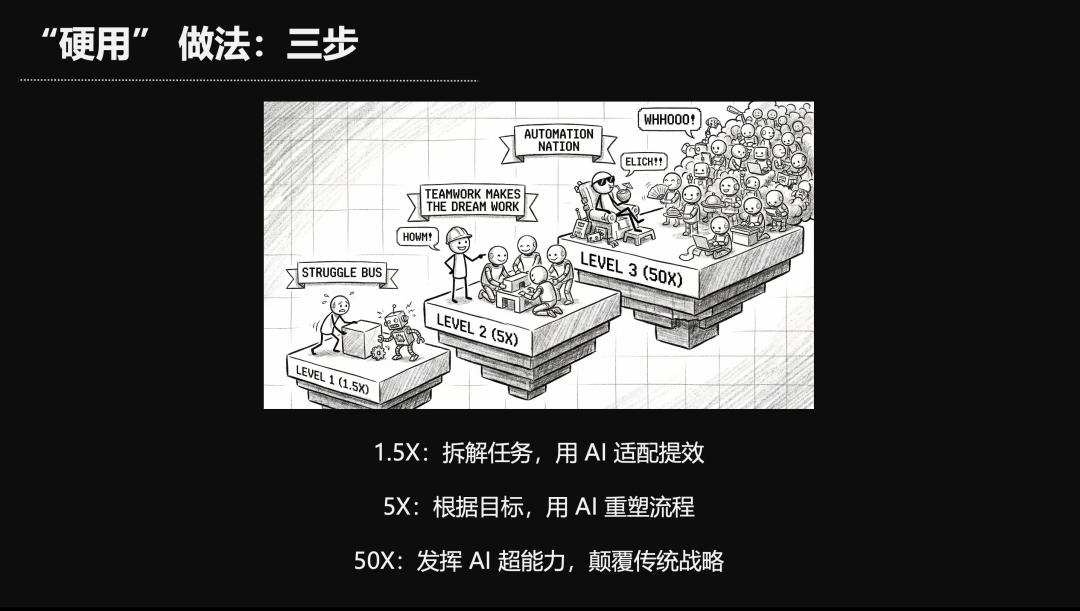
You can take all three paths simultaneously. The opportunities increase layer by layer, and actually, the later the step, the greater the opportunity.
In an era of abundant intelligence, how to discover AI business opportunities?
Next, let's talk about the opportunities at the product and business levels.
Actually, there's a fundamental question that needs to be thought through first: What is the essence of a product? Simply put, it's to solve problems and help