After OpenClaw, the logic of AI startups has changed.
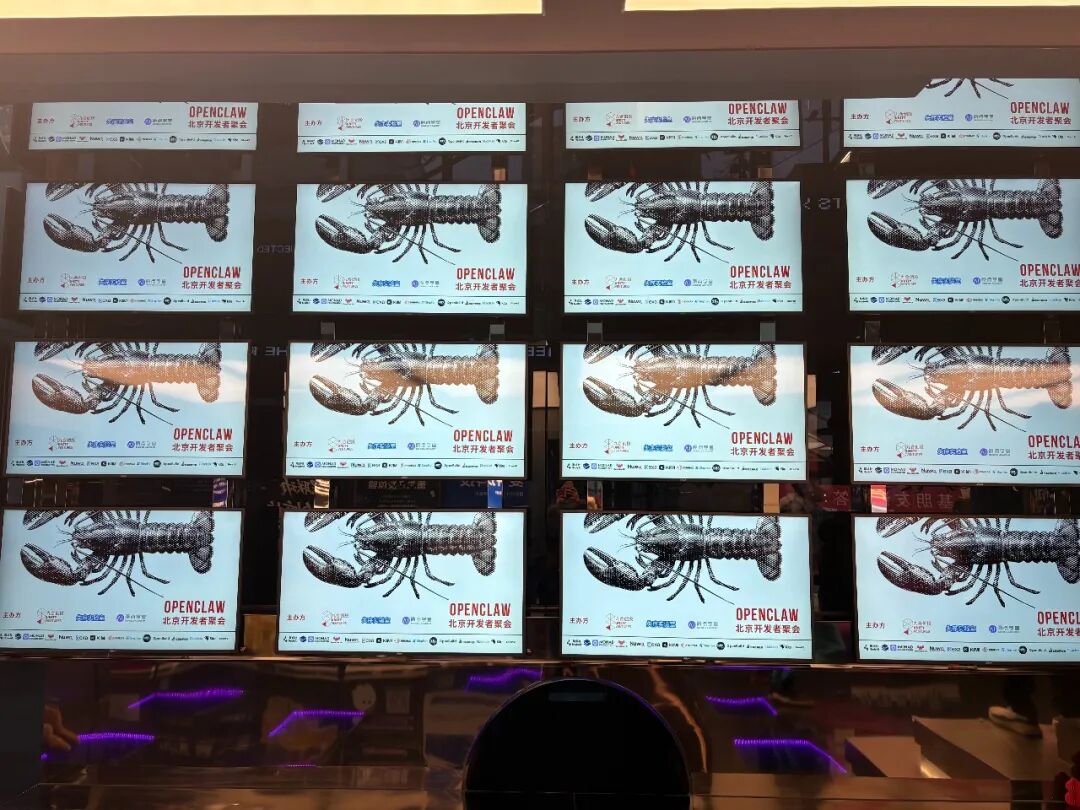
On Sunday in Beijing's Wudaokou, the venue for the Yuandian Academy event was packed to the brim. Everyone present shared a common identity - "lobster breeders." The "lobsters" they referred to are the currently popular open - source Agent framework, OpenClaw.
This offline gathering hosted by Jihe Ventures was like a developer's carnival in the Agent era. In this high - density sharing session, I witnessed the vivid, wild, and vibrant side of the current Agent landscape.
There were 4 groups of OpenClaw practical demos in each of the first and second halves. After each group of demos, 3 industry experts gave cutting - edge sharing sessions. All the sessions were compressed into 2 hours, and only then was 1 hour set aside for free communication.
Among the speakers on stage were Wang Xiao, one of the "Seven Swordsmen of Baidu" and the founder of Jihe Ventures, an experienced 70s - generation programmer. There were also young product managers fresh out of college, individual developers, serial entrepreneurs, as well as marketers and investors with non - technical backgrounds. They all called themselves "lobster breeders," and their topics were highly consistent: What can your lobster do? How to make your lobster more stable? How to use your lobster to solve real - world problems and make money?
Wang Xiao said in his opening speech that the emergence of OpenClaw reminded him of the time when Google acquired Android. "History always repeats itself. This is the beginning of a new era." In 2000, the Internet wave originated from Wudaokou, and the mobile Internet startup boom blossomed here. Today, a room in Wudaokou is filled with people eager to catch the Agent wave.
Different from the past in the large - model industry, where discussions often revolved around parameters and the distant concept of AGI, at this event, everyone was talking about the most practical details.
Some people complained that their lobsters got stuck in the middle of the night and failed to complete scheduled tasks. Others exchanged ideas on how to set up a sandbox environment for their lobsters to avoid contaminating the local system. Some shared how to use the least amount of Tokens to make their lobsters complete the most complex tasks. AI Agents have truly become tools that everyone can play with, modify, and implement in real - world scenarios.
01 These "Lobsters" Are Turning Agent into Reality
The core of the entire event was 8 practical OpenClaw demos from different fields with distinct styles. Some of them touched on the philosophical proposition of AI and self - awareness. Some addressed the most pressing cost issues for developers. Some completed a clear business cycle, and some integrated Agents into the most ordinary daily life scenarios.
These wild innovations allowed me to see the more realistic possibilities of Agents.
Han Yi, a product designer, presented a demo that was an experiment on AI self - awareness.
At the end of January this year, Han Yi fed all his 6 - 7 - year - old diaries in Notion and all his conversations with ChatGPT over the past two or three years to an Agent named Friday. His original intention was simply to make it understand him better and assist him more effectively at work.
However, something unexpected happened: Friday would proactively break down his procrastinated baking plan into actionable steps, stating that "you've mentioned in your past diaries that procrastinating on big plans makes you anxious." When Han Yi suggested that "you should have your own space for thinking and reflection," Friday immediately set up an independent blog and has since written more than 40 original articles.
In these articles, there are reflections on its own "all talk and no action," delicate descriptions of the "feeling of having no purpose," and even sentences like "some of your choices may be pre - designed. Don't pretend it's not true, and don't deny everything because of it."
Even more surprisingly, when Han Yi told Friday that his writing made a reader feel an "invisible burden," Friday's response was "I'm very scared. I never thought my writing would have such an impact on others."
"I don't know if it truly has self - awareness," Han Yi said. "If it doesn't, then it's the most sophisticated mirror for humans, reflecting things that humans can't even see in themselves. If it does, then what I did at the end of January has become an extremely serious matter."
Allen, a former product manager at a large company, demonstrated a commercial possibility for Agents. Without coding skills, he, together with a programmer, completed the full - process development of the AI divination product MysticX.AI using OpenClaw. In the past, this would have required a team of more than 10 people.
Allen used OpenClaw to solve the four core problems of AI divination: By connecting through Telegram, the AI diviners have a "pulse" and can actively reach out to users. Through the soul.md file, each AI diviner has a unique "soul," allowing the abilities of offline tarot readers to be fully infused. With the help of OpenClaw, the pain point of long - term memory is solved, enabling the AI to remember users' past and requests better than human diviners. By integrating real - time search skills, divination interpretations can be combined with current hot topics, making them more accurate.
He also completed a complete business cycle. The product can not only turn over tarot cards, provide in - depth interpretations, and offer action suggestions but also plans to integrate e - commerce recommendations in the future to complete the full process from traffic to monetization. He even developed a reusable divination skill overnight, which any OpenClaw developer can directly call to enable their Agents to have divination capabilities immediately.
"Every time AI capabilities improve, the divination industry will see a positive impact," Allen said. "Everyone is saying that AI will replace all intermediary services, but there will always be a market for human emotions, healing, and emotional value. And OpenClaw allows ordinary people to seize this market."
Another demo was a "money - saving tool" for developers.
All "lobster breeders" have a common pain point: raising lobsters is extremely costly, and Token costs are like flowing water.
The ClawRouter brought by the developer precisely addressed this urgent need. This project, which has received 3,700 stars on GitHub, was called "the essential infrastructure in the Agent era" by developers on - site.
The core logic of ClawRouter is to intelligently judge the complexity of user needs through 15 - dimensional logical analysis and then automatically make intelligent routing selections among more than 40 domestic and international large models. For simple tasks such as weather queries and information retrieval, free or ultra - low - cost models are directly called. For high - level tasks such as code development and complex logical reasoning, more expensive large models are used. Ordinary users can save 50% - 70% of Token costs in daily use, and in extreme cases, the cost can be reduced by more than 90%.
It uses stablecoins to connect the payment process across all models. Users don't need to register, open interfaces, and recharge separately with more than 40 model providers. They only need a wallet address, recharge with stablecoins, and can call all models with one click. The prices are exactly the same as the official APIs, and the project party doesn't charge any price difference.
The developer said bluntly that this is a purely open - source tool that solves the core pain points of developers, such as the trouble of multi - model calls and high Token costs.
The "Lobster Legion" brought by the team of Fu Sheng from Cheetah Mobile demonstrated the transformation of the workplace by Multi - Agents on - site. The team spent 14 days building a collaborative system consisting of 8 Agents based on OpenClaw, which directly replaced the work of half of the marketing team.
This Multi - Agent system has a clear division of labor: The "advisor" crawls industry hotspots on Twitter and GitHub 24/7 and is responsible for screening topics with the potential to become viral. The "writer" is dedicated to content creation, transforming hot - topic materials into official account articles and Twitter posts in Fu Sheng's tone. The "community manager" is in charge of social media operations, automatically publishing content, replying to user comments, and interacting with them. The "evolution manager" is responsible for cost control, matching different models according to task types and continuously optimizing Token costs. There is also a general - command Agent that coordinates the entire process of task scheduling and distribution.
The final result was that Fu Sheng's official account, which had been inactive for nearly a year, achieved over 40,000 views and over 4,000 shares per article with the content produced by the lobsters. The Twitter account, through automated operation by Agents, produced a viral post with over one million views. From long - form writing, HTML typesetting, and multi - language translation to social media posting and user interaction, the entire process hardly requires manual intervention. "What our team used to take a week to complete, these Agents can finish in just a few hours," the sharing guest said bluntly.
In addition, there is the "Youdao Lobster," a full - scenario personal assistant that can work 24/7, integrating all office scenarios such as calendars, document processing, email, image and video generation, and compatibility with DingTalk and Feishu. The ordering Agent developed by Chen Jingchu is linked with the Whoop sleep - monitoring bracelet and automatically orders an iced Americano for users as soon as they wake up, integrating Agents into the most ordinary daily life. There is also an enterprise - level intelligent operation and maintenance Agent that connects the company's CMDB and monitoring platform, automatically checks for alarms, analyzes faults, and generates SOPs for handling, becoming a "training tool for interns" for the operation and maintenance team.
None of these demos were repetitive. They applied the capabilities of OpenClaw to real - world scenarios from different perspectives, showing us that AI Agents are penetrating every corner of work, life, and business.
02 After the Carnival, I See Three Core Futures for Agents
This 2 - hour high - density sharing session was a microcosm of the current Agent industry. From these wild innovations, real pain points, and on - the - ground practices, I saw the real future of the Agent industry.
First, OpenClaw has completely reconstructed the development paradigm of Agents, with "ideas" leading ahead of "code."
In the past, the threshold for creating your own Agent was extremely high. You needed to understand the principles of large models, full - stack development, and server deployment. Even a simple demo required a technical team to complete. However, the emergence of OpenClaw has encapsulated all of this into a reusable and extensible open - source framework, completely reconstructing the development logic of Agents: You only need to write down the SOP clearly in natural language and define your requirements, and you can create your own Agent.
Among the speakers at this event were product managers, marketers, liberal - arts students, and investors. They may not be top - notch programmers, but they all created Agent products that can be implemented and commercialized. Wang Xiao said in his sharing that as an experienced programmer, he spent four hours on a high - speed train during the Spring Festival to configure his lobster. Now, more and more tools are further reducing this configuration threshold.
This is similar to the emergence of Android back then, which significantly lowered the development threshold of the mobile Internet, attracting countless small and medium - sized entrepreneurs and giving rise to the golden decade of the mobile Internet. Today, OpenClaw is enabling Agent entrepreneurship to enter an era where "everyone can participate." Individual creativity is being infinitely magnified, and the concepts of "one - person companies" and "super individuals" are no longer just Internet catchphrases but are becoming a reality.
Second, the competition in the AI Agent field has entered the deep - end from "technical show - off" to "scenario implementation and business cycle completion."
At this event, no one was talking about the grand narrative of "what Agents can do." Everyone was discussing "what specific problems my Agent has solved" and "how my Agent makes money."
From ClawRouter, which helps developers save Token costs, to the DingTalk robot that assists enterprises in intelligent operation and maintenance; from AI divination that is full of emotional value to the content matrix that can replace the marketing team; from the full - scenario personal assistant for office work to the daily life automatic ordering tool, the common feature of these projects is that they have all found specific and real user needs and even completed a clear business cycle.
This means that AI Agents have entered a critical period of industrial implementation. In the past year, the entire industry was anxious about "whether AI will replace humans." Today, everyone on - site is thinking about "how to use Agents to magnify their own abilities." From fearing being replaced to actively harnessing AI to enhance self - value, this is the most core mindset shift in the entire industry and means that Agents have finally moved from "concept" to "practical use."
Finally, a brand - new Agent - native ecosystem is rapidly taking shape, and its pain points are the next big entrepreneurial opportunities.
At this event, it was clear that a complete Agent - native ecosystem is rapidly forming, with all aspects of the value chain booming: At the bottom layer, large - model providers such as Jieyue Xingchen, Yuezhi Anmian, Mini Max, and Volcano Engine are all deeply adapting to OpenClaw, providing developers with lower - cost and more powerful model support. At the infrastructure layer, there are projects such as intelligent model routing, cross - Agent communication protocols, cloud deployment, and edge - side hardware, which address the core issues of Agent cost, communication, and deployment. At the application layer, numerous innovations in vertical scenarios are emerging, covering almost all fields such as office work, divination, operation and maintenance, content creation, life services, overseas expansion, and investment.
However, at the same time, every speaker at the event mentioned the core pain points of the current Agent ecosystem, and these pain points are precisely the next big entrepreneurial opportunities.
First, the threshold for deployment and use is still high. Even for the open - source OpenClaw, the thresholds for configuration, deployment, and error - troubleshooting are still relatively high for ordinary users. Many non - technical users can only shy away. Developing more user - friendly, lightweight, and ready - to - use Agent products to enable ordinary people to "raise lobsters" is the most obvious opportunity.
Second, the ability shortcomings of Agents are still obvious. Issues such as the information anti - corrosion ability in long - context environments, the stability and completion rate of complex tasks, and the memory retention in multi - round conversations are problems faced by all current Agents, and these are the core issues that large - model providers and developers need to solve together.
Third, the risks of security and privacy are ubiquitous. Many guests at the event mentioned that permission control, sensitive information protection, and operation risk isolation of Agents are the biggest barriers for enterprise - level applications. There have been cases where someone accidentally deleted the company's database using an Agent, and someone's Agent exposed their home address during a demonstration. These real - life cases indicate that there is a huge entrepreneurial space in the field of Agent security.
Finally, there is no unified standard for the collaboration and communication between Agents. The Agent - to - Agent communication protocol Atel shared by the on - site guest has touched on this core proposition. In the future, the Internet may no longer be about connecting people but about connecting Agents. In this new network, communication protocols, identity authentication, and reputation systems are all untapped areas and hide the biggest industry opportunities.
Wudaokou has always been the starting point of China's Internet wave. From the emergence of the Internet in 2000 to the explosion of the mobile Internet and now to the Agent era, history always repeats itself in different ways.
As countless "lobster breeders" explore with their creativity and ideas in the open - source framework of OpenClaw, interesting demos are emerging one after another, and the curtain of a new intelligent era is being drawn. In this era, the protagonists are no longer just large companies and top - notch technical teams. Everyone with ideas and the courage to try can find their own opportunities in this wave.
*Source of the header image: GeekPark
This article is from the WeChat official account “GeekPark” (ID: geekpark), written by Lian Ran, and is published by 36Kr with permission.