Selling 1.72 million more vehicles but earning 80 billion less, Chinese cars are making less profit despite increasing sales.
The harm of involution to the Chinese automotive industry can now be quantitatively measured through data from the National Bureau of Statistics.
Professionals in the Chinese automotive industry are experiencing their own version of "A Few Extra Bushels of Grain."
Peasants in the south of the Yangtze River had a bountiful harvest, with a few extra bushels of grain per mu of land. Full of hope, they rowed their boats to Wansheng Rice Shop to sell their grain, only to encounter a sharp drop in rice prices: rough rice was only five yuan per dan, and unhusked rice was three yuan, far lower than last year's price of seven and a half yuan.
"Five yuan for rough rice, three yuan for unhusked rice." The clerk in the rice shop replied listlessly.
"What!" The farmers in old felt hats could hardly believe their ears. Their bright hopes suddenly sank, and everyone was stunned for a moment.
"Didn't you sell it for thirteen yuan in June?"
"It was even sold for fifteen yuan, not to mention thirteen."
"How could the price drop so sharply!"
"Don't you know what time it is now? Rice is pouring in like a tide from everywhere, and the price will drop even more in a few days!"
This is the realistic short story "A Few Extra Bushels of Grain" written by Ye Shengtao and published in the inaugural issue of Literature in July 1933.
Today, the scenario depicted in this novel 93 years ago is playing out in another form in the Chinese automotive market.
"The total production and sales volume has increased, but the total output value has decreased, which is actually quite unexpected." As an industry veteran with decades of experience in the Chinese automotive industry, Xu Daquan, the President of Bosch China, was also confused when faced with the performance report of the Chinese automotive industry in 2025.
The sigh of the head of a leading supplier is often the most sensitive indicator of the industry's trend.
After checking a round of data, Yiche of EqualOcean did not find the data on the total output value of the Chinese automotive industry in 2025 on the official websites of the National Bureau of Statistics, the China Association of Automobile Manufacturers and other departments or associations. However, there is a piece of data that is very similar to what Xu Daquan called the "total output value," which is the total retail sales of Chinese automobiles in 2025 announced by the National Bureau of Statistics, showing a year-on-year decline of 1.5%, more than 7.91 billion yuan.
It should be noted that in 2025, the domestic new car sales in China increased by 6.7%, reaching 27.302 million vehicles.
Calculated in this way, it means that in 2025, the Chinese automotive market sold 1.725 million more new cars, but received 7.91 billion yuan less, almost 8 billion yuan.
Professionals in the Chinese automotive industry have encountered their own version of "A Few Extra Bushels of Grain," and it's the second consecutive year.
The divergence between sales volume and sales revenue is not common in the Chinese automotive industry. Yiche of EqualOcean sorted out the data on the domestic automotive sales volume and sales revenue in China from 2015 to 2025 and found that these two data were mostly proportional, rising and falling together.
It was only from 2021 to 2022, and from 2025 to 2026 that the divergence between sales volume and sales revenue occurred.
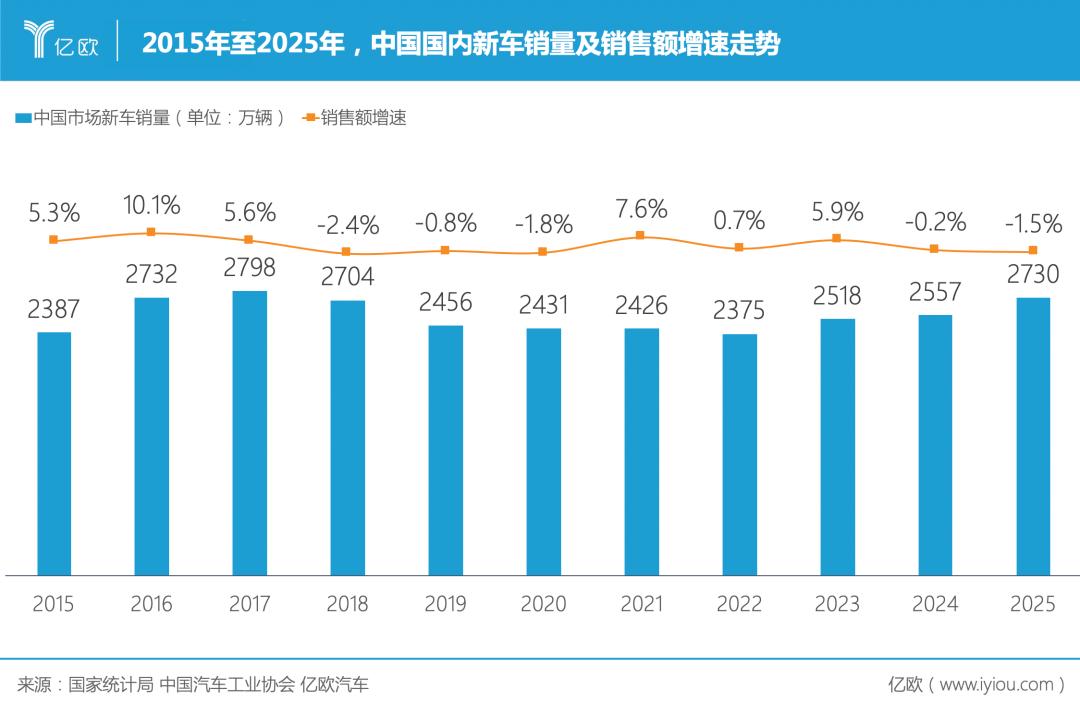
However, these two time periods are not the same. From 2021 to 2022, the sales volume declined, but the sales revenue increased. The reason is not hard to understand. At that time, the global automotive industry chain was interrupted by force majeure factors, and new cars were in short supply, so the sales revenue increased instead.
The most typical case is that the sales volume of the world's three major luxury car brands, Mercedes - Benz, BMW, and Audi, declined, but their sales revenue and net profit soared.
But in 2024 and 2025, the situation reversed. The sales volume increased by 1.6% and 6.7% year - on - year respectively, but the sales revenue declined, and it declined more and more each year, from - 0.5% to - 1.5%, from a decrease of 3.2 billion yuan to an evaporation of nearly 8 billion yuan.
It should also be considered that in 2025, the regulatory authorities repeatedly emphasized the need to combat involution in the Chinese automotive industry, but there was still a loss of nearly 8 billion yuan in sales revenue.
What does 8 billion yuan mean?
For comparison, NIO's total revenue in the first three quarters of 2025 was only 8.12 billion yuan, and XPeng Motors' total revenue in 2024 was 4.08 billion yuan.
This means that the involution in the Chinese automotive industry in 2025 made NIO's efforts in the first three quarters in vain, or it was equivalent to wiping out two XPeng Motors in 2024.
Combatting involution still has a long way to go.
Three Years of Hard Work, but the Average Price Is Lower Than Three Years Ago
Since 2020, against the backdrop of the once - in - a - century transformation in the automotive industry and various high - intensity force majeure factors, professionals in the Chinese automotive industry have shown their strength when faced with challenges, enabling the industry to recover and grow rapidly.
In terms of scale, after years of efforts, the sales volume of Chinese automobiles in 2025 has increased to 27.302 million vehicles, which is very close to the historical peak of 27.988 million vehicles in the domestic market in 2017.
In terms of quality, professionals in the Chinese automotive industry have achieved a breakthrough through electrification and intelligence, and have occupied 70% of the Chinese automotive market. While becoming the dominant force in the Chinese automotive market, Chinese automobiles have also achieved brand upgrading, driving up the overall average price of new cars in the Chinese market.
Data from the China Passenger Car Association shows that from 2019 to 2024, the average price of new cars in China has increased for five consecutive years, rising from 151,000 yuan per vehicle to 184,000 yuan per vehicle.
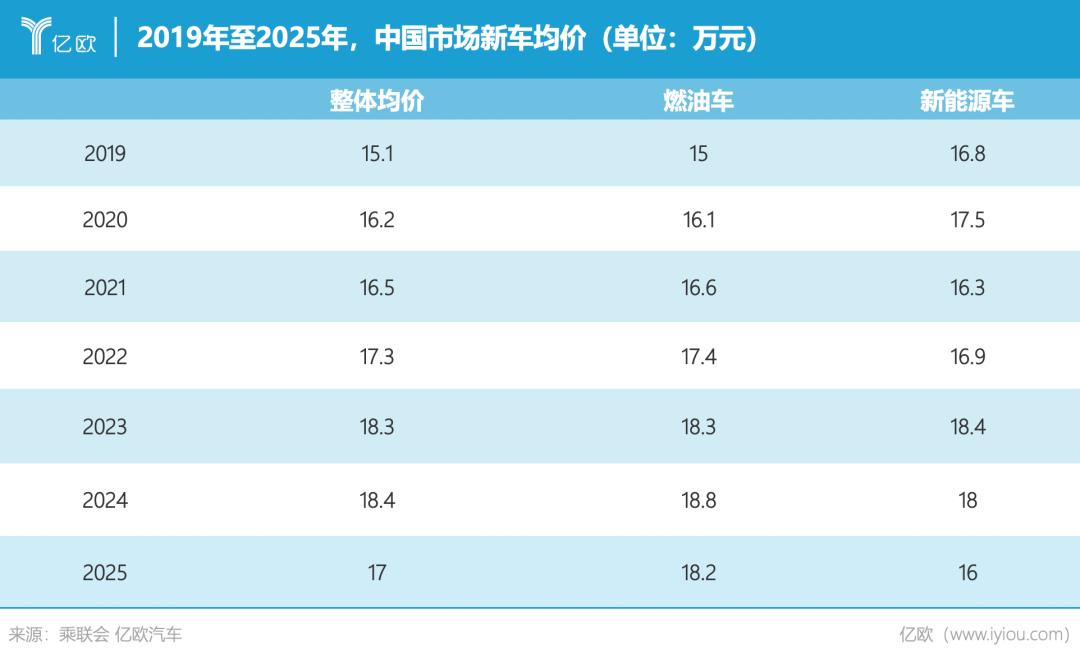
But in 2025, the situation suddenly changed. The overall average transaction price of new cars in China dropped to 170,000 yuan at once, a 7.5% decline from 2024. It is already lower than the 173,000 yuan in 2022 and slightly higher than the 165,000 yuan in 2021.
Why, when the industry is booming and the sales volume is continuously increasing, did the average price of new cars suddenly return to three years ago and cause a reduction of nearly 8 billion yuan in the total retail sales?
Cui Dongshu, the Secretary - General of the China Passenger Car Association, believes that the change in the consumption structure of new cars has affected the average price. On the one hand, the high - end fuel - powered vehicle market shrank rapidly in 2025. At the same time, the average price of new energy vehicles gradually decreased, which led to the decline in the average price of new cars.
In addition, Cui Dongshu believes that in the second half of 2024, due to the promotion of policies such as vehicle scrapping and replacement subsidies, the sales volume of mid - and low - end vehicles increased significantly. Therefore, the average price of new cars in 2025 decreased.
But ultimately, it all boils down to one word - involution.
From the two reasons summarized by Cui Dongshu, it can be clearly seen that the shrinkage of the high - end fuel - powered vehicle market and the decline in the average price of new energy vehicles are both the result of price wars, that is, the impact of involution.
Moreover, in addition to the average price of new cars, another important indicator of the Chinese automotive industry, the profit margin, dropped to 4.1% in 2025, hitting a new low in the past five years. Compared with the average profit margin of 5.9% of downstream industrial enterprises, the automotive industry's profit margin is also relatively low.
So, involution, please take the blame.
But the question also arises. In 2025, the regulatory authorities repeatedly emphasized the need to combat involution. Why was involution not curbed?
Some suppliers told Yiche of EqualOcean that although the regulators have repeatedly emphasized the need to combat involution, some leading automobile manufacturers have become even worse.
However, overall, the work of combating involution in 2025 has achieved remarkable results. Taking the much - concerned issue of the payment cycle of automotive suppliers as an example, there has been a significant improvement.
After conducting a research and analysis on the situation of 17 automobile manufacturers, the China Association of Automobile Manufacturers said in February that the vast majority of key automobile manufacturers have compressed the payment cycle to within 60 days, with an average payment cycle of about 54 days, about 10 days shorter than the same period last year. In terms of payment methods, 15 enterprises use cash or bank acceptance drafts, and individual enterprises use commercial acceptance drafts.
However, the China Association of Automobile Manufacturers also pointed out that there are still some problems in the payment of suppliers' payments by some automobile manufacturers. For example, there are different ways to calculate the starting point of the payment cycle, such as goods delivery and acceptance, centralized reconciliation, invoice receipt, and vehicle loading verification. Although the nominal payment cycle is 60 days, the time difference for suppliers to receive payment from the time of delivery is relatively large, and there are situations where the payment cycle is extended in disguise, and so on.
So, will the average price of the Chinese automotive market rebound in 2026?
Game in 2026
There are already obvious signs of recovery.
According to the latest data released by the China Passenger Car Association, the average price of passenger cars in January 2026 has reached 186,000 yuan, far higher than the average price of 170,000 yuan in 2025, and even exceeding the historical high of 184,000 yuan in 2024.
Looking at the breakdown, the purchasing group of high - end fuel - powered vehicles has gradually stabilized, driving up the average price of fuel - powered vehicles. The average price in January was 181,000 yuan; the average price of new energy vehicles increased even faster, reaching 195,000 yuan in January.
The average price trend in January has set a good start for the whole year, and the forecast of the annual sales volume may also support the average price trend this year.
In 2026, both the China Association of Automobile Manufacturers and the China Passenger Car Association predict that the sales volume of new cars will continue to grow. Based on the experience of the past decade, it is highly likely that the sales volume and sales revenue are proportional, and there has never been a situation where the sales volume and sales revenue were inverted for three consecutive years. Therefore, the increase in sales volume will undoubtedly support the average price of new cars.
On the other hand, the new car prices in 2026 may also receive some "support" from the supply chain level.
Since 2025, with the explosion of the artificial intelligence industry, overseas AI giants have started to purchase a large number of memory chips, resulting in a rapid increase in the prices of related products and greatly squeezing the demand of vehicle manufacturers.
Data from UBS shows that in the past three months, the overall price of automotive DRAM memory chips has increased by 180%. Monitoring data from TrendForce shows that since the second half of 2025, the price of DDR4 memory in automotive DRAM has increased by more than 150% in total, and the price of DDR5 memory has skyrocketed by 300%.
At the same time, because vehicle manufacturers account for less than 5% of the global memory chip procurement share, vehicle manufacturers lack the confidence in the competition with AI giants for memory chips. Li Bin, the founder, chairman, and CEO of NIO, recently said that NIO is under pressure in the competition of rising memory prices. "We are competing for resources with AI and computing power centers. They are investing hundreds of billions of dollars, and we can't compete." So, at the beginning of 2026, Li Bin advised consumers to buy cars earlier, while the impact of rising memory prices on the automotive industry has not fully manifested. Consumers who want to buy cars had better do it as soon as possible.
Lu Weibing, the President of Xiaomi, was more direct. In order to cope with the rising price pressure, Xiaomi has signed a memory supply agreement for 2026.
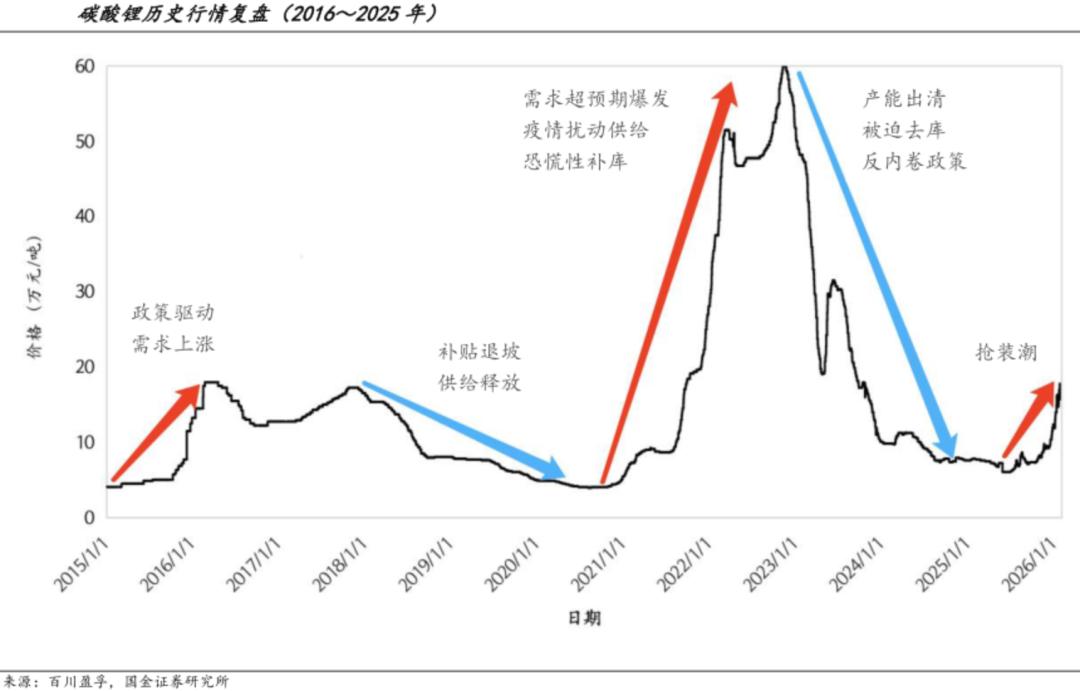
As another major cost element of new energy vehicles, power batteries also face huge price - rising pressure. From July 2025 to January this year, the price of lithium carbonate soared from 70,000 yuan per ton to 180,000 yuan. Although it has declined somewhat after the Spring Festival, as of the close on February 27, the price of the main contract of lithium carbonate futures was still as high as 168,000 yuan per ton.
But on the other hand, major automobile manufacturers are still engaging in disguised price competition despite the cost pressure.
On February 26, Tesla announced that before March 31, three of its main models can enjoy a five - year zero - interest loan plan. At the same time, many automobile manufacturers, including BYD, have also launched their own interest - free or low - interest loan plans.
Combatting involution still has a long way to go. The data on the total sales revenue and profit margin in 2025 have given a serious warning: if one blindly pursues the illusion of scale while ignoring the most basic business logic and value laws, then the closer this growth gets to the peak, the farther it may be from true healthy development.
After experiencing this "A Few Extra Bushels of Grain" situation, the Chinese automotive industry may need to seriously consider how to recover the lost output value in future competition and let growth return to the origin of value.
This article is from the WeChat official account "Yiche of EqualOcean". Author: Guo Huaiyi, Editor: Hao Qiuhui. Republished by 36Kr with permission.