In Southeast Asia, where Japanese cars are everywhere, Chinese cars have carved out a niche.
You may not have expected that Japanese cars are on the verge of losing their stronghold.
For Japanese brands, although the North American market has the largest share, accounting for about 30% of the total global sales, the real home ground, apart from Japan itself, is Southeast Asia.
Here, the market share of Japanese brands has long been over 80%, which is a solid base.
I've experienced it firsthand. Two years ago, when we went on a team - building trip to Thailand, we found that Japanese cars were everywhere. There were even various modified cars from different eras. It's a more pure JDM holy land than Japan itself.
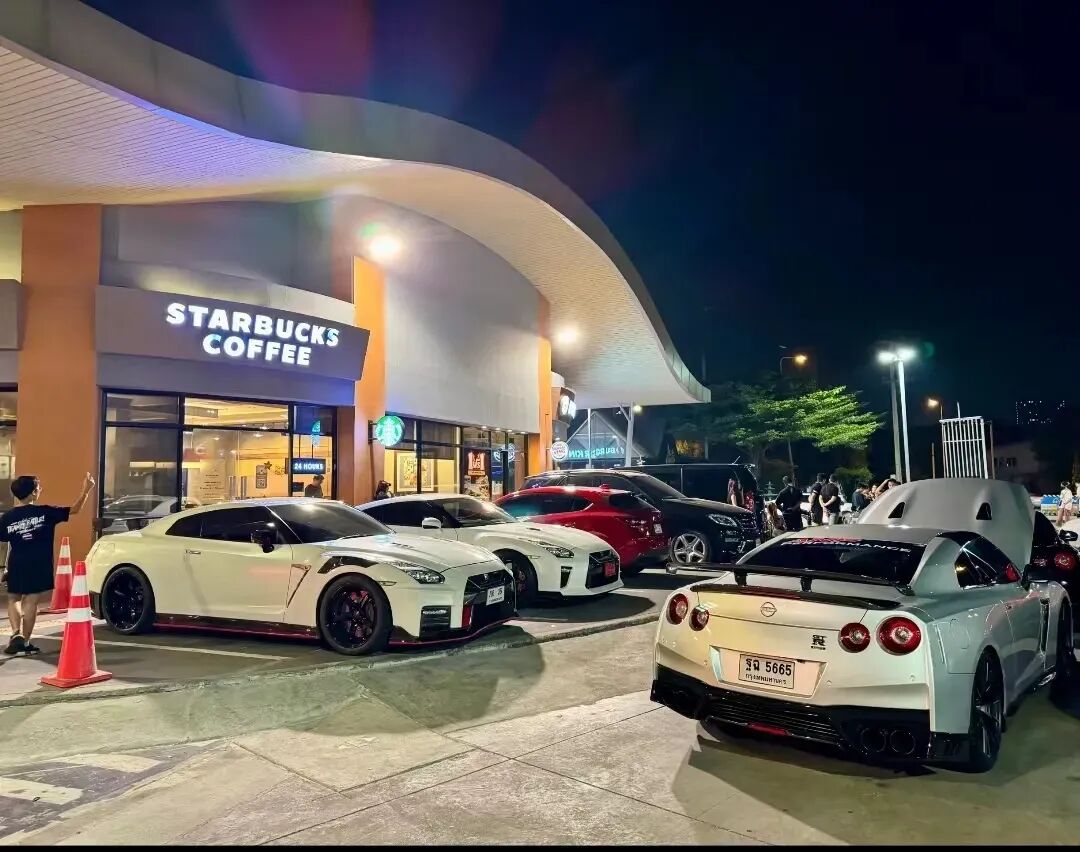
However, even at that time, the dominance of Japanese cars had already started to waver.
When you walk around the streets of Thailand, you'll notice many "discordant" voices, that is, the billboards of Chinese cars that are everywhere on the roadside. Judging from the density of these billboards, you can see how much effort Chinese car brands have put into the Thai market.
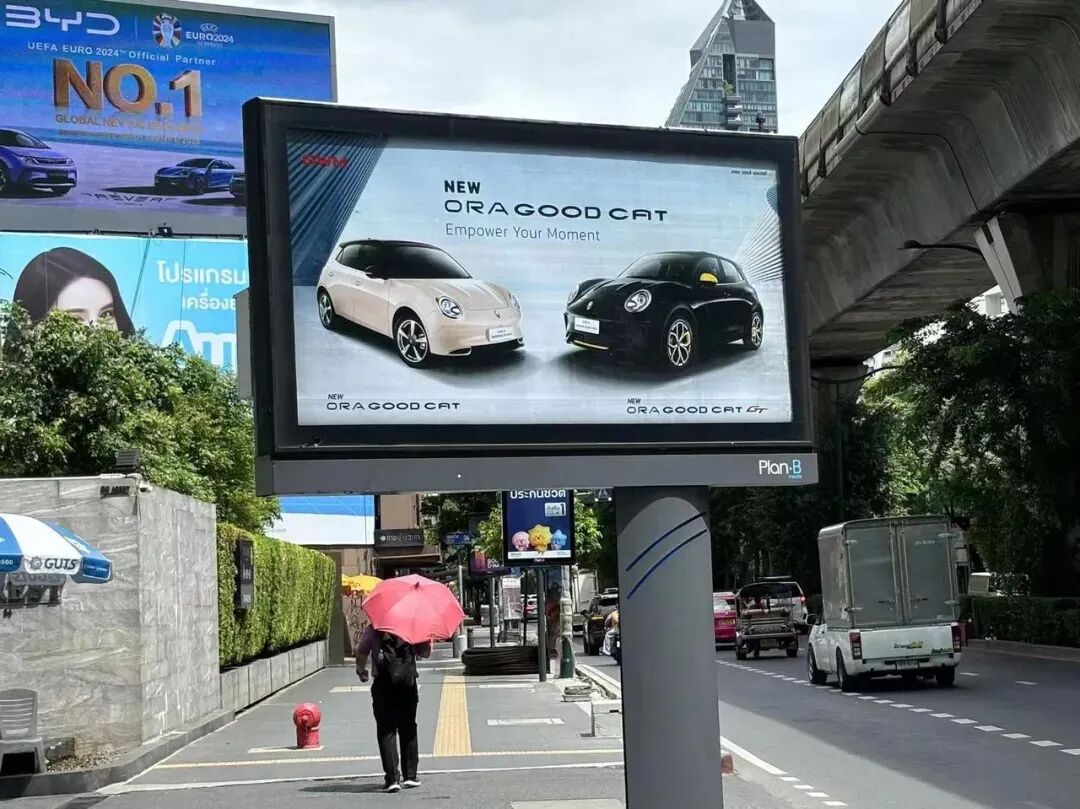
It's true that you won't see batches of Chinese cars on the road. At most, you'll come across a Yuan PLUS around a street corner. But this trend of substitution is like a spark that is getting stronger and stronger.
According to Nikkei News, in the six ASEAN countries of Indonesia, Malaysia, Thailand, Vietnam, the Philippines, and Singapore, Japanese cars are losing ground on a large scale. In 2025, the sales volume decreased by 22% compared with that in 2019.
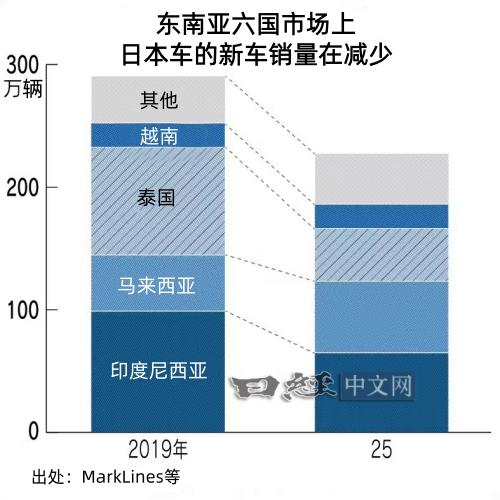
What does this mean? From 2019 to 2025, the total sales volume of the six major Japanese car companies (Toyota, Honda, Nissan, Subaru, Mazda, Mitsubishi) in the United States remained at around 6 million, hardly changing.
It's only in China and Southeast Asia that Japanese cars are in retreat. In the Chinese market, the sales volume of the three giants, Toyota, Honda, and Nissan, dropped from 4.72 million in 2019 to 3.08 million last year, a decrease of one - third. Southeast Asia is just following in our footsteps.
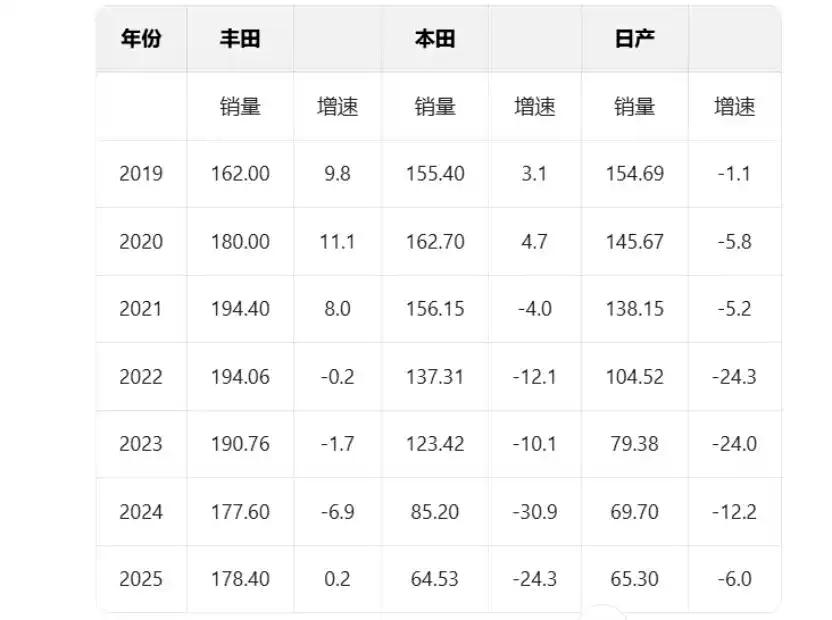
Just looking at the data from last year, 2025, the market share of Japanese cars in Thailand and Indonesia decreased by 8 - 9 percentage points year - on - year, 6 percentage points in Vietnam and Singapore, and 3 - 4 percentage points in Malaysia and the Philippines.
Especially in Thailand and Indonesia, which are die - hard fans of Japanese cars, the decline is the most significant. In 2019, the proportion of Japanese cars in Thailand was close to 90%, but now it's only 68%. Although Indonesia still maintains a share of 81%, a gap has been firmly opened.
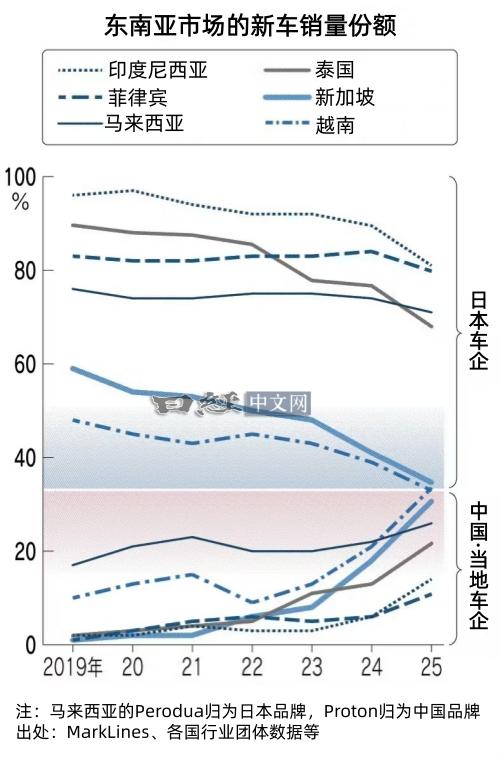
Why is this happening? To put it simply, the rise of new energy vehicles in China is about to be replicated in Southeast Asia.
Since 2019, the share of Chinese brands in the six Southeast Asian countries has increased from less than 1% initially to about 12% now. For example, it has reached 22% in Thailand and 14% in Indonesia, taking up most of the market share that Japanese brands have lost.
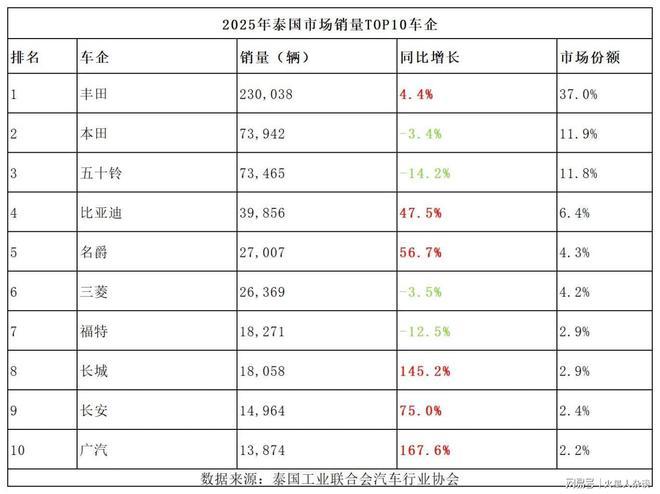
Last year, among the top ten car - selling companies in the Thai market, there were BYD, MG, Great Wall, Changan, and GAC. Their growth rates were all in double - digits or even triple - digits. Most of them rely on electric cars, including Dolphin, Atto 3, AION Y Plus, MG4 Electric, etc.
If this trend continues, maybe in two or three years, domestic Chinese cars will be on par with Japanese cars.
The key is that this time it's not just Chinese brands fighting alone. Another part of the market that Japanese cars have lost has been taken by local Southeast Asian brands. Chinese cars and local brands in Southeast Asian countries together form the "anti - Japanese alliance" in Southeast Asia.
For example, VinFast, the national car brand in Vietnam, has developed a very large product portfolio over the years. It ranges from the MINIO GREEN, an electric vehicle with a 170 - km range, to the 7 - seat SUV VF9 with a 626 - km range. In 2025, VinFast's sales in Vietnam had already exceeded Toyota's, accounting for one - third of the total car sales in Vietnam.

Moreover, we shouldn't ignore the automotive industry in Malaysia. Currently, it has two major local brands, Perodua and Proton. Their sales actually account for 60% of the total in Malaysia.
If you look closely, there are many Chinese influences in these local car brands. For example, the three - electric systems of VinFast basically come from China. As for Proton, it has long been acquired by Geely, and many of its cars are just right - hand - drive rebadged versions of Geely cars.
But at this point, you must be wondering. Japanese car companies have been operating in Southeast Asia for 70 years and have established a solid barrier. Why can it be easily broken by us?
I think it's not only because the strength of our automotive products has improved, but also because Southeast Asian countries are actively giving up Japanese cars. In the past few decades, the monopoly of Japanese cars in Southeast Asia was the result of the joint efforts of Japanese car companies and Southeast Asian countries.
Around 1960, in order to protect their domestic industries, Southeast Asian countries imposed high tariffs on imported complete vehicles. Whether it was Japanese or European and American brands, they couldn't make much money. However, compared with the arrogance of European and American brands, Japanese car companies always regarded Southeast Asia as their future territory. Since 1962, they gradually established factories in Southeast Asia to assemble parts, that is, the CKD model.

Later, Southeast Asian countries introduced more radical policies, requiring car companies to produce about half of the parts locally. Only Japanese car companies responded and continued to invest in Southeast Asia.
Part of the reason is that the appreciation of the Japanese yen after the Plaza Accord in 1985 made Japanese car companies realize that building factories locally was actually cheaper than transporting complete vehicles. So they convinced some of their industrial chains to move to Southeast Asia, such as Denso, Aisin, and Toyota Boshoku.
In short, after localization, other brands were gradually squeezed out of the market, and Japanese cars became more and more closely tied to Southeast Asia. They made local improvements in products, channels, finance, etc., so that no other brand could break in.
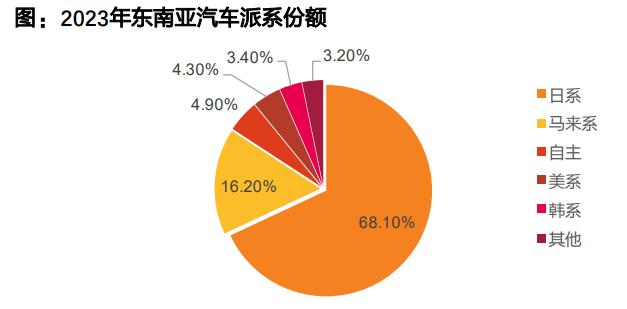
This monopoly was actually a good thing for Southeast Asia at that time because it could receive the transferred automotive industry from Japan and promote economic prosperity.
But now, when Southeast Asian countries find that Japanese brands are losing ground and that following Japan means only doing assembly work and accepting backward technologies, they are ready to explore a second path.
So you can see that Southeast Asian countries are actively supporting new energy vehicles. But it's almost impossible for them to develop from scratch. After looking around, only China might be able to help them.
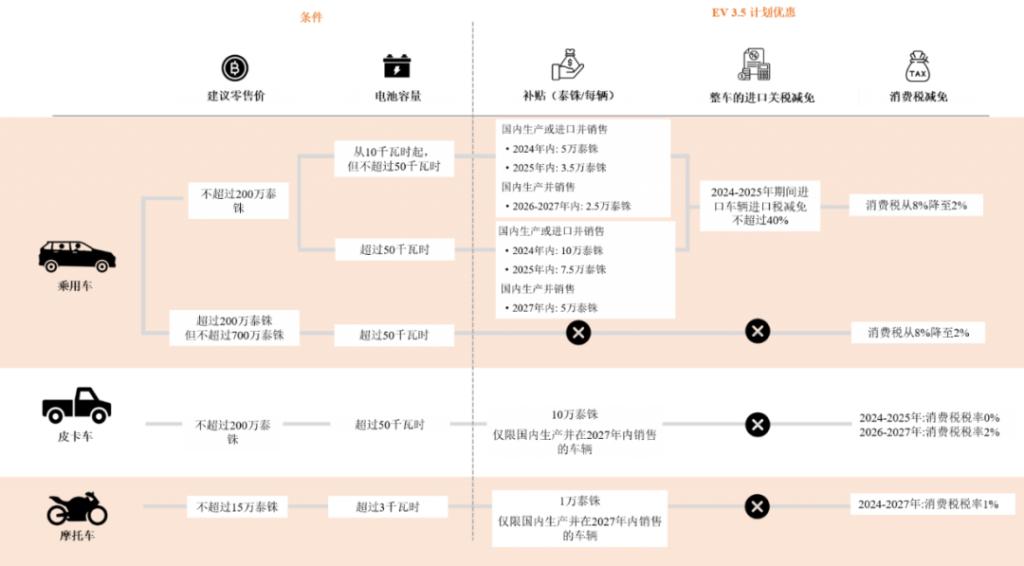
For example, Thailand recently introduced an EV 3.5 plan, which is almost like waving a handkerchief to invite Chinese car companies to build factories there. If you can build a factory according to Thailand's requirements, you can get a maximum of 40% tariff reduction and 6% consumption tax reduction.
There is also a cash subsidy from the Thai government. For example, in 2024, if the battery capacity of your car is more than 50 kWh, you can get 100,000 Thai baht (about 20,000 RMB). If it doesn't meet the standard, don't worry, you can still get half (the subsidy decreases year by year).
There are also the national car plan in Indonesia and the road tax incentives in Malaysia. I won't go into details here.
In short, except for Nezha, which took advantage of the government subsidy without much effort, Southeast Asian governments are very welcoming to Chinese car companies. Thanks to the positive attitude of these countries, Chinese electric cars have carved out a market from the monopoly of Japanese cars.
Of course, this is not just the one - sided wish of Southeast Asian countries. It also coincides with our export transformation plan.
You should know that last year, despite the encirclement and suppression of European and American countries, our trade surplus still reached a "record high in human history" of 1 trillion US dollars. A large part of this contribution comes from Southeast Asia.
To achieve this, on the one hand, our manufacturing capacity has improved. Now China no longer focuses its exports on labor - intensive industries such as food, household appliances, and clothing, but on high - tech products such as cars, lithium - ion batteries, and photovoltaics.
On the other hand, China brings industries, employment, and even cooperation in cutting - edge technologies to other regions through factory - building. This export model is welcomed by various countries.
This is a bit like Japan's flying geese model back then, except that this time China is leading the way.
Source of pictures and materials:
Nikkei Chinese Net | Chinese Cars are Shaking Japanese Car Companies' "Cash Cow" in Southeast Asia
Thailand Implements the Second - Phase Electric Vehicle Subsidy (EV 3.5 Policy)
This article is from the WeChat official account "Chaping X.PIN", author: TC, editor: Neck Right - Twist & Mianxian. Republished by 36Kr with permission.