The next leading sports brand? This trail running brand is rewriting the rules of the outdoor market.
At the end of last year, a full-page advertisement in the Wall Street Journal triggered an earthquake in the sports industry.
Chip Wilson, the founder of Lululemon, expressed his disappointment with the current situation, stating bluntly that the industry is being taken over by "businessmen and algorithms," with creativity being squeezed and products becoming more homogeneous.
This statement reflects a dilemma in the sports apparel industry: When a brand reaches a scale of billions, can it still maintain its extreme pursuit of every single yarn?
As if in response, Aaron Jackson, an industry expert who once built Lululemon's core fabric system, came from Vancouver to Shanghai at this time and joined an outdoor startup team, seemingly rediscovering the original intention forgotten by the industry.

Originating from Lululemon
A Fabric Scientist's New Endeavor
In 2013, a pair of black yoga pants changed the fate of Lululemon.
Due to the problem of light transmission after the fabric was stretched, the company was forced to initiate a large-scale recall. The stock price fluctuated, and high-level turmoil followed. For a brand that regards "functional fabrics" as its core asset, this was not an ordinary quality accident, but a comprehensive trial of the R & D system and supply chain capabilities.
A few months before, Lululemon had just recruited fabric engineering expert Aaron Jackson from the UK to serve as the director of raw material R & D at its Canadian headquarters. After the crisis broke out, he almost rebuilt the underlying product logic of this listed company from scratch - the supply chain was reorganized, and the R & D system was completely disassembled.
Every link, from fiber selection, weaving structure to post - finishing processes, was recalibrated; global partner factories were re - screened, evaluated, and trained. Suppliers were no longer just production ends but were incorporated into the R & D cooperation system. This project, seemingly a "repair of the accident," ultimately evolved into a long - term technological upgrade.
In the following nearly ten years, Lululemon entered a rare product explosion period. The Nulu bare - feeling fabric was born, and Luxtreme and Warpstreme continued to iterate. "Technological fabrics" transformed from internal R & D language into a consumer mental barrier and also became an important fulcrum for the continuous upward movement of the brand's valuation.
The experiences that consumers describe as "not knowing exactly what's good, but just feeling comfortable" essentially come from Aaron Jackson and the material R & D system he established.
After entering the 2020s, as Lululemon continued to expand into commuting and lifestyle scenarios, the product development logic gradually tilted towards efficiency and scale. Founder Chip Wilson once said bluntly, "Excellent creative talents are flowing to competitors."
Aaron Jackson was also one of the "departing members."
In 2021, Alexis Hou, a former Lululemon China retail executive, founded Outopia in Shanghai, and Aaron joined as a co - founder and served as the chief product officer. The combination of the two is highly complementary - Aaron is responsible for material and product R & D, while Alexis has also worked for a long time in multiple brands under the LVMH Group and the Lebanese high - end custom brand Elie Saab in the Asia - Pacific region, and is good at commodity systems, brand storytelling, and offline retail and experience management.
One comes from the laboratory, and the other from the luxury retail system. However, their sights are set on the Chinese trail - running market, which was still in its infancy at that time.
The core team of Outopia gradually took shape later: the former head of Lululemon China's brand community and professional trail - runners who have stood on the podium multiple times joined. This team, which has both international brand experience and real sports backgrounds, gives the brand a composite DNA different from the previous generation of Chinese sports brands at its inception - technology, community, and sports culture are written into the starting point at the same time.
It was also during this period that Outopia gradually established a product logic completely different from the industry mainstream. The team always emphasizes that technology must solve problems for real trail - runners, rather than getting caught in a self - cycle of technology for the sake of innovation.
Since then, the starting point of almost every Outopia product has come from the specific needs put forward by runners or the difficulties encountered by team members during real mountain - running; and the solution path returns to the "first - principles" at the material and structural levels. When the industry increasingly relies on algorithm prediction and scale efficiency, this team that emerged from the Lululemon system and the trail - running scene tries to answer an seemingly old question - where should functional apparel start?
But at that time, this was not a decision that was generally favored.
Alexis recalled that many industry insiders believed that the trail - running market was limited in scale, and with the team's resume, they could enter the urban sports or lifestyle track with more definite returns. However, the team saw a different picture: Chinese trail - running was moving from the "wild growth" stage 1.0 to the rapidly maturing stage 2.0 - the number of races increased sharply, the structure of runners became more diverse, and the demand upgraded from "being able to complete the race" to comprehensive requirements for technological performance, wearing experience, and aesthetic expression.
Meanwhile, even in the global outdoor industry, there are few brands truly built around trail - runners. Traditional outdoor brands have a slow pace, and emerging brands often stay at a single dimension of function or style, making it difficult to meet the simultaneous needs of the new generation of trail - runners for performance, culture, and identity recognition.
"Trail - running should be a multi - billion - dollar track. It seems small now just because the wave hasn't really arrived," Alexis said. "But all the pre - conditions are already in place."
Amidst the dissuasion, Outopia chose to enter the wave in advance.
The Outopia team has always emphasized that technology should solve problems for real trail - runners, rather than indulging in self - satisfaction of technology for the sake of innovation. From then on, the birth of every new Outopia product comes from the needs put forward by some trail - runners or the difficulties encountered by the team during mountain - running, and the solution method completely follows the "first - principles." So, when algorithms and scale become the main theme of the industry, a core team emerging from Lululemon and trail - runners tries to answer an old question: where should functional apparel start?

Using Fabric R & D as a Barrier:
Outopia's Product Philosophy
Aaron Jackson is almost a typical "technology obsessive." He was born into a textile family in New Zealand, and four generations of his family have been engaged in the textile industry. When he was seven or eight years old, his uncle asked him to crawl into the textile machine to clean and disassemble the interior because he was small enough. This made him very familiar with all kinds of textile machines, and he could even assemble them all after taking them apart. And at the dinner table in the evening, he had to listen to his grandfather, father, and uncle discuss yarn density and weaving structure. For him, fabric is not a commodity, but an engineering system that can be repeatedly disassembled, optimized, and reorganized, as well as his 50 - year life experience.
Thirty years ago, he officially entered the industry from the New Zealand Wool Research Institute. From New Zealand to Canada, from traditional textiles to sports technology, Aaron has always been doing one thing: exploring the limits of fabrics.

He once described his career goal on his personal blog like this: "Create a series of fabrics based on natural materials that offer the performance of synthetic fibers without relying on additional chemical post - finishing. When you don't have to sacrifice aesthetics for performance or performance for aesthetics - that's the ideal state."
This sentence can almost be regarded as Outopia's product manifesto.
As is well - known, the finer the merino wool, the softer the touch. Super - fine wool with an average diameter of less than 18 microns is already a high - grade raw material. But the price of fineness is fragility - the single fiber can bear limited tensile force and is more likely to break during the spinning and weaving processes. However, the requirements of trail - running for fabrics are exactly the opposite: high - intensity friction, long - time sweating, and repeated washing all test the stability of the fiber structure.
This means that if super - fine wool is to be used for the functional base layer, the textile process must shift from "extensive" to "intensive cultivation."
Aaron chose a path less traveled - introducing the high - strength fiber technology from New Zealand, originally used for shoe uppers, into the wool blend structure. At the same time, the team also grafted the high - durability yarn structure from the fields of furniture decoration and household textiles into sports apparel, and combined with New Zealand's patented spinning technology to keep the fibers stable under stretching and friction.
As a result, Outopia's merino wool is no longer just a synonym for "softness," but a comprehensive performance material with quick - drying, wear - resistance, and structural stability.
The market feedback is also quite direct. An outdoor long - sleeve shirt marked with 78% merino wool and priced at 699 - 799 yuan on Outopia's Tmall flagship store has sold more than 50,000 pieces. In a relatively niche and vertical field like trail - running, this number is not small. More importantly, the repurchase rate and word - of - mouth are good - the high - frequency words in the comment section are "no deformation after washing," "not stuffy after three hours," and "not sticky when sweating." These evaluations at the sensory level are often more convincing than any advertising slogans.
Outopia has currently established a clear product scenario direction, ranging from 330 - kilometer long - distance trail races, to 20 - kilometer mountain entry runs, and then to urban road running and training, all closely centered around the running, training, and playing lifestyles of trail - runners. Its several core product series - the Wonderland all - weather series, the Earth love - the - earth series, the Fibo seamless integrated weaving series, the Soul Run high - load compression pants series, and the Vita 330 - kilometer windbreaker series, etc., have also achieved excellent results in terms of market share and domestic and international product awards.
The highlights of these single products are reflected in the in - depth application of materials, forming a structure of base layer, insulation layer, and protective layer built step by step. Appropriate materials are used in each suitable scenario, and then the materials are innovated, upgraded, and transformed for that scenario.
"We see more brands looking for fabrics similar to ours, and even our factory partners say that requests from domestic and international outdoor brand parties to replicate our fabrics are increasing," Aaron said.
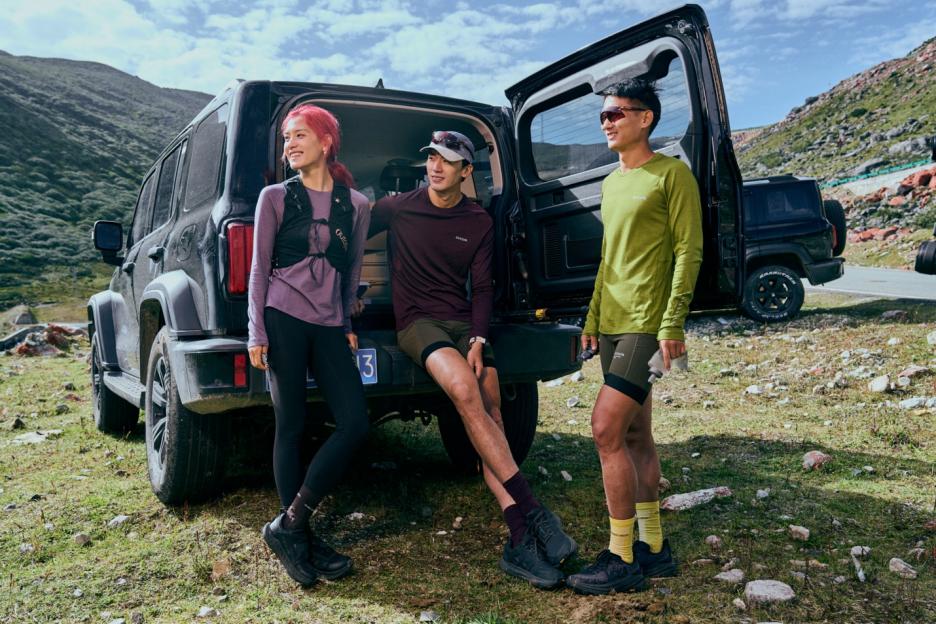
If fabric is hard power, then design is another invisible bonus. The luxury background of co - founder Alexis Hou gives Outopia an extra layer of aesthetics beyond technological expression.
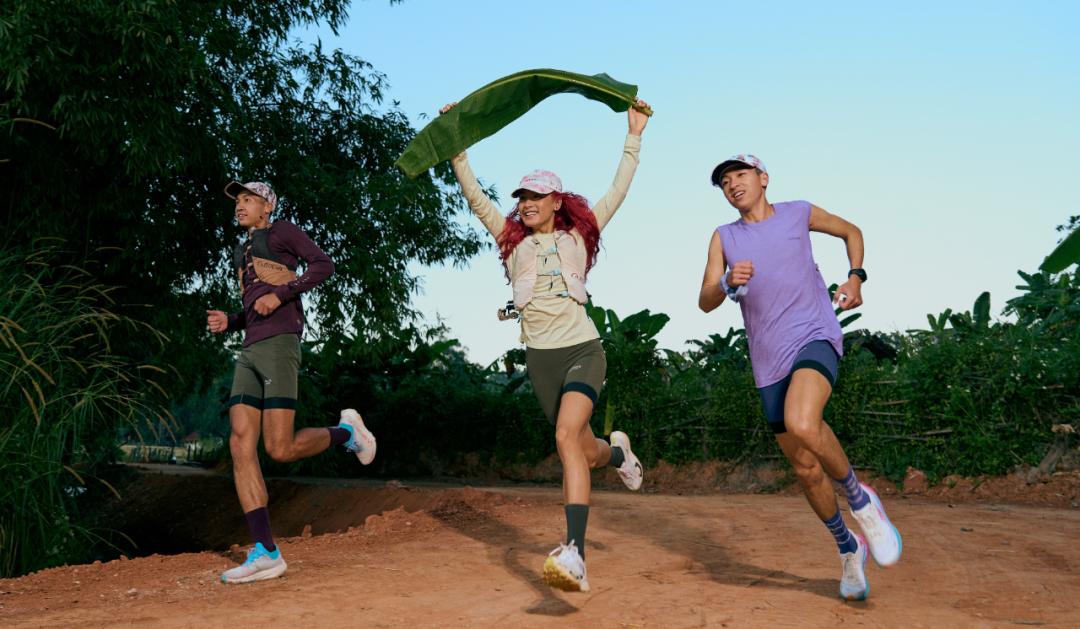
On social media, the colorful tie - dye style of the Earth love - the - earth series has become a popular style. In the comment section, users describe the 1970s retro tone as "more energetic when running." Many people mention that Outopia's color - matching "enhances one's appearance," distinguishing it from the common red and green color systems of outdoor brands. The brand's expression of natural elements and environmental protection also resonates with middle - class consumers.

Growing from Community Culture:
A Brand that Resonates with Trail - Runners
Outopia's uniqueness is not only reflected in product R & D but also in its understanding of user relationships - it doesn't operate the community as a traffic pool but as a story - sharing field. It doesn't focus on conversion around popular products but on finding resonance with trail - runners in their search for the original intention.
First of all, the Outopia team itself consists of trail - running enthusiasts, which gives the products a clear real - use logic from the very beginning of the design. For example, the Wonder Fast series designed for autumn and winter speed running uses more than 160 grams of wool to achieve moisture absorption and sweat wicking, combines quick - drying fibers and heat - dissipation structures, and has a watch window on the wrist so that runners can check their pace and heart rate without pulling up their sleeves; its 2.5L load - compression shorts can keep items stable during high - speed running, and there is no need for an additional fanny pack or backpack for short - distance trail running or urban training. In addition, the brand has also launched a winter warm - keeping jacket that can be compressed to the size of a Coke bottle and weighs about 200g, providing lightweight protection for runners "just in case."
At the supply chain level, in 2024, Outopia became the first outdoor sports cooperation brand in China for the New Zealand ZQ™ traceable wool system. This certification has extremely high thresholds for sustainability, animal welfare, and supply chain transparency, which also means higher costs and a longer production cycle.
But in the team's view, this is exactly the responsibility that an outdoor brand should undertake - performance should not come at the cost of the environment.
Outopia also turned the kittens and puppies picked up on the trail - running track into well - received printed T - shirts, making "adopt don't shop" a declaration on the backs of runners. This design language that doesn't pursue mass recognition but emphasizes group resonance and is full of warmth is also rare among traditional brands.
In the sponsored races, the brand encourages runners to carry garbage bags with them and organizes "trash running" before and after the race to clean the track; environmental protection lectures and dialogues are regularly held in stores and community activities, striving to practice the brand vision of "making the world a better place through trail - running."
In terms of encouraging more people to take up trail - running, Outopia actively lowers the participation threshold in its self - owned IP "Mountain Race," connecting trail - running with urban life. Activities such as pickleball games, pet - friendly days, and alley trash - picking runs held in its Beijing and Chengdu stores make sports and mountains no longer aloof but integrated into daily life. This shift in the event style from "looking up to idols" to "embracing like - minded people" also fits the psychological state of the current young consumer group.
In recent years, the proportion of female participants in Chinese trail - running races has been increasing, and the proportion of