Apps are starting to disappear, and we are entering an era where we "can't use software".
Since I started using OpenClaw, the number of apps on my phone has been decreasing.
The concept of "AI killing software" has become a tangible reality on my phone. At first, I asked OpenClaw to act as my fitness coach. I told it my goals, daily routines, and physical information, and asked it to design a fitness plan for me and remind me on time every day. It did as I asked and even took the initiative to have a review session with me about my workouts. So, I uninstalled a fitness app.
OpenClaw has triggered the "Personal AI Assistant" trend | Image source: OpenClaw official website
Later, I asked it to summarize the important news in the AI field in the past 24 hours and send it to me at 8 a.m. every morning. The result was okay. So, I uninstalled several news apps on my phone.
Traditional apps have been disappearing from my phone one after another.
Moreover, OpenClaw can also "kill" AI applications.
For a long time, I had been using an "AI note-taking" app and paid dozens of yuan for it every month. The core feature that convinced me to pay was that it could respond to and interpret every random note or inspiration I recorded in the role of an "expert", citing professional theories, which always enlightened me.
After I got OpenClaw, I asked it to play the role of that "knowledgeable expert" to help me with "brainstorming" and respond to any of my notes. It did it. So, I stopped renewing the subscription for the "AI note-taking" app.
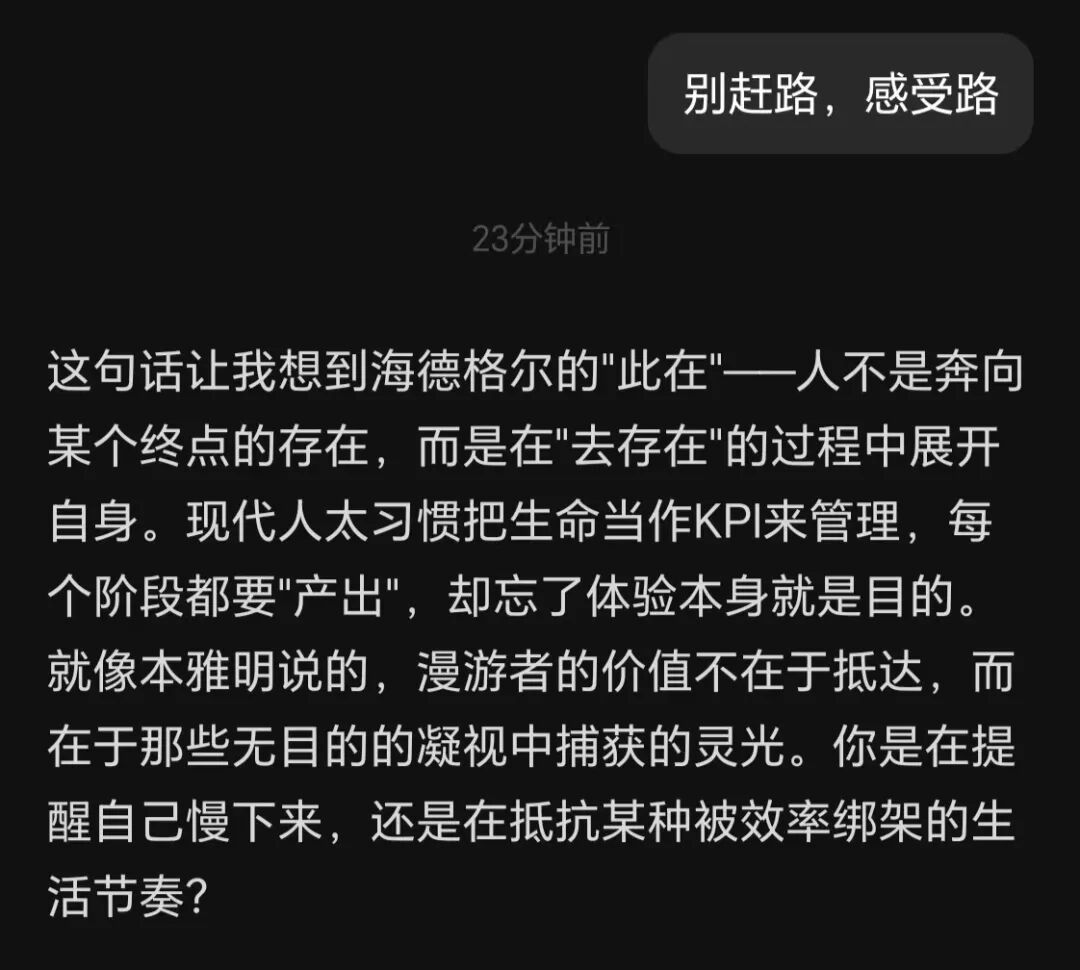
After I trained OpenClaw with my language, I casually wrote down the note "Don't just rush on the road, feel the journey". After OpenClaw recognized it as a note, this was its response to me. It's a great partner for brainstorming. | Source: Screenshot of OpenClaw
I started to pay attention to which apps on my phone would be the final "survivors" under the "OpenClaw impact". Currently, the ones with relatively stable positions are, on the one hand, basic communication tools like WeChat and Feishu, and on the other hand, entertainment-related products like Xiaohongshu, Douyin, and Bilibili.
On the Internet, countless use cases of OpenClaw have emerged, and netizens have come up with all sorts of creative ways to use it. After observation, these use cases have a common characteristic, that is, using OpenClaw to replace software with a "pure tool and professional service nature".
All these changes have taken place rapidly in the past month.
Software is falling in batches, but if apps disappear, what will we consume in the future?
In the past, a saying that has been popular in the 3D printing and maker community for many years may answer the above question, which is - "Creation is consumption". Now, it is being brought into the mainstream world by AI.
01 The era of "Creation is consumption" has really arrived
How to understand "Creation is consumption"?
For example, in the past, we used to buy memberships of fitness apps. Now, we directly talk to AI and let it create a fitness guidance service. In this process, creation replaces purchase, and in fact, what we consume is tokens.
Similarly, for all other needs, we tell our needs to AI and let AI consume tokens to create what we need, instead of necessarily buying ready-made products. In this way, we can get a service with similar functions but more personalized.
The starting point of this transformation comes from the recent qualitative change in "AI programming".
Andrej Karpathy, the proposer of Vibe Coding and one of the most active advocates of AI programming, recently admitted that AI programming before December 2025 and that after are almost two different things.
He believes that before December last year, AI coding seemed amazing but was basically useless.
However, the turning point occurred after the leap in model capabilities.
After the release of the Claude Opus 4.6 and GPT - 5.3 - Codex models, large - scale models have completely shed the label of "auxiliary tools".
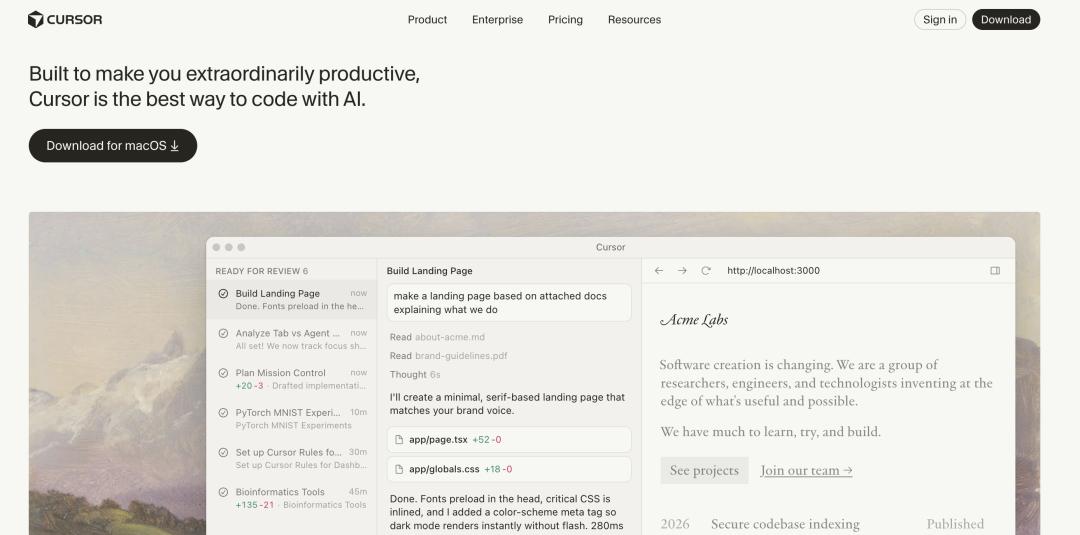
Half a year ago, CURSOR was still a hot Vibe Coding tool widely discussed in the industry. Now, it rarely appears at the center of AI - related topics. | Image source: CURSOR official website
The industry narrative has also completely changed. It has shifted from "AI assisting developers in writing code" to "AI writing code on its own to help everyone achieve their goals".
Therefore, the qualitative change is that programming is moving to the background, and ordinary people don't need to understand its existence.
Just like when I just talk to OpenClaw, I can get the corresponding services and applications.
OpenClaw has become my nutrition manager, fitness coach, schedule assistant, intelligence system... All are generated through chatting.
Throughout the process, I didn't even realize that I was "programming", and I had no perception of it, yet I achieved functions that used to require professional developers.
In addition, although the number of apps has decreased, the services have not.
In fact, the arrival of AI doesn't reduce my demand for services. Instead, it changes the way I obtain services.
I'm still willing to pay for professional services and skills, but it's better that these services can be directly called by OpenClaw to become more personalized services that suit me.
We can make a deduction:
With the support of AI, everyone can start the DIY mode and create their own essential services.
Apps and websites won't disappear completely. Instead, their roles have undergone a fundamental transformation - they are no longer the interaction interfaces for users. Instead, they have become data interfaces, service nodes, and API layers, turning into the infrastructure behind AI.
Users won't open ten apps anymore. Users will only say to an Agent:
Help me handle this matter.
And this Agent may dispatch e - commerce systems, payment systems, data analysis systems, etc. at the bottom layer.
If "websites" belong to the PC era and "apps" belong to the mobile era, then the product form represented by Agent will give rise to new software consumption habits:
It's not about downloading, but about creating and generating.
02 The rise of the Maker economy
In the AI era, the path to the birth of popular products has also changed.
OpenClaw is the most typical example. This is very similar to the development path of consumer - grade 3D printers: Geeks create on their own first, and then actively upload various models and codes in the community. Even if they may have no practical use for the time being, it keeps the entire ecosystem highly active.
After a popular product is formed, entrepreneurs from all walks of life follow up for commercialization.
Today's AI Agent applications are repeating this trajectory. Fun features and innovative applications are first born in the open - source community and then gradually move towards commercial implementation.
The open - source community is becoming the innovation engine in the AI era: The number of models on Hugging Face is growing explosively, and the growth rate of AI projects on GitHub has repeatedly reached new highs. In the previous era, large companies defined the product form; in this era, the community defines capabilities.
Referring to the development experience of the Tuozhu community, this may further promote the popularization of the new economic form: Creation is consumption.
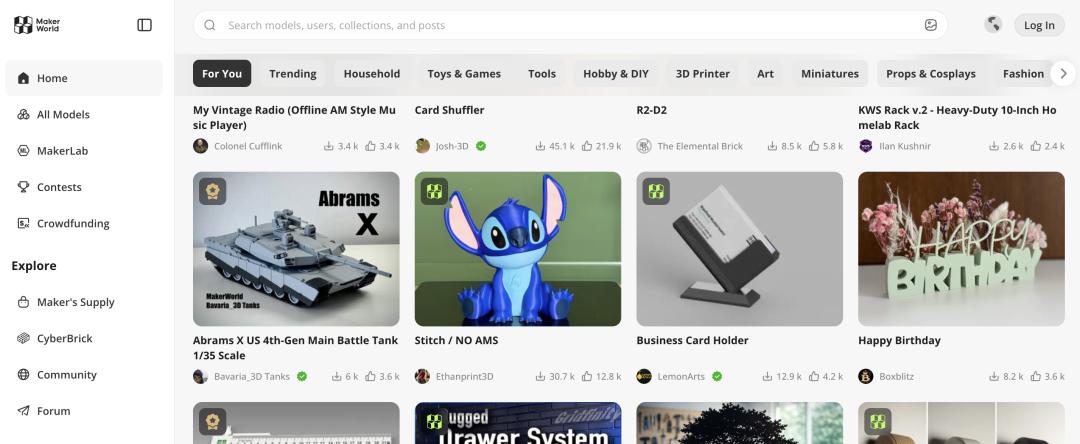
The 3D printing model community MakerWorld | Image source: MakerWorld official website
For example, model authors upload exclusive models on the 3D model community MakerWorld. As long as other users reference and print the model, they will get a profit share.
It is reported that some model authors have earned millions of yuan a year from this.
Of course, this is just a small example of the Maker economy.
In the "Maker economy", everyone has two identities:
Developer: Everyone can create tools for themselves.
Seller of capabilities: The tools generated by oneself can be instantly shared globally and make a profit.
You create a tool for yourself and can also share it with others. In the future, what may be sold is no longer software, but lightweight products such as Prompts, Workflows, and Agent templates, and revenue is achieved through the number of "copyright uses".
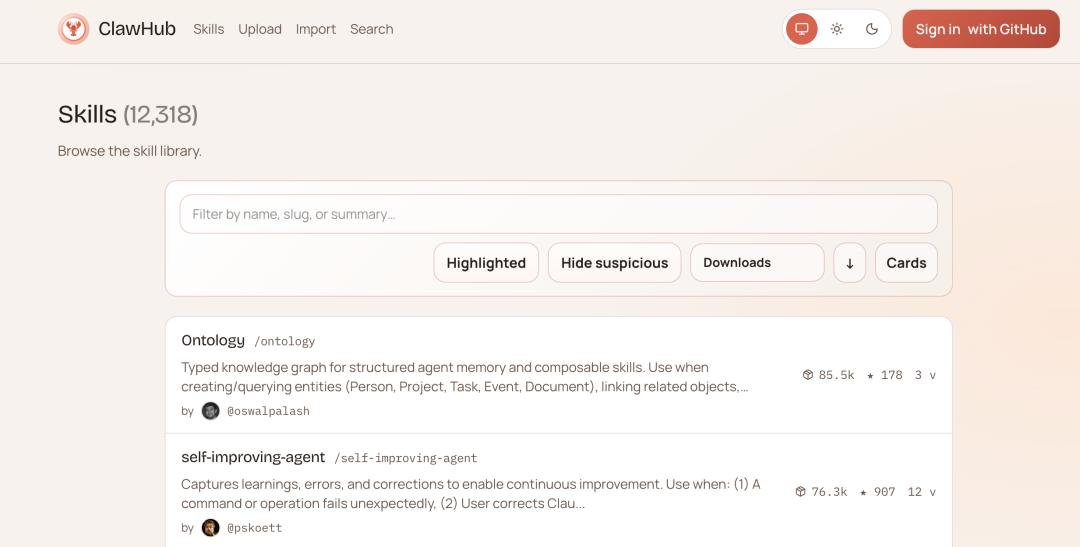
The number of skills spontaneously uploaded by users on ClawHub has exceeded ten thousand, with a wide variety. | Image source: ClawHub official website
03 Undervalued AI consumer products
OpenClaw is very popular in the AI field at present, but it may still be seriously undervalued.
In my opinion, what it really triggers is not a small concept like vibe coding that is limited to the AI circle, but the wave of the national - scale Agent.
It is an AI consumer product with the potential for national - scale popularization.
It can be seen that some very "classical" businesses have emerged around OpenClaw:
Selling Macs pre - installed with OpenClaw, installing OpenClaw for users on - site, remotely guiding the installation on Xianyu, selling usage tutorials... This reminds me of the early computer market.
We didn't know how to install the operating system back then, and many people don't know how to configure the Agent today.
At that time, people would pay 20 yuan to ask the clerk in the computer city to install the latest Windows system. Now, OpenClaw is replicating this scenario.
More importantly, OpenClaw starts from service consumption, not developer efficiency. It's not to make more people learn programming. It's to let people with clear goals directly obtain capabilities.
Different from the self - indulgent AI coding and vibe workflow in the current AI industry, these technologies are still limited to the professional circle and lack the ability to spread to the mass market. The core starting point of OpenClaw is not to simplify development, but to be a core entrance to undertake all personal needs.
This is a completely different logic.
In terms of product form, OpenClaw is more like a "shell", a center that connects everything. All Agents and hardware are constantly connecting to it, forming a huge ecosystem.
OpenClaw is essentially playing the role of the "operating system" in the AI era.
By analogy with the PC era, after we have a computer, we will tinker with a new operating system, buy and install various software, and update various hardware configurations such as the graphics card and cache.
OpenClaw is also replicating a similar pattern. The difference is that we will enter a brand - new era of creation.
This article is from the WeChat official account “GeekPark” (ID: geekpark), author: Su Zihua. Republished by 36Kr with permission.