In 2026, will the elimination round of smartphones begin?
Not long ago, market research firm Counterpoint Research released a weekly sales tracking report on smartphones in China. The data was not very encouraging. In January this year, the sales volume of smartphones in China decreased by 23% year-on-year, and most domestic brands experienced double-digit declines in sales. Only Apple maintained a year-on-year positive growth.
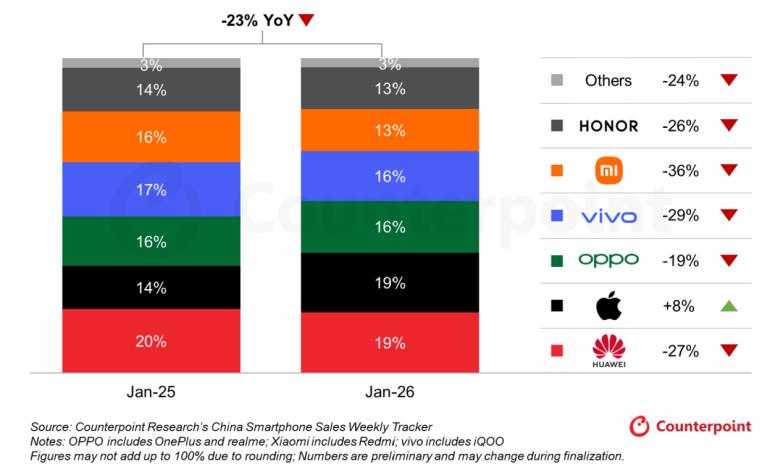
There are, of course, special reasons for this unusual decline. In January last year, the Spring Festival promotion period coincided with national subsidies, which advanced market demand and created a high base for overall sales. This year, the Spring Festival fell at a different time from last year, and the national subsidies were not as strong as last year. As a result, the market performance of domestic mobile phone manufacturers declined significantly.
However, there is also a significant difference between Apple and other competitors - price. Due to its pricing, most of Apple's models are not eligible for subsidies, so they are less affected.
In addition to the withdrawal of subsidies, mid - and low - end smartphones are facing an even greater challenge - the epic price increase of memory chips. The soaring demand for AI has not only driven up the stock prices of Zhipu and MINIMAX and made American gas turbines in short supply but also exhausted the production capacity of memory manufacturers. Consumer - grade memory sticks have been sidelined, which has put mobile phone manufacturers in a difficult position.
Transsion, known as the "king of African mobile phones," saw an increase in revenue but not in profit in the third quarter of last year, and its gross profit margin dropped by two percentage points. According to supply - chain sources, many mobile phone brands have reduced their overall device orders for 2026 by 10% - 20%. There are also reports that Meizu's mobile phone business has effectively ceased operations, and the development of the Meizu 23, originally scheduled for release in 2026, is no longer being actively promoted.
Will 2026 be a year of reshuffle for the smartphone industry?
The Old Problem of Moving Upmarket
The attempt of domestic mobile phone brands to move upmarket is an old story.
According to Counterpoint data, 2017 was a watershed for smartphone shipments. Before 2017, the global smartphone market showed an upward trend. From 2017 to 2020, the global smartphone shipments began to decline slightly, and in 2023, they reached the lowest point in a decade.
With the market growth reaching its peak, there are two changes in consumers' demand for replacing mobile phones.
First, the replacement cycle is getting longer. In 2020, the average replacement cycle for Chinese consumers was 24 - 25 months, but by 2025, it had extended to 33 - 38 months.
Second, consumers are continuously upgrading to higher - priced models. Year - end holiday promotions, installment - payment financing plans, and trade - in activities have jointly promoted the high - end trend in the mobile phone market.
Judging from the latest market situation, market growth is still mainly driven by "value expansion" rather than "scale expansion." Counterpoint data shows that in the fourth quarter of 2025, the global smartphone market revenue increased by 13% year - on - year, reaching $143 billion, a record high for a single quarter. At the same time, the average selling price (ASP) of smartphones increased by 8% year - on - year, exceeding $400 for the first time in a single quarter.
IDC predicts that in 2026, the market share of smartphones priced over $600 in the Chinese market will reach 35.9%, a year - on - year increase of 5.4 percentage points. The market share of smartphones priced between $400 and $600 will be 10.1%, a decrease of 0.8 percentage points; the market share of smartphones priced between $200 and $400 will be 34.0%, a decrease of 0.3 percentage points; and the market share of smartphones priced under $200 will shrink by 4.3 percentage points to 20.0%.
Going upmarket is a must.
Although Huawei slipped from the top two positions in the rankings under the US government's sanctions in 2020, leaving market space and a time window for other domestic manufacturers, so far, domestic mobile phone brands other than Huawei still lag in the development of their high - end product lines.
According to data shared by Weibo blogger RD Observation, in terms of the annual brand sales share by price segment in 2025, 56% of Huawei's sales were in the price segment above 4,000 yuan, while the figures for Xiaomi, vivo, and OPPO were 20.5%, 18.5%, and 13% respectively.
Looking at the sales of the latest flagship series, as of the sixth week of 2026, the sales of Apple, Huawei, Xiaomi, vivo, and OPPO were approximately 20.9327 million, 3.1105 million, 3.5046 million, 1.4544 million, and 1.1677 million respectively. Although Xiaomi's sales were higher than Huawei's, Xiaomi's flagship series was released earlier, and Huawei's weekly sales data were better.
The progress in moving upmarket has also allowed Huawei and Apple to be more relaxed during this Spring Festival promotion period.
Huawei's Spring Festival promotion covered all categories of its products. The original price of the Mate 70 Pro + was 8,499 yuan, and the maximum price reduction could reach 2,700 yuan. Apple offered a price reduction of 2,000 yuan for the poorly - selling iPhone Air model, and with the national subsidy, the maximum price reduction could reach 2,900 yuan. Other domestic brands did not offer influential discount policies during the Spring Festival sales period.
While others' success is indeed discouraging, what worries other mobile phone brands more is the arrival of a super - bull market for memory.
The Killing Line for Smartphones
Since the second half of last year, not only AI and gold but also memory has gone crazy.
According to TrendForce data, in the first quarter of 2026, the contract price of general - purpose DRAM increased by 55% - 60% quarter - on - quarter, and the price of NAND flash memory increased by 33% - 38%. Considering the continuous upward trend in the previous quarters, this round of memory price increases has entered the "super - bull market" range, with the increase even exceeding the historical high in 2018.
How fierce is this round of price increases?
A very intuitive example is the 64GB RDIMM memory for servers. In the third quarter of 2025, it cost about $255, and in the fourth quarter, it jumped directly to $450. According to data from multiple authoritative institutions, the contract price has now reached the $900 mark, and the industry generally expects that it may hit the $1,000 mark in the second quarter of 2026. This sharp increase is also driven by AI.
Faced with such a large profit margin, suppliers hardly hesitated.
The three major memory manufacturers, including Samsung, SK Hynix, and Micron, are significantly reducing the production capacity of consumer - grade DDR4 and DDR5, giving priority to the supply of HBM and server memory. As a result, consumer - grade memory has to give way, the supply has plummeted, and the price has been rapidly pushed up. How tight is the supply? SK Hynix said in October last year that the production capacity of its three major product lines - DRAM, NAND Flash, and HBM - had been fully booked for 2026, and Samsung and Micron have also sold out all their HBM production capacity.
To make matters worse, this wave of price increases is difficult to ease in the short term. Counterpoint predicts that the memory price will soar by 40% - 50% in Q4 2025; it will rise by another 40% - 50% in Q1 2026 and is expected to increase by about 20% in Q2 2026.
This has made what people used to complain about as Apple's "gold - plated memory" truly valuable.
In 2020, memory accounted for about 8% of the Bill of Materials (BoM) of the iPhone 12 Pro Max. By 2025, memory accounted for more than 10% of the BoM of the iPhone 17 Pro Max.
According to UBS' calculations, by the fourth quarter of last year, the proportion of memory in the BoM of mid - and low - end mobile phones may have risen to 34%, compared with only 22% in 2024. In terms of cost, this means that the cost per unit may increase by about $16, a nearly 37% increase.
High - end mobile phones have high profit margins and can withstand the cost increase. However, for mobile phone manufacturers focusing on the mid - and low - end markets, an awkward situation has emerged:
Memory chips are a rigid cost but not a selling point. If they raise the price, mid - and low - end users are price - sensitive. They are used to getting 512GB/1TB of storage for around 1,000 yuan. Telling them that the same configuration will cost more now will likely make them choose to wait. But if they don't raise the price, the already thin profit margin may be completely eroded by the rising costs.
Transsion is a typical example. In 2025, Transsion's total revenue was 68.7 billion yuan, a year - on - year decline of less than 5%, but its profit was almost halved. The annual net profit attributable to the parent company was about 2.5 billion yuan, a decrease of 3 billion yuan compared with the previous year, a year - on - year decline of up to 54%. Transsion's explanation in its earnings forecast was straightforward: the core reason for the profit decline was the rising memory prices. In highly price - sensitive markets like Africa, calculations show that for every $5 increase in the terminal price, the sales volume may decline by more than 10%.
According to Jiemian News, in January this year, Wan Zhiqiang, the CMO of Xingji Meizu Group in China, revealed that the significant increase in memory prices had a huge impact on the mobile phone business plan, and the launch of the Meizu 22 Air was cancelled. Recently, there are also reports that Meizu's mobile phone business has effectively ceased operations, and the development of the Meizu 23 project is no longer being actively promoted.
As the cost continues to rise, industry differentiation is almost an inevitable result. High - end brands can rely on their scale and supply - chain capabilities to withstand the pressure, while manufacturers relying on low - price and high - volume sales have been forced to find their own ways out, such as raising prices, reducing configuration to maintain prices, and reducing production.
Price Increases, Finding New Paths, and AI
2026 is destined to be a year of differentiation for mobile phone manufacturers.
With the high - end trend and the memory cycle, the advantages of Apple, Samsung, and Huawei are becoming more and more obvious. In the fourth quarter of last year, Apple's single - quarter shipments and revenue both reached record highs, increasing by 14% and 23% year - on - year respectively. Its revenue also set new records in many regions, including the United States, China, Latin America (LATAM), Western Europe, the Middle East, and South Asia.
Android manufacturers with diversified businesses will be less affected. Xiaomi's mobile phone business was under significant pressure in the fourth quarter of last year, with shipments decreasing by 11% year - on - year. However, the good news is that at the group level, Xiaomi does not rely solely on its mobile phone business. Both its IoT business and automotive business are showing good development momentum. In the third quarter of last year, Xiaomi's automotive revenue was 29 billion yuan, a year - on - year surge of 199.2%. It also achieved an operating profit of 700 million yuan for the first time in a single quarter, with a gross profit margin of more than 25%.
Other mobile phone manufacturers with relatively single - minded businesses may face greater challenges.
To cope with the crisis, various manufacturers have taken action.
The first is to raise prices to maintain profits.
According to Sina Technology, starting from March, the price increase of mobile phones will enter an accelerated stage. The price increase of new products can be at least 1,000 yuan. At the same time, mainstream brands such as OPPO, OnePlus, vivo, iQOO, Xiaomi, and Honor may gradually raise the prices of their old - model phones to cope with the frequent fluctuations in memory costs.
The second is to explore new business opportunities.
In the past few years, mobile phone manufacturers have been taking more and more actions to expand their business. For example, since last year, there have been reports that many mobile phone manufacturers, including OPPO, vivo, and Honor, have started to layout projects similar to the handheld gimbal camera like Pocket. They are eyeing the handheld gimbal camera market, where DJI has a gross profit margin of over 50% and has sold more than 10 million units over the product's lifecycle.
There have also been some personnel changes. Recently, vivo announced a new management adjustment. Shen Wei, the founder and CEO of vivo, will no longer serve as the company's president. Hu Baishan, the executive vice - president, has been promoted to the company's president and will continue to serve as the COO, reporting to Shen Wei. The latter is a key figure in vivo's technological upgrading. He led the establishment of vivo's Central Research Institute and promoted the global imaging strategic cooperation with Zeiss. The outside world believes that this personnel change means that vivo is gradually transforming into a multi - terminal company and accelerating the implementation of new businesses such as MR and robotics.
The third is AI.
Since last year, there have finally been some changes in edge - side AI that can influence users' decisions. The technical preview version of the Nubia M153 Doubao mobile phone assistant, a cooperation between ByteDance and Nubia, can directly respond to users' intentions, enabling functions such as price comparison and placing orders across platforms and directly retouching photos by voice - calling the assistant. ByteDance, Alibaba, and Tencent have also shown users how to better use AI on mobile phones. Ni Fei, the CEO of Nubia, once said that the development trend of AI - enabled mobile phones is irreversible, and "open cooperation" is the way forward.
A definite trend is that as the capabilities of models become more widespread, the binding between models and systems and between models and mobile phones will become closer and closer. Whoever can first explore a mature implementation path for an edge - side intelligent agent may trigger a new wave of mobile phone replacements.
Reference Sources
1. GeekPark: The "Methodology" for Leading the Way in 2026 with Intelligent Mobile Phones
2. Yuanchuan Technology Review: The Sky Is Falling for Budget Phones Due to Memory Price Increases
3. Polyhedron InterfaceX: Meizu Mobile Phones May Become History: Business Effectively Ceased, to Be Officially Delisted in March
4. Counterpoint Research: Memory Prices Soar by 50%, and the Upward Trend Will Continue into 2026
5. Counterpoint Research: The Global Smartphone Average Selling Price Exceeds the $400 Mark for the First Time in a Single Quarter
6. Dingjiao: The Spring Festival Mobile Phone Battle: Some Offer a Direct Discount of 4,000 Yuan, While Others Hold Back
This article is from the WeChat official account "Bohu Finance and Economics," written by Lu Fei, and is published by 36Kr with permission.