2026: Beginnt die Eliminationsrunde im Smartphone-Markt?
Recently, the research institution Counterpoint Research published a report on the weekly sales figures of smartphones in China. The figures don't look very good. In January of this year, smartphone sales in China dropped by 23% compared to the previous year. Most Chinese brands recorded double - digit decline rates, and only Apple could record positive growth compared to the previous year.
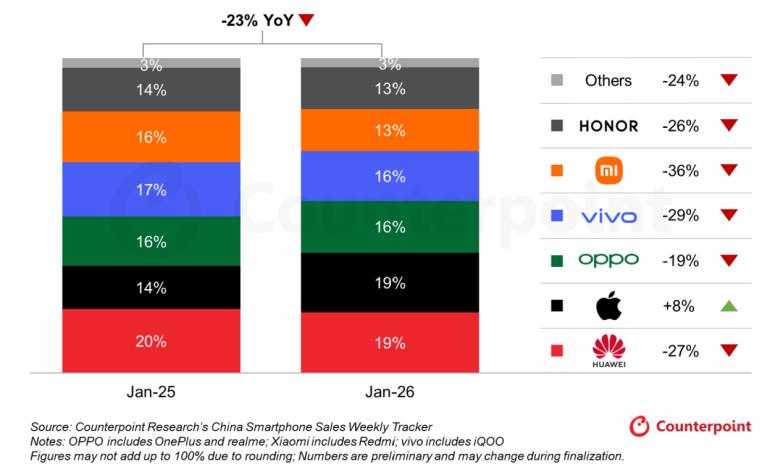
Of course, there are special reasons for this unusual sales decline. In January of last year, the Chinese New Year sales promotion coincided with government subsidies, which advanced the market demand and created a high base for total sales. This year, the Chinese New Year falls at a different time than last year, and the government subsidies are weaker than last year. This has led to Chinese smartphone manufacturers showing significantly worse market performance.
But in addition, there is a clear difference between Apple and other manufacturers - the price range. Due to the prices, most Apple models are not included in the subsidy range and are therefore less affected.
Besides the reduction of subsidies, smartphones in the mid - and low - price ranges have to deal with an even bigger problem - the epic price increase of memory chips. The sudden increase in demand for AI has not only driven up the stock prices of Zhipu and MINIMAX and briefly offered US gas turbines, but also exhausted the production capacities of memory manufacturers. As a result, the memory banks for the consumer sector have fallen behind, which is a headache for Chinese smartphone manufacturers.
The African smartphone company Transsion achieved more sales but less profit in the third quarter of last year, and the gross margin decreased by two percentage points. According to supply - chain information, several smartphone brands have reduced their orders for 2026 by 10% to 20%. There are also rumors that the smartphone business unit of Meizu has actually been shut down and the Meizu 23 originally planned for 2026 will no longer be pursued.
Will 2026 be a year of restructuring for the smartphone market?
The old problem of up - grading
The pursuit of premium segmentation by Chinese smartphone brands is a well - known topic.
According to Counterpoint data, 2017 was a turning point for smartphone shipments. Before 2017, the global smartphone market was on the rise. Between 2017 and 2020, global shipments showed a slight decline, and in 2023, shipments fell to the lowest level in ten years.
With the saturation of market growth, there are two changes in the demand for smartphone replacement.
First, the replacement period is extended. In 2020, the average replacement period for Chinese consumers was 24 to 25 months, but by 2025, this period had extended to 33 to 38 months.
Second, consumers are constantly upgrading to models in the higher - price segment. The year - end sales promotions, installment - payment financing models, and old - device trade - in programs have jointly promoted the premium trend of the smartphone market.
The latest market situation shows that market growth still mainly relies on "value expansion" rather than "volume expansion". According to Counterpoint data, the global smartphone market sales in the fourth quarter of 2025 increased by 13% compared to the previous year, reaching $143 billion, which is a new record for a single quarter. At the same time, the average selling price (ASP) increased by 8% compared to the previous year and exceeded the $400 mark for the first time in a quarter.
IDC predicts that the market share of smartphones over $600 in China will rise to 35.9% in 2026, which is an increase of 5.4 percentage points compared to the previous year. The market share in the price range of $400 to $600 will drop to 10.1%, which is a decrease of 0.8 percentage points. The market share in the range of $200 to $400 will fall by 0.3 percentage points to 34.0%, and the market share below $200 will drop by 4.3 percentage points to 20.0%.
Premium segmentation is inevitable.
Although Huawei has gradually dropped from the top two positions in the ranking to the "Other" category under the sanctions of the US government since 2020, leaving market space and time windows for other Chinese manufacturers, Chinese smartphone brands other than Huawei have not developed their premium product lines sufficiently so far.
According to the data shared by the Weibo blogger RD Observation, Huawei has placed 56% of its sales volume in the price range above 4,000 yuan, while Xiaomi, Vivo, and Oppo have achieved 20.5%, 18.5%, and 13% respectively in this regard.
If we look at the sales figures of the latest flagship series, as of the sixth week of 2026, the sales figures of Apple, Huawei, Xiaomi, Vivo, and Oppo were approximately 20.9327 million, 3.1105 million, 3.5046 million, 1.4544 million, and 1.1677 million units respectively. Although Xiaomi achieved better sales figures than Huawei here, the release of Xiaomi's flagship series was earlier, and Huawei's weekly sales figures are better than Xiaomi's.
The progress in premium segmentation has also given Huawei and Apple more leeway in the Chinese New Year sales promotions.
Huawei's Chinese New Year grand promotion covered all end - device categories. The Mate 70 Pro +, originally sold for 8,499 yuan, can be discounted by up to 2,700 yuan. Apple has given a price reduction of 2,000 yuan for the poorly - sold iPhone Air model, and together with government subsidies, the maximum price reduction can reach 2,900 yuan. However, other Chinese brands did not offer influential discount programs during the Chinese New Year sales period.
Although the success of other manufacturers is frustrating, what worries other smartphone brands even more is the super - bull market for memory chips.
The price limit for smartphones
Since the second half of last year, not only the AI industry and the gold market have been in a frenzy, but also the memory market.
According to TrendForce data, the contract price of ordinary DRAM in the first quarter of 2026 increased by 55% to 60% compared to the previous quarter, and the price of NAND - Flash memory increased by 33% to 38%. If we add the continuous increase in previous quarters, this price increase of memory chips has reached the "super - bull market", and the price increase has even exceeded the historical high in 2018.
How sharp is this price increase?
A very vivid example is the 64 - GB - RDIMM server memory: in the third quarter of 2025, it cost about $255, and in the fourth quarter, it jumped directly to $450. According to data from several authoritative institutions, the contract price has now exceeded the $900 mark. The industry generally expects that the $1,000 mark could be reached in the second quarter of 2026. This sharp increase is also driven by AI demand.
In the face of this profit difference, suppliers have hardly hesitated.
The three major memory manufacturers, Samsung, SK Hynix, and Micron, are significantly reducing the production capacities of DDR4 and DDR5 memory for the consumer sector and giving priority to the supply of HBM and server memory. As a result, the memory for the consumer sector is pushed aside, the supply collapses, and prices rise rapidly. How tight is the supply? SK Hynix announced in October of last year that the production capacities of the three product lines, DRAM, NAND Flash, and HBM, for 2026 are already fully reserved. The HBM capacities of Samsung and Micron are also fully sold.
To make matters worse, this price increase is unlikely to subside in the short term. Counterpoint predicts that memory prices will increase by 40% to 50% in the fourth quarter of 2025, by another 40% to 50% in the first quarter of 2026, and by about 20% in the second quarter of 2026.
This has led to the so - called "gold - memory" of Apple, which was often criticized before, actually becoming real gold.
In 2020, the memory accounted for about 8% of the Bill of Materials (BoM) of the iPhone 12 Pro Max. By 2025, the memory's share in the BoM of the iPhone 17 Pro Max had already exceeded 10%.
According to UBS estimates, the share of memory in the BOM of mid - and low - price smartphones could have risen to 34% by the fourth quarter of last year, while it was only 22% in 2024. This corresponds to an increase in the cost per device of about $16, which is an increase of almost 37%.
Smartphones in the premium - price range have high profits and can handle this increase. However, for manufacturers of mid - and low - price smartphones, there is an unpleasant dilemma:
Memory chips are a rigid cost component but not a selling point. If the prices are increased, mid - and low - price consumers are price - sensitive. They are used to getting 512 GB or 1 TB of storage space for 1,000 yuan. If you tell them now that the price for the same configuration will increase, they will probably wait and see. However, if the prices are not increased, the already small profit margin could be completely eaten up by the rising costs.
Transsion is a typical example. In 2025, Transsion achieved a total sales volume of 68.7 billion yuan, which is a decline of less than 5% compared to the previous year, but the profit was almost halved. The annual after - tax profit was about 2.5 billion yuan, which is 3 billion yuan less than the previous year, corresponding to a decline of 54%. In the earnings forecast, Transsion directly stated that the core reason for the profit decline is the increase in memory prices. In a price - sensitive market like Africa, it is estimated that a price increase of $5 per end - device could lead to a sales decline of over 10%.
According to a report by Jiemian News, Wan Zhiqiang, the CMO of the Chinese region of the Xingji Meizu Group, stated in January of this year that the sharp increase in memory prices poses a huge challenge to the smartphone business, and the Meizu 22 Air will no longer be launched. Recently, there have also been rumors that the smartphone business unit of Meizu has actually been shut down and the Meizu 23 project will no longer be pursued.
If the costs continue to rise, an industry split is almost inevitable. Premium brands can assert themselves with their scale and supply - chain capacity, while manufacturers that rely on low prices and high sales volumes are forced to find other ways, such as price increases, reducing the configuration at the same price, or reducing production.
Price increases, finding new ways, AI
The year 2026 will inevitably be a year of split for smartphone manufacturers.
The premium trend and the memory cycle strengthen the advantages of Apple, Samsung, and Huawei. In the fourth quarter of last year, Apple reached new records in both shipments and sales, with an increase of 14% and 23% respectively compared to the previous year. The sales in the United States, China, Latin America (LATAM), Western Europe, the Middle East, and South Asia have each reached new highs.
Android manufacturers with diverse business operations will be less affected. Xiaomi's smartphone business was under great pressure in the fourth quarter of last year, and shipments dropped by 11% compared to the previous year. However, the good news is that Xiaomi at the group level is not solely dependent on the smartphone business. Both the IoT business and the automotive business show good growth potential. In the third quarter of last year, Xiaomi achieved sales of 29 billion yuan with its cars, which is an increase of 199.2% compared to the previous year. For the first time, it achieved an operating profit of 700 million yuan in a quarter, and the gross margin exceeded 25%.
Other smartphone manufacturers with relatively one - sided business operations may have to face greater challenges.
To deal with the crisis, manufacturers have already taken measures.
The first measure is to increase prices to secure profits.
According to a report by Sina Technology, the price increase for smartphones will accelerate from March. The prices of new models will increase by at least 1,000 yuan, and mainstream brands such as Oppo, OnePlus, Vivo, iQOO, Xiaomi, and Honor may successively raise the prices of their older models to cope with the frequent fluctuations in memory costs.
The second measure is to look for new business fields.
In recent years, smartphone manufacturers have increasingly made attempts to expand their business. For example, there have been rumors since last year that several smartphone manufacturers, including Oppo, Vivo, and Honor