Chinese robots are dancing, while American robots are publishing papers.
From the spinning handkerchief act at last year's Spring Festival Gala to the joint appearance of various robots on this year's Spring Festival Gala stage, major robot manufacturers have successively gained widespread attention. In the past year, robots have been involved in various activities, from walking the catwalk to "punching" their founders, and even performing hot dances at the robot marathon concert. Their popularity among the public has reached new heights. The only pity is that the stock market is closed during the Spring Festival.
Compared with Chinese robots, which have a growing public base and are tangible, the robot industry in the United States seems much quieter.
As radical as Tesla, which has even halted production of the Model S/X to focus on the mass production of robots, still claims that "deliveries will start in the second half of 2026." Boston Dynamics, an old internet celebrity that has been quiet for many years, can barely be considered another example. At the beginning - of - the - year CES, it released a robot with a large USB interface on its face:
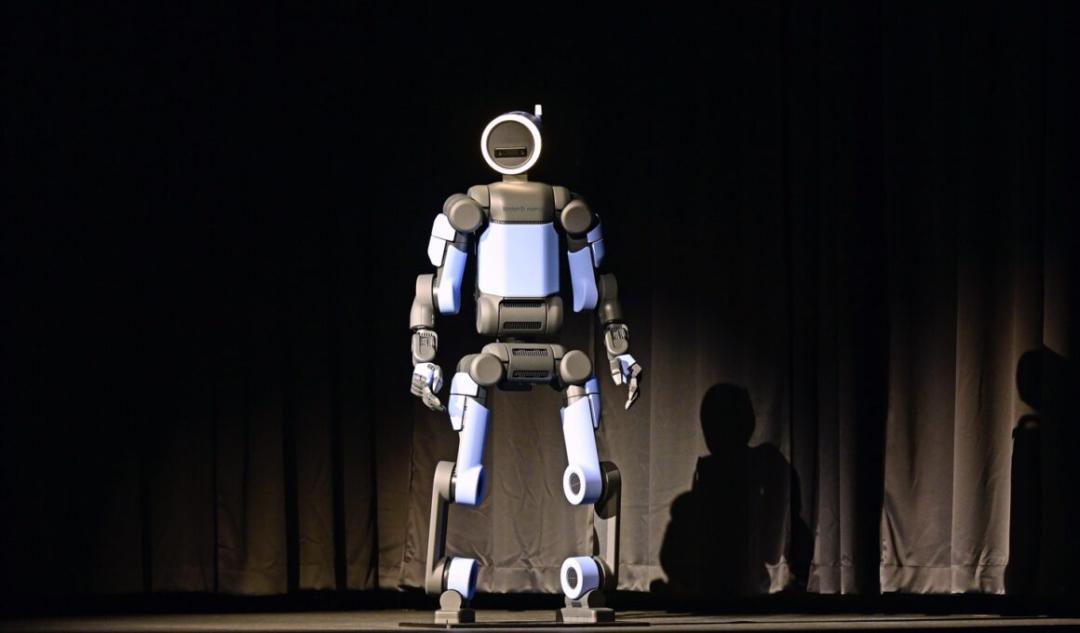
Boston Dynamics' humanoid robot Atlas
There are indeed few robots in the United States, but robot companies are actually very numerous.
Fei - Fei Li, a leading figure in artificial intelligence, targeted the robot field for her first entrepreneurial venture. Her company World Labs focuses on data synthesis and robot models. Physical Intellence, invested in by OpenAI, is also a company working on models. Its founding team comes from OpenAI and Google's DeepMind.
NVIDIA, of course, is not idle either. In addition to making chips, it has also designed the Isaac large - model platform specifically for humanoid robots, updating it three times within a year, even more frequently than its GPU updates.
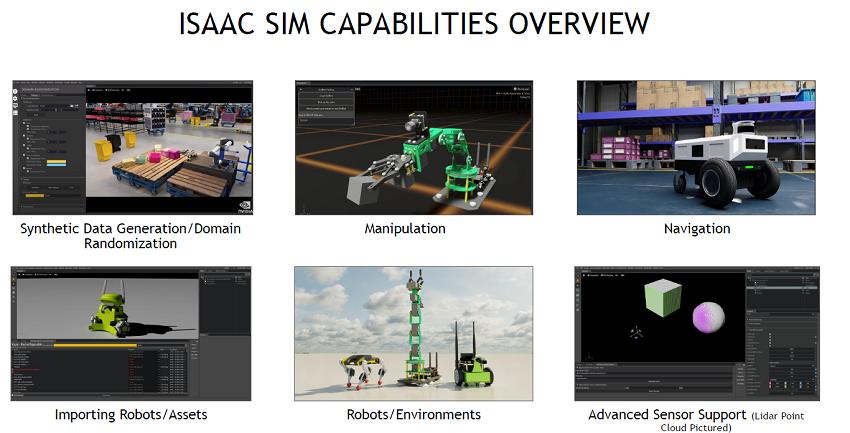
NVIDIA's Isaac platform provides model training and simulation testing for humanoid robots
It can be seen that there is no shortage of consensus between the Chinese and American industrial circles on the development prospects of robots, but the technological paths seem to have diverged in completely different directions:
China focuses on hardware. Chinese robots are capable of handling weapons and performing complex tasks, and some promising ones are already working in factories, tightening screws. The United States focuses on software. Although they have produced few robots, they have published many algorithms and papers and filed a large number of patents. Their product press conferences are more like academic seminars.
Previously, Figure AI released the VLA model, which led to a significant increase in the company's valuation. Later, Tesla's third - generation robot publicly demonstrated "end - to - end" video learning, replacing traditional programming, which has kept Silicon Valley's attention firmly on formulas and codes.
China has strong manufacturing capabilities, while the United States has a profound industrial foundation in computer science. In the robot field, the two sides seem to be gearing up for another race.
Tacit Division of Labor
The two diverging technological paths represent the two "legs" for the implementation of humanoid robots: hardware and software.
Different from traditional industrial robots, the long - term goal of humanoid robots is "versatility," that is, robots can perform all tasks that humans can do, just like humans.
All tools for human transformation of nature are designed based on the human body. From the size of daily utensils to the planning of factory production lines, as Protagoras said, "Man is the measure of all things." For robots to achieve "versatility," they need to adapt to the things created by humans. Therefore, they not only need to be in a human form but also have flexible limbs and dexterous hands like humans.
At the same time, robots cannot sense the touch, gravity, and feedback of the real world. Therefore, they need software algorithms to help them understand the physical rules of the real world. For example, when a robot picks up an egg, the hardware is responsible for executing the action, while the software determines the amount of force the robot should apply so as not to crush the egg.
In other words, hardware is the body of a robot, and software is its brain. Both are indispensable. They can either promote each other's progress or become obstacles to each other.
For Chinese robot manufacturers, making robots dance is not just for the purpose of promotion. It is a way to show off their strength in various aspects, demonstrating to the industrial circle how much effort they have put into hardware development.
The robot industry is a brand - new one, and the parts of robots have a low degree of compatibility with those of existing industries. For example, the "electronic skin" covering the robot's surface needs to achieve a similar sense of perception to human skin. The requirements for the sensitivity and accuracy of sensors far exceed industry standards, and factors such as weight and cost also need to be considered. There is no unified solution yet.
Another example is the joint, which accounts for the highest proportion of hardware value. Just as human joints support the movement of limbs, robot joints are the foundation for all complex operations. The strength of the hip joint determines the weight of the goods a robot can carry, and the fingertip joints of the thumb and index finger determine the fineness of the needle and thread a robot can handle.
Even a more natural gait when walking and a more flexible hip - twisting movement when dancing are determined by the advancement of the joint design.
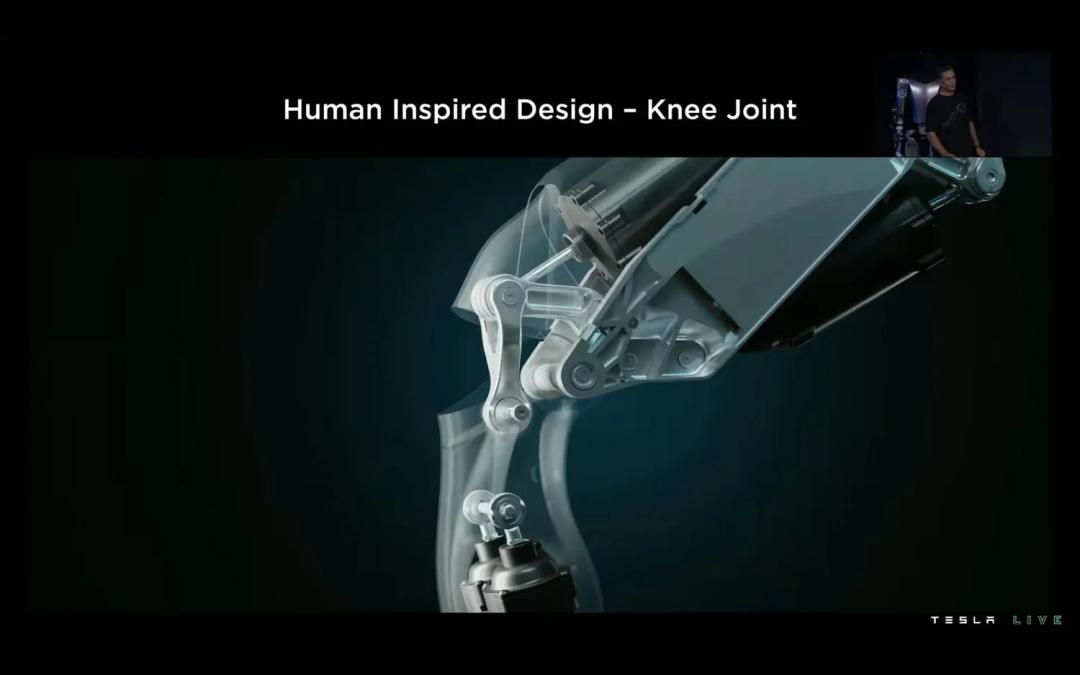
The knee joint of Tesla's humanoid robot on display
In contrast, American robot companies focus on the software aspect, striving to cross the divide between large language models and spatial intelligence: understanding of physical rules.
For example, a language model knows that an apple will fall to the ground because it has been trained with countless data about apples falling to the ground. However, this is just a description of a physical phenomenon, not an understanding of the physical rules themselves.
A language model is similar to a probability prediction, speculating on the next word. However, spatial intelligence is closer to the simulation of the real physical world. The algorithm needs to predict the changes in the surrounding environment in the next second. Compared with handling weapons, tasks like unscrewing a bottle cap or opening a can are actually more difficult to achieve.
Whether it is large companies like Google and NVIDIA or startups like World Labs and Physical Intellence, they are all targeting the world model at the software level, aiming to make AI learn the compulsory course of physics.
China is reshaping the physical body of robots, while the United States is training the "brain" of robots. This tacit division of labor between hardware and software seems familiar.
Yes, it is the new energy vehicle industry.
Electric Vehicles with Legs
Electric vehicles - more precisely, autonomous driving - can be regarded as the "pre - industry" of humanoid robots. If electric vehicles are robots with wheels, then humanoid robots are electric vehicles with legs.
The main architectures of both autonomous driving and humanoid robots can be seen as "AI brain + actuator": Both rely on various cameras and sensors to obtain external data, make decisions through computing chips and model algorithms, and then drive the vehicle body or robot body through motors to perform tasks.
The difference is that humanoid robots need to obtain more accurate data (more types of sensors and higher precision), process more complex decisions (general large models), and perform more diverse tasks (more flexible joints and more scientific engineering design).
Comparing the key components of the two, most of them have the same technological origin, only differing in specifications and parameters.
The joints of humanoid robots are themselves miniaturized high - performance motors. The 2.3kWh battery pack on Tesla's Optimus chest re - uses the battery pack technology of electric vehicles in terms of circuit protection and energy management systems. The electronic control technology used to control the wheel speed of electric vehicles is also what robots rely on to hold an egg without breaking it.
The hardware is highly compatible, and the software can be directly applied. For robots, the algorithms used to identify a bolt in a factory and to distinguish traffic lights on the road are similar. Optimus even uses the FSD algorithm from electric vehicles.
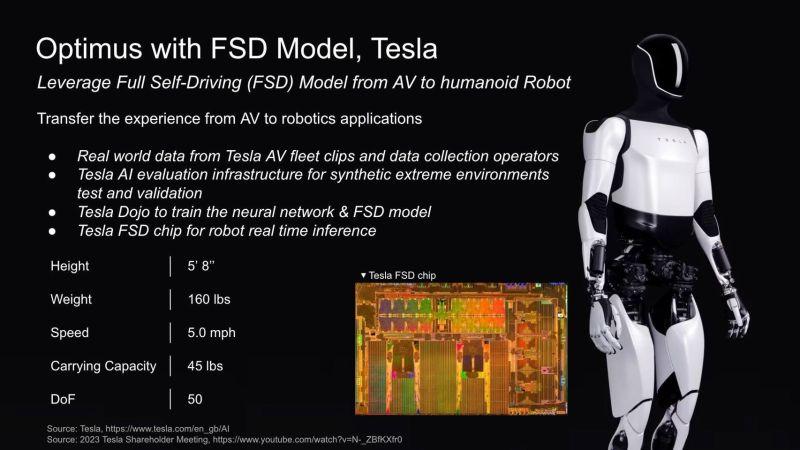
Optimus uses Tesla's FSD model
This is why companies that have achieved success in the electric vehicle industry have all considered entering the robot field. Needless to mention Tesla, XPeng has also built its own robot, and Li Auto has stated that it will fully invest in AI and transform into an embodied intelligence company.
The tacit division of labor between China and the United States in terms of hardware and software is even more evident in the supply chain. China has manufacturing enterprises derived from the automotive industry, while the United States has a large number of software and chip design companies.
In the Chinese robot supply chain, many familiar names in the automotive industry are very busy. For example, Sanhua Intelligent Control, which has been reported by multiple sources to have won the joint order for Optimus, is also the supplier of Tesla's electric vehicle thermal management module. Other suppliers rumored to have won orders include Tesla's chassis supplier and the supplier of aluminum alloy die - castings for the Model 3/Y.
Automotive Tier 1 Joyson Electronics has directly announced its upgrade to a "dual - track Tier 1 for automotive + robots." Relying on its comprehensive strength accumulated in electric vehicle battery management, chassis control, etc., it has started supplying core components for humanoid robots. Its customers include not only the rumored Tesla but also Chinese robot manufacturers such as Unitree and Zhipu.
It's hard to say that the improved performance of humanoid robots in gymnastics in the past two years has nothing to do with these automotive suppliers.
China's supply chain provides support for hardware, and American giants are crossing - over to support the software aspect.
Needless to say about NVIDIA, which has dominated the high - computing - power chip market for many years. It has prepared a computing - power chip Jetson Thor specifically for robots - actually the "robot version" of the autonomous driving chip Drive Thor. It not only uses the same chip architecture (Blackwell) but also has similar maximum computing power.
Waymo, the hope of the American autonomous driving industry, is also an active participant in the robot field. Not only has its sister company DeepMind jointly launched a robot world model, but it has also transplanted its lidar and camera technologies to Google's RT - 2 robot experimental platform. Google itself released the Gemini Robotics model for robots last year.
The last company to achieve success by leveraging China's strong manufacturing capabilities and the United States' strong computer industry is precisely Tesla, which is now advocating for robots.
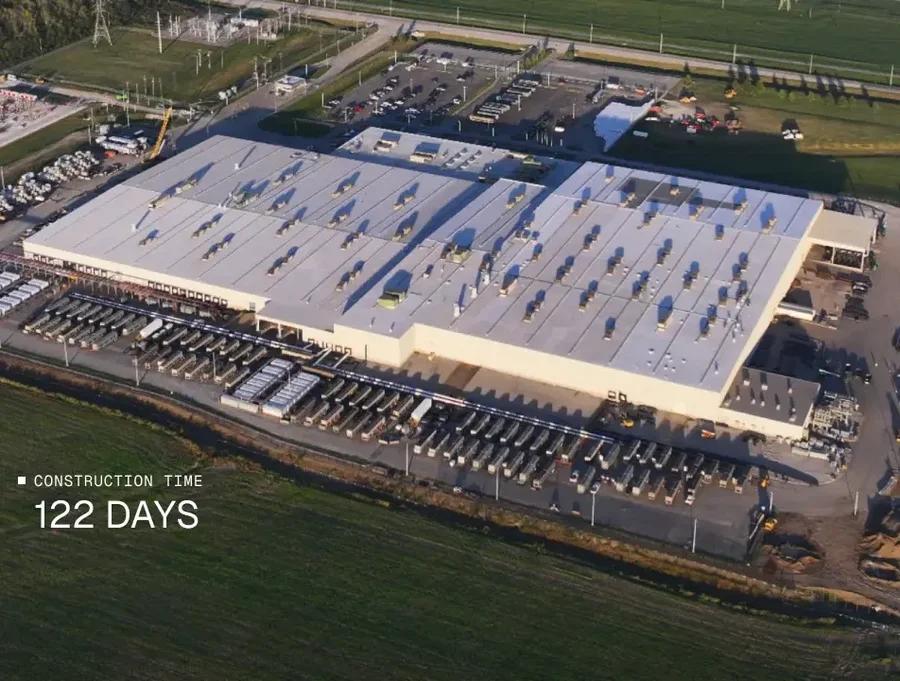
As Tesla's first overseas factory, the Shanghai factory started construction in January 2019 and delivered its first vehicles in December of the same year, creating the miracle of "starting construction, completing construction, starting production, and delivering products within the same year." Relying on the developed automotive industry chain in the Yangtze River Delta, it saved Tesla, which had just emerged from the "production hell."
Currently, the Shanghai factory is still Tesla's most productive factory. It not only supports Tesla's deliveries in China but also shoulders the export task for overseas markets.
However, at the same time, all departments related to software, such as the R & D of the FSD algorithm, the design of the AI5/AI6 chips, the large model of xAI, and the data center, are all located in the United States headquarters.
The xAI data center in Memphis
Now, a similar industrial background and a similar tacit division of labor seem to be playing out again in the robot industry.
No Next Tesla
Top - notch talents always tend to flow towards the high - end of industries. The United States is the birthplace of the computer science industry, leading from integrated circuits to artificial intelligence. In sub - markets such as software, the Internet, and chip design, almost all the giants at the top of the pyramid are American companies.
These industries not only attract the world's top talents but also continuously train talent reserves for cutting - edge technologies. One of the core factors for Tesla's rise is the continuous supply of talents from IT giants such as Microsoft, Google, and NVIDIA. Although they are new to the manufacturing industry, they are far ahead in the software field.
China's advantage lies in manufacturing. Many traditional industries are the "pre - industries" for emerging markets. Before the emergence of power batteries for new energy vehicles, lithium - ion batteries for consumer electronics had already taken root in East Asia. In this process, electrochemistry talents followed the transfer of the industrial chain, providing a considerable talent reserve for power batteries.
In the field of robots, the vast manufacturing industry has been continuously providing support. The American industrial circle is well aware of this. The Silicon Valley venture capital firm a16z said in a report titled "America Cannot Lose the Robotics Race":
"Chinese companies are destined to dominate and monopolize one sub - market after another until the production of all competitors becomes unprofitable."
According to previous reports from Morgan Stanley, Tesla's Optimus can be priced at around $20,000, thanks in large part to China's low - cost components. Analysts from TrendForce revealed that after Chinese component manufacturers supply parts to Tesla, they will make improvements based on test feedback and then provide the improved versions to domestic manufacturers.
Based on this industrial characteristic, all American high - tech companies build their core added value through software. They hand over production and manufacturing to China's large - scale supply chain while firmly controlling the most value - added and absolutely advantageous industrial segment in the United States: software.
As a master of the supply chain, Tim Cook inherited Steve Jobs' legacy and established a seamless supply - chain empire in China. With less than 20% of the global mobile phone shipment share, Apple takes more than 80% of the industry's operating profit. The Shanghai factory is responsible for more than half of Tesla's deliveries, and at the same time, data centers are springing up in the United States.
In 2023, Google closed its robot hardware R & D department Everyday Robots and merged its technical assets into DeepMind. It basically gave up robot hardware development and fully shifted to the R & D of the robot "brain" centered on algorithms.
From consumer electronics (Apple), new energy vehicles (Tesla) to robots (Google), investing resources in the software aspect is not only a practical choice based on their own advantageous industries but also the key to obtaining high profit margins and high added value.
However, the Chinese industrial circle has not been idle in the software aspect either.
During the smartphone era, there was a huge gap between China and the United States in areas such as operating systems and chip design, resulting in China being restricted by others in terms of core components. However, in the new energy vehicle industry, opinions may vary on which side has stronger autonomous driving capabilities, but the gap between the two sides has significantly narrowed.
The reason is that China's developed Internet industry has