South Korea's top national policy think tank admits that China leads South Korea in many cutting-edge technologies, and its industrial policy towards China should shift to cooperation and utilization.
Yesterday, the Korea Institute for Industrial Economics and Trade (KIET), a national policy think - tank in South Korea, released a report titled "Analysis of the Competitiveness of High - tech Industries between South Korea and China and Policy Directions", which has attracted wide attention and caused a stir in the South Korean industrial community.
The Korea Institute for Industrial Economics and Trade is the only national - level policy research institution in South Korea that focuses on the cross - field research of industry and trade. Since its establishment by the South Korean government in 1976, it has always taken promoting South Korea's industrial development and enhancing national competitiveness as its core mission, and serves as the core intellectual support for South Korea's industrial policy - making.
After more than half a year of research and analysis, this top - level South Korean national policy research institution has to admit that in the era of physical AI, the rapid growth of China's high - tech manufacturing industries such as robotics, semiconductors, electric vehicles, and batteries has given China an obvious advantage over South Korea.
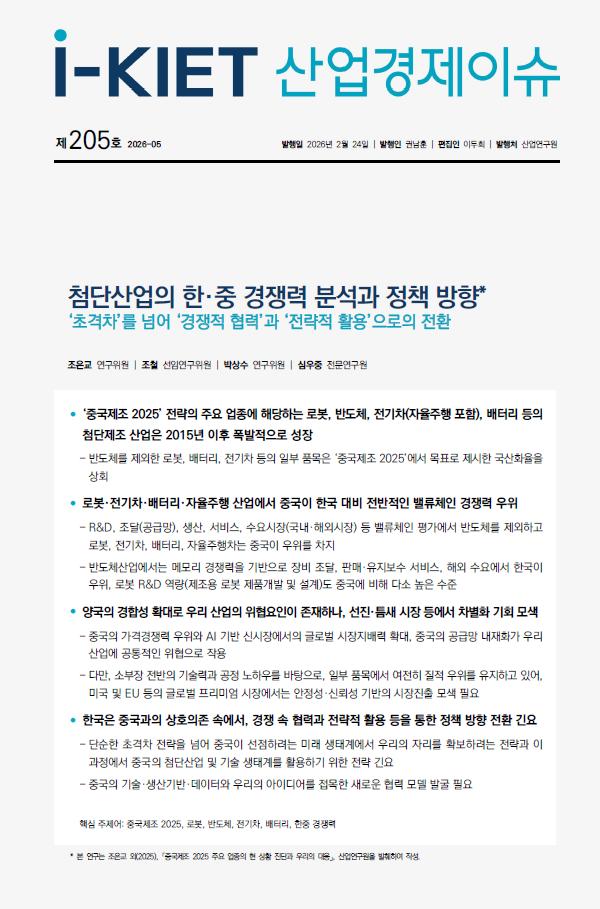
The cover of KIET's report (Source: KIET)
Regarding the semiconductor industry, which South Korea has always been proud of, the evaluation conclusion of the Korea Institute for Industrial Economics and Trade is that the two countries have comparable strength. This is mainly because although South Korea has the world's highest - level competitiveness in the memory semiconductor field, China has relatively high competitiveness in non - memory fields such as AI chips and IGBTs. Most experts believe that China has an overwhelming advantage in fields such as AI chip design, and even has leading strength in aspects such as technology, price, and infrastructure in the fabless manufacturing and packaging processes.
The report bluntly states that "the era of China catching up with South Korea has come to an end, and now it's South Korea's turn to catch up with China." This assertion is gradually becoming a common consensus in the South Korean industrial community and has triggered strong anxiety.
However, paradoxically, most ordinary South Korean people are not aware of this technological trend. Some financial bloggers even complain that in the past two years, South Koreans have only learned about candied haws and hot pot from China, but they don't care about the most important cutting - edge technologies at all.
01 Where is the gap?
Since last September, the Korea Institute for Industrial Economics and Trade has conducted research on the development of high - tech industries in China and South Korea through on - site inspections, expert surveys, targeted group interviews, data analysis, etc., and published a research report.
The report systematically analyzes the competitiveness differences between China and South Korea in the high - tech industry through multi - dimensional comparisons. The core conclusions are as follows:
Strategic leadership promotes localization
Since 2015, high - tech manufacturing industries such as robotics, semiconductors, electric vehicles (including autonomous driving), and batteries have become the main industries of the "Made in China 2025" strategy and have developed rapidly. Industries such as robotics, batteries, and electric vehicles (excluding semiconductors) have exceeded the localization rate set by "Made in China 2025".
Leading competitiveness in multiple industries
Overall, in the robotics, electric vehicle, battery, and autonomous driving industries, China has an advantage over South Korea in the overall value - chain competitiveness. However, South Korea has an advantage in equipment procurement, sales, and maintenance in the semiconductor industry and in the overseas market (memory chips). However, this gap is being rapidly narrowed.
In the semiconductor field, South Korea still occupies an absolute dominant position in the memory chip market. China has not achieved the localization rate target set by "Made in China 2025" in the wafer foundry (manufacturing) and semiconductor equipment fields, but has a relatively high achievement rate in the fabless and post - process fields.
It is worth noting that China has established an advantage in non - memory chip fields such as AI chip design, achieved a series of breakthrough results, and gradually narrowed the overall gap with South Korea in the semiconductor field. As Chinese technology companies such as Huawei, Baidu, Alibaba, and ByteDance expand the design and application of self - developed AI chips, the overall competitiveness of China's AI semiconductor design capabilities and the fabless ecosystem has been strengthened.
Against the backdrop of the US sanctions on China's AI chips, China is building an independent technological ecosystem that includes semiconductor chips and related systems capable of effectively driving model operation. It is going beyond the simple strategy of catching up in AI technology and hardware and building a Chinese - style AI ecosystem.
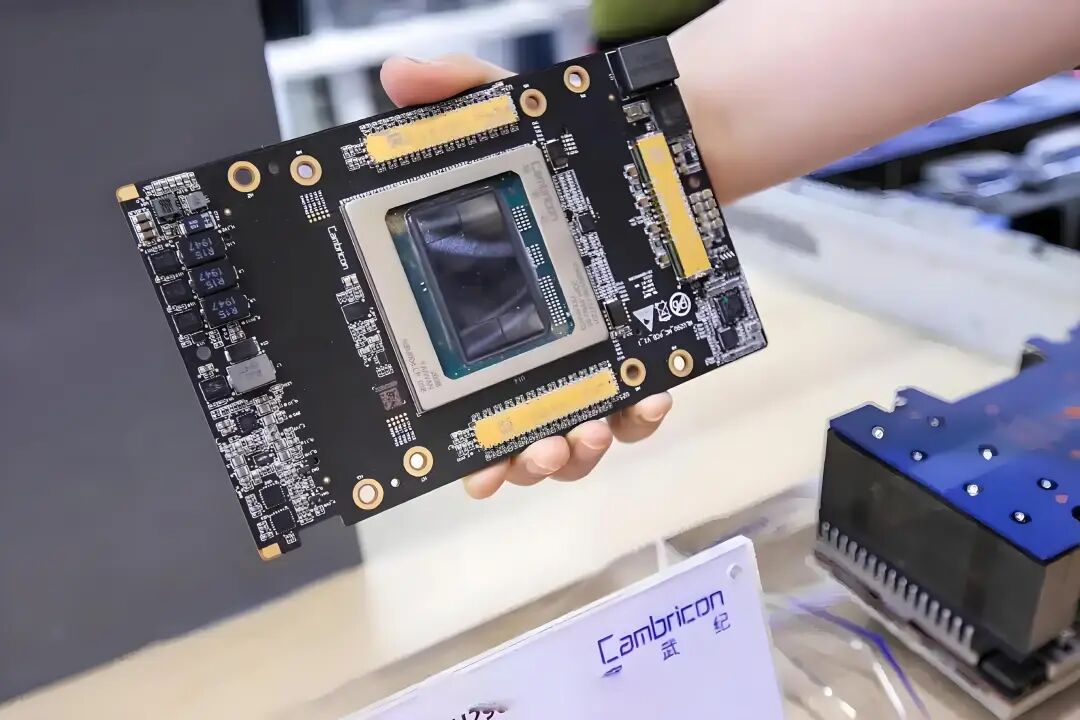
Chinese AI chip companies represented by Cambricon are rising (Source: Getty Images)
In the robotics field, South Korea has a certain basic advantage in the R & D of industrial robot technology. Although China faces difficulties in ensuring semiconductors due to US sanctions, it has built "technological self - reliance" and "supply - chain integrity" in the field of robot hardware. In particular, humanoid robots are entering the commercialization stage fastest under the support of the government's active policies, and service robots used in fields such as cleaning, food delivery, and logistics are strengthening their dominance in the global market. While the domestic market demand is strong, the expansion of the overseas market has achieved remarkable results, and the international influence of "Made in China" robots continues to increase.
From the perspective of the industrial chain, China's industrial robot market performs outstandingly in core links such as spare - parts procurement, large - scale production, and market expansion. Relying on a complete supply - chain system and huge market demand, China has achieved low - cost and high - efficiency operation of spare - parts procurement. The large - scale production bases and mature manufacturing processes ensure the market supply capacity. Although the localization rate has not reached the original target of 70%, the localization rate of core components such as reducers, servo systems, and controllers has exceeded 50%.
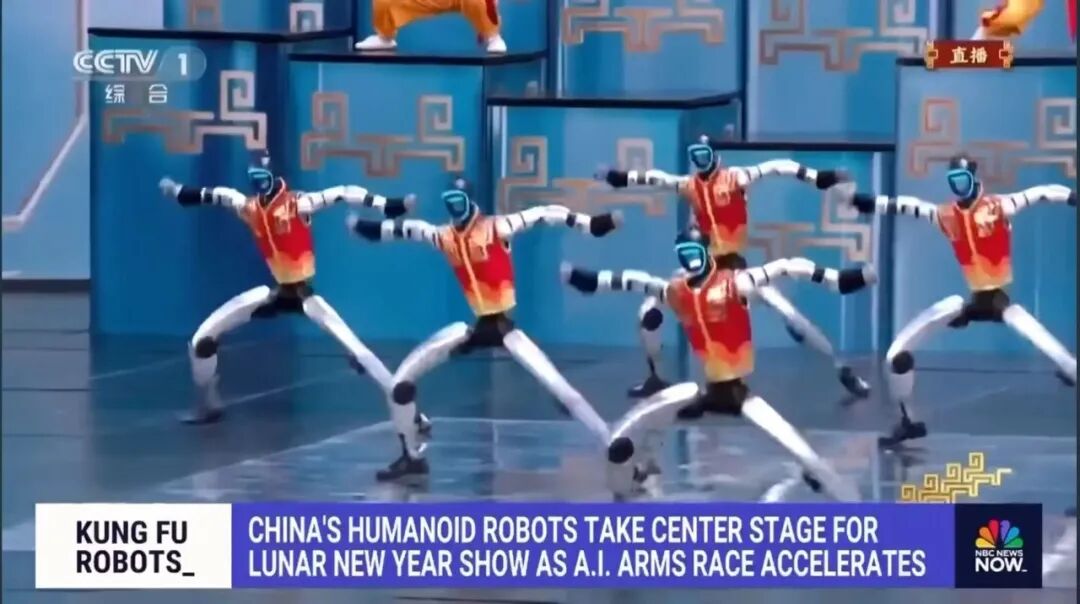
The "WuBOT" at the Spring Festival Gala of the Year of the Horse has sparked hot discussions overseas. The picture shows the NBC report (Source: NBC)
In the electric vehicle field, South Korea has a certain advantage in the after - sales maintenance service system and market expansion experience, while China has formed a relatively leading position in the R & D and application of electric vehicle technology.
The "Made in China 2025" strategy once proposed the goal that new - energy vehicles (electric vehicles) should account for 20% of the total automobile sales by 2025, but in 2024, this proportion has reached 45.3% (including BEV, PHEV, FCEV), more than twice the policy target.
Thanks to the coordinated development of artificial intelligence, big data, and communication technologies, China's autonomous driving technology has received strong support. Currently, pilot operations have been carried out in multiple cities, and the stability, safety, and intelligence level of the technology are continuously optimized and upgraded, gradually approaching the commercialization standard. The installation rate of semi - autonomous driving systems below Level L3 has reached a considerable level, and the achievement rate of the installation rate target of fully autonomous driving systems above Level L4 is also very high. The achievement rates of in - vehicle optical systems and high - precision maps are also quite impressive.
In the battery field, China's comprehensive competitiveness advantage is particularly significant, leading the world in R & D investment, technological innovation, and production capacity scale. Mainstream domestic battery companies have continuously made breakthroughs in core fields such as lithium - ion batteries and solid - state batteries, and the key performance indicators such as battery energy density, cruising range, and charging speed have been steadily improved.
At the same time, China has built a complete battery industrial chain. From the upstream raw - material mining and processing, to the mid - stream battery production and manufacturing, and then to the downstream terminal applications, all links work together to form a strong industrial cluster competitiveness.
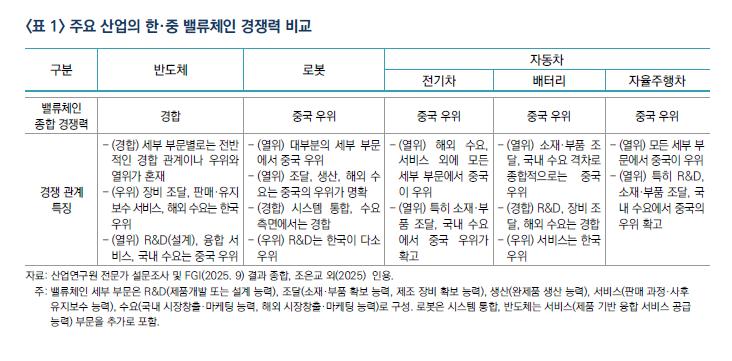
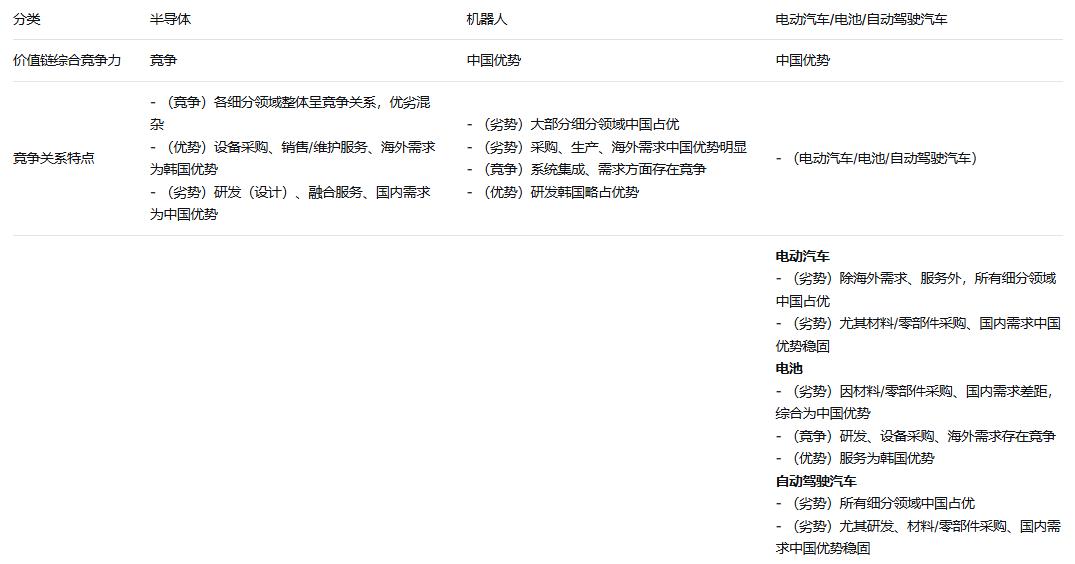
KIET's analysis and translation of the competitive advantages and disadvantages of China's high - tech industries (Source: KIET; Translation: DeepSeek)
02 Why can China catch up and overtake?
So, why has China been able to achieve technological catch - up and overtaking of South Korea in just a few years?
The strong impetus of policies
The first core view put forward in the report is that the Chinese government, based on long - term development, has introduced a series of national - level strategic policies such as "Made in China 2025", which have clarified the direction and drawn a blueprint for the high - quality development of the technology industry.
In terms of financial support, special industrial support funds have been established to provide sufficient financial guarantee for enterprises' R & D investment, production - capacity expansion, and technology transformation. In terms of tax incentives, significant tax - reduction policies have been implemented for high - tech enterprises, effectively reducing the operating costs of enterprises and stimulating their innovation enthusiasm. In terms of land guarantee, high - quality land resources are preferentially allocated to technology enterprises to help them build R & D centers and expand production scales. All policies work together to build a comprehensive and multi - level industrial support system, injecting strong impetus into the development of the technology industry.
The scale dividend of the market
In the view of the Korea Institute for Industrial Economics and Trade, China's huge domestic market is also a unique advantage for the rapid development of the technology industry.
Take the new - energy vehicle field as an example. China has ranked as the world's largest new - energy passenger - vehicle market for many consecutive years. In 2025, China's new - energy passenger - vehicle market share in the global market reached as high as 67.6%. The huge market demand provides broad development space for new - energy vehicle enterprises, and enterprises can optimize costs through large - scale production and form an economies - of - scale advantage.
In the robot market, China also shows great market potential. The application scenarios of industrial robots and service robots continue to expand, promoting relevant enterprises to continuously achieve technological innovation and product iteration, further strengthening the industrial advantage. The diversified and upgraded market demand forces enterprises to continuously increase R & D investment, optimize product performance and quality, and enhance core competitiveness.
The vitality of the innovation ecosystem
The innovation vitality in China's technology field continues to be released, and core innovation achievements are constantly emerging.
Huawei has made global breakthroughs in 5G communication technology and AI chips. Its 5G technology has been widely applied globally, and the performance of its AI chips has reached the world - leading level. Enterprises such as Cambricon, which focus on AI chip R & D, have launched a series of high - performance products, providing strong computing power support for the development of the artificial - intelligence industry. The innovation practices of these enterprises not only enhance their own international competitiveness but also drive the coordinated development of the entire industry.
At the same time, China has built a complete innovation ecosystem, promoting the in - depth integration of universities, research institutions, and enterprises, forming a collaborative innovation pattern of industry - university - research - application, continuously injecting innovation impetus into the development of the technology industry and accelerating the transformation of innovation achievements into real productive forces.
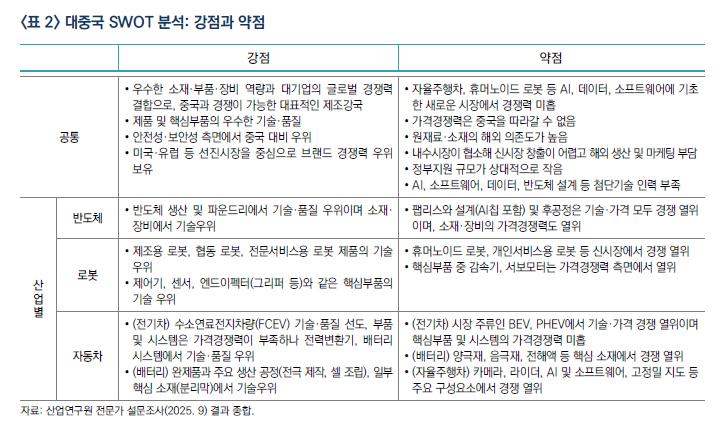
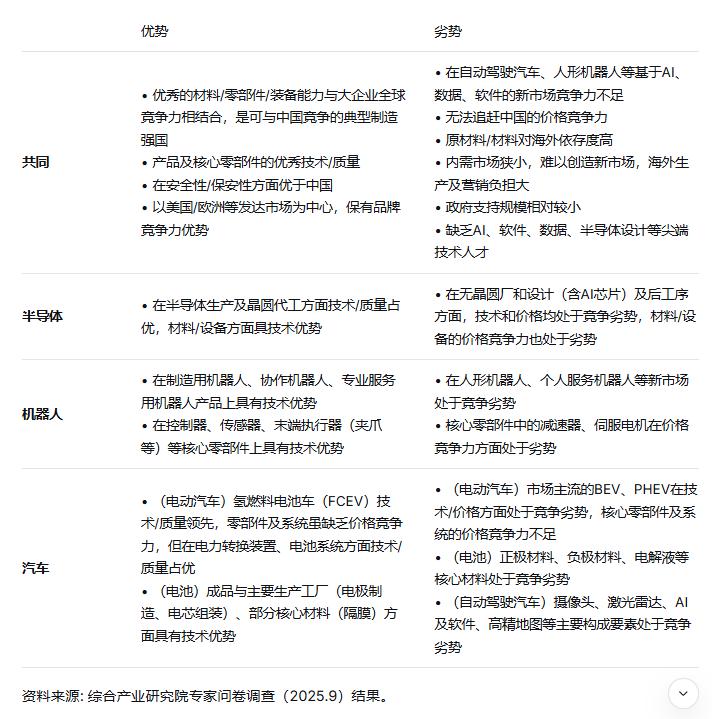
South Korea's SWOT analysis and translation of China's high - tech industries (Source: KIET; Translation: DeepSeek)
03 A pragmatic strategic shift
The report finally points out coldly that China is expanding its market share in the Southern Hemisphere market based on price competitiveness and is building its own ecosystem in the overall AI - demand market such as AI chip design, humanoid robots, autonomous driving, and next - generation batteries, and has emerged as a global leader in high - tech industries.
The industrial competition between China and South Korea is shifting to the high - tech manufacturing field. The industrial division - of - labor structure between the two countries has changed from vertical division to horizontal competition. The strategy of South Korea using China as a production base and a supply - chain procurement base in the past is no longer effective. China has surpassed traditional industries. Through large - scale state - led investment and ecosystem expansion in core high - tech industries such as electric vehicles, robotics, and semiconductors, it is threatening South Korea's manufacturing position.
South Korea still has room to seize high - quality global markets, especially in the European and American markets where there is a relatively high level of vigilance against Chinese products. However, China is expanding its dominance in the global market with advantages such as price competitiveness and supply - chain integration, which undoubtedly poses a huge risk to South Korea's industries.
However, the report also points out that as China's AI - based demand market expands, new market opportunities are being created. There are opportunities for South Korean enterprises' intermediate products such as industrial parts and equipment to enter, especially in fields such as next - generation batteries and autonomous driving. Considering technological complementarity and the possibility of market expansion, South Korean enterprises can selectively cooperate with China.
In the past, South Korea's industrial competition strategy against China was the "super - gap" strategy, that is, maintaining a technological generational lead over China and using China as a low - cost manufacturing base through technology transfer and licensing to carry out vertical industrial division of labor.
However, the basis of this strategy no longer exists. The Korea Institute for Industrial Economics and Trade proposes to shift to "competitive cooperation" and "strategic utilization". South Korea's industrial policy should not avoid competition but should shift to achieving differentiated competitiveness and strategic utilization in the interdependence with China. The core is not simply to reduce dependence on China and overcome the trade deficit with China, but to respond to the China - led global supply chain from a long - term perspective and consider how to hitch a ride to maximize South Korea's national interests.
The Korea Institute for Industrial Economics and Trade believes that the South Korean industrial community needs to go beyond the simple super - gap strategy and shift to a strategy of ensuring that South Korea has a place in the future ecosystem that China intends to capture, and make use of China's high - tech industries and