Altman: It takes 20 years and the evolution of 100 billion people to train a human. Training an AI is more cost-effective.
OpenAI's CEO, Altman, just finished attending an AI forum in India these days and then came to the Express Ada series of talks hosted by The Indian Express, where he participated in a 60 - minute interview.
This conversation covered a wide range of topics, from the development speed of AI, competition among big tech companies, AI - related employment, to even some anecdotes about Altman's personal life.
AGI (Artificial General Intelligence) and ASI (Artificial Superintelligence) have always been the most controversial topics in the AI industry. Many people believe that AGI is still at least several decades away, and ASI is even more out of reach.
However, in this interview, Altman stated that AGI is quite close, and ASI is not that far off either. He said, "The pace of technological development is faster than I initially anticipated."
Altman explained that six years ago, most people couldn't imagine that AI could independently conduct new research, write complex computer programs, let alone imagine that AI could push the boundaries of human knowledge in fields such as mathematics and physics.
He believes that current AI already has a certain degree of generality. "A system that can act as an AI doctor, lawyer, or computer scientist and handle various complex knowledge - based tasks is actually quite close to general intelligence. We just get used to the existing technology, so we think AGI is still far away."
At the same time, Altman also warned, "Given the current trend of accelerated technological development, I think the arrival of superintelligence will be faster than many people expect. That's why we must attach great importance to AI safety."
But Altman doesn't think the arrival of AGI and ASI is all good news. He added, "We must take safety precautions in advance to ensure that the technology won't be misused. Meanwhile, we should distribute power widely to prevent a single entity from controlling superintelligence."
In addition, the interview also touched on the idea of building data centers in space, which many people see as a future solution to meet the computing power requirements of AI. Google and Musk, one of Altman's rivals, are both deploying their own space - based data centers.
But Altman said bluntly, "To be honest, I think the idea of putting data centers in space under the current circumstances is absurd."
His reasons are very practical. A rough calculation shows that the launch cost is not cost - effective compared to the electricity cost on Earth. Moreover, it's impossible to repair a broken GPU in space.
Altman admitted that one day, space - based data centers will make sense, but "orbital data centers won't be of great significance on a large scale in this decade."
Altman emphasized, There shouldn't be any single ASI in the world. No individual, country, or company, including the United States, should be in control of ASI.
Altman expressed his views on this, "Things are much more complicated than that. AI will become one of the most important global political issues. Geopolitical tensions and cooperation will be intertwined, and alliances will constantly change with technological development. It won't be a fixed confrontational relationship."
"Widely distributing power is the best scenario. Every country should have a say so as to avoid the abuse of power and truly let AI benefit all of humanity," Altman said.
The host also took the opportunity to ask Altman about a rumor, "Each query on ChatGPT consumes 17 gallons of water." According to the rumor, each query consumes the battery power equivalent to ten iPhones. To cool down the heat generated by power consumption, OpenAI needs 17 gallons of water to cool the GPUs.
Altman smiled and said, "It's completely untrue and has nothing to do with reality."
He said, "It used to be true. In the past, we used evaporative cooling technology in our data centers, and it did consume a certain amount of water. But now we've phased out this technology. The claim that 'each query consumes 17 gallons of water' circulating on the Internet is a crazy rumor without any scientific basis."
The energy consumption of AI is indeed an issue that needs attention, but it's not the case that "each query consumes a large amount of energy," Altman explained.
During the interview, the host also mentioned the current situation in India. In 2025, about 8% of India's GDP comes from IT enterprise services. However, the emergence of AI programming tools like OpenAI's Codex has posed a major challenge to this industry. The reason is simple: when people can use AI to write code, the cost of software development will drop significantly.
Altman didn't shy away from this question. He frankly said, "I really think it will bring about many changes and have a huge impact."
But at the same time, he also expressed his optimism about the future.
In his view, just like every advancement in computer programming, people will operate at a higher level of abstraction and be able to do more things. The quantity of products and code produced will increase significantly, and expectations will rise.
Altman said "As long as countries and companies in this field quickly adapt to this new world, there will be many new things to do."
Altman has never thought that AI will replace human jobs, and he's not an AI doomsday - believer. He pointed out that every technological revolution has caused panic about job losses, but new opportunities have emerged every time.
His advice is: Proficiently use AI tools, figure out what people want and how to be useful to them, and learn how to cooperate with others.
Since the interview lasted for an hour, Altman was inevitably asked some personal questions.
The host asked Altman what he was thinking when he decided not to hold any equity in OpenAI. His answer was unexpected: "That was really one of the stupidest things I've ever done. As someone who has made a lot of stupid decisions."
He explained that at that time, as a board member of a non - profit organization, he thought he had to remain uninterested.
However, this also got Altman into trouble. For example, some people said that he did all this just for power, not really wanting to do something beneficial for the world.
When the host asked if he would accept it if someone found a way to let him enter the equity structure today.
Altman looked exhausted: "I mean, at this point, I'm so tired of this whole conversation and feel so trapped. I'm not sure what to do. It seems like a lose - lose situation for me."
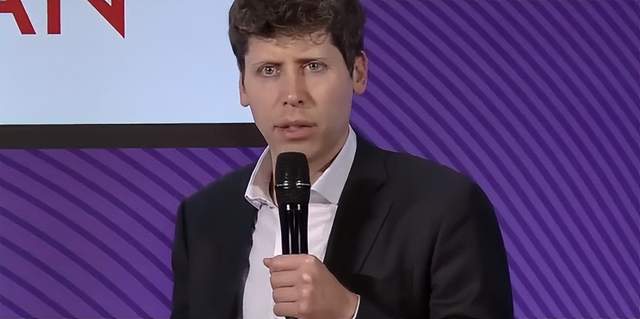
Altman was very helpless because no matter what choice he made, he would be questioned.
Then the host asked Altman which of the following two things he thought was impossible: for TSMC to lose its monopoly on global chip manufacturing or for him and Musk to become friends again.
Altman's answer was straightforward: "I think it's impossible for me to become friends with Musk again."
However, when asked to name one thing he admired about Musk, Altman thought for a minute and then gave an answer: "He is very good at physical engineering and also very good at making people perform well at work."
It can be seen that although Altman hates Musk very much, he can still objectively evaluate the world's richest man.
Next, the host brought up an online argument that "AI makes children stupid."
Altman admitted, "It's true for some children." He heard some children say, "This is great. I cheated throughout high school. I never did any homework." These children assumed that they could still use ChatGPT for work in the future, which is "very bad."
However, he emphasized that this is not the case for most children. Most children say, "I can't believe what I can accomplish now. Look at what I just made. I've established these incredible new work processes."
Just like their generation used Google to do homework in high school, today's children just have new tools.
Altman recalled that when he was in middle school, his teacher said that Google was "the worst thing ever" and thought teaching was meaningless. But he believes that memorizing historical dates is a complete waste of time, and you can look them up whenever needed.
He is very sure that "Children born today will be able to do things that no one has ever done before when they graduate from high school at 18. I think it's great."
The interview also touched on some corporate - related questions. The host said that OpenAI's transformation from a non - profit to a capped - profit organization and then to almost accepting any form of income, including advertising, has raised many questions.
Altman gave a direct reason: "To promote the popularization of AI technology and to stay at the forefront of research, both of which require huge capital."
He said that OpenAI is still a research - first company.
"The coolest thing about AI is that most of the work in creating a good product is doing good research. The early versions of ChatGPT had almost no product design. It was just like a text box. You input into the model and then display the output on the screen. Research continues to drive what the model can do, which makes everything possible."
Altman also shared a case. He had a meeting with a large company the day before. They planned to formulate a strategy in 2026, prepare the company in 2027, and deploy in 2028.
He said bluntly: "Doing this for AI would be a catastrophic mistake."
He pointed out that this kind of timeline may work for other types of technologies, such as a large - scale ERP migration. However, the agility, implementation speed, and resource investment required for AI are completely different.
If companies can't quickly adapt to and deploy AI technology, they will lose their competitiveness.
Next was a very interesting topic: falling in love with AI. Altman revealed that indeed, some people fall in love with AI or let AI send messages for them on dating apps.
This has led some people to be pessimistic about human civilization. Their view is that since people can use AI to express their emotions, they will surely indulge in it and stop interacting with real humans.
Altman refuted this view, "In the future, we will actually value interpersonal relationships more."
He believes that humans are naturally like this. In a more prosperous world, a world where one can have anything, interpersonal connections, human attention, and human warmth will be among the most valuable commodities.
"I bet we'll care more about this in a world with AI."
Then, the host asked Altman what question he would never ask ChatGPT. Altman's answer was thought - provoking: "I think I'll never ask it how to be happy. I'd rather ask a wise person."
This answer drew applause from the audience. With the rapid development of AI in recent years, large - scale models can generate professional and accurate answers in various fields. However, regarding the philosophy of life, Altman still said that he wouldn't take AI's answers seriously.
Altman believes that there are certain fields where machines can't replace humans.
Full - text translation:
Host: A very warm welcome to Express Ada. Everyone, today is a very special day for us. Forbes magazine has named OpenAI one of the most important companies in the world. If we look back on this moment 20 years from now, I'll wait for the audience to quiet down first.
Okay, is everyone quiet? Alright.
If we look back on this moment 20 years from now, I don't think it's an exaggeration to say that the gentleman in front of me might be the one who initiated this disruptive and structural change. If there's anything comparable to the Industrial Revolution, it might be this gentleman in front of me. Everything might have started with him. Is that fair, Altman?
Altman: No. You know, I think this is a common phenomenon for many companies. The people running the companies get too much credit compared to the work done by everyone else. But this is especially true in our case. This is actually a story of scientific discovery. A few researchers have worked wonders and figured out some very profound things about how the world works.
The reason why deep learning is so special, what makes it so versatile, is that we - this small group of researchers - discovered an algorithm that can learn anything, and the larger the scale, the better. Then a large number of people worked very hard to achieve this scale in these models, and then the whole world figured out how to build incredible products and services around it. But most importantly, this is a story of scientists.
Host: Yes. A lot has changed in the world since you last visited India. But what do you think has changed in India in terms of AI?
Altman: I last came here more than a year ago. Before talking about what has changed in India, I think it's worth talking about what has changed in AI because it sets the foundation. A year ago, AI could just do high - school math.
This was incredible. AI could do high - school math, and it did it very well, not excellently but very well. People couldn't believe it. I was in India at that time, giving speeches at events like this, and I was talking about this. People - this had just happened - were really amazed. They said, you know, it can do what an 11th - grade student can do. This is amazing because just a few years ago, AI couldn't do any math at all. It couldn't do elementary - school math; it struggled with it.
By last summer, it was competing in the world's most difficult math competitions and performing quite well. Last week, there was something called "first proof." Mathematicians posed 10 research questions whose solutions were unknown and required the best mathematicians, the forefront of research, and new knowledge to solve because it hadn't been shared. I believe our latest AI correctly solved 7 of these questions.
So AI has gone from being okay at high - school math to being able to do new research - level math and find new knowledge. This is also happening in physics. It's an amazing change in just one year. We've gone from AI being able to do what we expect a very smart high - school student to do to pushing the boundaries of human knowledge. Another change is that AI has gone from being able to write a little programming code to completely changing what it means to be a computer programmer.
The last time I was here, people were amazed by these code - auto - completion tools. Now, a year later, if you input an idea into something like Codex, you can create a complete application. I think the job of programmers has changed more in the past year than in any year since I became an adult.
Codex is our - India is our fastest - growing market for Codex. So especially what's happening here, going back to the next part of the question, is really remarkable.
The biggest change I've felt is that the last time I was here, it felt like India was a consumer of AI. People were using these services and doing other things. Now, the entrepreneurial vitality of Indian developers has completely exploded.
Host: You actually said something a bit controversial last time. It's controversial now because at that time, you said, you know, you painted a rather bleak picture, saying that a $10 - million fund was not enough to build a meaningful large - language model in India. And yesterday, we were talking about India launching a full - stack, and India could actually lead in AI. Yes.
Altman: That comment, I mean, it was taken out of context. It was a few years ago. But that comment wasn't saying that India couldn't do amazing work with a $10 - million company and a $10 - million model. I think it's obviously possible. The question is, can you build a very cutting - edge model with $10 million? I didn't think so at that time. And I think it's even less possible now.
Host: Even less possible now.
Altman: To build a cutting - edge model with $10 million. Yes, that's right.
Host: They've become very expensive.
Altman: But if India has enough funds, Indian companies can definitely do it, and the smaller, narrow - domain models that India is developing are incredible.
Host: So, did anything surprise you about India and AI between your last trip and this one?
Altman: The statistic I mentioned a few minutes ago, that this is the fastest - growing market for Codex in the world. I'm very happy about it. I think I shouldn't be surprised, but it's really nice