The missed highlights of the Winter Olympics have been retrieved by Alibaba Cloud AI this time.
In the distance, there are snow - covered mountains. The race track descends along the mountain slope, looking like a carefully carved silver trail. The sky is a nearly transparent azure blue. The sunlight pierces through the cold air, illuminating the ski slopes and the entire open - air snow sports event.
In the Livigno competition area, one of the four major competition areas of the Milan - Cortina Winter Olympics, before each competition starts, the audience's attention is often drawn to the huge screen in the center of the venue.
In the large - screen images, the athletes participating in the Winter Olympics are frozen in the air again and again. They hover in mid - air, and their snowboards and bodies are frozen in each cross - section where time and space are relatively static. Meanwhile, the perspective doesn't stop but rotates 360° around these cross - sections. With the successive exclamations of "Bravo", "Amazing" and "Cool" from the on - site audience, the day's competition officially begins.

Space is frozen, time is stretched, and the perspective can move freely... The movement trajectories that were difficult to be captured by the naked eye in the past, especially those that the on - site audience might not see clearly or remember, are presented in a three - dimensional way.
Below the screen, the blue fence with the Olympic rings logo is the official competition venue of this Winter Olympics. The ticket - holding audience standing on the site can not only watch the competition as before but also appreciate the beauty of the structure and power of the pre - game movements.
Such images come from Alibaba Cloud's "360° Real - Time Replay Technology" Real - Time 360° Replay, which is bringing positive changes to this Winter Olympics.
The final of the women's aerials at the Milan Winter Olympics, the competition site of Xu Mengtao
Different from the traditional slow - motion replay, as a real - time reconstruction of the sports moment, the 360° Real - Time Replay Technology collects the venue images through a multi - camera matrix. After frame synchronization and video pre - processing, the signals are uploaded to the cloud. AI completes three - dimensional modeling, space completion and real - time rendering, generating multi - perspective images that can be freely viewed from all around. Those angles that could not be fully captured in the past are reconstructed.
Finally, for the on - site audience, those fleeting moments of take - off, rotation and landing are re - presented. The movements are disassembled, the trajectories are clearly shown, and the details that are difficult to distinguish with the naked eye gain a new time scale and spatial dimension on the screen.
The Redefined Replay
Behind the emergence and evolution of the 360° Real - Time Replay Technology is the structural change of the Olympic Games broadcast system.
Ioannis Exarchos, the CEO of the Olympic Broadcasting Services (OBS), has mentioned in public exchanges many times that under the support of digitalization and cloud technology, the Olympic Games broadcast system is constantly increasing the intensity of content production and distribution, making the coverage form and content scale far exceed the era that only relied on traditional TV. Beyond the competition signals, a large number of derivative perspectives, multi - version productions and platform - customized contents are constantly increasing. Tens of thousands of production contents have been pushed to OBS, and the broadcast has shifted from recording the event to supplying content.

The increase in content supply further broadens the composition of the audience.
Nearly half of the Olympic Games audience are not core sports fans. They watch the competition but may not be familiar with the rules; they are attracted by the moments but may not understand the difficulty of the movements. For this part of the audience, the value of the traditional slow - motion replay is decreasing. Simple repeated replays are increasingly difficult to undertake the task of "explanation".
This brings new expectations to the Olympic Games broadcast: In addition to presenting the actions that have happened or are happening from a single perspective, it is also necessary to replay the action skills from a more comprehensive perspective, which means that the popularization threshold of the technology becomes lower. Ideally, the audience should be able to freeze the action at any time, observe the trajectory from any angle, and disassemble the details at any node.
Theoretically, the perspective rotation originally depends on the high - density layout of cameras. In reality, the number of camera positions, the venue structure, the cost and the deployment conditions all form rigid constraints.
As a technology co - builder of the Olympic Games broadcast system, in addition to the path of increasing cameras, Alibaba Cloud has been continuously looking for solutions. The 360° Real - Time Replay Technology collects signals through multiple cameras, uploads the video streams to the cloud, and AI completes three - dimensional space modeling, camera position completion and real - time rendering, reconstructing the images that can be freely viewed from all around under the condition of limited camera positions. Finally, the 360° Real - Time Replay has changed from the original post - game special effect to a basic ability.
At the Paris Olympics, the 360° Real - Time Replay Technology has been used in key scenarios. At the Milan Winter Olympics, the role of this technology has moved further forward. It not only serves the broadcast system but also begins to enter the venue display system.
As the content scale continues to expand and the audience structure becomes increasingly diverse, the explanatory ability is becoming the new infrastructure of the Olympic Games broadcast.
View the Margins that Determine Victory or Defeat from a New Perspective
In the Olympic Games system, the principle of "Clean Venue" has long been a default rule.

Brand logos cannot enter the core visual space of the competition. No matter how great the sponsor's rights and interests are, it is difficult to reach the official presentation system of the venue. This set of rules maintains a certain purity of the Olympic Games stage - business takes a back seat, and sports competition is in the center.
But this year, the situation has changed subtly.
The emergence of the Authentic Brand Connection project in the Milan - Cortina Winter Olympics venue has finally made the technology visible. After each day's competition ends, the 30 - to 35 - second key moments produced by the 360° Real - Time Replay Technology are deployed to 17 competition events in 10 core competition venues for loop playback after being uniformly reviewed by the International Olympic Committee. Three - dimensional reconstruction can be achieved within just 15 - 20 seconds, meeting the live - broadcast requirements. This also means that the technology has begun to become part of the experience. This has impressed the International Olympic Committee and opened up the imagination of the "Clean Venue".
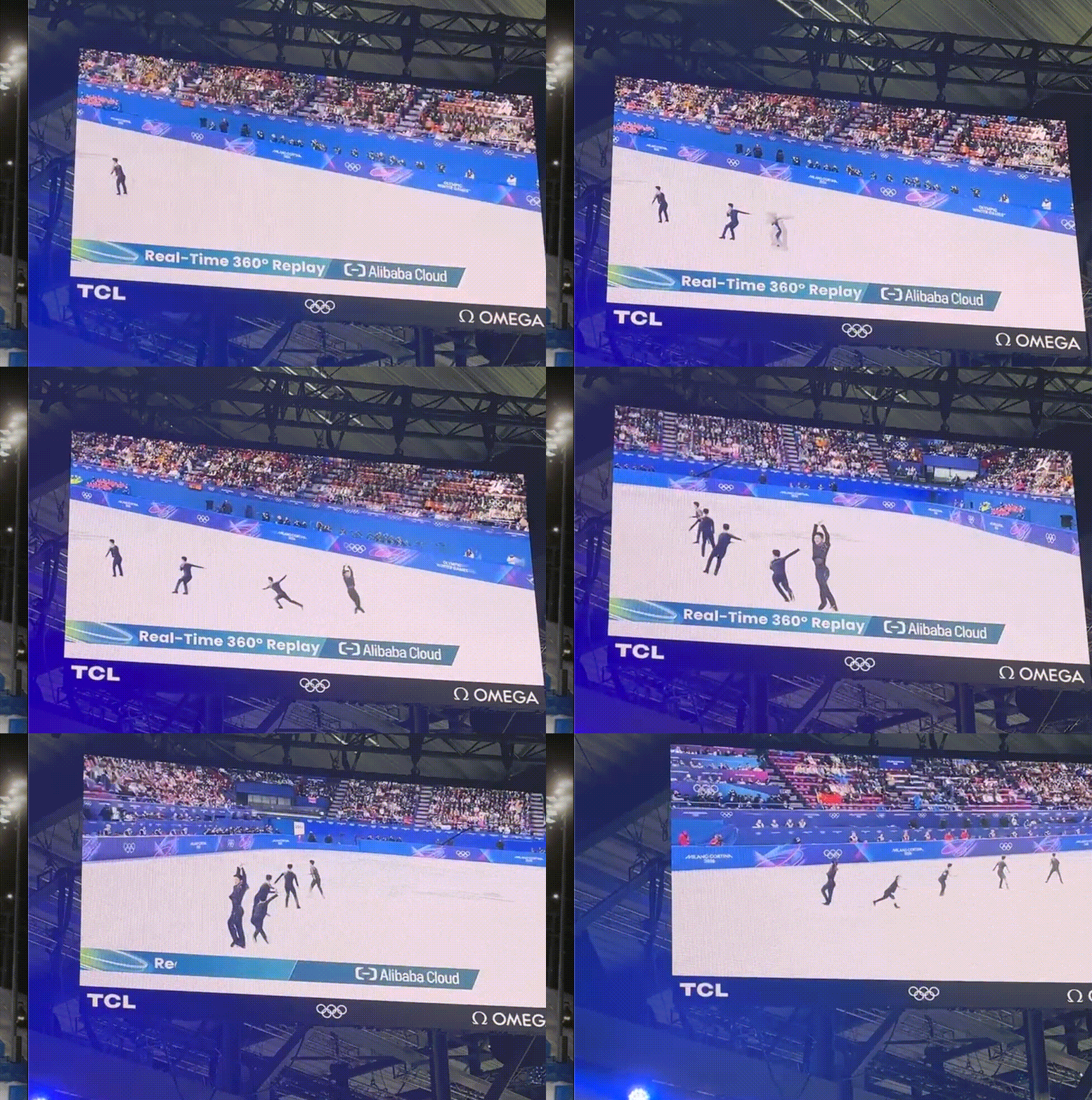
With the introduction of the Authentic Brand Connection project, the International Olympic Committee has allowed technology partners to enter the venue display system as technology service providers rather than for commercial exposure for the first time. The reason why technology companies are allowed to enter the venue is that their technological capabilities have become part of the event experience and operation system.

In the past, the multi - perspective space replay mainly served TV and streaming media audiences. The Authentic Brand Connection project allows some immersive shots that originally existed in the broadcast signals to be directly presented to the on - site audience. The competition breaks are filled, the waiting time is reconstructed, and the venue experience begins to have a new rhythm and level. Immersion is no longer exclusive to the other side of the screen.
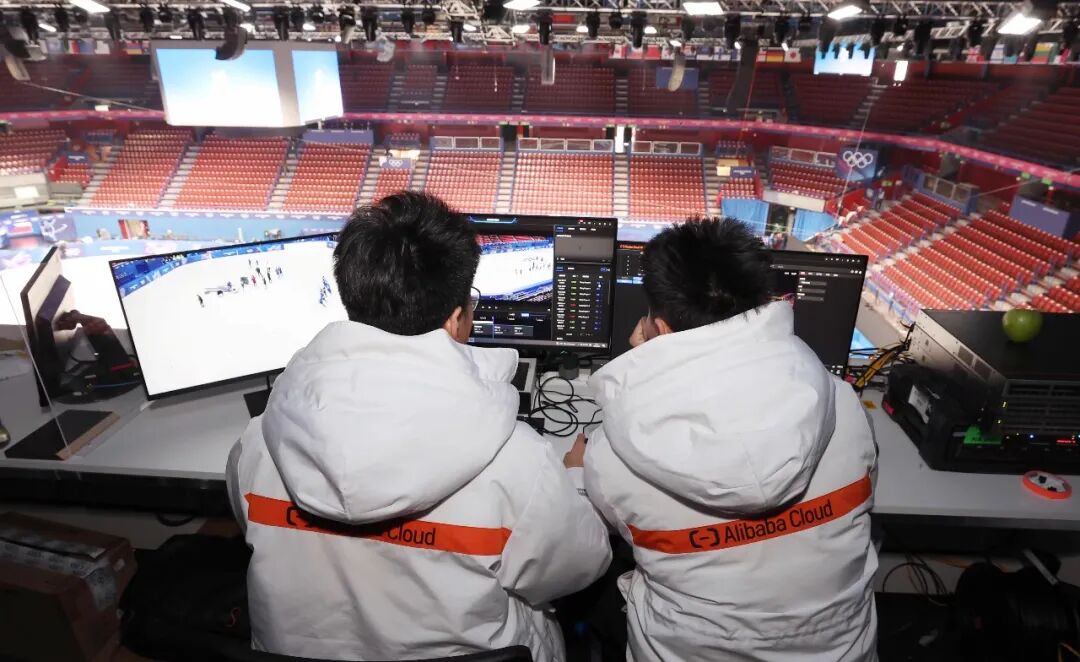
For a long time, technology companies have mainly played the role of infrastructure providers in the Olympic Games system. Cloud computing, data processing and signal distribution form the underlying structure that is not directly perceived by the audience but maintains the stable operation of the event. Alibaba Cloud's 360° Real - Time Replay Technology is also the same. Before it was widely discussed, this 360° Real - Time Replay Technology had already entered the Olympic Games broadcast system and continued to evolve in multiple events.
The origin of the 360° Real - Time Replay Technology comes from the earlier imaging industry system. Around 2017, as the Olympic Games broadcast infrastructure gradually migrated to the cloud, the 360° Real - Time Replay Technology began to move from concept verification to systematic application. By the Paris Olympics cycle, this link was able to stably complete multi - camera collection, frame - level synchronization, cloud - based three - dimensional modeling and real - time rendering output, compressing the space replay ability that originally belonged to the offline production process into the live - broadcast system.
At the Milan - Cortina Winter Olympics, the 360° Real - Time Replay Technology has undergone a more clearly - directed upgrade - Spacetime Slices. Specifically, the movement trajectory is divided into continuous spacetime cross - sections, and the trajectory, after - image and posture structure are presented in a superposition in the same picture, unfolding the movement in both the time and space dimensions. It is the "time - sliced movement trajectory" effect presented by these technologies that brings innovative broadcast highlights to this Milan Winter Olympics.
Meanwhile, the official social platform of the International Olympic Committee has also launched special - topic content around this technology, presenting relevant competition images and technology applications in a concentrated manner. With authorization, the technology support party is allowed to use some real competition highlight images on the social platform for the global dissemination of technological achievements.
The relevant representatives of the International Olympic Committee said in the communication that the content generated based on the 360° Real - Time Replay Technology has played an important role in improving the on - site audience experience and has received positive evaluations from the event display team and the audience. For the audience, the value of this technology is intuitive and specific - the subtle differences that determine success or failure in high - speed sliding, take - off and flipping, and instantaneous landing have finally obtained a visual expression that can be understood. (Original reference: Letter from a representative of the International Olympic Committee: "I would like to emphasize that your content has been very appreciated by the SPP team and the crowds, and has really played a big part in elevating the spectator experience in the venues. Thank you!")
This presentation method not only brings a more immersive viewing experience to the on - site audience but also, through the linkage between the venue host's broadcast and the large - screen system, allows "Powered by Alibaba Cloud" to enter the official presentation system of the Olympic Games venue for the first time in the form of a technology signature.
When Chinese Technology is Seen by the World
The history of the modern Olympic Games is, to some extent, also a history of how humans continuously expand their perception ability.
In the 1896 Athens Olympics, photos recorded the events; in the 1964 Tokyo Olympics, satellite live - broadcast brought the events into the era of global synchronization; in the 2024 Paris Olympics, cloud - based broadcast signals exceeded the traditional satellite system in scale for the first time, and AI replay appeared frequently; at the Milan - Cortina Winter Olympics, the 360° Real - Time Replay Technology has changed the on - site audience's perception of the Olympic Games venue.
Technology has always existed but often stays in the background. The audience sees the sports competition itself but rarely realizes that what supports all this is the continuously evolving imaging, computing and transmission systems.
The technological fulcrum of this change comes from Alibaba Cloud.
When a real - time space reconstruction technology led by a Chinese technology company becomes an important part of the Olympic Games broadcast and venue display system, its significance goes beyond a single technological breakthrough. On the Olympic stage, which has the most stringent global technology and engineering standards, being adopted, operated and seen is in itself a proof of long - term capabilities.
Moreover, the value of such verification is not limited to the sports events. From a broader industrial perspective, the sports scenario is just the starting point. The more complex real world - the operation process in industrial sites, the delicate movements in medical surgeries, and the behavior analysis in education and training - also requires free perspectives, three - dimensional modeling and real - time rendering, and also depends on the high - precision reconstruction and explanation of actions, spaces and processes. The technological capabilities verified under high - pressure in the Olympic Games venue are also opening up imagination space for more extensive industry applications.
In this evolutionary path, the role of Chinese technology is also quietly changing. As Kirsty Coventry, the President of the International Olympic Committee, mentioned in an event held at the International Broadcast Center recently, the transformative significance of AI technology for this Winter Olympics. She pointed out: "The technology of Alibaba's Qianwen large - model will bring more intelligent operation, more in - depth interaction to the Olympics and bring new possibilities to the Olympic movement."
In the past, Chinese technology was more of a participant and service provider. Now, it is gradually becoming the builder and definer of key technological capabilities.
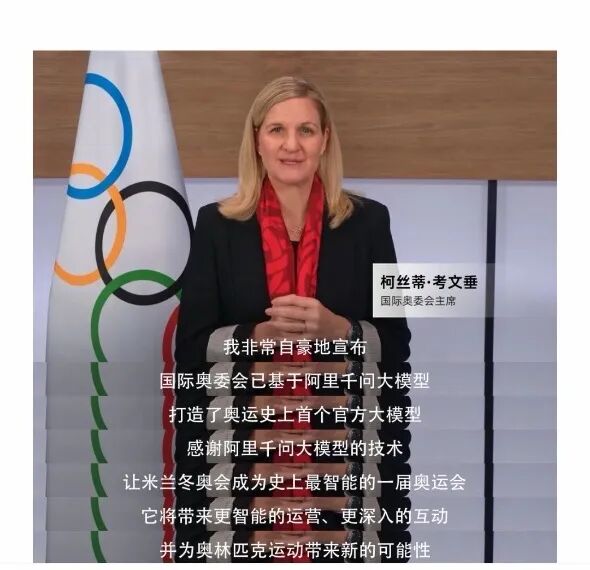
Kirsty Coventry, the President of the International Olympic Committee, highly praised the transformative significance of AI technology for this Winter Olympics. Image source: Alibaba's official account