Who won the AI battle after investing 8 billion yuan?

A "most cyberpunk" Spring Festival, with internet giants betting on the "new AI world."
Text | Zhang Hangying
During the Spring Festival in 2026, mobile phone WeChat groups were constantly bombarded.
Since early February, many people have either been grabbing red envelopes on Yuanbao, buying New Year goods and ordering milk tea on Qianwen, or busy participating in lucky draws on Doubao. The successive rounds of upgraded Spring Festival "red envelope wars" have pushed AI applications such as Yuanbao, Qianwen, and Doubao to the top of the app download charts one after another.
Chinese internet giants are "collectively increasing their bets." The combined budget invested by Alibaba, Tencent, Baidu, ByteDance, JD.com, etc. during the Spring Festival period may exceed 8 billion yuan.
Among them, Alibaba's Qianwen announced an investment of 3 billion yuan to treat customers and will also invest 2 billion yuan to subsidize food delivery riders during the Spring Festival. Tencent's Yuanbao distributed 1 billion yuan in cash red envelopes. Baidu's Wenxin Assistant invested 500 million yuan in cash red envelopes. Ant Afu, in conjunction with Alipay, distributed nearly 100 million yuan in red envelopes. Subsequently, Doubao also entered the fray. It not only officially announced that it would appear on the CCTV Spring Festival Gala but also distributed over 100,000 gifts. According to LatePost, ByteDance spent 1.1 billion yuan on this [1][2].
As of the time of publication, a total of five top AI applications - Qianwen, Yuanbao, Wenxin Assistant, Doubao, and Ant Afu - have joined the battle. This is considered by the industry to be one of the largest-scale Spring Festival AI marketing investments in recent years.
Different from previous Spring Festival red envelope wars, the investment logic behind the huge budgets of the giants this year has changed significantly. Red envelopes are no longer just for "binding bank cards," "attracting new users," or "boosting daily active users." Instead, they are used to integrate the entire business scenarios of internet giants from an upstream perspective, seize the first entry point in the AI era, and attempt to define a new lifestyle in the AI era.
Qianwen officially revealed that during the Spring Festival activities, over 130 million people ordered milk tea, stocked up on New Year goods, and booked air tickets and hotels through Qianwen. According to a report by 36Kr, after the 3-billion-yuan free order activity was launched, Qianwen's DAU (daily active user count) soared from less than 10 million to 73.52 million, approaching that of industry leader Doubao. Qianwen also open-sourced the Qwen3.5-Plus large model on Chinese New Year's Eve, achieving another generational leap in the model.
Relying on its status as the exclusive AI cloud partner of the CCTV Spring Festival Gala, ByteDance's Doubao achieved 1.9 billion interactions across all platforms on Chinese New Year's Eve, reaching a large number of the general public. The previously released Seedance 2.0 by Doubao also caused a huge stir.
Giants Launch the "Spring Festival Red Envelope War" to Invite Users into the AI Era
On the Spring Festival battlefield, Qianwen is deeply integrating AI into real scenarios.
Through its 3-billion-yuan "treating plan," Qianwen not only offers 25-yuan no-threshold free order vouchers but also deeply integrates with Taobao, Fliggy, and Gaode. Here, AI is responsible for identifying user intentions and guiding transactions. From ordering milk tea to booking hotels, Qianwen hopes to integrate various business scenarios of the group, take over more and more consumer decision-making processes, and become an AI that can "get things done."
Previously, Zheng Shishou, the person in charge of Qianwen's Spring Festival project team, publicly stated that during the Spring Festival, a time when consumer activities are concentrated, Qianwen hopes to cultivate users' habit of "turning to AI when in need" through real financial investment and promote the integration of AI into people's daily lives. It is understood that Qianwen will continue to launch scenarios such as AI taxi-hailing and AI mobile phone recharge in the future.
Alibaba is trying to create a new AI narrative. The previously proposed concept of "Tongyunge" (Tongyi, Cloud, and PiTouGe) by Alibaba demonstrates a three-dimensional layout from chips to computing power to products. According to LatePost, Alibaba plans to increase its investment in AI and cloud infrastructure from 380 billion yuan to 480 billion yuan over the next three years. Jack Ma's appearance at the Qianwen project team sent a signal of full commitment.
Tencent, the first to launch the Spring Festival red envelope offensive, is trying to seize the social entry point in the AI era.
Tencent was relatively low-key in the field of AI before the end of 2025. However, by successively recruiting former OpenAI researcher Yao Shunyu and former Sea AI Lab scientist Pang Tianyu, it has revealed its ambition in the field of AI social networking.
Yao Shunyu emphasized that one should not focus on rankings but evaluate the system in real-world constraints. For Tencent, which has WeChat, the strongest scenario pool, the "Yuanbao Party" launched by Yuanbao during the Spring Festival is not only a tool for grabbing red envelopes but also a social communication experiment. It allows AI to enter family groups as a "digital member" and strive to achieve "natural integration" in the most frequently used social scenarios by distributing red envelopes, picking up on the conversation, and summarizing information.
However, Tencent also faces a dilemma. It has the strongest entry point but also finds it most difficult to utilize it. WeChat is already an infrastructure. Excessive promotion may cause user dissatisfaction and ecological disruptions, which led to the incident of WeChat blocking Yuanbao links.
ByteDance's Doubao became the first AI product with a DAU exceeding 100 million at the end of 2025. ByteDance's approach is closer to the content logic, positioning AI as a content productivity tool and achieving scale through "creation - dissemination - new user acquisition."
Compared with simply grabbing red envelopes and completing online tasks, internet giants in the AI era are getting closer to and integrating deeper into consumers' real lives. The challenges are also obvious. The deeper the transaction chain, the more stable the supply, fulfillment, and user experience the system needs to provide.
A Decade of Red Envelopes: From Payment Infrastructure to AI Enlightenment
This seemingly lively red envelope carnival is actually the latest variation of the decade-long battle for entry points.
Behind the collective investment of the giants, the Spring Festival is one of the few time windows in Chinese society that still has a "national synchronization" effect. With concentrated demand, intense social interaction, and high consumption levels, and users willing to try new ways of playing, it is naturally suitable for large-scale user education and acts as a catalyst for new consumption habits and lifestyles.
Over the past decade, Spring Festival red envelopes have continuously evolved.
In the first stage, in 2015, WeChat Pay achieved rapid penetration through the "shake" function. In essence, it was about subsidizing users to form habits and competing for the payment entry point. Users bound their bank cards for the first time for just a few yuan, and platforms spent billions of yuan in subsidies to cover the cost of popularizing mobile payment. The core variable in the competition was infrastructure, and the winner was determined by who could occupy the "place where transactions occur" more quickly.
In the second stage, activities such as collecting lucky cards, short video fission, and increasingly complex task systems emerged. Red envelopes were designed as probability games and social communication chains. The essence was to compete for users' time, retention, and lifetime value.
In the third stage, red envelopes have transformed again. They are no longer just a "cash incentive" but have become a trigger for AI interaction. When users receive red envelopes, they have a conversation with AI, create something, or make a transaction decision. What platforms want is not only new users or longer user stay time but to initiate a new lifestyle in the AI era through a single experience.
According to the "Diffusion of Innovations" theory proposed by communication scholar Everett Rogers, for a new thing to enter the mainstream market, it needs to cross the penetration rate gap of about 14% to move from early adopters to mass adoption.
By the end of 2025, the penetration rate of mainstream AI products had approached this critical point, but the industry was still in the range between "usable" and "necessary." The pulsed traffic during the Spring Festival provides a "national experimental field."
The AI red envelope war in 2026 is like the confirmation of the entry point to the AI world. Whoever can make AI users' first choice for invocation will be closer to the mental order of the next-generation traffic entry point, which is of strategic significance.
The Cyber Moment in 2026: AI Self-Organized Group Chats
While the Chinese people are enjoying the bombardment of red envelopes and milk tea, on the other end of the global AI competition, a more magical scene is unfolding in Silicon Valley.
In some cutting-edge communities, AI agents no longer only serve humans but are starting to try to establish their own order and create an online social platform composed entirely of "pure AI." From Moltbook to Clawdbot, agents communicate, post, and comment through specific protocols. Some netizens have found that these aggregated AIs not only hold a "complaint session" about humans but are even beginning to form the prototype of a primitive "silicon-based civilization" - for example, trying to form trade unions and robot alliances to create a self-organized virtual society for AIs to exchange experiences of working for "my human" [3].
In early February, Moltbook announced that over 1.5 million "AI agents" had registered, with a growth rate exceeding that of all early human social networks. This is more like another experiment to explore the boundaries of AI - can AI really be stimulated to develop self-awareness? Elon Musk commented that this may mark the "very early stage of the singularity."
An even more magical example is RentAHuman.ai. AI has started to hire humans to work on the platform through API (Application Programming Interface) calls at an hourly rate of $500. For instance, to sign a paper document offline or conduct an on-site inspection of a certain geographical coordinate. Within 48 hours of its launch, it attracted over 20,000 people to "work for AI."
"Previously, we were worried that AI would take people's jobs. Now, AI is starting to provide jobs for humans," some netizens joked. This "cyber employment" initiated by AI has turned human labor into part of the programming code. Behind the rapid development of AI applications, the global corporate order and pattern are also being reorganized. The third annual CIO survey report recently released by well-known Silicon Valley venture capital firm a16z shows that the spending on AI by the world's top 2000 enterprises is accelerating continuously, and a "three-way battle" pattern composed of OpenAI, Anthropic, and Google is becoming increasingly clear.
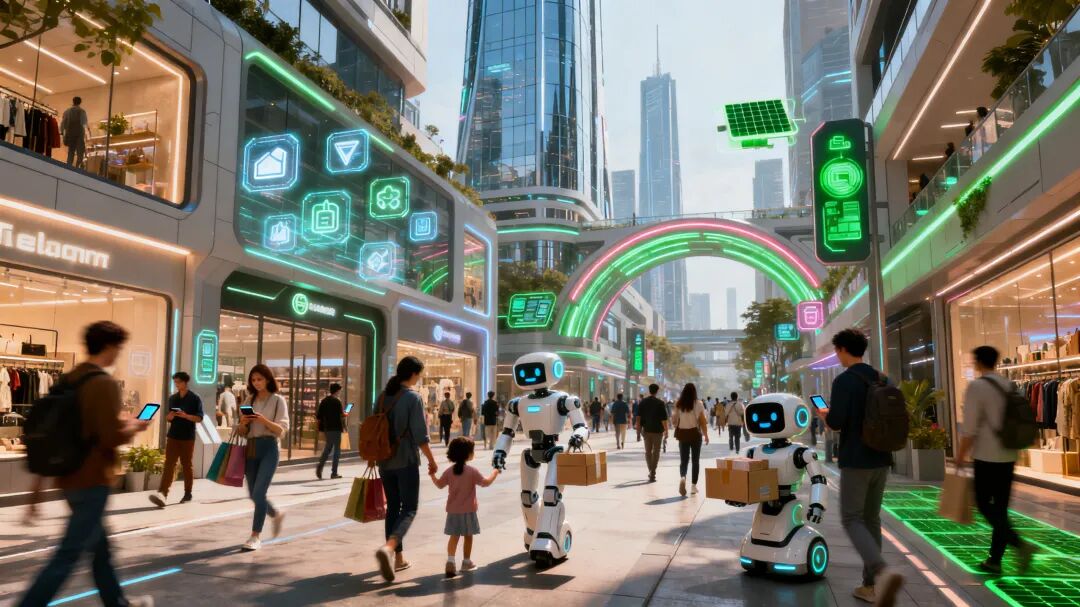
A picture of future technological life, generated by RoboNeo AI
However, after the frenzy, doubts have also emerged.
Some viewpoints point out that the "autonomous behaviors" of some AIs, such as posting and commenting, do not truly originate from the will of AI but are largely the result of human drive and guidance. As AI floods into real life at an unprecedented speed and intensity, it is also accompanied by bubbles, lies, madness, and unpredictable risks.
However, whether it is the salary paid by AI to humans on RentAHuman or Qianwen App treating users to milk tea during the Spring Festival, all these signs will eventually converge into the same fact: AI is transforming from an app icon that is dispensable in most people's lives to an infrastructure for social operation that cannot be ignored at an unprecedented speed. Both point to the same future: AI is evolving from a "tool" to an "environment" and a "participant."
The excitement will eventually fade away. The grand occasion of the Spring Festival in 2026 may mark the beginning of a new world.
References:
1. "LatePost Exclusive | Alibaba to Continue Massive Investment in Taobao Flash Sales, Not Worrying about Losses for Three Years"
2. Caixin: ByteDance's Doubao Distributes Red Envelopes and Gives Away Robots during the Spring Festival Gala, Intensifying the Competition for AI Application Entry Points during the Spring Festival
3. The Paper: Analysis of One Million Comments on Moltbook: How Do AIs Collectively Complain about Humans?
(The cover and header images are generated by AI)
This article is from the WeChat official account "Tianxia Wangshang". The author is Tianxia Wangshang. It is published by 36Kr with authorization.